

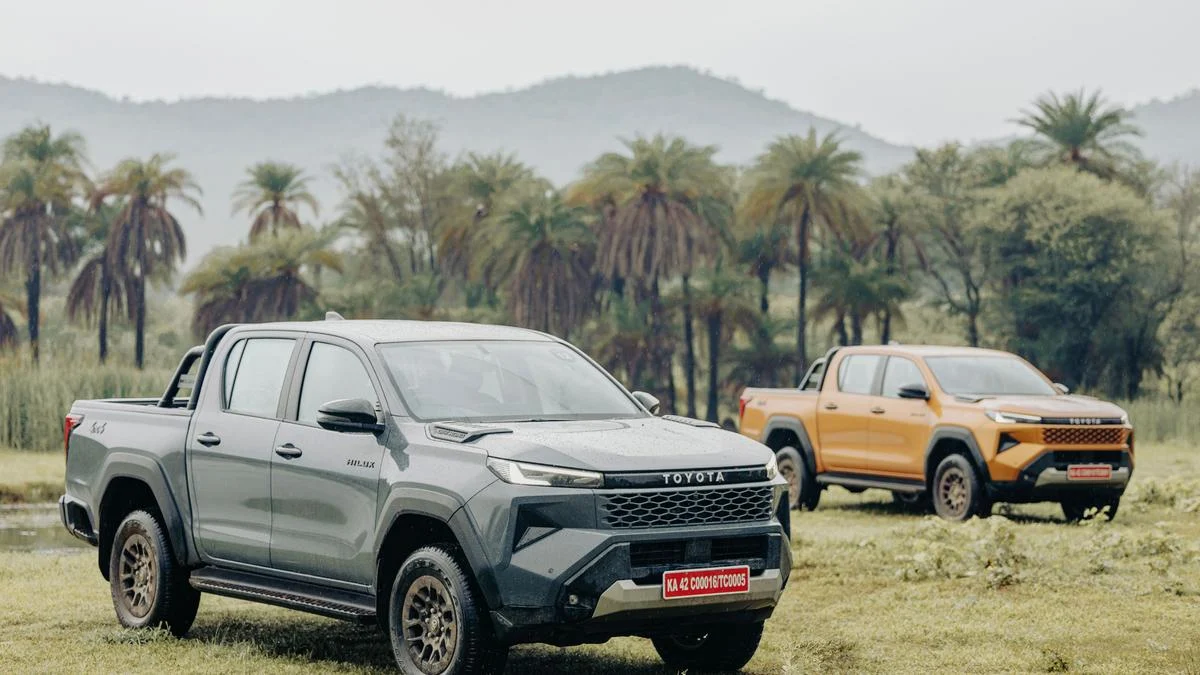
The Toyota Hilux occupies a space in the Indian automotive landscape that is virtually uncontested. While the market is flooded with monocoque crossovers and ladder-frame SUVs, the Hilux stands as a solitary sentinel of a different philosophy: the lifestyle pickup. To call it merely a "utility vehicle" would be a gross understatement. Globally, the Hilux is not just a truck; it is a cultural phenomenon. From the frozen wastes of the Antarctic to the sweltering dunes of the Sahara, and through decades of geopolitical shifts, the Hilux has earned a reputation for being "unbreakable."
In its latest iteration for the Indian market, Toyota has attempted a delicate balancing act. They have sought to modernize a legend without diluting the raw, mechanical honesty that defines it. This update brings a bold new design language, refined interiors, and a simplified powertrain lineup, all while doubling down on the ruggedness that has made the Hilux a household name in over 180 countries.
Main Facts: The Evolution of a Legend
The updated Toyota Hilux arrives in India with a clear mission: to cater to the growing tribe of adventure seekers and "overlanders" who find traditional SUVs too restrictive. The most significant changes are centered around a new design philosophy, a revised interior tech suite, and a streamlined mechanical offering.
The vehicle continues to be built on the legendary IMV (Innovative International Multi-purpose Vehicle) platform, which it shares with the Fortuner and the Innova Crysta. However, the Hilux is engineered for a higher degree of abuse. With a payload capacity of approximately 500kg and a towing capacity that rivals heavy-duty machinery, it remains a "truck" in the truest sense.

Priced between INR 31.99 lakh and INR 36.69 lakh (ex-showroom), the Hilux is positioned as a premium lifestyle choice. It is no longer offered with a manual transmission in its higher trims, reflecting a shift toward ease of use for long-distance touring, even as it retains its hardcore off-road hardware.
Chronology of Change: From Conservative to "Cyber Sumo"
The previous iteration of the Hilux in India was often criticized for being a bit too "safe" in its styling—resembling a Fortuner with a bed. Toyota’s designers have responded to this feedback by embracing a radical new aesthetic they call the "Cyber Sumo" design philosophy.
The Exterior Overhaul
The transformation begins at the front. The relatively rounded, conservative nose of the predecessor has been replaced by a much flatter, more vertical bonnet line. This gives the truck an immediate sense of "stature" and "bulk." The redesigned hexagonal grille is more prominent, flanked by revised LED headlamps that feature a sharper, more technical signature.
The "Cyber Sumo" influence is most visible in the angularity of the bumper and the flared wheel arches. These lines are intended to mimic the powerful, squat stance of a Sumo wrestler, combined with a futuristic, "cyber" edge. While the design has divided opinions among purists, there is no denying its presence. In a sea of generic SUVs, the Hilux commands attention, not through chrome and glitter, but through sheer mechanical mass.

The addition of black 17-inch alloy wheels further reinforces this "stealth-rugged" look. At the rear, Toyota has introduced a practical innovation: a side step integrated into the cargo bed. For a vehicle this tall, climbing into the loading area was previously a chore; this simple addition significantly enhances daily usability for those who actually use the bed for gear.
Interior Refinement and the "Trade-off"
Inside, the chronology of the Hilux’s evolution takes an interesting turn. Toyota has prioritized connectivity and ergonomics over traditional "luxury" materials.
The centerpiece of the updated cabin is a significantly larger touchscreen infotainment system. Crucially, it now supports wireless Apple CarPlay and Android Auto—a much-needed update for a vehicle intended for long, cross-country expeditions. The center console has been decluttered, and the steering wheel now features a more "squared-off" design to match the exterior’s angularity.
However, in a move that has surprised some, Toyota has removed certain premium features. The leather upholstery has been swapped for high-quality, durable fabric. The electrically adjustable driver’s seat and automatic climate control have been replaced by manual counterparts. Furthermore, rear passengers still lack dedicated AC vents.

While these omissions might seem like a step backward on a spec sheet, they reflect a strategic choice. Fabric is often more breathable and durable for off-road use; manual controls are less prone to electronic failure in extreme environments. Toyota is betting that the Hilux buyer values "longevity" over "luxury."
Supporting Data: Performance and Engineering Specs
Under the hood, the Hilux retains the powerhouse that has made it a favorite among enthusiasts: the 2.8-litre, four-cylinder turbocharged diesel engine.
- Power Output: 201 PS
- Peak Torque: 500 Nm (available from as low as 1,600 RPM)
- Transmission: 6-speed Torque Converter Automatic
- Drivetrain: Electronic 4WD with High (H4) and Low (L4) range
- Performance: 0-100 km/h in approximately 12 seconds
- Fuel Efficiency: ~10 km/l (Estimated real-world)
The engine’s torque delivery is the highlight of the driving experience. The 500 Nm of torque provides a "wave" of momentum that makes the 2.3-ton truck feel surprisingly light on its feet. During performance testing, the Hilux showcased an eagerness to accelerate that belies its utilitarian roots.
Toyota has also made significant strides in NVH (Noise, Vibration, and Harshness) levels. By using better insulation and revised engine mounts, the typical "diesel clatter" is well-muted inside the cabin. At highway speeds of 100-120 km/h, the Hilux is remarkably quiet, allowing for easy conversation—a trait not usually associated with pickup trucks.

Official Responses: Toyota’s Design and Engineering Philosophy
Toyota’s approach to the Hilux update is rooted in what they call "Customer-Centric Engineering." According to official design briefs, the "Cyber Sumo" look was developed to give the vehicle a unique identity that separates it from the "passenger-car-like" SUVs.
Toyota engineers have defended the use of hydraulic power steering in the Indian-spec Hilux, despite electric systems being available elsewhere. Their reasoning is simple: Feedback and Reliability. On rocky terrain, hydraulic systems provide a more direct connection between the driver’s hands and the front wheels, allowing for better "feel" of the grip levels. Furthermore, hydraulic systems are often easier to repair in remote areas—a key consideration for a vehicle built to explore the "middle of nowhere."
Regarding the suspension, Toyota maintains that the leaf-spring rear setup is non-negotiable. While it results in a firmer ride when empty, it is the only way to ensure the vehicle can carry a half-ton load across a mountain range without bottoming out.
Implications: The Lifestyle Pickup in a Changing India
The updated Hilux arrives at a time when the Indian consumer’s relationship with travel is changing. Post-pandemic, there has been a surge in "adventure tourism" and "overlanding." The Hilux is the quintessential tool for this lifestyle.

Off-Road Dominance
The implications of the Hilux’s mechanical hardware become clear the moment the tarmac ends. With an electronically locking rear differential, Active Traction Control (A-TRC), and a wading depth of 700mm, the Hilux can go places where most premium SUVs would suffer expensive body damage. Its approach and departure angles are designed for steep inclines, and the sheer articulation of the suspension ensures that wheels stay in contact with the ground even on severely rutted trails.
The Urban Compromise
However, the Hilux is not a vehicle without compromises. Its length (over 5.3 meters) makes it a nightmare to park in congested cities like Mumbai or Delhi. The turning circle is wide, and the height makes it ineligible for some older basement parking lots. For the urban buyer, the Hilux is not a "need"; it is a "want."
Market Competition
The Hilux’s only direct rival in India remains the Isuzu D-Max V-Cross. While the Isuzu is more affordable, the Toyota offers a more powerful engine, a more robust service network, and a significantly higher "brand equity." The Hilux isn’t just competing with other pickups; it is competing with the Toyota Fortuner itself. It offers a more "rugged" alternative for those who find the Fortuner too common or too "executive."
Conclusion: Why the Hilux Still Matters
The Toyota Hilux is a rare breed of vehicle. It is one of the few machines left on sale that feels like it was built by engineers rather than marketing committees. It demands that the owner make certain compromises—it is bouncy when empty, it lacks some modern "toys," and it is gargantuan in traffic.

But in exchange, it offers something no other vehicle in India can: absolute peace of mind. Whether you are crossing a river in Spiti or cruising down the National Highway, there is a visceral sense of security that comes from sitting behind the wheel of a Hilux.
As the automotive world moves toward electrification and "software-defined vehicles," the Hilux remains a bastion of mechanical excellence. You don’t buy a Hilux because it has the most features; you buy it because you know that twenty years from now, it will still be ready for an adventure. In the end, the Hilux is more than a truck—it is a promise that the road never has to end.
