

Chennai, India – In a corner of DakshinaChitra Museum’s Varija Art Gallery, a colossal book, a remarkable 7.5 meters in length, lies unfurled like an ancient scroll. Titled The Pardhaan Continuum, this monumental illustrated work is more than just an art piece; it is a vibrant tapestry woven from the rich, intricate history of the Pardhaan Gonds, a revered sub-community within the larger Gond tribes. The book meticulously captures their sacred origin myths, deeply ingrained traditional rituals, and the pantheon of their deities, all anchored by the profound narratives of Bada Dev, their supreme creator.
This exhibition, Myth, Memory and Form, is a powerful testament to the enduring legacy of indigenous Indian cultures. It offers a crucial bridge, providing vital context for the often textless Gond art that finds its way into urban landscapes today. The Gonds, recognized as one of the oldest indigenous Dravidian groups in India, have historically inhabited vast swathes of Madhya Pradesh, Chhattisgarh, Maharashtra, and Odisha. Within this expansive community, the Pardhaans have historically held a unique and indispensable role, serving as priests, hereditary bards, and genealogists, meticulously preserving and transmitting the community’s collective memory and lore.
The Genesis of The Pardhaan Continuum and Myth, Memory and Form
The exhibition and the extraordinary book are the brainchild of Apoorva Mishra and Achyut Siddu, a dynamic duo of architects, researchers, and writers. As co-founders of Loksutr, a Madhya Pradesh-based design research practice, they are dedicated to translating oral traditions and classical texts into tangible forms – illustrated manuscripts, books, and art. Their work with Gond narratives is particularly compelling due to the inherent challenges in dating these stories and the fluid nature of their transmission. Each community member, in retelling these deeply held memories, imbues them with their unique perspective, meaning no two tellings are ever identical.

"Our aim with Loksutr is not merely livelihood generation," explains Siddu, "but to create the conditions for knowledge that is currently inaccessible, difficult to parse, or overlooked, to find real expression and reach people." This philosophy is vividly brought to life in Myth, Memory and Form.
A Collaborative Chronicle: Artists and Narrators Unite
The exhibition showcases the profound artistic interpretations of these ancient tales. National Award-winning Gond artists, including luminaries like Kailash Pradhaan and Ajay Marko, have collaborated with Pattachitra artist Prahallad Moharana. Together, they have meticulously recorded and transformed the community’s oral narratives into breathtaking paintings.
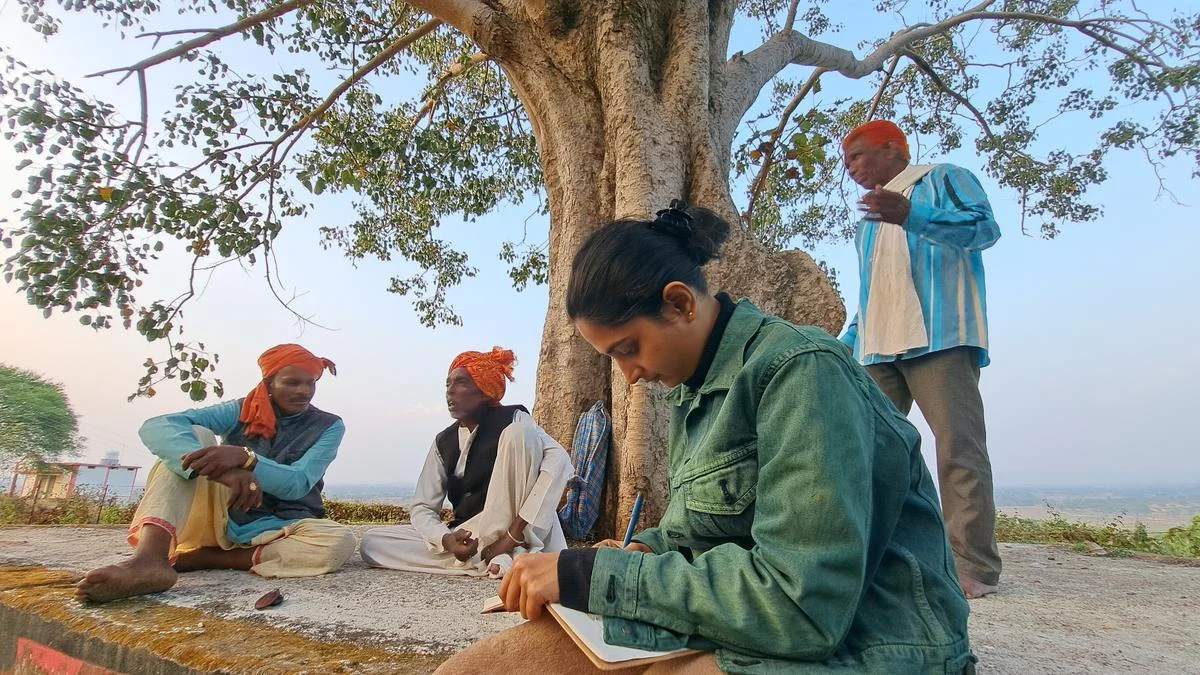
"We have worked closely with Pardhaans from Patangarh village in Madhya Pradesh’s Dindori district for over three years," Siddu elaborates, highlighting the deep engagement and respect that underpins their research. This extended period of immersion allowed for a nuanced understanding and faithful representation of the Pardhaan Gonds’ cultural heritage.

Retelling Ancient Tales: A Divergent Pantheon of Stories
The walls of the DakshinaChitra gallery are adorned with 40 striking paintings, each a window into a different facet of Gond cosmology and folklore. Among these is a colossal 10 ft. x 20 ft. canvas that dramatically depicts the origin story of the River Narmada in a single, unbroken scene. While many are familiar with the 8th-century CE Skanda Purana version, which attributes the river’s genesis to Shiva’s intense meditation, the Pardhaan Gond narrative offers a compellingly different perspective.
The Amar Katha: A Gond Origin of the Narmada
The story, as recounted by Gangaram Uikey, a Pardhaan Gond from Patangarh, is known locally as Amar Katha (The Immortal Tale). In this version, Shiva and Parvati embark on a quest for a secluded place where Shiva can impart the secret of immortality. They find solace within a bamboo forest in the Satpura mountains. However, during Shiva’s profound narration, Parvati succumbs to sleep. Unaware, Shiva continues his discourse. The potent energy of the tale awakens two parrot eggs, bestowing upon them immortality. Enraged by these unintended witnesses to sacred knowledge, Shiva chases the birds away. As he does, three drops of his sweat fall to the earth, miraculously forming the sacred rivers Narmada, Johila, and the Behtarni stream. This rendition underscores the Pardhaan Gonds’ unique cosmology and their deep connection to the natural world.

Smriti Sutradhaara: The Divine Art of Painting
Another significant narrative on display is Smriti Sutradhaara (The Thread of Memory). This tale originates from the Vishnudharmottara Purana, a text dating back to the Gupta period (around the 5th or 6th century CE). Through the story of King Bhayajit, who was later renamed Nagnajit, the text establishes painting as the ultimate skill. At the command of Lord Brahma, King Bhayajit painted the first chitra (painting) to revive a dead boy. This ancient account, which champions the divine origins and power of visual art, has been masterfully rendered in the traditional Pattachitra style of Odisha, showcasing a fascinating cross-cultural artistic dialogue.
The Loksutr Ethos: Preserving and Presenting Indigenous Knowledge
Siddu articulated Loksutr’s mission with clarity at a recent inaugural lecture at the Alliance Française of Madras: "Loksutr’s work responds to the triple challenges faced by India’s indigenous knowledge, which still lives in oral, performative, and transient forms, or sits in specialist archives that prevent the wider public from interacting with it."

He further emphasized the profound impact of stripping down myths to their core: "When you strip a myth down to its essence – its archetypes, emotional resonance, and cultural symbols – it ceases to be just an old story and becomes a foundational blueprint for how we shape both the physical and digital worlds." This perspective highlights the universal relevance and timeless wisdom embedded within indigenous narratives.
A precursor to this exhibition, featuring Amar Katha and The Pardhaan Continuum, was previously held in Delhi. It garnered significant attention from student groups, who, according to Siddu, responded with a markedly deeper sensitivity towards these traditional knowledge systems. This observation underscores the potent educational and empathetic value of such exhibitions.
Of Consent, Control, and Ethical Archiving
The exhibition also serves as a critical platform for discussing the ethical considerations surrounding the documentation and dissemination of indigenous knowledge. Anitha Pottamkulam, Director (Culture) at DakshinaChitra, who is also organizing a workshop for Madras School of Social Work students in conjunction with the exhibition, stresses the importance of Loksutr’s methodology.

"It is vital for us to understand Loksutr’s process of transforming an archive into art," Pottamkulam states. "A lot of well-meaning initiatives fail due to a lack of rigorous ethics. Take the recent news report about the apex body [Idu Mishmi Cultural and Literary Society] representing the indigenous Idu Mishmi community in Arunachal Pradesh’s Dibang Valley. They officially blacklisted four researchers for violating localized ethical standards."
Pottamkulam’s cautionary tale refers to a situation where researchers entered indigenous community lands without prior consent from the community’s Research and Ethics Review Board. Their research was characterized as "extraction-based," involving the collection of data and biological samples without meaningful, long-term participation or shared benefits for the local community. "What’s happened with the Idu Mishmi community is a warning about research and knowledge extraction that proceeds without the community’s consent and control," she asserts.
The Economic and Intellectual Value of Indigenous Narratives
Loksutr’s books, while a vital repository of knowledge, carry a premium price tag. For instance, The Whispers of Immortality, which delves into the origin myth of the River Narmada, is priced at ₹4,550. The pricing structure reflects a commitment to fair compensation for the participating artists. Artists are paid for their paintings and receive royalties for every book sold. This ensures that their contributions are valued and that they benefit directly from the commercialization of their art and stories.

However, the value chain extends far beyond the immediate collaborators. The artists’ work is built upon the cumulative wisdom of generations of Pardhaan bards and the foundational scholarship of pioneering art historians like B.N. Goswamy. Goswamy, along with A.L. Dallapiccola, played a pivotal role in rendering the Chitralakshana of Nagnajit into English in 1976. This treatise, considered the earliest known Indian text on painting, provides crucial historical context for the artistic traditions explored in the exhibition.
Implications for the Digital Age and Decolonization
In an era where indigenous art is increasingly commodified, often detached from its cultural context, Loksutr’s research serves as a poignant reminder. Selling indigenous art without documenting the traditional knowledge that underpins it risks creating a product as hollow as the frantic flight of those two parrot hatchlings in the Amar Katha, desperately trying to escape Shiva’s wrath.
The exhibition, however, does more than just preserve; it provokes critical thought. It raises urgent questions pertinent to our contemporary, digitized world: What happens when an oral story is translated into an image on a phone screen? Does the experience of listening transform into the consumption of an object? Does the act of writing down one version of a story diminish the validity of all other versions that continue to live vibrantly in collective memory?

In this age of decolonization and rapid digitalization, Myth, Memory and Form compels audiences to engage with these complex issues, leaving them with a profound sense of responsibility and a deeper appreciation for the enduring power and multifaceted significance of indigenous knowledge systems. The exhibition is not merely a display of art; it is an invitation to a dialogue, a reckoning with history, and a recognition of the vital role these ancient narratives play in shaping our present and future.
The exhibition ‘Myth, Memory and Form’ is on display until December 6 at the DakshinaChitra Heritage Museum, ECR, Chennai.
