

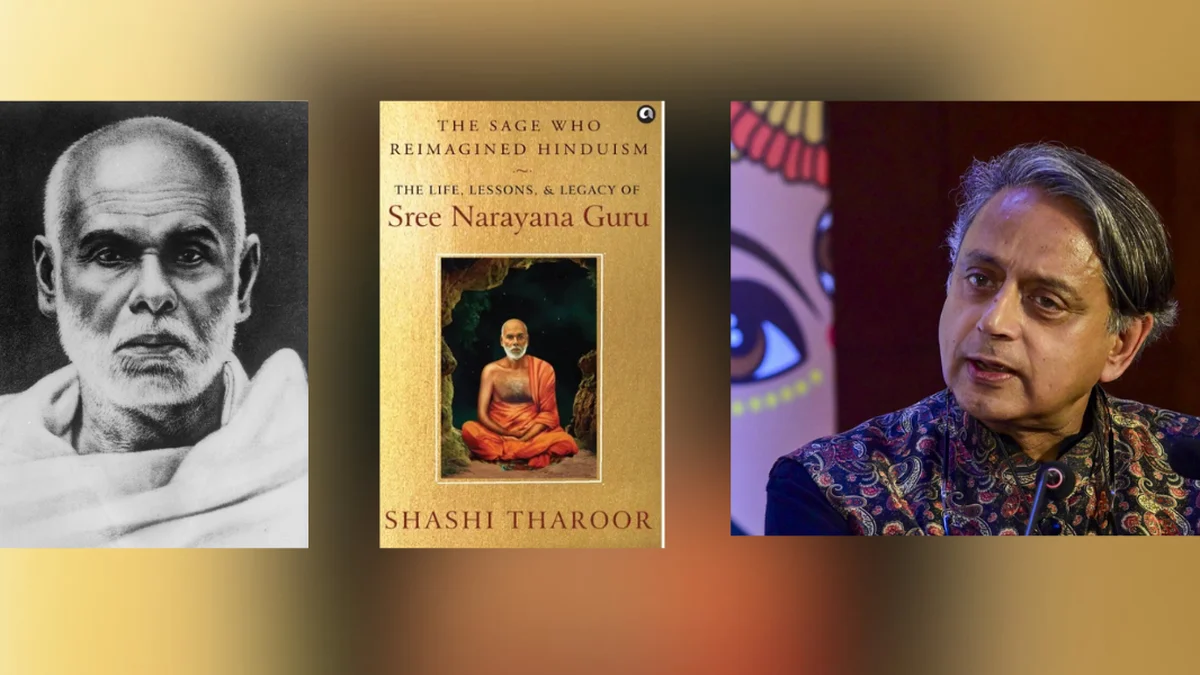
The history of modern India is often told through the lens of political movements and constitutional battles. However, a deeper narrative exists—one of profound social and spiritual restructuring that began in the southern tip of the subcontinent. At the heart of this transformation was Sree Narayana Guru, a sage-reformer whose influence reshaped the socio-cultural fabric of Kerala and provided a blueprint for anti-caste movements nationwide.
In his latest intellectual biography, The Sage Who Reimagined Hinduism, Shashi Tharoor attempts to bridge a significant historical gap. While Sree Narayana Guru is a household name in Kerala, his philosophical depth and radical social interventions remain under-discussed in the broader Indian national discourse. Tharoor’s work serves as an essential introduction to a man who did not merely seek to improve the lot of the oppressed but sought to redefine the very nature of human identity.
Main Facts: The Philosophy of Universalism
Sree Narayana Guru (1856–1928) emerged from the Ezhava community, a group then considered "avarna" or outside the four-fold varna system, subjected to the indignities of untouchability and even "unapproachability." His response to this systemic oppression was not one of bitterness, but of a radical, inclusive humanism grounded in the Vedantic tradition of Advaita (non-dualism).
The Guru’s most enduring contribution to Indian thought is encapsulated in his famous proclamation: "Oru Jathi, Oru Matham, Daivam Manushyanu" (One Caste, One Religion, One God for Mankind). This was not merely a slogan for social harmony; it was a direct theological challenge to the Brahmanical worldview. By asserting that all humans belong to the same species (caste) and that the goal of all religions is the same, he stripped the caste system of its religious legitimacy.
Tharoor’s biography emphasizes that the Guru was a "practical reformer." He understood that spiritual equality was hollow without material and social advancement. Consequently, his movement focused on three pillars:
- Education: He famously urged his followers to "gain freedom through education."
- Organization: He advocated for "strength through organization," leading to the formation of the Sree Narayana Dharma Paripalana (SNDP) Yogam.
- Economic Uplift: He encouraged the establishment of industries and the modernization of agricultural practices.
Chronology: From Hermit to Social Revolutionary
The life of Sree Narayana Guru follows a trajectory from personal spiritual seeking to collective social liberation.
- 1856: Born in the village of Chempazhanthy, near Thiruvananthapuram, in a family of farmers and Ayurvedic physicians.
- 1880s: After a period of wandering and intense meditation in the forests of Maruthwamala, he achieved spiritual enlightenment.
- 1888: The Aruvippuram Consecration. In a landmark act of defiance, the Guru consecrated a Shiva idol at Aruvippuram. When challenged by Brahmins who argued that only they had the right to install idols, the Guru famously replied that he had installed an "Ezhava Shiva," not a "Brahmin Shiva." This act effectively broke the monopoly of the priestly class over the sacred.
- 1903: The formation of the Sree Narayana Dharma Paripalana (SNDP) Yogam. This organization became the vehicle for the Ezhava community’s social and political mobilization.
- 1910-1920: The Guru traveled extensively, establishing temples that were open to all, regardless of caste. He also shifted his focus from building temples to building schools, famously stating that "the school should be the main temple."
- 1924: The Vaikom Satyagraha. This landmark protest against untouchability in the Kingdom of Travancore saw the Guru’s active support. It brought national attention to the plight of the oppressed castes in Kerala.
- 1928: The Guru attained Mahasamadhi (death), leaving behind a transformed society and a robust institutional framework.
Supporting Data: The Broader Landscape of Anti-Caste Movements
To understand the magnitude of Narayana Guru’s work, one must situate him within the wider context of Indian social reform. Tharoor’s book places the Guru alongside figures like Jotirao Phule in Maharashtra, Harichand Thakur in Bengal, and later, B.R. Ambedkar.
Unlike the Adi movements of the early 20th century, which often sought to establish a pre-Aryan, non-Hindu identity, or Ambedkar’s eventual conclusion that the annihilation of caste required a total break from Hinduism, Sree Narayana Guru chose a path of internal democratization. He utilized the tools of Sanskrit, Vedanta, and temple ritual—the very tools used to exclude the oppressed—to claim a space for them within the spiritual landscape.
Comparison with Ayyankali
A vital aspect of Kerala’s "Renaissance" was the interplay between different reformist strands. While Narayana Guru worked on the ideological and spiritual front, his contemporary, Ayyankali, led a more militant struggle for the civil rights of the Pulayar community. Ayyankali fought for the right to walk on public roads, for children to attend schools, and for the dignity of labor. Where the Guru offered a new consciousness, Ayyankali demanded new conditions of existence. Together, they formed a pincer movement that squeezed the life out of Kerala’s orthodox caste hierarchy.
The Vaikom Dispute
The Vaikom Satyagraha of 1924-25 provides a fascinating data point on the Guru’s radicalism compared to other national leaders. While Mahatma Gandhi viewed the struggle through the lens of moral persuasion and was willing to accept a compromise that allowed access only to the roads surrounding the temple, Narayana Guru pushed for more. He believed that the right to equality was indivisible; if a human could walk the road, they must also be allowed to enter the sanctum sanctorum. His vision prefigured the Temple Entry Proclamation of 1936, which legally ended temple exclusion in Travancore.
Official Responses and Scholarly Interpretations
Tharoor’s biography has been met with both acclaim and critical scrutiny. Scholars note that Tharoor, a master of the English language, succeeds in making the Guru’s complex Advaitic poetry accessible to a global audience. However, critics point to a tension that Tharoor himself acknowledges: the "limitations of internal reform."

The Scholarly Critique
Many historians argue that while the Guru’s message was universal, the actual social mobilization remained largely confined to the Ezhava community. The SNDP Yogam, though inspired by universal ideals, eventually evolved into a powerful interest group for a specific caste. This raises a recurring question in Indian sociology: Can a movement based on caste identity ever truly transcend caste?
Furthermore, some activists suggest that by remaining within the Hindu fold, the Guru’s legacy is susceptible to "saffronization" or co-option by right-wing forces seeking to homogenize Hindu identity. Tharoor’s book attempts to counter this by highlighting the Guru’s pluralism, but the debate remains a central point of contention in Kerala’s contemporary politics.
The Political Response
Political leaders across the spectrum in Kerala continue to claim the Guru’s legacy. For the Left, he is a precursor to class struggle; for the Right, he is a reformer who saved Hinduism from its own excesses; for the Centrists, he is the apostle of secular humanism. Tharoor’s biography leans toward the latter, portraying the Guru as a visionary who grounded human dignity in a rationalist interpretation of spirituality.
Implications: Why Sree Narayana Guru Matters Today
The relevance of Sree Narayana Guru in the 21st century extends far beyond the borders of Kerala or the specifics of the Ezhava community. His life and work offer several critical implications for modern India:
1. Spiritual Secularism
In an era of increasing religious polarization, the Guru’s philosophy offers a model of "spiritual secularism." He did not call for the abolition of religion, but for its refinement. By stating that the "essence of all religions is one," he provided a framework where religious identity does not necessitate social exclusion or communal conflict.
2. The Power of Intellectual Sovereignty
The Guru’s act of consecrating a Shiva idol was an act of intellectual and spiritual sovereignty. He demonstrated that the oppressed do not need "permission" from the oppressor to engage with the sacred or the intellectual. This remains a powerful message for marginalized communities worldwide seeking to reclaim their narratives.
3. Education as Liberation
The Guru’s insistence on education as the primary tool for social mobility remains the bedrock of Kerala’s high human development indices. His legacy serves as a reminder that social reform is unsustainable without a corresponding investment in human capital.
4. The Challenge of "Universalism"
The historical trajectory of the Guru’s movement—shifting from a universal spiritual vision to a specific socio-political interest group—serves as a cautionary tale for modern social movements. It highlights the difficulty of maintaining a "universal" identity in a political system that rewards "particular" (caste or religious) mobilization.
Conclusion
Shashi Tharoor’s The Sage Who Reimagined Hinduism is a timely intervention in the project of national memory. By introducing Sree Narayana Guru to a wider English-speaking audience, Tharoor ensures that one of India’s most original social philosophers is no longer confined to regional history books.
While the book is celebratory in tone, its value lies in its clarity and empathy. It presents Narayana Guru not as a static figure of worship, but as a dynamic thinker whose questions about equality, dignity, and the nature of belief are as urgent today as they were a century ago. As India continues to grapple with the persistent shadows of caste and communalism, the "Sage of Aruvippuram" remains a lighthouse, pointing toward a shore where humanity is the only caste and dignity is the only creed.
