

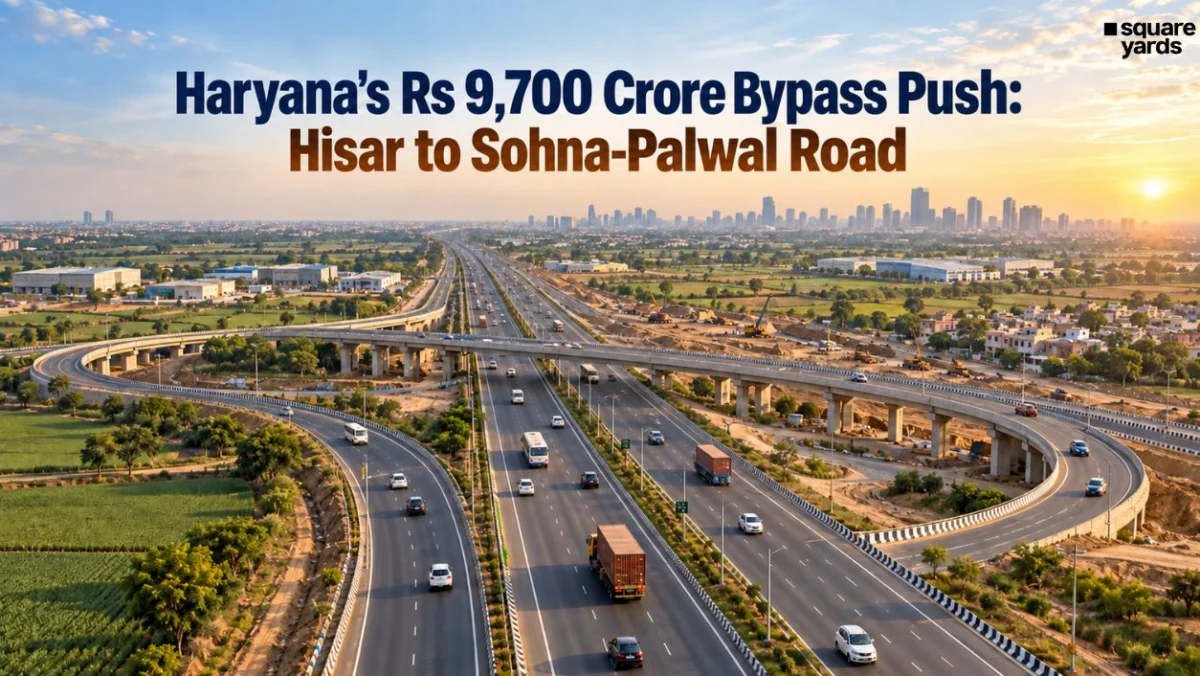
CHANDIGARH — In a move designed to redefine the logistical landscape of North India and catalyze urban development, the Chief Minister of Haryana, Nayab Singh Saini, has officially greenlit a massive ₹9,700 crore road infrastructure package. This strategic investment focuses on the development of five major bypass projects across the state, targeting the high-growth and high-congestion zones of Hisar, Kurukshetra, Narnaul, Jind, and the critical Palwal-Sohna belt.
The announcement marks a significant shift in Haryana’s urban planning philosophy. Rather than focusing solely on inter-state expressways, the state is now prioritizing "bypass-led urbanism"—a strategy aimed at removing heavy transit traffic from city centers to improve livability while simultaneously creating new peripheral economic hubs.
I. Main Facts: The ₹9,700 Crore Blueprint
The Haryana government’s latest fiscal commitment is not merely a collection of isolated road projects but a synchronized effort to integrate the state’s mid-sized cities into the national economic grid. The ₹9,700 crore allocation will be utilized for land acquisition, civil construction, and the integration of these bypasses with existing National Highways (NH).
Key Project Breakdown:
- Hisar Bypass: Designed to facilitate the city’s transition into an aviation and logistics hub by connecting NH-52 with the Delhi and Kaithal routes.
- Kurukshetra-Ladwa Bypass: A project aimed at managing the massive seasonal influx of pilgrims and tourists, with a Detailed Project Report (DPR) already finalized.
- Narnaul City Bypass: An 11-km stretch connecting NH-148B, vital for the Haryana-Rajasthan transit corridor.
- Jind Bypass: A dual-layered project featuring a four-lane bypass on NH-352 and a comprehensive outer ring road.
- Palwal-Sohna Bypass: The crown jewel of the package, positioned within the Delhi-Mumbai Industrial Corridor (DMIC) and the Kundli-Manesar-Palwal (KMP) influence zone.
To ensure the financial viability of these projects, Chief Minister Saini has established a high-level three-member committee. This panel, comprising senior officials from the Finance, Public Works (PWD), and Urban Local Bodies (ULB) departments, is tasked with negotiating cost-sharing formulas with the Central Government, specifically the Ministry of Road Transport and Highways (MoRTH).
II. Chronology: From Congestion to Connectivity
The evolution of Haryana’s road network has moved through several distinct phases, leading up to this September 2026 announcement.
- 2015–2018: The Expressway Era. The completion of the Western Peripheral Expressway (KMP) and the Eastern Peripheral Expressway (KGP) set the stage for bypassing Delhi. However, while these helped the National Capital Region (NCR), interior Haryana towns continued to struggle with "through-traffic"—heavy trucks passing through narrow city streets.
- 2019–2023: The Industrial Corridor Push. The state began aligning its local infrastructure with the Delhi-Mumbai Industrial Corridor. During this time, Sohna emerged as a primary beneficiary of the Sohna Elevated Road, providing a blueprint for how high-speed connectivity transforms sleepy satellite towns.
- Early 2026: The Policy Shift. Recognizing that cities with over 100,000 residents were reaching a breaking point due to traffic bottlenecks, the state government began drafting a "Ring Road Policy."
- September 22, 2026: The Final Approval. Chief Minister Saini signs the ₹9,700 crore package, mandating that every town in Haryana with a population exceeding one lakh must eventually have an outer ring road or bypass aligned with the central government’s framework.
III. Supporting Data: The "Bypass Multiplier" in Real Estate
The economic justification for this ₹9,700 crore investment lies in the historical performance of "bypass-adjacent" land. Data suggests that bypasses often generate higher residential value than direct highway frontages.
The Sohna Case Study
Sohna serves as the primary evidence for the government’s strategy. Over the last five years, property prices in Sohna have surged by 151%, with average prices climbing to approximately ₹15,600 per sq. ft. This growth was not accidental; it was the direct result of the Sohna Elevated Corridor and the city’s position at the confluence of the KMP and DMIC.
Currently, the Haryana State Industrial and Infrastructure Development Corporation (HSIIDC) is developing a 607-hectare industrial township along the KMP Expressway. Furthermore, Sohna’s Master Plan 2031 has earmarked 255 hectares for commercial use, specifically along the Eastern Peripheral Road. Developers are responding to this infrastructure with a pipeline of nearly 16,000 housing units scheduled for delivery over the next 36 months.
The Land Value Re-rating Cycle
Market analysts identify a two-phase value jump associated with these projects:
- The Speculative Phase: A 20–30% spike in land prices occurs the moment the alignment is notified and the DPR is approved. This is currently being observed in Jind and Narnaul.
- The Infrastructure Phase: A steadier, long-term appreciation of 10–15% annually begins once construction crosses the 50% mark and service roads are integrated, making the land viable for commercial warehousing or residential townships.
IV. Official Responses and Strategic Vision
Chief Minister Nayab Singh Saini, during the signing ceremony, emphasized that these bypasses are essential for "future-proofing" Haryana’s urban centers.
"We are not just building roads; we are defining the boundaries of our future cities," Saini stated. "By removing heavy freight from the hearts of Hisar, Jind, and Kurukshetra, we are giving the streets back to the citizens. Our directive is clear: any town with a population over one lakh must have a dedicated bypass to ensure that local trade thrives without the burden of interstate transit traffic."
The PWD (B&R) Department noted that the Hisar project is particularly time-sensitive. With Hisar being positioned as a "Global Integrated Logistics Hub" and the Maharaja Agrasen Airport expanding its operations, the bypass is viewed as a "missing link" that will allow cargo to move seamlessly from air to road without entering the city’s residential zones.
The Finance Department has also signaled that the ₹9,700 crore is a "revolving investment." The state expects to recoup a significant portion of this expenditure through increased CLU (Change of Land Use) charges, enhanced property tax collections from new peripheral developments, and potential tolling on specific four-lane stretches.
V. Implications: Micro-Market Deep Dive
The impact of this package will be felt differently across the various micro-markets involved.
1. The Logistics Play: Hisar and Narnaul
Hisar is the gateway to Western Haryana and Punjab. The bypass will allow the city to function as a genuine "secondary city" to Delhi, attracting warehousing firms that find the NCR too expensive. Narnaul, meanwhile, is the dark horse of this announcement. As it connects to NH-148B toward Rajasthan, the bypass will likely turn Narnaul into a vital transit stop for freight moving between the manufacturing hubs of Haryana and the markets of Jaipur and Ajmer.
2. The Tourism Play: Kurukshetra
For Kurukshetra, the bypass is a social necessity. During the International Gita Mahotsav and other religious festivals, the city’s internal roads become paralyzed. The Kurukshetra-Ladwa bypass will allow tourists to bypass the congested old city, potentially leading to the development of new hotel and hospitality clusters on the city’s outskirts.
3. The Connectivity Web: Palwal-Sohna
This is the most strategically significant stretch. By linking the DND-Faridabad-Ballabhgarh corridor via the KMP to the Delhi-Mumbai Expressway, the government is creating a "super-loop." This loop will eventually connect to the Jewar International Airport in Uttar Pradesh. This makes the Palwal-Sohna bypass a critical artery for the entire tri-state (Delhi-Haryana-UP) economic zone.
VI. Critical Analysis: The Risks Nobody is Talking About
While the project promises immense growth, several structural risks could delay the realization of these benefits.
- The Federal Funding Gap: The three-member committee faces a tough negotiation. If the Central Government does not agree to a favorable cost-sharing ratio, the burden on the state exchequer could lead to a phased slowdown of the less "glamorous" projects like Jind or Narnaul.
- Land Acquisition Hurdles: Haryana has a history of litigious land acquisition. Even with the ₹9,700 crore budget, farmer protests or demands for higher compensation could stall construction for years, as seen in previous sectors of the KMP.
- The "Hollow Core" Risk: There is a danger that by moving all commercial activity to the bypass, the original town centers may face economic stagnation. Urban planners warn that without a "downtown revitalization" plan, the old markets of Jind and Hisar could lose their footfall to the newer, shinier developments on the periphery.
- Speculative Bubbles: In areas like Palwal, land prices are already being quoted at "future rates"—prices that assume the road is already built. If construction takes five years instead of three, many early-stage investors may find their capital locked in a non-performing asset.
VII. Conclusion: The Livability Dividend
The true success of the ₹9,700 crore package will not be measured in kilometers of bitumen, but in the reduction of decibel levels and PM2.5 concentrations in Haryana’s city centers. By extracting the "noise, dust, and pressure" of heavy trucking, the state is making a bet that its citizens will stay and invest in their home cities rather than migrating to an overcrowded Gurugram.
Bypasses are the silent engines of the Indian property market. While expressways grab the headlines, the bypass decides the daily quality of life for the middle-class resident. As Haryana moves toward a formalized statewide ring-road policy, it is setting a precedent for other states to follow: build the edges to save the core. For investors, the message is clear—the periphery is no longer the "outskirts"; it is the new center of gravity.
