

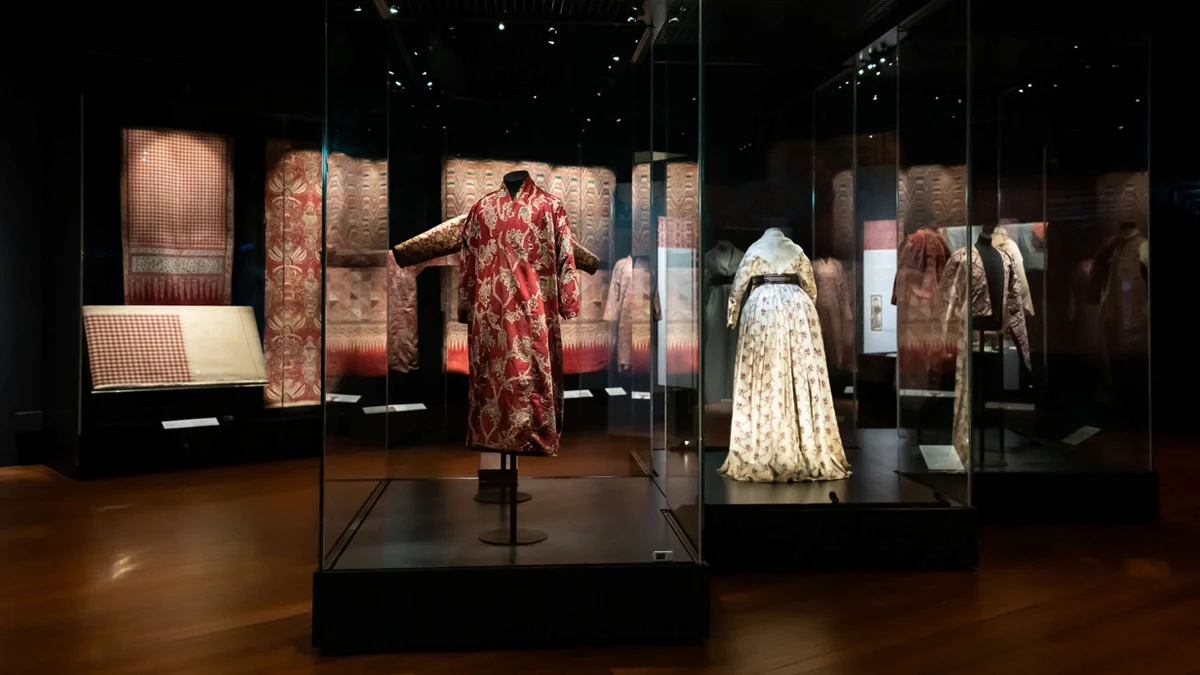
Singaporean collector, independent scholar, researcher, and curator Peter Lee is a man who defies easy categorization. With roots tracing back to the Peranakan Chinese community, Lee possesses a unique intellectual curiosity that spans continents and cultures, finding profound connections between seemingly disparate traditions. His work champions the often-overlooked narratives of trading communities and celebrates the beauty and significance of hybridity in art and material culture. Lee’s recent participation in the Chettinad Heritage and Cultural Festival in Karaikudi, India, served as a poignant reminder of the deep historical ties and shared sensibilities that bind his Peranakan heritage with South Indian traditions, particularly through the shared "love of checks" evident in their textiles.
The Enduring Allure of the Checked Pattern: A Personal Connection
Lee’s fascination with the intersection of Peranakan and South Indian textiles is deeply personal, stemming from cherished childhood memories. "My father and grandfather wore what we call Pulicat sarongs at home," he recalls, referring to the distinctive checked cloths with origins in the 17th-century port town of Pulicat in Tamil Nadu. These vibrant fabrics, he explains, are "so much a part of my memories of everyday life." This intimate connection underscores his broader academic and curatorial pursuits, which aim to illuminate the intricate web of cultural exchange that has shaped Southeast Asia and beyond.
A Resonant Heritage: Chettinad and the Unwritten Histories
The experience of attending the Chettinad Heritage and Cultural Festival in Karaikudi was profoundly inspiring for Lee. He found a deep resonance with the Chettinad community, an ancient group of traders with extensive regional networks. "Coming from an old community of traders with regional networks, Chettinad heritage really resonated [with me]," he states. Lee critiques the traditional dominance of "state narratives and the works of intellectual elites" in art history, arguing for a more inclusive understanding of the past. He believes that the history and material culture of communities like the Chettinad, alongside the Peranakan, Parsi, and Armenian trading groups, offer crucial "facets that contour our understanding of the past in diverse ways." This perspective highlights his commitment to unearthing and promoting the rich, often unacknowledged, histories embedded in material objects and community traditions.

Decoding the Kebaya: A Symbol of Cultural Synthesis
One of Lee’s most significant scholarly contributions lies in his in-depth exploration of the kebaya, a traditional open jacket worn by women. Tracing his own Peranakan genealogy back nine generations has provided him with an intimate understanding of his community’s cultural evolution. Initially, Lee perceived the kebaya as quintessentially Peranakan. However, his extensive research, culminating in his 2014 book Sarong Kebaya, revealed a far more complex history. "The deeper I got into it… the complexities of the cultural entanglements of its past became more apparent," he shares.
Lee’s work demonstrates that the kebaya‘s design is a testament to the influence of multiple cultures. He challenges the imposition of rigid racial and identity markers on dress, asserting that Peranakan fashion, and the kebaya in particular, offers a powerful lens through which to "rethink that." The Peranakan community’s historical presence in multicultural port cities meant they were not bound by strict sumptuary dress codes. This freedom allowed for the adoption and adaptation of various stylistic elements, fostering a spirit of "hybridity." Lee’s research on the kebaya prompted him to question "every object and culture and how things are pieced together."
The Peranakan community itself is an expansive term encompassing mixed-heritage families across Southeast Asia. Lee emphasizes that concepts like "race, identity, and nationality are all modern concepts." He posits that "the past was more organic." The historical intermarriages between migrant merchants and local populations naturally led to the development of hybrid rituals, spiritual practices, and customs, a phenomenon he meticulously explores.

This commitment to exploring historical empires and their cross-cultural impact is further evidenced in Lee’s documentary series, The Mark of Empire: Kingdoms of the Sea. Available on YouTube, this four-part series, produced by IFA Media for CNA, delves into the histories of four Southeast Asian empires that left an indelible mark on world history. The series has garnered international recognition, recently receiving a Silver Dolphin award in the ‘Ethnology and Sociology’ category at the Cannes Corporate Media & TV Awards, underscoring the global significance of his research and storytelling.
The NUS Baba House: A Living Archive of Peranakan Life
Lee’s profound interest in Peranakan heritage led him to a pivotal role as the founding curator of the NUS Baba House. This 19th-century townhouse, once belonging to a prosperous stevedore family, has been meticulously preserved as a museum. Lee describes his involvement as serendipitous. He met the current owner of the house, who harbored a strong desire to preserve its history, at a time when his aunt, Agnes Tan, was seeking a meaningful project to honor the memory of her late father, Tun Tan Cheng Lock, a prominent Peranakan businessman and political leader. Lee facilitated the connection, leading to the transformation of the Baba House into a unique museum. The house retains its original interiors and objects from 1929, offering an unparalleled glimpse into the domestic life of a wealthy Peranakan family.
Lee champions historical house museums as vital spaces for a "multi-sensory understanding of the past." He argues that "the subliminal effect of seeing, smelling and even feeling things is something not achievable in a standard museum." The Baba House, currently undergoing restoration, is slated to reopen next year. The Tun Tan Cheng Lock Trust has generously provided an endowment to the National University of Singapore (NUS) to ensure ongoing funding for staffing, programming, and maintenance, securing the house’s legacy for future generations.

Family Influence: Nurturing a Collector’s Instinct
Peter Lee’s extensive collection, encompassing Tamil and Indian textiles, Peranakan artifacts, vintage photographs, and objects that chronicle Asian trade, migration, and cultural exchange, is deeply rooted in the influences of his family. He attributes his passion to three key mentors: his father, mother, and paternal uncle.
His father instilled in him a love for learning and a disciplined approach to knowledge acquisition, often taking him to bookstores and encouraging him to purchase a book on each visit. His mother, however, was an "instinctive collector" with a discerning eye for beauty. Her varied interests naturally evolved into curated collections, ranging from porcelain and furniture to textiles. She possessed one of the finest assortments of sarong kebaya sets, each exquisitely adorned with print, painting, and embroidery.
His paternal uncle, an architect and architectural historian, provided Lee with access to a vast personal library filled with old maps and 19th-century cityscapes. This early exposure to historical cartography and visual archives undoubtedly shaped Lee’s meticulous research methodologies and his appreciation for historical context.

The Heart of Hybridity: Celebrating the Unclassifiable
Lee’s travels throughout India have been instrumental in shaping his understanding of textile traditions. He has learned from esteemed scholars, including the late collector Jagdish Mittal from Hyderabad. His personal bias, he admits, lies with chintz and kalamkari textiles. "I have been collecting kalamkaris from various world markets, from Japan to Thailand, Indonesia, Nepal, Iran, the Netherlands and even America," he reveals. He finds it "fascinating how versatile and creative the artisans were to produce patterns in demand in specific markets."
A prime example of this adaptive artistry is the production of two-sided kalamkari, known as kain chit dua muka or chintz with two faces, specifically for the Southeast Asian islands. Lee explains that because these textiles were often draped in ways that displayed both sides, it was essential for artisans to meticulously draw and dye the patterns on both surfaces of the cloth. His expertise in this area is further solidified by his publication of two essays on chintz, demonstrating his deep engagement with the subject.
For Lee, the act of collecting transcends mere acquisition. It is not about being "greedy or self-indulgent," but rather serving a "bigger purpose." He is remarkably open, welcoming "all kinds of people" to his home to experience his collection of photography and textiles. He actively encourages visitors to "touch and smell old textiles," emphasizing that "they all have different feels and scents; this is something AI can never reproduce." This tactile and olfactory engagement with historical objects underscores his belief in the power of direct experience to foster a deeper connection with the past.

Hybridity, in all its forms, holds a special place in Lee’s heart. He is drawn to objects that resist definitive categorization, those that historians might overlook because they don’t neatly fit into established typologies of culture, period, or community. The transient nature of Asian port cities, he argues, was an ideal breeding ground for such unclassifiable objects. "For example, in the Indonesian market kalamkari does not have the same national stature as indigenous textiles like Javanese batiks," he observes. "But culturally, they are integral to the material culture of the islands."
Lee eloquently articulates the significance of these hybrid traditions: "The art and culture of these communities that are hybrid celebrate human enterprise at its most unbridled and egalitarian. And the spirit of unabashed experimentation, creative improvisation, and non-conformist expression resonate with contemporary global art and culture." This perspective highlights his forward-thinking approach, connecting historical artistic practices to contemporary global trends in art and culture.
Future Endeavors: Illuminating Peranakan Heritage and Tagore’s Legacy
Peter Lee’s curatorial work continues to expand, with an upcoming exhibition at the Peranakan Museum in Singapore scheduled for the end of October. Titled Exceptional/Everyday: New Acquisitions, New Perspectives, the exhibition will showcase 14 objects, both remarkable and commonplace, aiming to "reshape what we think of Peranakan heritage."

Furthermore, Lee is lending his expertise as a curatorial consultant to Darshan Shah of Weavers Studio, a renowned textile atelier in Kolkata. He is assisting with Shah’s upcoming exhibition, Sarong to Sari: 100 Years of Tagore’s Batik Legacy. This exhibition commemorates the centenary of Rabindranath Tagore’s 1927 journey to Java and his subsequent introduction of batik to Santiniketan. The exhibition is set to open in January 2027 in Santiniketan, promising to shed new light on a significant cultural exchange between India and Southeast Asia.
Peter Lee’s multifaceted career as a collector, scholar, and curator is a testament to the power of interdisciplinary exploration and the profound beauty of cultural interconnectedness. His dedication to unearthing and celebrating the nuanced narratives of hybridity enriches our understanding of the past and offers valuable insights for the present and future.
The author is a cultural activist, philanthropist, and founder of Prakriti Foundation.
