

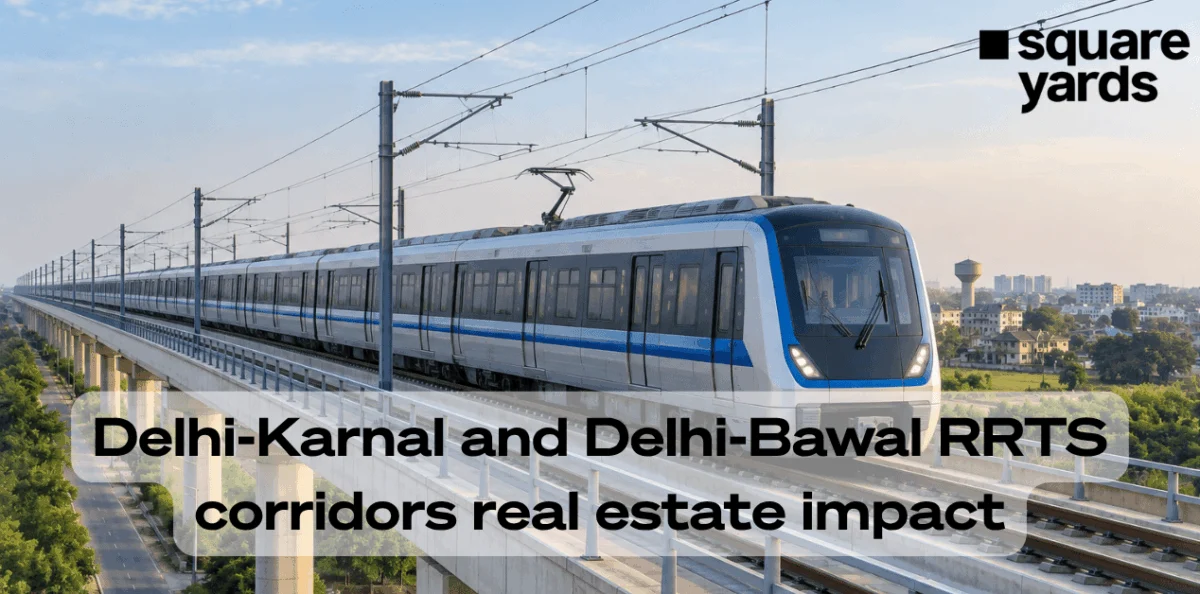
The landscape of the National Capital Region (NCR) is on the precipice of a logistical revolution. As the Government of India intensifies its focus on high-speed regional connectivity, the proposed expansion of the Namo Bharat Regional Rapid Transit System (RRTS) toward Karnal and Bawal marks a significant milestone in urban planning. These corridors are not merely transport projects; they are economic arteries designed to decentralize the national capital, bridge the urban-rural divide, and foster a seamless "commuter economy."
With Detailed Project Reports (DPRs) now under active review by the Union Government, the transition from road-dependent travel to high-speed rail is poised to redefine how millions of people live, work, and invest in Northern India.
1. Main Facts: The Scope of the New Corridors
The National Capital Region Transport Corporation (NCRTC) has officially submitted the blueprints for two massive extensions of the RRTS network. These projects follow the successful implementation of the Delhi-Ghaziabad-Meerut corridor, which served as a proof-of-concept for the Namo Bharat trains.
The Delhi-Panipat-Karnal Corridor
This northern corridor is designed to stretch approximately 136.30 km, originating from the multi-modal hub at Sarai Kale Khan in Delhi and terminating in the historic city of Karnal.
- Key Stops: Sonipat, Gannaur, Samalkha, and Panipat.
- Infrastructure: The route is slated to feature 22 stations, strategically placed to serve both densely populated residential clusters and industrial zones.
- Financial Outlay: The estimated cost for the Delhi-Panipat-Karnal project is pegged at approximately Rs 33,051 crore, reflecting the massive scale of land acquisition and high-tech engineering required.
The Delhi-Gurugram-Bawal Corridor
Extending toward the southwest, this 107 km corridor is perhaps the most economically vital link in the network. It aims to connect the heart of Delhi with the industrial powerhouses of southern Haryana.
- Key Stops: Gurugram, Manesar, and Rewari, ending at Bawal.
- Strategic Importance: This corridor passes through the Manesar-Bawal Investment Region (MBIR), a critical node of the Delhi-Mumbai Industrial Corridor (DMIC).
Technical Prowess
Both corridors will utilize the state-of-the-art Namo Bharat trainsets, capable of design speeds of 180 kmph and operational speeds of 160 kmph. With a planned frequency of 15 minutes during initial phases, the system promises a "wait-less" experience for commuters.
2. Chronology: The Evolution of the Namo Bharat Network
The journey toward a high-speed regional rail system in India has been decades in the making, evolving from a conceptual framework to a tangible reality.
- 2005–2013: Conceptualization: The need for a rapid transit system was first identified in the Regional Plan 2021 for the NCR. Functional plans were drawn up to identify eight potential corridors, with three being prioritized: Delhi-Meerut, Delhi-Panipat, and Delhi-Alwar (via Bawal).
- 2013: Formation of NCRTC: The National Capital Region Transport Corporation was established as a joint venture between the Centre and the states of Delhi, Haryana, Rajasthan, and Uttar Pradesh to implement the project.
- 2019–2023: The First Phase: Construction began on the Delhi-Meerut corridor. In October 2023, the first 17-km "Priority Section" was inaugurated, marking the debut of the Namo Bharat trains.
- 2024–2025: Expansion and DPR Submission: Following the success of the Meerut line, the NCRTC finalized and submitted the Detailed Project Reports for the Karnal and Bawal extensions.
- September 2026 (Current Status): The Central Government is in the final stages of reviewing these proposals. Preparatory works, including geotechnical surveys and utility shifting plans, have already commenced in several segments of the proposed routes.
3. Supporting Data: Travel Time and Economic Metrics
The primary value proposition of the RRTS is the drastic reduction in travel time. Currently, the National Highway 44 (NH-44) to Karnal and the NH-48 to Bawal are among the most congested roads in the country, frequently plagued by heavy truck traffic and commuter bottlenecks.
Travel Time Comparison
| Route | Current Time (Road) | Projected Time (RRTS) | Efficiency Gain |
|---|---|---|---|
| Delhi to Karnal | ~180 Minutes (3 hrs) | ~90 Minutes | 50% Reduction |
| Delhi to Bawal | ~150 Minutes (2.5 hrs) | ~67 Minutes | 55% Reduction |
Real Estate and Pricing Insights
The announcement of the RRTS has already begun to influence property valuations. Investors are pivoting away from the saturated Delhi market toward peripheral cities where the "yield-to-connectivity" ratio is higher.
Average Real Estate Prices (as of late 2026):
- Panipat: Rs 7,300 – 12,000 per sq ft (A textile and industrial hub seeing high demand).
- Manesar: Rs 9,000 – 12,000 per sq ft (Driven by proximity to Gurugram and the auto-hub).
- Rewari: Rs 5,500 – 8,000 per sq ft (Emerging as a mid-income residential favorite).
- Sonipat: Rs 4,300 – 5,800 per sq ft (Benefiting from educational hubs and proximity to Delhi).
- Bawal: Rs 2,000 – 3,500 per sq ft (Primarily industrial and warehouse-driven growth).
- Karnal: Rs 5,000 – 15,000 per sq ft (A wide range reflecting luxury plotted developments and older urban areas).
Source: Square Yards Research
4. Official Responses and Governance
The progress of these corridors is a result of coordinated efforts between the Ministry of Housing and Urban Affairs (MoHUA) and the State Government of Haryana.
The Centre’s Perspective:
Officials from the Ministry have noted that the RRTS is a "key pillar" of the Gati Shakti National Master Plan. By reviewing the DPRs for Karnal and Bawal, the Centre aims to ensure that these projects are financially viable while maximizing their reach. The government is particularly focused on Multimodal Integration, ensuring that RRTS stations connect seamlessly with Indian Railways stations, ISBTs (Inter-State Bus Terminals), and Delhi Metro lines.
The NCRTC’s Stance:
The NCRTC has emphasized that the Namo Bharat system is designed for the "regional commuter." Unlike the Metro, which serves intra-city needs with frequent stops, the RRTS is designed for longer distances with higher speeds, catering specifically to those who live in the hinterlands but work in the capital.
State Government of Haryana:
The Haryana government has been a proactive partner, recognizing that the Delhi-Bawal line is crucial for the success of the Industrial Model Townships (IMT) at Manesar and Bawal. By facilitating faster movement of the workforce, the state expects a significant uptick in GST collections and industrial output.
5. Implications: The Future of the NCR
The expansion of the RRTS into Karnal and Bawal carries profound implications for the socio-economic fabric of Northern India.
A. Decentralization of the National Capital
Delhi is currently struggling under the weight of over-population, pollution, and infrastructure strain. By making a 90-minute commute from Karnal feasible, the RRTS allows people to reside in less congested, more affordable cities while maintaining their professional ties to Delhi. This "reverse migration" of sorts could lead to a more balanced distribution of population across the NCR.
B. The Rise of Transit-Oriented Development (TOD)
Under the TOD policy, the areas surrounding RRTS stations will see higher Floor Area Ratio (FAR) permissions. This means we can expect high-density mixed-use developments—skyscrapers that house offices, apartments, and retail outlets—all within walking distance of the Namo Bharat stations. This urban model reduces the need for private vehicles and promotes a "walk-to-work" culture.
C. Industrial and Logistics Boost
The Delhi-Gurugram-Bawal corridor is a lifeline for the manufacturing sector. Bawal is home to numerous multinational corporations, particularly in the automotive and electronics sectors. High-speed connectivity will allow for a more mobile specialized workforce, enabling companies to hire talent from a wider geographical radius. Furthermore, the corridor will likely spur the development of modern warehousing and cold-storage facilities along the route.
D. Environmental Impact
One of the most significant yet under-discussed benefits is the reduction in carbon footprint. By providing a reliable, electric-powered alternative to thousands of private cars and diesel buses that ply the Delhi-Chandigarh and Delhi-Jaipur highways daily, the RRTS will contribute substantially to improving the air quality of the NCR—a region that has historically struggled with seasonal smog.
E. Social Transformation
The "Namo Bharat" effect will likely extend to education and healthcare. Students in Panipat or Rewari will have easier access to premier universities in Delhi, while residents of these towns can access specialized tertiary healthcare in the capital without the grueling three-hour road journey.
Conclusion
The Delhi-Karnal and Delhi-Bawal RRTS corridors represent a bold step toward a "Smarter NCR." As the Centre nears the conclusion of its proposal review, the focus will shift toward land acquisition and the mobilization of resources. For the resident of Sonipat or the factory manager in Bawal, the promise of a sub-90-minute journey to the heart of Delhi is no longer a futuristic dream—it is a fast-approaching reality.
The success of these corridors will likely set the template for similar regional rapid transit networks across India, from the Mumbai-Pune axis to the Bengaluru-Mysuru stretch, ushering in a new era of high-speed, sustainable, and inclusive urban growth.
