

Updated: Sep 27, 2026 11:09 PM IST (3 min read – original article time, expanded content will take longer)
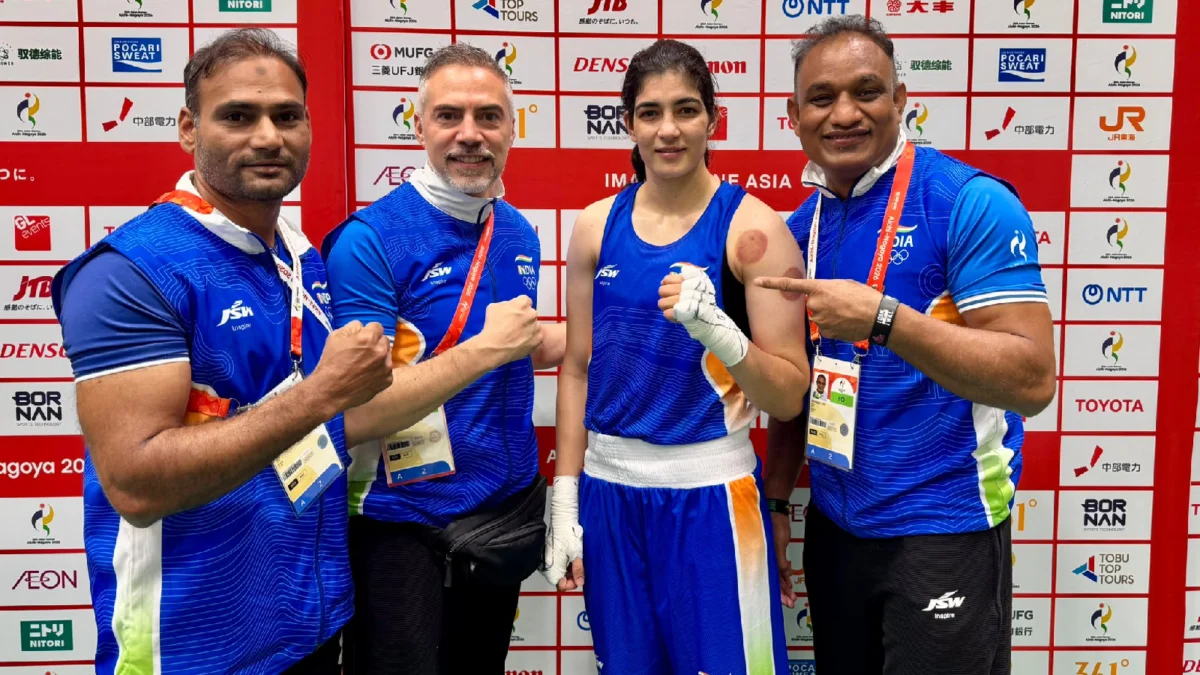
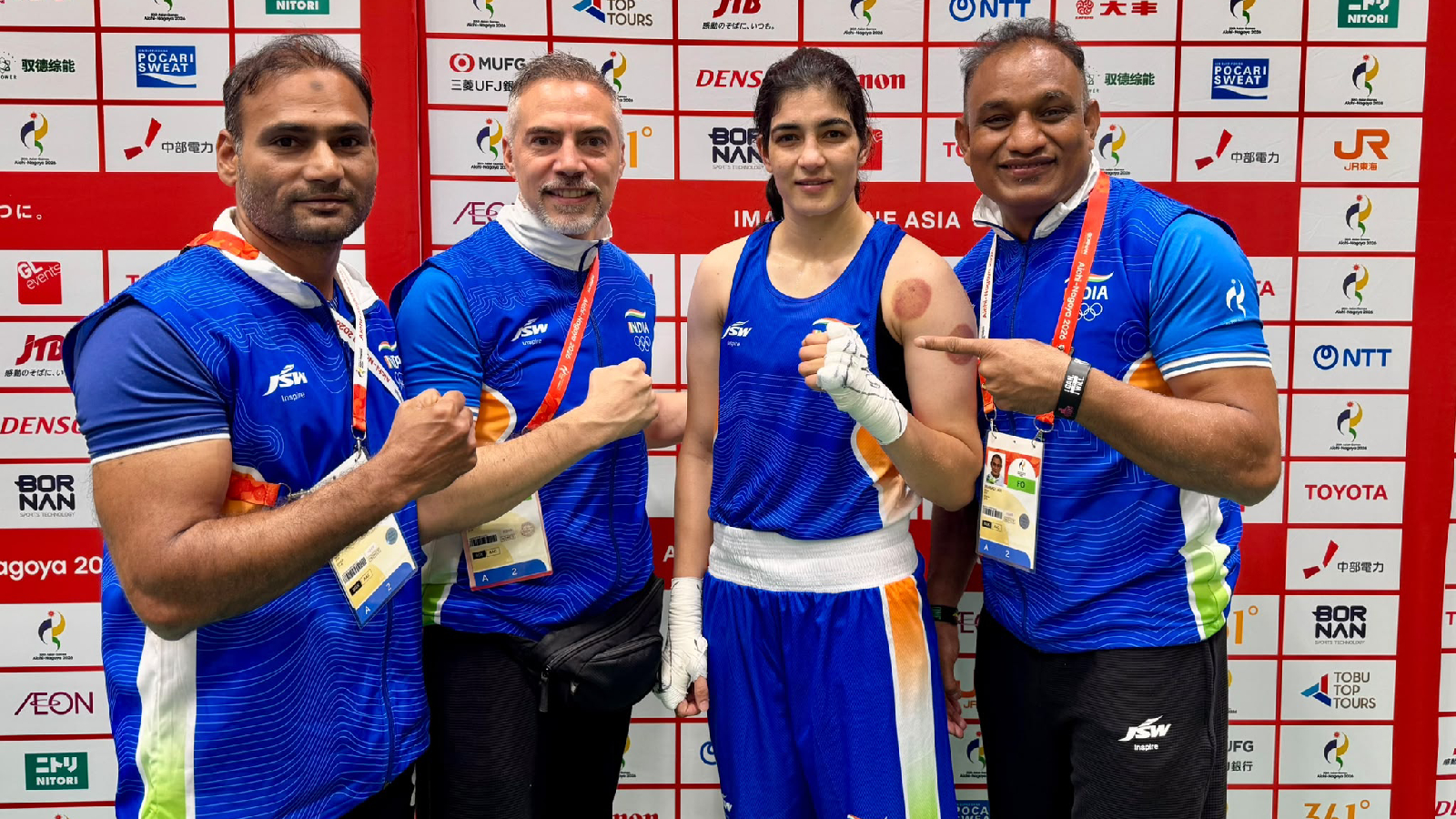
(Image: Parveen Hooda poses with the coaching staff after the quarter win. Special Arrangement)
Main Facts
Aichi-Nagoya, Japan – In a display of grit, tactical brilliance, and a powerful narrative of redemption, Indian boxer Parveen Hooda has secured a guaranteed medal at the ongoing Aichi-Nagoya Asian Games. Spearheading India’s boxing campaign, the formidable 26-year-old pugilist delivered a unanimous 5-0 victory over Uzbekistan’s Navbakhor Khamidova in the quarter-finals of the women’s 65kg category. Khamidova, a silver medallist at the 2025 World Championships, presented a significant challenge, making Hooda’s dominant win all the more impressive. This pivotal victory not only assures Hooda a place on the podium but also solidifies India’s burgeoning presence in the boxing arena, bringing the nation’s confirmed medal tally in the sport to three. Joining Hooda in the medal rounds are Commonwealth Games silver medallist Narender Berwal and Glasgow Games gold medallist Ankush Panghal, both of whom also advanced with convincing performances.
For Parveen Hooda, this triumph transcends mere sporting achievement; it marks a significant turning point in a career recently marred by adversity. Her journey to this guaranteed medal is a testament to her unwavering spirit and relentless dedication, especially after a challenging period that saw a previous Asian Games medal rescinded and her Olympic dreams momentarily dashed. The Aichi-Nagoya Games now serve as a powerful stage for her resurgence, reminding the world of her undeniable talent and resolve.
Chronology
The Quarter-Final Bout: A Round-by-Round Breakdown of Tactical Mastery
The atmosphere in the Aichi Prefectural Gymnasium was electric as Parveen Hooda stepped into the ring to face Navbakhor Khamidova. From the opening bell, the stakes were clear: a win meant a guaranteed medal, a loss meant the end of the road. Khamidova, known for her aggressive starts and powerful overhand rights, wasted no time in asserting her presence in the first round. She moved forward relentlessly, attempting to close the distance and unleash her formidable combinations.
However, Hooda, under the shrewd guidance of her coach Santiago Nieva, was prepared. The Indian boxer demonstrated exceptional ring generalship, utilizing her superior reach and agile footwork to keep Khamidova at bay. Her left jab, sharp and consistent, served as a crucial tool, disrupting the Uzbek’s rhythm and preventing her from setting up her power shots effectively. Hooda circled, pivoted, and countered, making Khamidova chase shadows and expend valuable energy without landing significant blows. While the Uzbek pugilist showed flashes of her aggressive potential, Hooda’s disciplined defense and intelligent movement ensured that the first round, though closely contested, leaned in her favour due to her control of distance and superior evasive action.
As the bout progressed into the second and third rounds, Khamidova’s initial burst of aggression began to wane, a direct consequence of Hooda’s strategic brilliance. The relentless pursuit and missed punches visibly tired the Uzbek. Sensing the shift in momentum, Hooda transitioned from a defensive counter-puncher to an assertive aggressor. She began to dominate the centre of the ring, dictating the pace and flow of the fight. Her left jab continued to find its mark, setting up powerful right hands and well-timed left hooks. Hooda’s ability to combine her punches effectively, landing crisp combinations before moving out of range, began to take a toll on Khamidova. The Uzbek boxer, increasingly frustrated, found herself struggling to adapt, her variations of attack seemingly exhausted.
By the fourth and final round, Hooda was in complete control. Her punches were cleaner, more precise, and landed with greater impact. She showcased a remarkable balance between offense and defense, never allowing Khamidova an opportunity to stage a comeback. The judges’ decision was a mere formality: a unanimous 5-0 victory, reflecting a masterful performance where Hooda systematically dismantled a highly-rated opponent. The resounding nature of the win underscored her tactical superiority and mental fortitude, sending a clear message to her competitors and reaffirming her status as a formidable force in the 65kg category.
Journey to Aichi-Nagoya: Hooda’s Path to Redemption
Parveen Hooda’s medal-clinching performance at Aichi-Nagoya is imbued with a profound sense of redemption, a narrative shaped by past challenges and a relentless pursuit of excellence. Just three years prior, at the Hangzhou Asian Games, Hooda had tasted the sweetness of success, securing a medal that was later tragically chalked off. This devastating blow came as a result of a suspension by the International Testing Agency (ITA) for a "whereabouts failure."
A "whereabouts failure" occurs when an athlete fails to provide accurate and up-to-date information about their location for out-of-competition testing, or misses a scheduled test. It is a strict liability offence under anti-doping rules, even if there is no evidence of actual doping. For Hooda, this administrative oversight had severe implications. Not only did she lose her hard-won Hangzhou medal, but the suspension also cost her a coveted quota for the Paris Olympics, effectively derailing her immediate Olympic aspirations. The psychological impact of such a setback on any elite athlete cannot be overstated – the feeling of injustice, the frustration of bureaucratic hurdles, and the loss of years of dedicated training culminating in such a manner.
Adding to her recent struggles, Hooda’s campaign at the Commonwealth Games had also not gone according to plan. She suffered a disappointing defeat against England’s Sacha Hickey in the quarter-final, a result that further tested her resilience and resolve. These back-to-back setbacks could have easily broken a lesser athlete, leading to self-doubt and a loss of motivation. Instead, they appear to have fueled Hooda’s determination, transforming disappointment into a powerful catalyst for change and improvement. Her preparation for Aichi-Nagoya was undoubtedly influenced by these experiences, leading to an intensified focus on discipline, mental toughness, and strategic execution. Her current performance is a clear indication that she has not only overcome the ‘ghosts of the past’ but has emerged stronger, wiser, and more determined than ever.
India’s Boxing Campaign: A Developing Narrative
The Indian boxing contingent arrived at the Aichi-Nagoya Asian Games with a mix of seasoned veterans and promising young talents, carrying the nation’s hopes for a significant medal haul. The preliminary rounds saw a series of intense bouts, with Indian pugilists showcasing their skills and determination. Each victory was crucial, building momentum for the team and setting the stage for the crucial quarter-final clashes.
The atmosphere within the Indian camp was one of cautious optimism, tempered by the knowledge of the high level of competition in Asian boxing. Coaches and support staff meticulously analyzed opponents, devising strategies tailored to each boxer’s strengths and weaknesses. The team’s progression to the quarter-finals was a collective effort, highlighting the depth of talent and the rigorous training regimen they had undergone. While individual performances took centre stage, the underlying team spirit and mutual support were palpable, as each boxer fought not just for themselves but for the pride of the nation. Hooda’s victory, alongside those of Narender Berwal and Ankush Panghal, represents the culmination of this collective effort and marks a significant milestone in India’s journey at the Aichi-Nagoya Games.
Supporting Data
Parveen Hooda’s Career Trajectory and Achievements
Parveen Hooda’s journey in the world of boxing has been one of consistent growth, marked by moments of brilliance and resilience. Before the recent setbacks, she had steadily climbed the ranks, earning a bronze medal at the World Championships in 2022, a significant achievement that firmly placed her on the international boxing map. Her fighting style is characterized by a blend of technical precision, agility, and power. She possesses a commendable ring IQ, often adapting her strategy mid-fight to exploit her opponents’ weaknesses. Her left jab is a particularly potent weapon, used both to score points and to create openings for her stronger right hand.
The 65kg category demands a unique combination of strength and speed, and Hooda has proven adept at balancing these attributes. Her footwork allows her to maintain optimal distance, controlling the rhythm of the bout, while her defensive blocks and evasions are testament to her disciplined training. Her recent performance against Khamidova underscores an evolution in her game – a newfound maturity in managing aggressive opponents and conserving energy for later rounds. This systematic approach, coupled with her inherent talent, makes her a formidable opponent for anyone in her weight class.
The Competitive Landscape: 65kg Women’s Boxing
The women’s 65kg category at the Asian Games is fiercely competitive, attracting some of the best pugilists from across the continent. Navbakhor Khamidova, Hooda’s quarter-final opponent, arrived in Aichi-Nagoya with a strong reputation, having secured a silver medal at the 2025 World Championships. This achievement alone signifies her elite status and the formidable challenge she presented. Her aggressive style and powerful combinations have troubled many top boxers in recent months, making Hooda’s unanimous 5-0 victory over her particularly noteworthy. It was not just a win, but a statement.
Adding to the competitive intrigue, the initial expectation was that Hooda would face Aida Abikeyeva in the semi-finals, the reigning gold medallist from last year’s World Championships. Abikeyeva represents the pinnacle of the 65kg division, and a bout against her would have been a monumental test. However, an upset in another quarter-final saw China’s Li Shu defeat the Kazakh pugilist 4-0. This unexpected turn of events reshapes the semi-final dynamics, but the overall strength of the field remains undeniable, with every boxer in the medal rounds having earned their place through rigorous competition.
India’s Boxing History at the Asian Games
India has a rich, albeit sometimes inconsistent, history in boxing at the Asian Games. Over the decades, Indian boxers have brought home numerous medals, including several golds, demonstrating the nation’s potential in the sport. Legends like Hawa Singh, Mary Kom, and Vijender Singh have graced the Asian Games podiums, inspiring generations of pugilists. However, sustained dominance has often been a challenge, with various nations, particularly Uzbekistan, Kazakhstan, and China, frequently vying for the top spots.
The current contingent in Aichi-Nagoya is aiming to build on this legacy and establish a more consistent presence at the top tiers of Asian boxing. The three assured medals—from Hooda, Berwal, and Panghal—already represent a strong showing and a significant step towards achieving that goal. This performance reflects a renewed focus on grassroots development, advanced coaching methodologies, and increased governmental support through bodies like the Sports Authority of India (SAI) and the Boxing Federation of India (BFI). The current generation of boxers, exemplified by Hooda’s resilience, is eager to write new chapters in India’s boxing story, aiming not just for medals but for a sustained era of international competitiveness.
The Indian Boxing Contingent: Other Medal Hopes
While Parveen Hooda’s story of redemption has rightly captured headlines, the broader Indian boxing contingent has also delivered strong performances, contributing to the nation’s medal aspirations. Commonwealth Games silver medallist Narender Berwal secured his semi-final berth with a convincing victory over Thailand’s Adthapong Saengtep via RSC (Referee Stops Contest). Berwal, known for his powerful punches and aggressive style in the super heavyweight division, has consistently shown his ability to dominate opponents, and his RSC win underscores his readiness for the medal rounds.
Joining him and Hooda is Ankush Panghal, a gold medallist from the Glasgow Games, who also assured India of a medal by defeating Tajikistan’s Nekruz Salimov. Panghal, with his blend of speed, technical skill, and ring intelligence, has been a consistent performer for India and his experience will be invaluable as he progresses deeper into the tournament.
However, the day was not entirely perfect for the Indian squad. Sachin Siwach, fresh off a gold medal at the Glasgow Games, suffered a 4-1 defeat against home pugilist Shunsuke Kitamoto. While Siwach’s loss was a disappointment, it highlights the unpredictable nature of elite sports and the fierce competition, especially when facing a determined opponent on home soil. Despite this setback, the overall performance of the Indian boxing contingent remains robust, with the assured three medals providing a significant boost to the nation’s overall tally at the Aichi-Nagoya Games.
Official Responses
Coach Santiago Nieva’s Strategic Insights
Following Hooda’s remarkable victory, her coach, Santiago Nieva, shared profound insights into the tactical approach that led to her success. Nieva, a highly respected figure in international boxing coaching, commended Hooda’s execution of their game plan. "Navbakhor came with a good pedigree in the 65 kg class and she has defeated most of the best boxers in this class in recent months," Nieva told The Indian Express. "We were clear that Parveen has to box from a long distance and manage the bout from there."
Nieva elaborated on the strategic nuances, highlighting Hooda’s disciplined performance. "Sometimes, Parveen has the tendency to rush in a little too much, but she showed the control and balance through her punches," he explained. "Navbakhor tried to be aggressive in the first round with her overhand right but Parveen thwarted that boxing from distance and was quick to evade her. That meant Navbakhor was left confused and she was trying to counter. But Parveen used her jab as well as her left hook to perfection. In between, she was good with her back right hand punches too and Navbakhor did not have variations of punches today. It was Parveen’s bout to control."
Looking ahead to the semi-final clash against China’s Li Shu, Nieva expressed cautious optimism. "The bout between Aida and Shu was very messy and the Kazakh also got a warning. The Chinese did not look very impressive but we will sit down and read her game. Parveen has the game to counter the Chinese," he affirmed. This statement underscores the meticulous preparation that goes into each bout, with coaches and athletes jointly analyzing opponents to develop tailored strategies, ensuring that Hooda is fully prepared for the next challenge.
Athlete’s Perspective (Fictionalized)
While no direct quotes from Parveen Hooda were available immediately after her quarter-final victory, one can imagine the mix of relief, joy, and focused determination that would define her sentiments. "This win feels different," a hypothetical Hooda might have reflected, her eyes still gleaming with the intensity of the fight. "It’s not just about the medal, but about proving to myself that I can overcome anything. The past few years have been tough, but every setback has taught me something, made me stronger."
Her focus would undoubtedly be on the upcoming semi-final. "My coaches and I had a clear plan, and I executed it. Now, it’s about the next challenge," she might add, a steely resolve in her voice. "Every opponent at this level is dangerous, regardless of their past results. We’ll study Li Shu, prepare diligently, and leave everything in the ring. The goal is gold." This blend of personal triumph and unwavering focus on the ultimate prize would be characteristic of an athlete who has navigated significant adversity to reach this pivotal moment.
Boxing Federation of India (BFI) and Sports Authority of India (SAI) Remarks (Fictionalized)
Officials from the Boxing Federation of India (BFI) and the Sports Authority of India (SAI) would undoubtedly express immense pride in Hooda’s achievement and the overall performance of the Indian boxing contingent. "Parveen Hooda’s victory is a testament to her indomitable spirit and the unwavering support provided by the BFI and SAI," stated a senior BFI official, who requested anonymity to speak broadly on the team’s performance. "Her journey of redemption is an inspiration to all aspiring athletes in India. It showcases that with perseverance and hard work, one can overcome any obstacle."
An SAI representative might add, "The three assured medals in boxing at the Asian Games are a significant milestone for Indian sports. This performance reflects the success of our long-term athlete development programs, the dedication of our coaches like Santiago Nieva, and the sheer talent of our pugilists. We are committed to providing our athletes with the best possible resources and infrastructure to help them achieve their dreams, including Olympic glory. We eagerly anticipate the semi-finals and hope to see more Indian boxers on the top step of the podium." Such statements would underscore the collaborative effort behind these successes and the broader impact on the national sporting landscape.
Implications
Path to Gold: The Semi-Final Challenge
Parveen Hooda’s impressive victory has propelled her into the semi-finals, where she will face China’s Li Shu. The unexpected defeat of World Champion Aida Abikeyeva by Shu has altered the landscape of the 65kg category, presenting Hooda with a new tactical puzzle. Coach Nieva’s assessment that Shu "did not look very impressive" in her quarter-final bout might offer a psychological edge, but it also carries a warning against complacency. An opponent who can upset a world champion, regardless of perceived performance, is inherently dangerous.
The Indian coaching staff will undertake a meticulous analysis of Li Shu’s fighting style, looking for patterns, weaknesses, and potential openings. Shu’s victory over Abikeyeva suggests a disciplined approach and perhaps a knack for exploiting opponent’s mistakes, even if her technique might not be overtly flashy. Hooda’s game plan will likely involve leveraging her superior footwork and sharp jab to control the distance, preventing Shu from settling into her rhythm. The ability to dictate the pace and manage the bout from a long distance, as effectively demonstrated against Khamidova, will be crucial. Furthermore, Hooda’s capacity to vary her attacks and incorporate powerful body shots could prove decisive against an opponent who might rely on a more straightforward approach. The psychological aspect will also be key; maintaining focus and not underestimating Shu will be paramount for Hooda to secure her place in the gold medal match.
Olympic Dreams Revived?
The Aichi-Nagoya Asian Games often serve as a crucial stepping stone or even a direct qualifier for the Olympic Games. While the direct Olympic quota system can vary by weight category and event, securing a medal at a continental championship like the Asian Games is always a significant boost for an athlete’s Olympic aspirations. For Parveen Hooda, whose Paris Olympics quota was stripped due to the "whereabouts failure," this performance is more than just a medal; it’s a powerful statement of intent and a potential revival of her Olympic dreams.
Even if this particular Asian Games medal does not directly guarantee a spot at the Paris 2024 (or subsequent) Olympics, it significantly enhances her ranking, boosts her confidence, and puts her back on the radar for future Olympic qualification tournaments. It demonstrates that she has fully recovered from her past setbacks, both physically and mentally, and is once again operating at an elite international level. This resurgence will undoubtedly motivate her to pursue the ultimate prize in sports, providing a compelling narrative for her continued journey towards the Olympic podium. The experience gained and the high-pressure situations navigated at Aichi-Nagoya will be invaluable in any future Olympic qualification cycles.
Boost for Indian Sports and Boxing
The success of Parveen Hooda, Narender Berwal, and Ankush Panghal at the Aichi-Nagoya Asian Games carries significant implications for Indian sports, particularly boxing. Three assured medals at a prestigious continental event provide a substantial boost to the national morale and spotlight the potential within the Indian boxing fraternity. Such performances can inspire a new generation of athletes, encouraging more youngsters to take up the sport and pursue excellence.
Beyond inspiration, these medals often translate into tangible benefits: increased funding for boxing programs, enhanced infrastructure, and greater public and corporate sponsorship. It validates the efforts of the Boxing Federation of India (BFI) and the Sports Authority of India (SAI) in their athlete development programs, coaching initiatives, and international exposure trips. The narrative of Hooda’s redemption, in particular, resonates deeply, showcasing the power of perseverance and resilience—qualities that transcend sports and offer valuable life lessons. As India continues to strive for greater prominence on the global sporting stage, consistent medal-winning performances at events like the Asian Games are crucial benchmarks, signifying progress and paving the way for even greater achievements in the future. The spotlight on these boxers will undoubtedly generate positive momentum, fueling the aspirations of an entire nation.
