

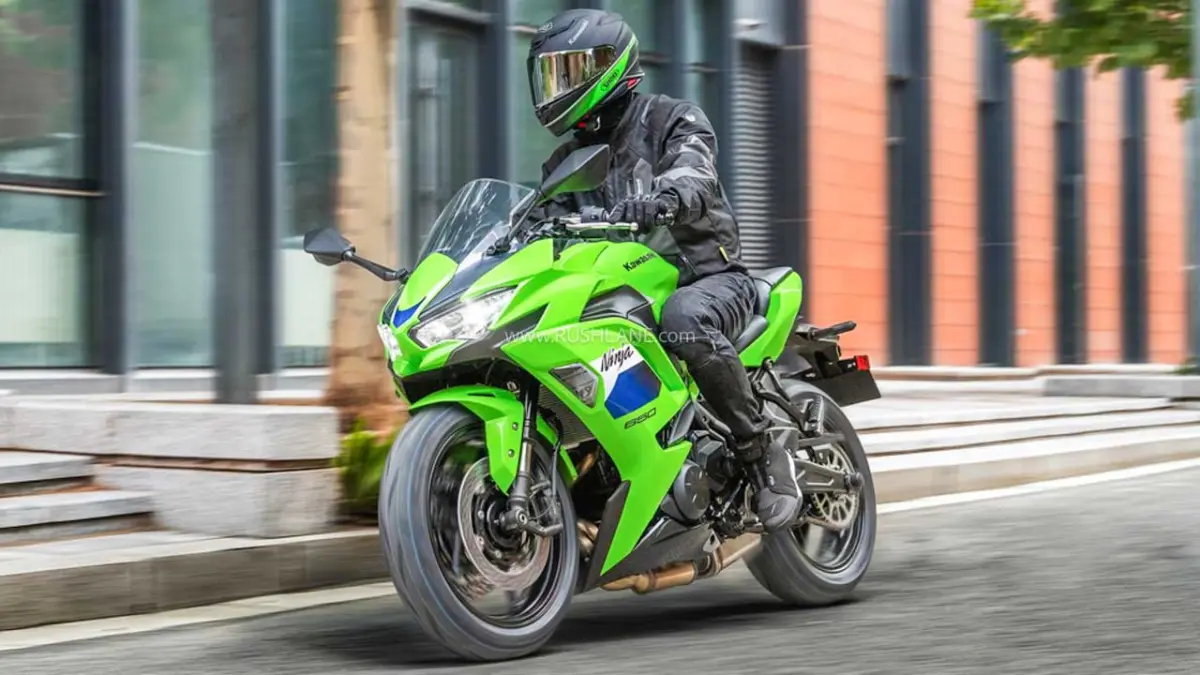
The global motorcycling landscape is witnessing a significant shift in the middle-weight segment, where the balance between everyday usability and track-focused performance is more contested than ever. In a move to consolidate its dominance in this crucial sector, Kawasaki has officially unveiled the 2027 iteration of the Ninja 650. Far from a mere cosmetic "sticker job," the 2027 Kawasaki Ninja 650 introduces pivotal mechanical enhancements designed to sharpen its handling and braking prowess, ensuring it remains a formidable contender against increasingly sophisticated rivals.
The Ninja 650 has long been celebrated as the "sensible" supersport—a motorcycle that offers the aggressive aesthetics of the Ninja family while maintaining the ergonomics and tractable power delivery required for daily commuting and long-distance touring. For the 2027 model year, Kawasaki has addressed the two most common critiques of the outgoing model: its conventional front suspension and its axial-mounted braking system.
Main Facts: A Strategic Evolution
The 2027 Kawasaki Ninja 650 has made its first official appearance in the United Kingdom, serving as the launchpad for what is expected to be a global rollout. Perhaps the most striking aspect of this launch is Kawasaki’s pricing strategy. Despite the inclusion of high-performance hardware, the motorcycle has been priced at GBP 7,499, which approximately converts to Rs 8.16 lakh. In the UK market, this represents a "no-upcharge" policy, where the brand has absorbed the costs of the new components to maintain its competitive edge.
Key Upgrades at a Glance:
- Suspension: Transition from 41 mm Right-Side Up (RSU) telescopic forks to 37 mm Upside-Down (USD) telescopic forks.
- Braking: Upgrade from axially mounted twin-piston calipers to radially mounted quad-piston calipers.
- Aesthetics: Introduction of the "Metallic Matte Graphenesteel Grey / Metallic Spark Black" livery alongside the signature "Lime Green."
- Technology: Continued integration of the 4.3-inch TFT display with enhanced connectivity via the Rideology app.
Chronology: The Pedigree of the Parallel-Twin
To understand the significance of the 2027 updates, one must look at the lineage of the Ninja 650. The platform began its life in the mid-2000s (originally as the ER-6f in many markets), designed to provide a more accessible alternative to the high-strung, four-cylinder ZX-6R.
Over the last two decades, the Ninja 650 has undergone several transformative phases:

- 2006–2011: The foundational years, establishing the 649cc parallel-twin as a reliable, torque-rich engine.
- 2012–2016: A major redesign that introduced a more aggressive fairing and a twin-pipe perimeter frame.
- 2017–2019: A massive weight-reduction phase, where the bike lost nearly 18kg and gained a trellis frame, officially adopting the "Ninja 650" moniker globally.
- 2020–2026: The digital era, introducing LED headlights, a TFT dashboard, and Euro 5 compliance.
- 2027: The "Performance Refinement" phase, focusing on chassis dynamics and braking feedback to bridge the gap between sport-touring and supersport.
The announcement of the 2027 model marks the most significant mechanical overhaul since the 2017 frame change, signaling Kawasaki’s recognition that modern riders demand premium hardware even in the middle-weight category.
Supporting Data: Engineering the 2027 Refinement
The Shift to USD Forks
For years, the Ninja 650 utilized 41 mm conventional forks. While comfortable, these lacked the rigidity required for aggressive cornering and high-speed stability. The 2027 model adopts 37 mm Upside-Down (USD) forks. By flipping the fork construction, Kawasaki has reduced the unsprung weight at the front wheel. This allows the suspension to react faster to road imperfections and provides a much stiffer interface between the triple clamps and the axle. For the rider, this translates to more "feel" from the front tire and significantly reduced fork flex under heavy braking.
Radially Mounted Braking Power
The braking department sees a move from "adequate" to "exceptional." The previous axial-mounted twin-piston calipers were often cited as having a "wooden" feel when pushed to their limits. The 2027 model features radially mounted quad-piston calipers.
Radial mounting reduces the torsional flex of the caliper during hard deceleration, ensuring that the brake pads maintain perfectly even contact with the discs. Combined with the four-piston setup, the new system offers a sharper initial bite and a more progressive lever feel, allowing riders to trail-brake into corners with much higher confidence.
The Heart: The 649cc Parallel-Twin
While the chassis has evolved, the engine remains the tried-and-tested 649cc liquid-cooled, DOHC, 8-valve parallel-twin.

- Peak Power: 68 bhp @ 8,000 rpm
- Peak Torque: 64 Nm @ 6,700 rpm
- Transmission: 6-speed with Assist & Slipper clutch.
This engine is famous for its 180-degree crankshaft, which provides a punchy low-to-mid-range torque curve, making it ideal for exiting tight hairpins or navigating city traffic. Despite the lack of a power bump, the engine’s reliability and linear power delivery remain its strongest selling points.
Connectivity and Ergonomics
The 2027 model retains the 4.3-inch full-color TFT instrumentation. Through Kawasaki’s Rideology The App, riders can access vehicle info, GPS trim logging, and phone notifications. The ergonomics remain unchanged, featuring a relatively low seat height of 790mm and a "sit-in" rather than "sit-on" feel, which continues to make it one of the most approachable big bikes for shorter riders.
Official Responses and Market Strategy
Kawasaki’s UK division has emphasized "value-added engineering" for the 2027 model year. By maintaining the GBP 7,499 price point, Kawasaki is effectively putting pressure on competitors like the Yamaha R7 and the Aprilia RS 660.
In official communications, Kawasaki representatives have noted that the 2027 updates are a direct response to customer feedback. Riders in the European and North American markets have increasingly requested "big bike" hardware—specifically USD forks—on middle-weight machines. By standardizing these parts, Kawasaki is future-proofing the Ninja 650 against newer entrants like the Triumph Daytona 660 and the Suzuki GSX-8R.
Regarding the Indian market, Kawasaki India has not yet released an official launch date. However, industry insiders suggest a late 2026 or early 2027 arrival. Given that the current India-spec Ninja 650 is priced at Rs 7.91 lakh (ex-showroom), the addition of USD forks and radial brakes is expected to push the price closer to the Rs 8.20 lakh – Rs 8.40 lakh mark, unless Kawasaki India manages to localize certain components to offset the cost.

Implications: The Changing Face of the Middle-weight Class
The debut of the 2027 Ninja 650 carries several broader implications for the motorcycle industry and enthusiasts alike:
1. The End of the "Budget" Compromise
For a long time, the 650cc class was seen as a "budget" step-up from 300cc-400cc bikes, often resulting in manufacturers cutting corners on suspension and brakes. Kawasaki’s decision to move to USD forks and radial calipers signifies that the "budget" compromise is no longer acceptable to modern consumers. Even entry-level middle-weights are now expected to feature premium componentry.
2. Longevity of the Parallel-Twin
While some enthusiasts clamor for the return of small-capacity four-cylinder engines (like the Ninja ZX-4RR), Kawasaki’s continued investment in the 649cc twin proves that this engine configuration is the future of sustainable, Euro-compliant performance. It offers the best balance of fuel efficiency, torque, and manufacturing cost-effectiveness.
3. Competitive Pressure in India
In India, the Ninja 650 has enjoyed a near-monopoly for years as the default choice for those graduating from the Ninja 300 or KTM RC 390. However, with the recent launch of the Triumph Daytona 660 and the impending arrival of more sophisticated rivals, Kawasaki needed this update to prevent the Ninja 650 from looking dated. The 2027 model ensures that the Ninja remains the "gold standard" for versatility.
4. Resale Value and Market Positioning
Current owners of the 2024-2025 Ninja 650 may see a slight dip in resale value once the USD-equipped 2027 model hits the showrooms. However, for new buyers, the 2027 model represents significantly better value for money, offering a "complete" package that won’t require aftermarket suspension or brake upgrades—a common practice among Ninja 650 owners in the past.

Conclusion
The 2027 Kawasaki Ninja 650 is a testament to the philosophy of "constant improvement." By retaining the soul of a versatile sport-tourer and injecting it with the hardware of a more focused supersport, Kawasaki has created a machine that is as comfortable on a 500-kilometer touring day as it is capable on a weekend track session.
While the engine remains a familiar friend, the new "legs" and "anchor" of the motorcycle—the USD forks and radial brakes—transform its dynamic character. As the motorcycle prepares to make its way to global showrooms, it stands as a reminder that in the world of motorcycling, you don’t always need more horsepower to have a better ride; sometimes, you just need better control. For riders in India and abroad, the 2027 Ninja 650 is no longer just a "sensible" choice—it is now a genuinely sharp one.
