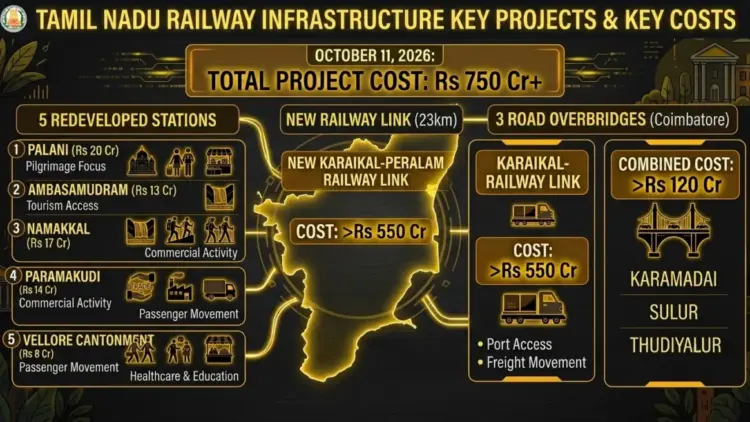
CHENNAI – In a significant move to bolster the multimodal connectivity of Southern India, Prime Minister Narendra Modi officially inaugurated a comprehensive infrastructure package for Tamil Nadu on October 11, 2026. Valued at approximately ₹750 crore, the projects encompass the redevelopment of five strategic railway stations under the Amrit Bharat Station Scheme, the commissioning of a critical 23-km railway line between Karaikal and Peralam, and the opening of three major road overbridges in the Coimbatore region.
This infrastructure push is poised to redefine the socio-economic fabric of the state, bridging the gap between pilgrimage hubs, industrial centers, and residential suburbs. Beyond mere transit convenience, the projects are being viewed as a massive stimulus for the regional real estate markets, with nine distinct locations now coming under the spotlight of investors and urban planners alike.
1. Main Facts: A Multi-Pronged Infrastructure Overhaul
The October 11 unveiling represents a tiered approach to infrastructure development, focusing on passenger experience, freight efficiency, and urban de-congestion.
The Amrit Bharat Station Scheme (ABSS)
Five stations—Palani, Ambasamudram, Namakkal, Paramakudi, and Vellore Cantonment—have been transformed into "modern gateways." The redevelopment focuses on "City Centers" within stations, featuring:
- Upgraded facades reflecting local culture.
- Segregated entry and exit points to manage peak-hour crowds.
- High-speed Wi-Fi, improved waiting halls, and executive lounges.
- Enhanced accessibility features (Lifts, escalators, and tactile flooring).
The Karaikal-Peralam Link
The standout project in terms of capital expenditure is the 23-km Karaikal-Peralam railway line. Built at a cost exceeding ₹550 crore, this line restores a historic link that had been defunct for decades. Its primary objective is to provide the Karaikal Port with a direct, efficient broad-gauge connection to the hinterlands of Tamil Nadu and beyond.
Coimbatore’s Overbridge Trio
To address the chronic traffic congestion in the state’s industrial powerhouse, three road overbridges (ROBs) were commissioned at Karamadai, Sulur, and Thudiyalur. With a combined investment of over ₹120 crore, these bridges eliminate "level-crossing bottlenecks," drastically reducing travel time for commuters and logistics providers in the Coimbatore metropolitan area.
2. Chronology: From Blueprint to Inauguration
The journey of these projects reflects the Central Government’s "Gati Shakti" vision, which emphasizes the timely execution of integrated infrastructure.
- 2023-2024: The Amrit Bharat Station Scheme was conceptualized, identifying over 1,300 stations nationwide for modernization. The five Tamil Nadu stations were fast-tracked due to their high footfall in the tourism and commercial sectors.
- 2024-2025: Land acquisition and civil works for the Karaikal-Peralam line gained momentum. Simultaneously, the Coimbatore overbridge projects were prioritized to support the city’s expanding "Western Bypass" and suburban growth.
- Early 2026: Final safety inspections by the Commissioner of Railway Safety (CRS) were completed for the new line and redeveloped platforms.
- October 11, 2026: Prime Minister Narendra Modi, via video conferencing, dedicated these projects to the nation, marking a milestone in Tamil Nadu’s journey toward "Viksit Bharat" (Developed India).
3. Supporting Data: Real Estate Trends and Economic Indicators
The correlation between infrastructure and property value is evident in the latest market data provided by Square Yards. The impact of these projects varies significantly across the different micro-markets.
The Coimbatore Surge: Thudiyalur vs. Sulur
The impact of the new overbridges is most visible in the residential pricing of Coimbatore’s suburbs.
- Thudiyalur: This locality has emerged as a high-growth zone. Average asking prices for apartments stand at ₹6,500 per sq. ft. (up 7.29%), while villas have seen a staggering 12.38% increase to ₹5,400 per sq. ft. The overbridge here is expected to further fuel this appreciation by improving connectivity to the IT corridors.
- Karamadai: Positioned as an affordable alternative, villas here are priced at ₹3,950 per sq. ft., showing a steady 3.61% growth.
- Sulur: While Sulur saw a marginal dip in the previous quarter—apartments at ₹5,250 per sq. ft. (down 4.61%)—analysts believe the new overbridge will act as a price floor, stabilizing demand as the area becomes more accessible for industrial workers.
The Port Effect: Karaikal
The Karaikal-Peralam line is a game-changer for the region’s industrial real estate.
- Villas in Karaikal are currently averaging ₹4,850 per sq. ft., reflecting a 6.94% increase.
- Specific micro-market rates touched ₹6,400 per sq. ft. in March 2026, signaling investor confidence in the logistics and warehousing potential brought by enhanced freight connectivity to the Karaikal Port.
The Healthcare Hub: Vellore
Vellore Cantonment’s redevelopment targets a unique demographic: medical tourists and students.
- Current villa prices stand at ₹4,750 per sq. ft., a downward correction of 8.91%. However, the modernization of the station is expected to reverse this trend by making the city more navigable for the thousands of patients visiting the Christian Medical College (CMC) and other institutions.
4. Official Responses: A Vision for Integrated Growth
During the inauguration, the Prime Minister emphasized that these projects are not isolated railway works but are "engines of economic transformation."
The Prime Minister’s Office (PMO) released a statement highlighting the "Amrit Bharat" philosophy: "Our stations are being reimagined as more than just transit points. They are becoming vibrant urban centers that showcase local heritage while providing world-class amenities. The Karaikal-Peralam line will specifically empower the Delta region by linking it to global trade via the port."
The Ministry of Railways noted that the focus on Tamil Nadu is a testament to the state’s role in India’s $5 trillion economy goal. Officials stated that the reduction in "detention time" at Coimbatore’s railway crossings through the new overbridges would save thousands of liters of fuel daily and significantly lower the carbon footprint of the region.
Local Industry Leaders in Namakkal and Paramakudi welcomed the move. A spokesperson for the Namakkal Transport Association stated, "The station upgrades and improved parking facilities complement our role as a national logistics hub. It makes the city more attractive for corporate offices and commercial investments."
5. Implications: The Future of Property and Commerce
The ₹750 crore investment is expected to trigger a "multiplier effect" across several sectors.
Hospitality and the Pilgrimage Economy
For Palani and Ambasamudram, the implications are primarily for the hospitality sector. Palani, being one of the Arupadai Veedu (six abodes) of Lord Murugan, sees millions of pilgrims. The ₹20 crore station upgrade creates a professional environment that encourages "stay-over" tourism rather than just day-trips. This shift is expected to drive demand for mid-range hotels, serviced apartments, and retail outlets specializing in religious tourism.
Logistics and Industrial Real Estate
The Karaikal-Peralam line is arguably the most significant for long-term economic growth. By facilitating the movement of coal, fertilizers, and food grains, the line creates a "Logistics Corridor." We can expect a surge in demand for:
- Large-scale warehousing near Peralam.
- Industrial plots along the 23-km stretch.
- Commercial office spaces in Karaikal to support port-linked businesses.
Suburbanization and Residential Demand
In Coimbatore (Karamadai, Sulur, Thudiyalur), the overbridges are accelerating the "de-centralization" of the city. As the core city becomes congested, improved road-over-rail access makes the suburbs viable for white-collar professionals. Thudiyalur’s double-digit growth in villa prices is a precursor to what may happen in Karamadai as it matures.
Commercial Resilience in Tier-II Cities
Namakkal and Paramakudi represent the resilience of Tamil Nadu’s Tier-II cities. The station redevelopments (costing ₹17 crore and ₹14 crore, respectively) provide the necessary infrastructure to support "organized retail." We are likely to see a transition from traditional high-street shops to modern commercial complexes and shopping centers near these redeveloped stations.
Conclusion: A Strategic Leap Forward
The October 11 inaugurations by PM Narendra Modi mark a strategic pivot in how Tamil Nadu’s infrastructure is perceived. It is no longer just about laying tracks or building bridges; it is about creating an ecosystem where transport, commerce, and real estate work in tandem.
While the data shows varying degrees of price movement—from the skyrocketing rates in Thudiyalur to the corrective phases in Vellore—the underlying trend is one of modernization. For real estate investors, the map of Tamil Nadu has effectively been redrawn, with these nine locations serving as the new focal points for sustainable, long-term growth. As the Karaikal-Peralam freight trains begin to roll and the Amrit Bharat stations welcome their first wave of travelers in their new avatars, the state moves one step closer to becoming a global benchmark for integrated urban development.