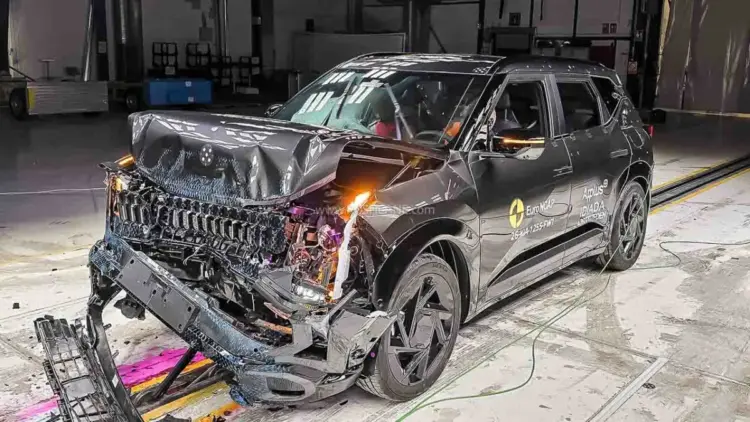
The global automotive landscape has witnessed a significant milestone in vehicle safety as the 2026 Kia Seltos officially earned a prestigious five-star safety rating from Euro NCAP (European New Car Assessment Programme). This achievement underscores Kia’s evolution from a value-oriented manufacturer to a leader in safety technology and structural integrity. The rating applies to several key configurations of the SUV, including the 1.6-litre turbo-petrol and the increasingly popular turbo-petrol hybrid variants, available in both two-wheel-drive (4×2) and four-wheel-drive (4×4) layouts.
As consumer demand for safer, more technologically advanced compact SUVs continues to surge, the 2026 Seltos positions itself as a formidable contender in the European and global markets. The Euro NCAP results provide a granular look at the vehicle’s performance across four critical categories: Safe Driving, Crash Avoidance, Crash Protection, and Post-Crash Safety.
I. Main Facts: A Comprehensive Breakdown of the Scores
The five-star designation is not merely a single metric but a composite of rigorous testing. The 2026 Kia Seltos demonstrated a balanced performance, though it excelled particularly in its ability to manage the aftermath of an accident and protect occupants during side-impact collisions.
The Scoring Matrix
Euro NCAP’s evaluation is divided into four main pillars. The Seltos achieved the following percentages:

- Safe Driving: 67%
- Crash Avoidance: 71%
- Crash Protection: 84%
- Post-Crash Safety: 90%
Protection and Airbag Performance
One of the standout features of the 2026 Seltos is its inclusion of a center airbag. Designed to prevent the heads of front-seat occupants from colliding with one another during a side impact, this feature was lauded by Euro NCAP for providing "good" protection. In the side barrier test—simulating a collision with another vehicle—the SUV provided robust protection to all critical body areas.
However, the testing also revealed areas for improvement. In the more severe "side pole" test, which simulates a vehicle sliding sideways into a rigid object like a tree or utility pole, the protection of the occupant’s chest was rated as "marginal."
Frontal Collision Dynamics
The frontal impact tests yielded a more nuanced set of results. In the frontal offset collision (where only a portion of the front hits an obstacle), the test dummies recorded high levels of compression. Consequently, chest protection was rated "marginal" for the driver and "weak" for the front passenger. Conversely, in the "full-width" frontal test, which involves the entire front of the car hitting a rigid barrier, the protection was rated as "good" or "adequate" for all three occupants assessed.
Vulnerable Road User Protection
While occupant safety was high, the Seltos faced challenges regarding pedestrian safety. Euro NCAP specifically identified "poor" protection for a pedestrian’s pelvis during a collision. This is an area where many high-riding SUVs struggle due to their blunt front-end designs, and the Seltos proved no exception.

II. Chronology: The Path to the 2026 Model’s Safety Standing
The journey of the Kia Seltos has been one of continuous refinement. When the model first launched globally, it was met with varying safety results depending on the market and the specific safety standards applied.
Evolution of the Platform
Between 2020 and 2024, Kia invested heavily in its "K-platform" architecture, focusing on the use of high-strength steel and advanced adhesive bonding. The 2026 model represents the pinnacle of this development, integrating sensors and structural reinforcements that were not present in earlier iterations.
The Shift to Hybrid Safety
The introduction of the 1.6-litre turbo-petrol hybrid variant marked a chronological shift in Kia’s testing strategy. Euro NCAP’s latest assessment specifically included these hybrid models to ensure that the added weight and complexity of the battery systems did not compromise the vehicle’s structural integrity or fire safety protocols. The five-star rating for the hybrid variant is a significant win for Kia as it pivots toward electrification in the European market.
III. Supporting Data: Technical Specifications and Market Performance
To understand the weight of this safety rating, one must look at the data supporting the vehicle’s performance both in the lab and on the showroom floor.

Active Safety Systems and Driver Monitoring
In the "Safe Driving" assessment, the Seltos earned full points for its occupant-sensing capabilities. The vehicle can accurately detect:
- Seatbelt misuse across all rows.
- Occupant stature (to optimize airbag deployment).
- Out-of-position occupants.
The driver monitoring system is particularly advanced, utilizing cameras and sensors to detect signs of fatigue and various forms of distraction, such as mobile phone usage. Furthermore, the Speed Assistance system was put to a real-world test spanning approximately 2,000 km. It correctly identified the speed limit for 94% of the distance covered, showcasing the reliability of its traffic-sign recognition technology.
Post-Crash Innovation: The 90% Benchmark
The highest score achieved by the Seltos was 90% in Post-Crash Safety. This is attributed to two primary technologies:
- Multi-Collision Brake: The SUV automatically applies brakes after an initial impact to prevent secondary collisions, which are often more fatal than the primary hit.
- Advanced eCall: This system automatically notifies emergency services after an accident, relaying the vehicle’s location, the number of occupants, and the severity of the impact.
Global Sales Context
The Seltos is not just a safety leader but a commercial powerhouse. In October 2026 alone, Kia sold 38,368 units of the Seltos globally, making it the brand’s second-best-selling model, trailing only the Sportage. In India, the Seltos remains the crown jewel of Kia’s lineup, with 13,423 units sold in October 2026—an 88.26% year-on-year increase.

IV. Official Responses and Comparative Safety Standards
While official statements from Kia Europe emphasize their "commitment to uncompromising safety," the most telling "response" comes from the vehicle’s performance in other jurisdictions, most notably India’s Bharat NCAP.
The Bharat NCAP Achievement
The India-spec Seltos, while featuring a different powertrain lineup than the European model, has also set records. In recent Bharat NCAP testing, it earned five stars for both adult and child occupant protection.
- Adult Occupant Protection: 31.70 / 32 points.
- Child Occupant Protection: 45 / 49 points.
With a combined tally of 76.70 out of 81 points, the India-made Seltos is currently the highest-scoring Internal Combustion Engine (ICE) car in India. It trails only a handful of high-end electric vehicles (EVs) from Mahindra and Tata, cementing its status as the gold standard for petrol and diesel SUVs in the Indian market.
Euro NCAP’s Critical Observations
Despite the five-star rating, Euro NCAP officials noted a missing feature: the Child Presence Alert. This system, which warns a driver if a child has been left in the rear seat, is becoming a standard expectation for family-oriented SUVs. The absence of this technology was one of the few detractors in an otherwise stellar report.

V. Implications: What This Means for the Industry and Consumers
The 2026 Kia Seltos’ five-star Euro NCAP rating has broad implications for the compact SUV segment and the future of automotive safety.
Setting a New Baseline for Compact SUVs
Historically, the "compact" or "B-SUV" segment often saw compromises in safety to maintain competitive pricing. Kia’s success with the Seltos proves that high-end safety features—like center airbags and sophisticated post-crash electronics—can be integrated into mass-market vehicles. Competitors like the Hyundai Kona, Toyota Corolla Cross, and Volkswagen T-Roc will now face increased pressure to match or exceed these safety benchmarks.
Boosting Hybrid Adoption
By securing a five-star rating for the hybrid variants, Kia has addressed a common consumer concern regarding the safety of electrified vehicles. Knowing that the 1.6-litre hybrid model is as safe as (or safer than) its traditional petrol counterparts will likely accelerate the transition toward greener powertrains in markets with strict safety and emission regulations.
Strengthening Brand Loyalty in India and Beyond
For the Indian market, where "safety" has become a primary car-buying criterion, the Seltos’ dual success in Bharat NCAP and Euro NCAP is a powerful marketing tool. It reinforces the narrative that Kia provides "global safety standards" to local consumers, which is critical for maintaining its 40% share of the brand’s total sales in the region.

The Road Ahead: Pedestrian and Chest Protection
The "marginal" and "weak" ratings in specific crash scenarios provide a roadmap for Kia’s engineering teams. Future mid-cycle refreshes will likely focus on softening the front-end structures to better protect pedestrians and refining crumple zones to reduce chest compression in frontal offsets.
In conclusion, the 2026 Kia Seltos has established itself as a benchmark for safety in the modern era. Its high scores in post-crash interventions and active driver monitoring reflect a shift in automotive safety—from merely surviving a crash to preventing it entirely and ensuring rapid medical response when the unavoidable occurs. For the global consumer, the Seltos now stands as a verified, high-safety choice in one of the world’s most competitive vehicle segments.