

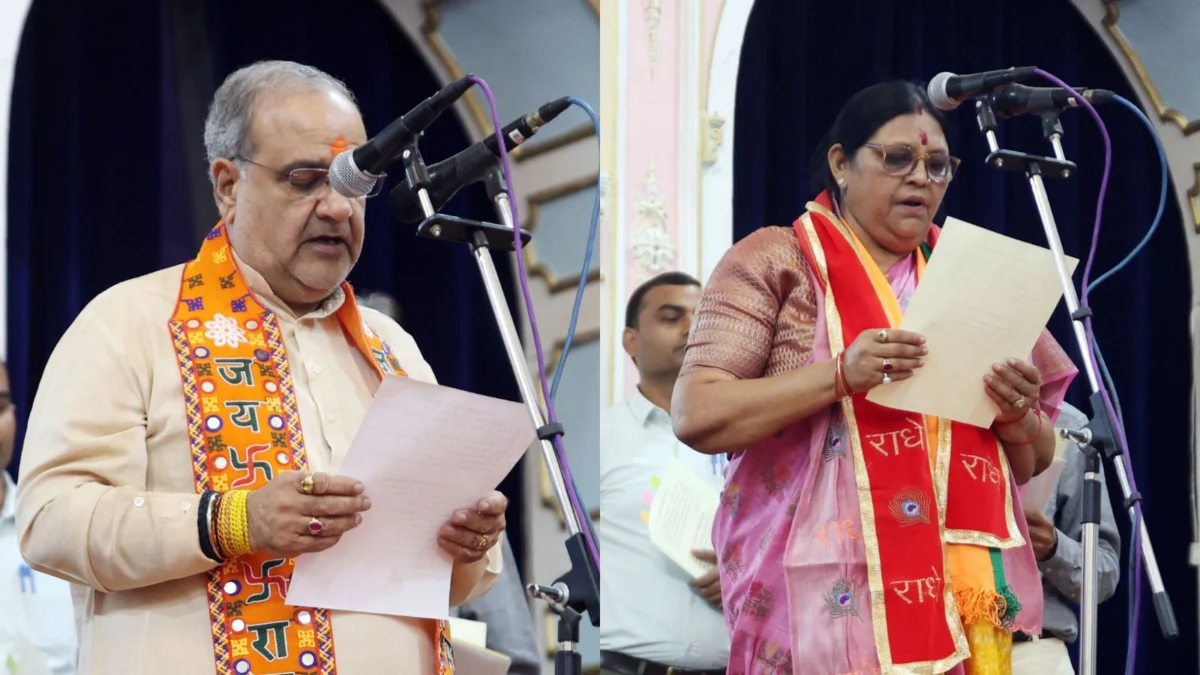
Lucknow, Uttar Pradesh – In a calculated political manoeuvre signalling its readiness for the 2027 Assembly elections, the Uttar Pradesh government on Sunday expanded its Cabinet, inducting six new ministers. The carefully curated expansion heavily emphasizes non-Yadav Other Backward Classes (OBC) and Scheduled Castes (SC), alongside a strategic outreach to the Brahmin community. This move is widely interpreted as a direct counter to the Samajwadi Party’s (SP) "PDA" (Pichda, Dalit, Alpasankhyak – Backward, Dalit, Minority) outreach, aiming to consolidate the Bharatiya Janata Party’s (BJP) electoral base and reclaim crucial ground across eastern and western Uttar Pradesh.
The new inductees comprise three OBC leaders, two Scheduled Caste representatives (including one woman), and one Brahmin face. This composition underscores the BJP’s intricate social engineering efforts, seeking to address perceived grievances, reward loyalty, and reinforce its appeal among diverse communities, particularly those traditionally courted by rival parties.
A Strategic Calculus for 2027
The timing and demographic composition of the Cabinet expansion leave little doubt about its primary objective: the 2027 Assembly elections. With the Samajwadi Party under Akhilesh Yadav aggressively pursuing its ‘PDA’ strategy – aiming to unite the ‘Pichda’ (OBCs, particularly non-Yadavs), ‘Dalits’ (Scheduled Castes), and ‘Alpasankhyak’ (minorities, primarily Muslims) – the BJP’s move is a proactive measure to disrupt this narrative and strengthen its own rainbow coalition.
The focus on non-Yadav OBCs is critical. While the Yadav community forms a significant portion of the OBC vote bank, the BJP has historically sought to cultivate other OBC sub-castes, such as Lodhs, Kurmis, Jats, and Vishwakarmas, to dilute the SP’s influence. By elevating leaders from these communities, the BJP aims to project itself as a more inclusive patron of backward classes, moving beyond the traditional Yadav-centric politics of the SP.
Similarly, the inclusion of two SC representatives, including a woman, highlights the BJP’s intent to broaden its appeal beyond its traditional upper-caste base and chip away at the Bahujan Samaj Party’s (BSP) dwindling but still significant Dalit support. The selection of specific sub-castes, such as Valmiki and Paswan, reflects a granular approach to Dalit outreach, acknowledging the diverse social and political aspirations within the broader SC community.
The Brahmin outreach, embodied by the inclusion of a prominent former SP leader, is equally significant. The Brahmin community, a traditional pillar of BJP support, has occasionally shown signs of discontent in recent years, leading to concerns about a potential erosion of this crucial vote bank. By bringing a Brahmin face into the Cabinet, especially one with a history of crossing party lines, the BJP aims to reassure and re-energize this community, signalling its continued importance within the party’s scheme of things. This move is designed to mitigate any perception of upper-caste neglect and consolidate their support ahead of the high-stakes electoral battle.
Geographically, the expansion seeks to balance representation across the state. With leaders inducted from western, central, and eastern UP, the BJP aims to ensure regional equity and address specific local dynamics. Western UP, with its significant Jat population, and eastern UP, a hotbed of caste politics and a key battleground for the SP, are clearly in focus.
The New Faces: Profiles and Political Significance
The six new ministers bring a mix of experience, community representation, and strategic value to the Yogi Adityanath-led government. Their inductions are not merely about filling vacancies but are deeply rooted in the BJP’s long-term electoral calculations.
Bhupendra Chaudhary: The Jat Stalwart’s Return
Age: 57
Current Role: BJP MLC
Bhupendra Chaudhary, a prominent Jat leader from western Uttar Pradesh, marks his return to the Cabinet, a move that underscores his enduring significance within the party’s organizational structure and electoral strategy. Chaudhary’s political journey dates back to the early 1990s, when he actively participated in the Ram Temple movement, a foundational moment for the BJP. His early career saw him rise through the ranks, serving as the district president of Moradabad, demonstrating his strong grassroots connect.
Chaudhary first gained widespread attention in 1999 when the BJP fielded him against none other than SP founder Mulayam Singh Yadav for the Sambhal Lok Sabha seat. Although he faced a formidable opponent and lost, this high-profile contest cemented his status as a trusted party loyalist. The BJP continued to entrust him with significant organizational responsibilities, appointing him as the regional president for western UP in the early 2000s, a crucial role in a politically sensitive region.
With the BJP’s landslide victory in 2017, Chaudhary was appointed Minister with Independent Charge for the Panchayati Raj Department, reflecting his experience and community standing. His effective performance led to his promotion as a Cabinet minister in 2019. Following the BJP’s return to power in 2022, he was re-elected and re-appointed Cabinet minister for Panchayati Raj.
However, his trajectory shifted when the party assigned him the critical organizational role of state president in August 2022. This appointment necessitated his resignation from the Cabinet, as he focused entirely on revitalizing the party machinery. His tenure as state president, though cut short in December 2025 by his replacement with Pankaj Chaudhary, solidified his image as an effective cadre leader. His re-induction into the Cabinet signals the party’s recognition of his administrative capabilities and his continued importance in representing the Jat community in western Uttar Pradesh, a region vital for the BJP’s electoral success. Known for his subtle working style and receptive nature, his inclusion is seen as particularly significant if he is assigned departments with direct public contact.
Hansraj Vishwakarma: PM’s Man in Varanasi and OBC Outreach
Age: 54
Current Role: BJP district president, Varanasi and MLC
Hansraj Vishwakarma’s induction is a powerful signal of the BJP’s commitment to specific non-Yadav OBC communities and its emphasis on rewarding loyal cadre, especially from the Prime Minister’s parliamentary constituency. Vishwakarma belongs to the numerically significant Vishwakarma OBC community and is considered one of the most trusted party workers in Varanasi. His reliability is underscored by his unprecedented third term as the district president of Varanasi, a role that requires immense dedication and organizational acumen.
Like many BJP veterans, Vishwakarma was an active participant in the Ram Temple movement in the early 1990s. He also shares a historical connection with former chief minister Kalyan Singh, having been considered close to him and even briefly joining Singh’s Rashtra Kranti Party before returning to the BJP fold. This experience across different political phases gives him a unique understanding of regional dynamics.
His selection comes at a strategic juncture, amidst recent Opposition criticism accusing the BJP of neglecting the Vishwakarma community. This criticism was amplified by an alleged incident involving the rape of a girl from the community in Ghazipur district. By elevating Hansraj Vishwakarma, the BJP directly addresses these concerns, demonstrating its recognition and respect for the community. Although he was appointed an MLC in 2023, many party insiders had anticipated a more significant role for him. Party sources indicate that his selection is expected to have a positive impact on the broader Vishwakarma community and other non-Yadav OBCs across eastern Uttar Pradesh, bolstering the BJP’s social base in a region critical for electoral gains.
Kailash Singh Rajput: Lodh Voice in SP Bastion
Age: 69
Current Role: BJP MLA from Tirwa Assembly Constituency in Kannauj
Kailash Singh Rajput is a seasoned politician and a second-term BJP MLA representing the Tirwa Assembly constituency in Kannauj, a traditional stronghold and Lok Sabha seat of SP chief Akhilesh Yadav. His inclusion is a strategic move to strengthen the BJP’s presence in a challenging region and to reinforce its connection with the Lodh Rajput community, to which former chief minister Kalyan Singh, a towering OBC figure, belonged.
Rajput’s political journey includes a brief stint with the Bahujan Samaj Party (BSP) during its rule from 2007 to 2012, highlighting his pragmatic approach to politics before his eventual return to the BJP. His consistent electoral success in Kannauj, where he has repeatedly defeated SP candidates in close contests over the past two elections, underscores his deep roots and personal appeal.
His influence extends beyond Kannauj, particularly in neighbouring regions where the Lodh community holds significant sway. As the 2027 Assembly elections loom, Kailash Singh Rajput remains a key figure for the BJP, tasked with consolidating the Lodh vote and challenging the SP in its own backyard. His induction also makes him the second minister from Kannauj, alongside Asim Arun, who serves as the Minister of State with Independent Charge for Social Welfare and SC/ST Welfare, indicating the BJP’s concentrated efforts in this politically crucial district.
Surendra Diler: Young Valmiki Leader with Legacy
Age: 33
Current Role: BJP MLA from Khair Assembly constituency in Aligarh
Surendra Diler represents the new generation of BJP leaders, combining youth with a strong political legacy. He hails from an influential political family in the region, with both his father and grandfather having served as BJP Members of Parliament from the Hathras Lok Sabha constituency. This lineage provides him with a strong base and an understanding of grassroots politics, honed by assisting his father, Rajveer Singh Diler, in booth management from a young age.
His grandfather, Kishan Lal Diler, was a political titan, serving as an MLA for six terms and a BJP Lok Sabha MP from Hathras for four terms. His father also held the Hathras MP seat in 2019. Surendra himself secured the Khair Assembly seat in a bypoll in 2024, following the vacancy created by BJP leader Anoop Pradhan, who became an MP the same year.
Diler represents the Valmiki community, a significant Scheduled Caste sub-group. His selection for the Cabinet, well before the 2027 Assembly elections, is a clear effort by the BJP to ensure prominent representation for the Valmiki community. This move is aimed at solidifying the party’s Dalit outreach, ensuring that various SC sub-castes feel represented and valued within the ruling establishment.
Krishna Paswan: Grassroots SC Woman Power
Current Role: Fourth-term BJP MLA from Khaga Assembly constituency in Fatehpur
Krishna Paswan is a pivotal inclusion in the new Cabinet, being the only woman and a key Scheduled Caste face in the expansion. Her journey exemplifies the BJP’s emphasis on promoting leaders who have risen from the party’s grassroots. She began her political career at the panchayat level, demonstrating a deep understanding of local issues and community needs.
Her electoral record is impressive: she was first elected as a BJP MLA from the Kisunpur Assembly seat in 2007, a notable achievement given that the BSP government came to power in the state that year. Subsequently, she consistently won the Assembly elections in 2012, 2017, and 2022 from the Khaga Assembly seat in Fatehpur. This four-term winning streak underscores her unwavering popularity and strong electoral base.
Party leaders indicate that her induction sends a powerful triple message: it emphasizes the importance of women in politics, highlights individuals who have ascended through the party’s organizational hierarchy from the ground up, and showcases a dedicated representative of the Scheduled Castes, particularly the Paswan community, in her region. This multifaceted appeal is crucial for the BJP’s inclusive agenda and its efforts to connect with women and Dalit voters.
Manoj Kumar Pandey: The Rebellious Brahmin Face
Age: 59
Manoj Kumar Pandey’s induction is perhaps the most intriguing, representing a strategic poaching operation and a clear outreach to the Brahmin community. Pandey is known as a "rebel leader" within SP political circles, having served three terms as an SP MLA from the Unchahar Assembly constituency. He was once considered a close confidante of SP chief Akhilesh Yadav, serving as a minister and later as the Assembly’s chief whip during Yadav’s regime from 2012 to 2017.
However, Pandey, who was seen as a prominent Brahmin face within the SP, dramatically resigned from his position and drew significant attention in 2024 for his cross-voting in the Rajya Sabha elections, defying the SP’s party line. Despite attempts by the SP leadership to bring him back, he openly campaigned for BJP candidates, further cementing his defection. In 2025, the SP officially expelled him along with other rebel MLAs. Speculation about his potential induction into the Cabinet had been rife for the past two years, making his formal inclusion a widely anticipated event.
While he is the sole upper-caste representative in this expansion, his selection specifically targets the Brahmin community, which has recently shown signs of discontent with the ruling party. His inclusion is viewed as a crucial strategy to win over this vital community in the state, addressing any perceived alienation and reinforcing the BJP’s traditional upper-caste support base, especially in eastern Uttar Pradesh where Brahmins hold significant sway. His political journey from a prominent SP leader to a BJP Cabinet minister highlights the fluid nature of UP’s caste-based politics and the BJP’s willingness to integrate influential defectors to bolster its ranks.
Broader Political Landscape and Future Implications
The Uttar Pradesh Cabinet expansion is more than a routine administrative adjustment; it is a declaration of intent by the BJP. By meticulously balancing caste, community, region, and experience, the party is drawing clear battle lines for the 2027 Assembly elections. The strategy is multi-pronged: countering the SP’s ‘PDA’ by presenting a broader, more inclusive OBC and Dalit narrative, while simultaneously reassuring its traditional Brahmin vote bank.
This move challenges the SP’s ambition to consolidate a large chunk of non-Yadav OBCs and Dalits, and it also puts pressure on the BSP, which has historically relied on the Dalit vote. The BJP’s proactive approach signals its determination to leave no stone unturned in securing another term in power, understanding that the path to Delhi often runs through Uttar Pradesh.
The implications for Uttar Pradesh’s political landscape are significant. This expansion is likely to trigger further political realignments and intensified caste-based politicking. Opposition parties will be forced to re-evaluate their strategies and potentially recalibrate their outreach efforts. The high stakes involved mean that every appointment, every community outreach, and every policy decision will be scrutinized through the lens of the upcoming elections, setting the stage for a fiercely contested political battle over the next three years.
