

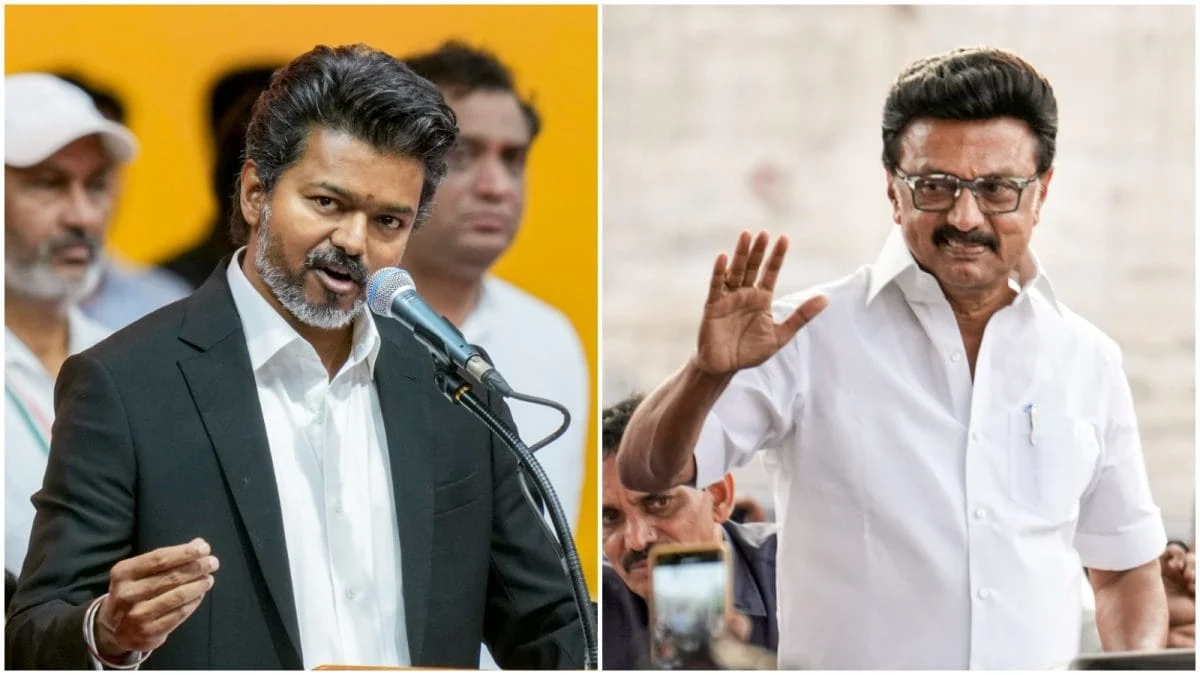
Chennai, Tamil Nadu – In a dramatic commencement to his tenure, newly sworn-in Tamil Nadu Chief Minister C. Joseph Vijay has ignited a fierce political confrontation, accusing the erstwhile Dravida Munnetra Kazhagam (DMK) government, led by former Chief Minister M.K. Stalin, of leaving the state’s coffers barren and burdened with an astronomical debt of Rs 10 lakh crore. The explosive allegations, delivered in Vijay’s inaugural address, have triggered a swift and sharp retort from Stalin, setting the stage for what promises to be an intensely fractious political landscape in the southern state.
The accusations, marking the first significant ideological and administrative clash following the recent change of government, have plunged Tamil Nadu into a high-stakes debate over fiscal transparency, governance, and political accountability. Chief Minister Vijay, leading the Tamilaga Vettri Kazhagam (TVK) in a coalition government, has vowed to unveil a white paper on the state’s financial health, promising an era of unprecedented transparency. However, Stalin, while extending customary congratulations, has vehemently dismissed the claims as baseless and premature, challenging the new administration to demonstrate its capacity for governance rather than engage in what he terms "diversionary tactics."
The Genesis of the Confrontation: CM Vijay’s Inaugural Accusations
The political fireworks began immediately after C. Joseph Vijay, a popular figure whose cinematic appeal has now translated into significant political power, took the oath of office on Sunday. Addressing the public for the first time as Chief Minister, Vijay painted a stark picture of the state’s financial predicament, directly attributing it to the policies and management of the preceding DMK government. His speech was a blend of solemn pledges and pointed criticisms, signalling a departure from the previous administration’s approach.
"The condition in which our Tamil Nadu government has been left is something I have seen for myself," Vijay stated with gravity, addressing an expectant audience. "The last government has gone out after borrowing debts of more than Rs 10 lakh crore; the treasury has been completely emptied before they left office… I am not saying this for effect; only after going inside and seeing things firsthand can one understand what is there and what is not."
This declaration was not merely an observation but a foundational assertion upon which the new government intends to build its narrative and policy framework. Vijay emphasized that his administration would eschew false promises, committing instead to realistic goals achievable with public support. "We will assess the financial situation thoroughly and bring out a White Paper for transparency," he affirmed, indicating a strategic move to provide a detailed, official account of the state’s economic standing. The promise of a white paper suggests an intent to quantify the alleged financial mismanagement and present it as empirical evidence to the public, thereby validating his initial claims and potentially setting a benchmark for future fiscal policy.
A New Era Dawns with Financial Scrutiny
Vijay’s ascent to the Chief Minister’s office was a hard-fought victory. His Tamilaga Vettri Kazhagam (TVK), though not securing a standalone majority in the 234-member Assembly, successfully formed a government with the crucial support of a broad coalition including the Congress, VCK (Viduthalai Chiruthaigal Katchi), CPI (Communist Party of India), CPI(M) (Communist Party of India (Marxist)), and IUML (Indian Union Muslim League). This coalition, crossing the majority mark, represents a significant shift in Tamil Nadu’s political landscape, long dominated by the DMK and AIADMK. The financial allegations, coming so early in his term, suggest a deliberate strategy by the new Chief Minister to establish a clear distinction from his predecessors and to perhaps manage public expectations regarding the immediate implementation of ambitious welfare schemes. By highlighting the alleged fiscal constraints, Vijay may be preparing the ground for a more cautious approach to spending, while simultaneously positioning his government as a responsible steward of public funds.
Stalin’s Swift and Vehement Rebuttal
The former Chief Minister and DMK President, M.K. Stalin, did not delay his response to Vijay’s allegations. Taking to X (formerly Twitter), the popular social media platform, Stalin congratulated Vijay on his assumption of office but wasted no time in rejecting the sweeping claims about the state’s finances. His tone was firm, seasoned with the experience of years in political leadership, and laced with a challenge to the nascent administration.
"Don’t start saying right away that the government has no money. It does have it. What’s needed is the will to give it to the people, and the ability to govern," Stalin posted, directly confronting Vijay’s narrative of an empty treasury. This statement encapsulated the DMK’s counter-argument: that the state’s financial health, while facing challenges, was not as dire as portrayed, and that effective governance was more about strategic allocation and resource generation than about perceived scarcity.
Stalin further defended the DMK’s track record, enumerating the numerous welfare schemes implemented during his tenure. He highlighted the significant challenges his government navigated, including the devastating impact of the Covid-19 pandemic, recurring floods that wreaked havoc across the state, and what he described as "limited support from the Union BJP government." This defense aimed to contextualize the state’s financial position, arguing that despite external pressures and insufficient central assistance, the DMK government had remained committed to public welfare. He asserted that the state’s debt levels were well within permissible limits and had been comprehensively detailed and explained in the budget presented in February. "Don’t deceive the people who voted for you again and try to divert the issue," Stalin admonished, suggesting that Vijay’s claims were a political ploy rather than a genuine reflection of financial reality. He reiterated that the financial position had been clearly presented to the public and the legislature earlier, implying transparency from his administration.
The Digital Battleground: Social Media as a Political Arena
Stalin’s immediate response via X underscores the evolving nature of political discourse. In an era where information travels at lightning speed, social media platforms have become critical battlegrounds for shaping public opinion. The concise, direct nature of Stalin’s tweet allowed him to swiftly counter the Chief Minister’s narrative, reaching a wide audience almost instantaneously. This rapid exchange exemplifies modern political communication, where formal press conferences are often supplemented, or even pre-empted, by digital pronouncements that set the immediate tone of a debate.
Unpacking the Financial Allegations: A Deeper Dive into Tamil Nadu’s Economy
The accusations and counter-accusations have brought Tamil Nadu’s complex financial health into sharp focus. Understanding the context of state debts in India is crucial to dissecting the claims made by both leaders.
The Labyrinth of State Finances: Understanding Debt and Deficit
State governments in India, like their federal counterparts, routinely incur debt to finance development projects, welfare schemes, and meet their administrative expenses. This debt can come from various sources, including market borrowings, loans from central financial institutions, and special purpose vehicles. The "Rs 10 lakh crore debt" figure, if accurate, would represent a substantial liability for the state, whose Gross State Domestic Product (GSDP) for the fiscal year preceding this political exchange would likely be in the range of Rs 25-30 lakh crore (based on projected growth from previous years). A debt-to-GSDP ratio of around 30-40% is generally considered manageable, though specific economic conditions and revenue generation capacity play a significant role.
Tamil Nadu has historically been one of India’s more economically developed states, boasting a robust industrial base, significant agricultural output, and a strong services sector. However, like many states, it has faced increasing fiscal pressures in recent years. The implementation of the Goods and Services Tax (GST) regime, while simplifying indirect taxation, has altered the revenue-sharing mechanism between the Centre and states, sometimes leading to shortfalls in compensation. Furthermore, the global economic slowdowns, compounded by domestic factors, have impacted revenue collection. The pandemic, in particular, led to unprecedented expenditure on healthcare and social safety nets, while simultaneously crippling economic activity and tax revenues, forcing states to borrow more.
When Chief Minister Vijay speaks of an "emptied treasury," he is likely referring to the state’s cash balance and immediate liquidity. An empty treasury does not necessarily mean the state is bankrupt, but it indicates severe short-term liquidity challenges, potentially hindering the government’s ability to meet immediate payment obligations such as salaries, pensions, or vendor payments without further borrowing.
The DMK’s Tenure: Welfare Schemes Amidst Economic Headwinds
Stalin’s defense hinges on the argument that despite the adverse circumstances, the DMK government prioritized public welfare and maintained fiscal prudence within reasonable limits. During its term, the DMK government launched and continued several ambitious welfare initiatives, which are often a hallmark of Dravidian politics. These include schemes like free bus travel for women, expanded healthcare facilities under the "Makkalai Thedi Maruthuvam" (Healthcare at People’s Doorsteps) program, breakfast schemes for school children, and various direct benefit transfers. Such programs, while socially beneficial, inherently place a significant strain on the state exchequer.
Stalin’s reference to "limited support from the Union BJP government" points to a perennial point of contention between state and central governments, especially those ruled by different political parties. States often allege insufficient financial devolution, delayed GST compensation, and inadequate disaster relief funds from the Centre, particularly when facing crises like the Covid-19 pandemic or severe floods. These factors, if true, would indeed have constrained the DMK government’s financial flexibility and potentially contributed to increased borrowing, even if for legitimate public expenditure.
The White Paper Promise: A Bid for Transparency or a Political Weapon?
Chief Minister Vijay’s pledge to release a white paper on the state’s finances is a significant political move. A white paper is an authoritative report or guide that informs readers concisely about a complex issue and presents the issuing body’s philosophy on the matter. In a financial context, it would typically detail the state’s assets, liabilities, revenue sources, expenditure patterns, and fiscal deficit over a specified period.
The release of such a document serves multiple purposes:
- Transparency: It aims to provide the public with a clear, verifiable understanding of the state’s financial health, fulfilling Vijay’s promise of open governance.
- Accountability: It seeks to hold the previous administration accountable for its fiscal decisions.
- Policy Justification: It can lay the groundwork for the new government’s own fiscal policies, justifying any austerity measures or re-prioritization of spending by citing the inherited financial constraints.
- Public Opinion: It is a powerful tool to sway public opinion, potentially solidifying support for the new government by demonstrating its commitment to responsible financial management.
However, a white paper can also be a potent political weapon. Its findings, even if factual, can be framed and interpreted in ways that support the ruling party’s narrative and discredit the opposition. The DMK, understanding this, is likely to scrutinize the white paper meticulously, ready to challenge its methodologies, interpretations, and conclusions. The battle over the white paper’s content and its implications could define the early months of Vijay’s administration.
Political Chessboard: Implications for Tamil Nadu’s Future Governance
This initial clash is more than just a war of words; it carries profound implications for the political stability and governance trajectory of Tamil Nadu.
A Test of the New Coalition’s Stability
Chief Minister Vijay’s TVK-led coalition, comprising diverse ideological partners like the Congress and various Left parties, faces its first major test. While the coalition partners have united to form the government, a deep dive into potentially contentious financial data could expose internal disagreements or pressures. The way the new administration handles the alleged debt crisis and its subsequent policies will be crucial in maintaining the cohesion of this alliance. Any perception of over-politicizing financial matters without concrete solutions could also erode public trust in the nascent government.
The Opposition’s Role: DMK’s Strategy Moving Forward
For the DMK, now in opposition, this confrontation offers a clear platform to assert its role as a vigilant watchdog. Stalin’s swift rebuttal demonstrates the party’s readiness to challenge the government on issues of governance and public welfare. The DMK will likely use every opportunity to question the veracity of the white paper, highlight the continuity of state expenditure, and champion the welfare schemes implemented during its tenure. This aggressive stance is typical of an opposition keen to regain lost ground and keep the ruling coalition on its toes. The debate around state finances will likely become a recurring theme in the Assembly sessions and public discourse.
Public Perception and Investor Confidence
Beyond the immediate political sparring, such high-profile allegations about the state’s financial health can have broader ramifications. For the general public, it can create confusion and anxiety about the economic future of Tamil Nadu. For potential investors, both domestic and international, political instability and concerns over financial transparency can deter investment, potentially impacting job creation and economic growth. Maintaining a delicate balance between transparency and projecting confidence will be a key challenge for Chief Minister Vijay’s administration.
Expert Perspectives: Economists Weigh In
Financial analysts and economists often view such political accusations with a degree of circumspection, understanding the political motivations behind them. Many would likely emphasize that state debts are a complex issue, not solely attributable to one administration.
Dr. Kavitha S. (name changed for illustrative purposes), a Chennai-based economist specializing in public finance, might comment, "While a debt of Rs 10 lakh crore is substantial, it needs to be seen in the context of GSDP growth, inflation, and the expenditures necessitated by unforeseen events like the pandemic. Most states in India carry significant debt. The key is the sustainability of this debt – the state’s ability to service it through its own revenue generation. An ’empty treasury’ usually refers to a short-term liquidity crunch, not necessarily insolvency, but it does indicate fiscal stress."
Another economic commentator, Professor Rajesh Kumar (name changed), from a prominent university, might add, "The call for a white paper is laudable for transparency. However, its presentation and interpretation will be highly politicized. What will be crucial is the new government’s action plan following the white paper – how they intend to increase revenue, rationalize expenditure, and ensure funds for development and welfare without stifling economic growth. Simply blaming the past government, while a common political tactic, doesn’t solve the underlying fiscal challenges."
These perspectives highlight that while financial transparency is vital, the political rhetoric surrounding debt often simplifies a multifaceted economic reality. The challenge for Chief Minister Vijay will be to move beyond mere accusation to concrete, sustainable fiscal reforms that genuinely improve Tamil Nadu’s financial health.
Conclusion: The Unfolding Narrative of Tamil Nadu’s Political-Economic Landscape
The opening salvo fired by Chief Minister Vijay and the immediate counter by former Chief Minister Stalin mark a defining moment in Tamil Nadu’s political narrative. This is not merely a dispute over numbers but a fundamental clash of governance philosophies and a contest for public trust. Vijay’s administration has chosen to frame its early days around fiscal transparency and accountability, positioning itself as a corrective force. Stalin’s DMK, on the other hand, is determined to defend its legacy and challenge what it perceives as an attempt to undermine its achievements and deflect from the new government’s responsibilities.
As the promise of a white paper hangs in the air, the people of Tamil Nadu await a clearer picture of their state’s financial standing. The unfolding debate will not only shape policy decisions but also dictate the political dynamics between the ruling coalition and the opposition. This early, intense confrontation signals that the political arena in Tamil Nadu is set for a period of robust, and potentially turbulent, engagement as both sides vie to control the narrative and steer the state’s future. The coming months will reveal whether Chief Minister Vijay’s accusations pave the way for a new era of fiscal discipline or merely deepen the political divide, further complicating the complex task of governance in one of India’s most dynamic states.
