

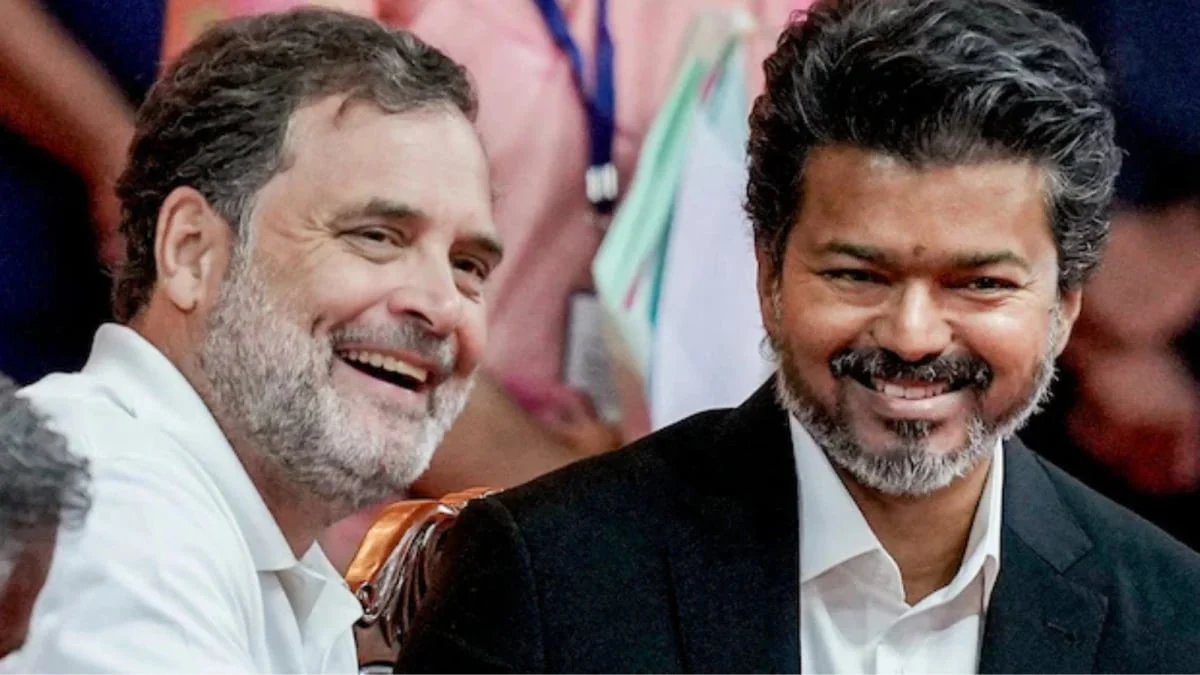
CHENNAI, India – May 15, 2026 – In a significant political development reshaping Tamil Nadu’s landscape, the Indian National Congress party is set to secure two coveted cabinet portfolios in the newly formed Tamilaga Vettri Kazhagam (TVK)-led government. The momentous announcement, confirmed by Congress Member of Parliament Manickam Tagore on Friday, marks a historic return for the grand old party to the corridors of power in the state cabinet after a hiatus of nearly six decades.
The move underscores the critical role played by the Congress as a key ally in forming the government, which saw actor-turned-politician C. Joseph Vijay sworn in as Chief Minister just days prior, on May 7. The TVK, despite emerging as the single-largest party in the recent assembly elections, fell short of an outright majority, necessitating the formation of a broad coalition. The inclusion of Congress ministers, pledged by Chief Minister Vijay, is seen as a fulfillment of his promise for shared governance and a strategic consolidation of the ruling alliance.
A Landmark Decision: Congress Returns to State Cabinet
The confirmation came directly from Congress MP Manickam Tagore, who expressed profound emotion and historical significance regarding the development. "The Congress will get two cabinet portfolios in the Tamilaga Vettri Kazhagam (TVK)-led government in Tamil Nadu," Tagore declared on Friday, electrifying party cadres and political observers alike.
In a poignant post on the microblogging platform ‘X’ (formerly Twitter), Tagore highlighted the stark contrast with previous political stances in the state. "Before the 2026 elections, the DMK openly declared that Tamil Nadu would not accept a ‘share in governance.’ The people have now delivered their verdict. The people of Tamil Nadu have said that they want a share in governance," he wrote, directly referencing the shift in political philosophy embodied by the new coalition.
He further elaborated on the profound impact of this decision on the Congress party, particularly for its grassroots workers. "A new history is being written. TVK leader Vijay, who had promised that alliance parties would always be given a share in power, has kept his word. Now, after 59 years, two Congress ministers wearing khadi have found a place in the cabinet. For thousands of Congress workers like me, this is an emotional and historic moment," Tagore stated, emphasizing the long wait and the symbolic victory for the party. The last time Congress held ministerial berths in the Tamil Nadu state cabinet was before 1967, when the Dravidian parties began their uninterrupted dominance.
Beyond celebrating the political breakthrough, Tagore also used the platform to articulate a clear vision for the new administration. He called for a fundamental shift in governance, stating, "Tamil Nadu must be taken from 36% commission politics to a corruption-free administration." This bold statement signals the alliance’s intent to prioritize transparency and good governance, potentially setting a new benchmark for public accountability in the state.
The Ascent of TVK and the Formation of a Diverse Coalition
The journey to power for the Tamilaga Vettri Kazhagam and its leader, C. Joseph Vijay, has been remarkably swift and impactful. Launched just two years prior, the TVK rapidly mobilized its formidable fan base, leveraging Vijay’s immense popularity as a film star into significant political capital. The party’s disciplined organizational structure and a fresh political narrative resonated with voters, allowing it to make a formidable debut in the 2026 Tamil Nadu Assembly Elections.
Chronology of Power Transition:
- Party Launch (2024): C. Joseph Vijay officially launches Tamilaga Vettri Kazhagam (TVK), transforming his massive fan clubs into a political movement. His declared entry into politics generated immediate buzz and anticipation.
- Campaign Trail (2025-2026): Vijay embarks on an intensive campaign, touring the length and breadth of Tamil Nadu. His speeches focus on clean governance, youth empowerment, and a departure from the entrenched two-party system dominated by the DMK and AIADMK.
- Assembly Elections (April 2026): The TVK contests its first-ever state assembly elections, emerging as a surprisingly strong contender.
- Election Results (May 4, 2026): The TVK secures 108 seats in the 234-member assembly, becoming the single-largest party. However, this tally falls short of the required 118 seats for a clear majority, necessitating the formation of a coalition. The result sends shockwaves through the political establishment, marking a definitive shift away from the traditional Dravidian dominance.
- The Hunt for Allies (May 4-6, 2026): Following the fractured mandate, Chief Minister-designate Vijay initiates intensive negotiations with potential allies. The Congress, with its five seats, quickly emerges as a crucial partner, providing the initial boost to the TVK’s numbers, bringing the alliance tally to 113.
- Coalition Consolidation (May 6, 2026): Regional parties, recognizing the shifting political tides and the potential for a new era, swiftly align with the TVK-Congress combine. This includes the Viduthalai Chiruthaigal Katchi (VCK), Indian Union Muslim League (IUML), Communist Party of India (CPI), and CPI(M). This diverse group of parties helps the alliance comfortably cross the crucial majority mark, securing a stable government.
- Swearing-in Ceremony (May 7, 2026): C. Joseph Vijay is sworn in as the Chief Minister of Tamil Nadu at a grand ceremony held at Chennai’s Jawaharlal Nehru Indoor Stadium. The event is attended by prominent national figures, including Congress leader and Leader of Opposition (LoP) in the Lok Sabha, Rahul Gandhi, signifying the national importance of this political transition. This historic moment sees Vijay becoming the first non-DMK and non-AIADMK Chief Minister in Tamil Nadu since 1967, breaking a nearly six-decade-long duopoly.
- Cabinet Expansion and Congress Inclusion (May 15, 2026): Following intense deliberations on portfolio allocation and alliance commitments, Congress MP Manickam Tagore announces that the Congress party will receive two cabinet berths, cementing its role in the new administration.
Supporting Data and Historical Context: A New Political Meridian
The 2026 Tamil Nadu Assembly Elections delivered a verdict that reverberated across the nation. The TVK’s impressive debut, securing 108 seats, fundamentally altered the state’s political landscape. This performance, from a party barely two years old, is a testament to the popular appeal of its leader, C. Joseph Vijay, and a clear indication of voter fatigue with the established political order.
The Congress, though winning a modest five seats, played a disproportionately crucial role in the post-election scenario. Its immediate backing of the TVK provided the necessary impetus for coalition formation, acting as an anchor for other regional parties to join. The swift alignment of VCK, IUML, CPI, and CPI(M) demonstrated a collective desire among smaller parties to be part of a government that promised a more inclusive approach to power-sharing.
The historical significance of Congress receiving cabinet berths cannot be overstated. Since 1967, Tamil Nadu politics has been firmly dominated by the Dravida Munnetra Kazhagam (DMK) and the All India Anna Dravida Munnetra Kazhagam (AIADMK). The Congress, which once held undisputed sway in the state under leaders like K. Kamaraj, gradually receded into a junior partner role, often aligning with one of the two Dravidian giants but rarely securing ministerial positions within the state cabinet. The 59-year gap since a Congress minister last sat in the Tamil Nadu cabinet is a stark reminder of its diminished influence, making this current development a monumental comeback and a potential turning point for the party’s revival in the state.
The very notion of "shared governance," as championed by Chief Minister Vijay and highlighted by Manickam Tagore, stands in direct contrast to the political culture that has often prevailed in Tamil Nadu. The DMK’s alleged pre-election stance against "share in governance" underscores a tendency among dominant parties to consolidate power rather than distribute it. Vijay’s explicit promise to include allies in power, and his subsequent fulfillment of that promise, introduces a more collaborative model of coalition politics, potentially fostering greater stability and accountability within the government.
Official Responses and Implications for Tamil Nadu Politics
Manickam Tagore’s enthusiastic announcement and his candid remarks on social media serve as the primary official response from the Congress side. His emphasis on the "emotional and historic moment" for thousands of Congress workers highlights the deep-seated aspirations within the party to regain a foothold in state governance. The call for a "corruption-free administration" and moving away from "36% commission politics" is a significant statement. While not explicitly naming any previous administration, it is widely understood as an indictment of the perceived corruption prevalent in the state’s political landscape, a common critique leveraged by opposition parties. This positions the new TVK-Congress alliance as a beacon of transparency and good governance.
The TVK, by fulfilling its promise to share power, demonstrates political maturity and a commitment to its coalition partners. This approach, spearheaded by Chief Minister Vijay, is crucial for maintaining alliance cohesion and ensuring the longevity of his government. It also enhances Vijay’s image as a leader who keeps his word, a valuable asset for a new entrant in the complex arena of state politics.
Implications for the Political Landscape:
-
Strengthened Coalition Governance: The inclusion of Congress in the cabinet solidifies the TVK-led alliance. It transforms the Congress from a mere external supporter to an integral part of the decision-making process, ensuring its active participation and commitment to the government’s agenda. This model of shared power could lead to more stable governance, as each partner has a vested interest in the alliance’s success.
-
Revival of Congress in Tamil Nadu: This move is a major shot in the arm for the Congress party in Tamil Nadu. After decades of playing second fiddle, having ministerial berths provides a platform for the party to implement its policies, connect with the electorate, and potentially rebuild its organizational strength from the ground up. It could inspire a new generation of Congress leaders and workers in the state.
-
New Era of Tamil Nadu Politics: The TVK’s rise and the formation of this diverse coalition mark a definitive departure from the bipolar DMK-AIADMK political structure that has defined Tamil Nadu for over five decades. This new era could usher in more multi-party dynamics, where smaller parties and national parties like Congress have a more significant say in state governance.
-
Focus on Anti-Corruption: Manickam Tagore’s strong statement against "36% commission politics" suggests that anti-corruption measures will be a key agenda item for the new government. This could translate into policy initiatives aimed at increasing transparency in public procurement, improving accountability, and streamlining administrative processes, potentially leading to a cleaner and more efficient governance model.
-
Impact on Opposition: The DMK and AIADMK, now in opposition, will have to recalibrate their strategies in the face of a unified and potentially popular new ruling front. The TVK-Congress alliance’s emphasis on shared governance and anti-corruption could resonate strongly with voters, posing a significant challenge to the traditional narratives of the established parties.
-
National Implications: For the Indian National Congress, securing cabinet berths in a major southern state like Tamil Nadu provides a much-needed boost to its national standing. It demonstrates the party’s ability to be a viable partner in regional coalitions and to return to power, even if in an allied capacity. This success could serve as a template for future alliance formations in other states.
The allocation of specific portfolios to the Congress ministers will be closely watched, as it will indicate the level of influence and responsibility the party will wield within the new government. Regardless of the departments assigned, the symbolic victory of regaining a place at the cabinet table after 59 years is a powerful message to both party loyalists and political rivals.
The TVK-led government, with its broad coalition and a promise of shared governance, embarks on its journey with high expectations. The inclusion of Congress ministers, a testament to Chief Minister Vijay’s inclusive political philosophy, sets the stage for a potentially transformative period in Tamil Nadu’s political history, characterized by collaboration, renewed political competition, and a strong focus on delivering a corruption-free administration to its citizens. The coming months will reveal how this historic alliance navigates the complexities of state governance and delivers on its ambitious promises.
