

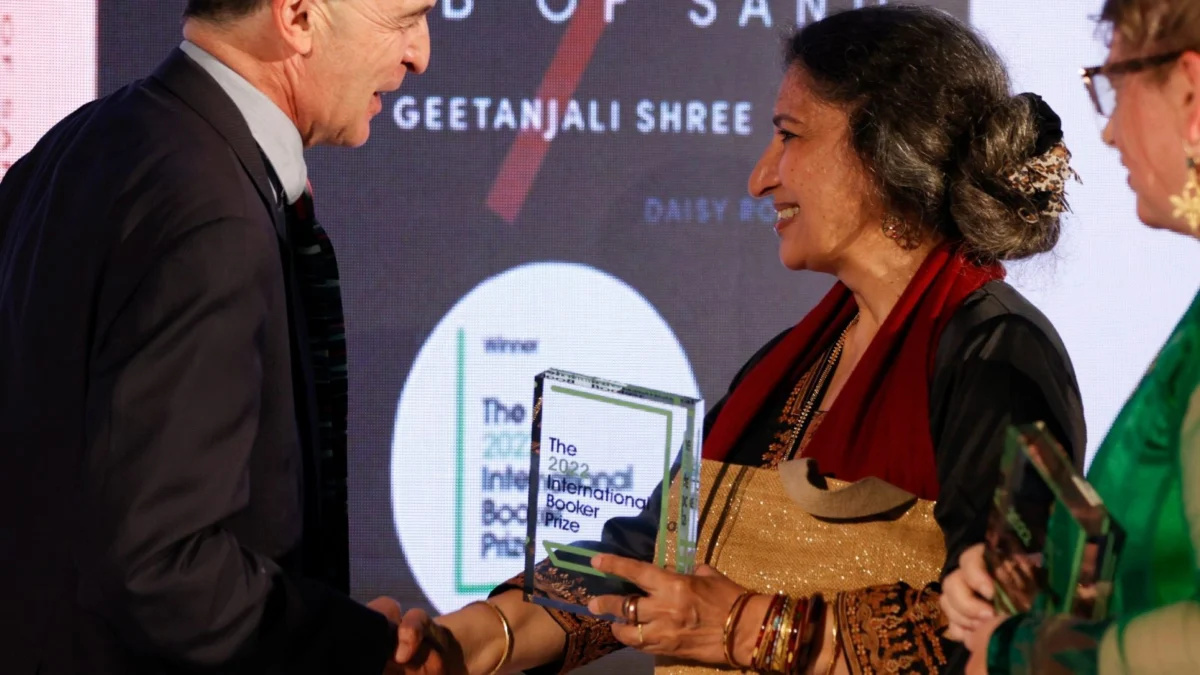
LONDON — In a move that has fundamentally altered the landscape of global literature, Delhi-based author Geetanjali Shree and American translator Daisy Rockwell have been awarded the 2022 International Booker Prize for the novel Tomb of Sand. The announcement, made at a gala ceremony in London, marks a series of historic "firsts": it is the first novel translated from Hindi—and indeed the first from any South Asian language—to receive the prestigious award.
The win represents a seismic shift for the Indian literary scene, propelling Hindi literature onto a global stage that has traditionally been dominated by English-language works or translations from European languages. Tomb of Sand, originally published in Hindi as Ret Samadhi in 2018, was described by the judging panel as a "luminous" and "polyphonic" masterpiece that transcends the boundaries of age, gender, and nationhood.
The Core Achievement: Breaking the Linguistic Barrier
The International Booker Prize, worth £50,000, is split equally between the author and the translator. This structure underscores the award’s mission to celebrate the art of translation as a vital bridge between cultures. While Indian authors writing in English—such as Arundhati Roy, Salman Rushdie, and Aravind Adiga—have famously won the "original" Booker Prize, the International Booker remained elusive for the subcontinent’s rich vernacular traditions until now.
Tomb of Sand beat out a formidable shortlist of five other titles, including works by Nobel laureate Olga Tokarczuk and previous finalists like Mieko Kawakami. The victory for Geetanjali Shree is not merely a personal triumph but a validation of the linguistic depth found in the 22 scheduled languages of India.
Chronology: The Journey from ‘Ret Samadhi’ to Global Acclaim
The trajectory of Tomb of Sand is a testament to the slow-burning power of high-quality independent publishing and the critical importance of literary translation.
- 2018: The Hindi Debut – Geetanjali Shree published Ret Samadhi with Rajkamal Prakashan, a premier Hindi publishing house. The book was immediately noted in Indian literary circles for its experimental prose and its unconventional treatment of the Partition of 1947.
- 2021: The English Translation – Daisy Rockwell, an accomplished artist and translator based in the United States, spent years meticulously translating the dense, pun-filled Hindi prose into English. The book was picked up by Tilted Axis Press, a UK-based independent publisher founded by Deborah Smith (the translator of The Vegetarian), which focuses on Asian and African literature.
- March 2022: The Longlist – The Booker Prize Foundation announced that Tomb of Sand had made the 13-book longlist. It was the first Hindi book to ever reach this stage, sparking immediate interest across India and the UK.
- April 2022: The Shortlist – The novel advanced to the final six. Critics began to rally around the book, praising its "exuberant" style and its 80-year-old protagonist.
- May 26, 2022: The Win – At the Southbank Centre in London, Frank Wynne, the chair of the judges, announced Shree and Rockwell as the winners, cementing the book’s place in literary history.
Supporting Data: Understanding the Work and Its Creators
The Narrative Architecture
Tomb of Sand is an expansive, 700-page novel that follows the journey of "Ma," an 80-year-old woman living in northern India. Following the death of her husband, Ma sinks into a deep depression, turning her back on the world—literally—by facing the wall. However, she eventually emerges with a newfound lease on life, deciding to travel to Pakistan to confront the ghosts of her past and the trauma of the 1947 Partition.
The novel is celebrated for its linguistic playfulness. Shree employs a "stream of consciousness" style that weaves together folklore, political commentary, and domestic drama. It subverts traditional tropes of aging, portraying the elderly protagonist not as a fading shadow, but as a woman reclaiming her agency and crossing forbidden borders.
About the Author: Geetanjali Shree
Born in Mainpuri, Uttar Pradesh, Geetanjali Shree has long been a respected figure in Hindi letters. She is the author of three novels and several short story collections. Her work often explores the intersections of history and the individual. Her 2000 novel, Mai, was previously shortlisted for the Crossword Book Award and brought her to the attention of English-speaking audiences, but Tomb of Sand has catapulted her to international stardom.
About the Translator: Daisy Rockwell
Daisy Rockwell’s role in this victory cannot be overstated. Hindi is a language rich in onomatopoeia, cultural idioms, and rhythmic repetitions that are notoriously difficult to render in English. Rockwell, who has also translated works by Upendranath Ashk and Bhisham Sahni, was praised by the judges for maintaining the "spirit and wordplay" of the original Hindi while creating a text that feels vibrant in English.
Official Responses: Acclaim from the Literary World
The reaction to the win was instantaneous and overwhelmingly positive, reflecting the sense that a new door had been opened for South Asian writers.
Frank Wynne, Chair of the Judges:
"This is a luminous novel of India and partition, but one whose spellbinding brio and fierce compassion weaves youth and age, male and female, family and nation into a kaleidoscopic whole. We were captivated by the power, the poignancy, and the playfulness of Tomb of Sand."
Geetanjali Shree (Acceptance Speech):
In her emotional acceptance speech, Shree reflected on the unexpected nature of the win. "I never dreamt of the Booker, I never thought I could. What a huge recognition. I am amazed, delighted, honoured and humbled," she said. She also noted the gravity of the moment for her mother tongue: "Behind me and this book lies a rich and flourishing literary tradition in Hindi, and in other South Asian languages. World literature will be the richer for knowing some of the finest writers in these languages."
Arunava Sinha, Noted Translator:
Writing on social media, the prolific Bengali-to-English translator Arunava Sinha hailed the moment as a "first win for a Hindi novel, an Indian novel, a South Asian novel." He emphasized that this win validates the labor of translators who work tirelessly to bring "regional" stories to the global forefront.
Implications: A New Era for Indian Vernacular Literature
The victory of Tomb of Sand carries profound implications for the publishing industry and the future of global letters.
1. The Decentralization of the "Indian Novel"
For decades, the "Indian Novel" in the West was synonymous with Indian Writing in English (IWE). This win forces a recalibration, reminding the global literary market that the most profound explorations of Indian life are often written in the languages spoken by the masses. It challenges the hegemony of English as the sole vehicle for Indian intellectual thought.
2. A Boost for Independent Publishing
The success of Tomb of Sand is also a victory for small, independent presses like Tilted Axis. While major corporate publishers often shy away from "difficult" translations from South Asia, independent houses have proven that there is a hunger for diverse, experimental voices. This win is likely to encourage more investment in the translation of "bhasha" (regional language) literature.
3. The "Translation Effect"
Following the win, publishers in France, Germany, and several other countries have already moved to acquire the rights for Ret Samadhi. This "Booker Effect" ensures that Shree’s voice will reach readers far beyond the Hindi-speaking heartland of India or the English-speaking world. It sets a precedent that may lead to more frequent appearances of Indian regional languages on prestigious international longlists.
4. Cultural Diplomacy and Identity
In a period where political borders in South Asia remain fraught with tension, Tomb of Sand offers a narrative of "border-crossing" that is both literal and metaphorical. By winning an international prize for a story about the Partition, Shree has brought a uniquely South Asian historical trauma into a universal context, fostering a deeper global understanding of the region’s complex identity.
As Tomb of Sand continues to climb bestseller lists globally, the legacy of May 26, 2022, will be remembered as the night the world finally started listening to the many voices of India, spoken in their own tongues.
