

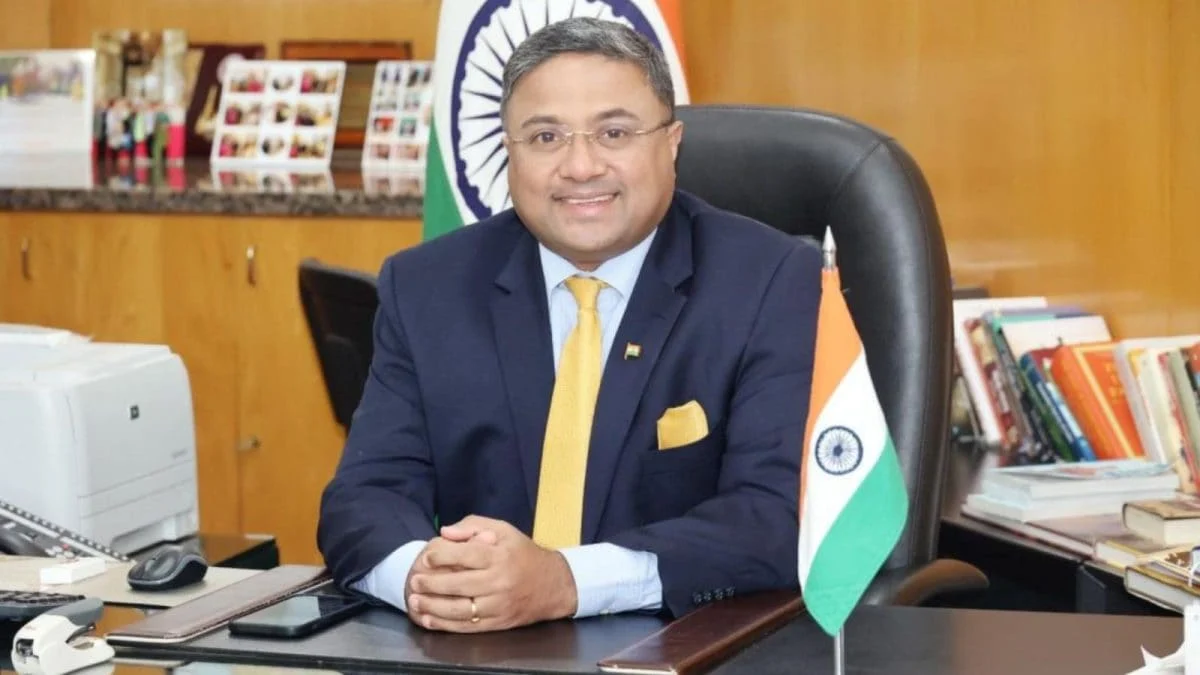
New Delhi, India – In the intricate ballet of international diplomacy, where carefully calibrated statements and measured responses are the norm, a new and compelling voice has emerged from India’s Ministry of External Affairs. Sibi George, a career diplomat with over three decades of experience, has recently captured global attention not for adhering to convention, but for boldly transcending it. As India’s Secretary (West), George has become an increasingly visible and vocal proponent of India’s narrative, adept at confronting tough questions from international media with a blend of constitutional pride, civilisational depth, and unshakeable confidence. His approach signals a significant evolution in India’s public diplomacy, positioning him as a frontline communicator for a nation whose global profile continues to ascend.
The latest instances of George’s distinctive style unfolded during Prime Minister Narendra Modi’s recent European tour, where he was a constant, reassuring presence alongside the Indian delegation. It was here that George stepped into the spotlight, transforming potentially awkward media encounters into powerful platforms for articulating India’s multifaceted story.
The Diplomat in the Spotlight: Navigating Global Scrutiny
The world stage, particularly during high-profile visits, often presents a gauntlet of pointed questions for visiting dignitaries and their accompanying officials. In this environment, Sibi George has proven himself not just capable, but exceptional, in turning scrutiny into an opportunity for comprehensive engagement.
A Forceful Defense of India’s Narrative
One such pivotal moment occurred when a Norwegian journalist posed a direct and challenging question: "Why should the world trust India?" The journalist further pressed on why Prime Minister Modi was not directly taking questions during his overseas visit – a common critique leveled against many world leaders. Expectations might have leaned towards a standard, brief diplomatic deflection. Instead, George leaned forward, a picture of composure, and launched into an expansive, meticulously constructed defense of India.
His response was a masterclass in weaving together diverse threads of India’s identity and achievements. He began by challenging the very premise of the question, calmly retorting, "How would you test trust in a country?" He then meticulously enumerated reasons for global trust in India, starting with its pivotal role during the COVID-19 pandemic – a period when India not only managed its own vast health crisis but also supplied vaccines and medical aid to numerous nations, embodying the spirit of ‘Vasudhaiva Kutumbakam’ (the world is one family).
George then pivoted to India’s robust democratic system, emphasizing its peaceful transfers of power, a fundamental pillar that has been consistently upheld since independence. He highlighted India’s ability to foster unity amongst deeply divided nations during the G20 Summit in New Delhi, showcasing its leadership in multilateralism and consensus-building. His memorable assertion, "We are 1/6th of the world’s population, but not 1/6th of the world’s problems," resonated widely, encapsulating India’s commitment to global solutions rather than being a source of global challenges. He further underscored India’s constitutional bedrock, emphasizing that every citizen possesses the fundamental right to approach the courts if their rights are infringed upon, a testament to the nation’s robust legal framework and individual freedoms. This comprehensive and unruffled articulation swiftly went viral across Indian social media, drawing widespread praise for his confidence and lucidity.
Beyond Soundbites: Expansive Engagement on Complex Issues
George’s unique approach was again evident during a subsequent interaction with a Dutch journalist who raised concerns about press freedom and minority rights in India. Instead of dismissing the queries, which is often the instinct in such situations, George embraced the opportunity for a deeper discourse. He eschewed brief talking points, instead embarking on a detailed historical and cultural exposition of India’s civilisational journey.
He articulated with conviction that "There is no other country in the world where four religions originated and continue to flourish," referencing Hinduism, Buddhism, Jainism, and Sikhism. He elaborated on how India has historically provided sanctuary and a fertile ground for Judaism, Christianity, and Islam to thrive over centuries, describing India not merely as a tolerant society, but one where diversity is intrinsically woven into its very fabric. This argument painted a picture of India as a unique crucible of faiths, where pluralism is a lived reality, deeply embedded in its cultural ethos.
On the matter of democratic credentials, George pointed to India’s staggering voter participation rates, the vibrant freedom of expression facilitated by a burgeoning digital media landscape, and the widespread use of smartphones. He concluded this segment with another impactful statement: "That makes our democracy a very noisy democracy and we are proud of that." This candid admission not only acknowledged the often-boisterous nature of Indian public discourse but also framed it as a strength – a testament to a truly free and participatory democratic system. These interactions have cemented George’s reputation as a diplomat willing to engage, explain, and assert India’s position with both intellectual rigor and national pride.
A Career Forged in Challenging Environments
The confidence and articulation that Sibi George displays on the global stage are not newfound attributes but the culmination of more than three decades immersed in some of the world’s most politically sensitive and diplomatically demanding environments. His journey reflects a relentless pursuit of excellence and a deep understanding of international relations.
Early Foundations and Academic Excellence
Sibi George hails from the distinguished Podimattam family of Pala in Kerala’s Kottayam district, a region known for its strong academic traditions and vibrant intellectual life. His academic record is exemplary; he earned gold medals in both his undergraduate and postgraduate studies, laying a strong intellectual foundation for his future career. His pursuit of knowledge extended beyond Indian shores, with studies at the American University in Cairo. Further honing his administrative and strategic acumen, he trained at prestigious institutions across India, including the Lal Bahadur Shastri National Academy of Administration, IIM Ahmedabad, IIM Bengaluru, the Indian Institute of Foreign Trade, and ISB Hyderabad. This diverse educational background equipped him with a multidisciplinary perspective, essential for navigating the complexities of modern diplomacy. George’s illustrious career in the Indian Foreign Service (IFS) commenced in 1993, marking the beginning of a remarkable trajectory.
Navigating Geopolitical Hotbeds
George’s diplomatic postings have consistently placed him at the heart of critical geopolitical challenges, each assignment contributing to his nuanced understanding of global dynamics.
His first posting as a political officer in Cairo exposed him early to the intricate political landscape and strategic imperatives of the Middle East, a region of immense significance to India’s energy security and diaspora. From Egypt, he moved to Doha, Qatar, where as First Secretary, he managed crucial consular, media, and community affairs, directly engaging with the vast Indian expatriate population.
Perhaps one of the most demanding assignments of his career was serving as Political Counsellor in Islamabad. This posting occurred during a period when India-Pakistan relations were, as described by those familiar with the region, "among the most fragile in the region." Navigating the perpetual tensions and delicate negotiations required immense skill, resilience, and an unwavering commitment to India’s interests.
Following this, George’s career took him to Washington D.C., where he handled both political and commercial responsibilities. This posting in one of India’s "most critical diplomatic relationships" demanded a deep understanding of bilateral ties, strategic convergence, and economic partnerships between the world’s two largest democracies. His roles as Deputy Chief of Mission in Tehran and Riyadh further underscored his capacity for high-stakes diplomacy. These positions required a delicate balancing act of India’s vital energy interests, regional security concerns, and the welfare of millions of Indian expatriates residing in West Asia. Diplomats familiar with these assignments attest that they are "among the toughest jobs in the foreign service," demanding not just negotiation prowess but also the ability to quietly and efficiently manage crises, often with far-reaching implications.
Leadership at Home: Shaping Foreign Policy from South Block
Beyond his extensive overseas experience, Sibi George has also held pivotal roles at the Ministry of External Affairs (MEA) headquarters in New Delhi, contributing significantly to India’s foreign policy formulation and execution.
He served in the East Asia Division, a critical portfolio dealing with India’s strategic relations with countries like China, Japan, and South Korea, amidst evolving regional dynamics. A notable achievement during his tenure was coordinating the India-Africa Forum Summit, one of India’s "largest diplomatic outreach exercises." This initiative was instrumental in strengthening India’s ties with African nations, underscoring its commitment to South-South cooperation and shared development goals.
Later, George headed the Administration, Establishment, and Welfare Divisions within the MEA – roles that required managing the ministry’s intricate internal systems, personnel, and ensuring the well-being of India’s diplomatic corps worldwide. His dedication and exceptional service were formally recognized in 2014 when he was honored with the prestigious SK Singh Award for Excellence in the Indian Foreign Service, a testament to his outstanding contributions.
The Art of Diplomatic Communication: Sibi George’s Unique Style
Sibi George’s persona is a fascinating blend of scholarly depth and practical diplomatic acumen. While he projects a polished international image, his colleagues describe him as grounded and academic, a testament to his Kerala roots and intellectual curiosity.
Composure Under Pressure
What sets George apart in media interactions is his remarkable composure under pressure. Those who have observed him note his meticulous preparation, which underpins his ability to respond comprehensively to complex questions. Yet, his delivery remains conversational, natural, and far from overly scripted. This combination allows him to engage authentically, drawing from a vast reservoir of knowledge encompassing history, economics, religion, and diplomacy, often weaving these diverse threads into a single, coherent narrative. This flowing narrative style makes his answers not just informative but also persuasive, resonating with audiences seeking depth beyond soundbites.
The "Rebuttal Machine" in Action
In an era of rapid information dissemination and often instant, sometimes uninformed, criticism, George has emerged as an unexpected "internet figure" for government supporters. Clips of his articulate responses circulate widely, lauded for his steadfastness and ability to present India’s perspective without appearing flustered. Critics might occasionally argue that his responses lean more towards political advocacy than traditional diplomacy, given their passionate defense of India’s national interests. However, there is universal acknowledgment of one undeniable fact: George rarely appears uncomfortable under pressure. This unflappable demeanor is crucial in maintaining credibility and authority when representing a nation on the global stage. He doesn’t shy away from difficult questions; rather, he confronts them head-on, using them as opportunities to educate and inform, rather than simply deflect.
The Rise of the Communicator Diplomat
The global landscape has dramatically shifted. India’s burgeoning economic power, its strategic importance, and its growing influence on international affairs mean that its domestic politics and policies are under unprecedented scrutiny during foreign visits. In this evolving environment, officials accompanying the Prime Minister are no longer merely quiet background figures. They are increasingly expected to be frontline communicators – to defend policy decisions, explain India’s intricate democratic framework, and respond instantly and effectively to global narratives, which can often be shaped by misinformation or biased perspectives.
Sibi George embodies this new paradigm of diplomatic engagement. His ability to articulate India’s position with conviction, drawing on its rich history, diverse culture, and robust democratic institutions, makes him an invaluable asset. He doesn’t just present facts; he crafts a narrative that is both compelling and deeply rooted in India’s identity.
Implications and Future Outlook
Sibi George’s emergence as a leading communicator has significant implications for Indian diplomacy and its global outreach.
Redefining Diplomatic Engagement
His approach may well set a new benchmark for how Indian diplomats engage with international media and address critical questions. By moving beyond terse official statements and embracing expansive, well-reasoned arguments, George demonstrates the power of proactive and confident communication. This method helps to demystify India’s complex realities for an international audience, countering simplistic or often negative portrayals. It underscores the importance of not just having a message, but also having diplomats capable of delivering it with conviction, historical context, and intellectual depth. This could lead to a broader adoption of more engaging and explanatory public diplomacy tactics across the Indian foreign service.
India’s Evolving Global Voice
Sibi George’s individual success is intrinsically linked to India’s broader aspirations on the world stage. As India seeks to play a more prominent role in global governance, climate action, economic development, and security, its voice needs to be heard clearly and persuasively. George’s ability to articulate India’s commitment to multilateralism, its democratic values, and its unique contributions to global challenges reinforces its image as a responsible and influential global power. He is not just defending India; he is actively shaping its international perception, contributing to the narrative of an India that is confident, democratic, and deeply committed to its constitutional ideals and civilisational heritage. His diplomatic interventions serve as a powerful testament to India’s growing maturity and self-assurance in international relations.
Conclusion
In a diplomatic world increasingly defined by instant communication and intense scrutiny, Sibi George has emerged as a vital and highly effective communicator for India. From his academic prowess and extensive experience in challenging diplomatic assignments across the globe to his current role as Secretary (West), George has honed a unique style that blends intellectual rigor with compelling narrative. He has transformed potentially adversarial media interactions into opportunities for a nuanced and forceful articulation of India’s identity, values, and contributions. As India’s global profile continues to rise, diplomats like Sibi George, who are willing and able to take tough questions head-on and respond with confidence and depth, will be indispensable in shaping the nation’s narrative and ensuring its voice is heard and understood in the intricate symphony of international relations. He is, without doubt, a career diplomat who has unexpectedly become a quintessential face of India’s robust and evolving public diplomacy.
