

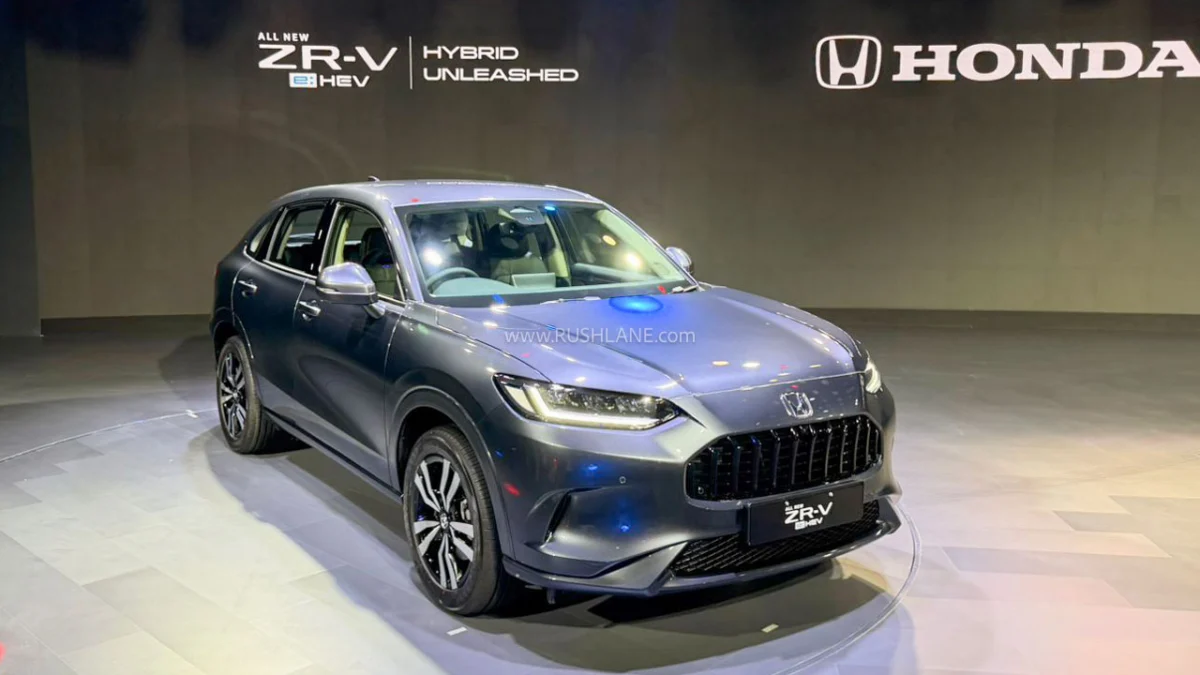
New Delhi, India – In a significant move to redefine its brand identity in the Indian subcontinent, Honda Cars India Ltd (HCIL) has officially debuted the ZR-V hybrid SUV. This introduction marks a pivotal moment for the Japanese automaker as it shifts its focus toward a "premiumization" strategy, aiming to capture the growing demand for high-end, environmentally conscious, and technologically advanced vehicles.

The ZR-V, a sophisticated crossover that sits between the HR-V and the CR-V in Honda’s global lineup, was unveiled alongside the 2026 Honda City facelift. By leveraging India’s liberalized import policies, Honda is positioning the ZR-V as a flagship technology demonstrator, showcasing the brand’s prowess in strong-hybrid powertrains and Level-2 Advanced Driver Assistance Systems (ADAS).

I. Main Facts: A New Contender in the Premium SUV Space
The Honda ZR-V enters the Indian market at a time when the "premium SUV" segment is witnessing unprecedented growth. Unlike the mass-market Elevate, the ZR-V is a global product built on the Honda Architecture (HA) platform, which it shares with the 11th-generation Civic.

Strategic Import Route
The ZR-V will be brought to India as a Completely Built Unit (CBU). This is made possible by the Government of India’s current automotive policy, which allows manufacturers to import up to 2,500 vehicles annually without the need for local homologation, provided they meet specific global standards. This route allows Honda to test market appetite for its premium global portfolio without the immediate massive capital expenditure required for local assembly lines.

Key Specifications at a Glance:
- Powertrain: 2.0-litre i-VTEC Direct Injection Engine with e:HEV Strong Hybrid system.
- Performance: Combined output of 184 PS and 315 Nm of torque.
- Efficiency: ARAI-certified (expected) fuel economy of 22.8 km/l.
- Safety: Honda SENSING Level-2 ADAS suite with 8 standard airbags.
- Dimensions: 4,568 mm (Length) x 1,840 mm (Width) x 1,620 mm (Height).
II. Chronology: Honda’s Road to the ZR-V
The arrival of the ZR-V is not an isolated event but the latest chapter in a long-term recalibration of Honda’s Indian operations.

- The SUV Vacuum (2020–2023): Following the discontinuation of the CR-V and the Civic in India due to the closure of the Greater Noida plant’s assembly lines, Honda’s portfolio was heavily skewed toward sedans (City and Amaze).
- The Elevate Launch (Late 2023): Honda re-entered the SUV space with the Elevate, a mid-size SUV designed specifically for emerging markets. While successful, it left a gap for customers seeking more "global" premium features.
- The 2028 Roadmap: Honda’s global CEO recently confirmed a roadmap to launch five new SUVs in India by 2030, including a sub-4-meter model and a dedicated mid-size electric SUV.
- The May 2026 Debut: The unveiling of the ZR-V and the 2026 City facelift signals the start of the "Premium Phase." Bookings for the ZR-V have officially commenced, with deliveries slated to begin in the second half of July 2026.
III. Supporting Data: Design, Technology, and Engineering
The Honda ZR-V is designed to appeal to the "urban elite"—buyers who prioritize aesthetics and refinement over rugged off-road capability.

Exterior Sophistication
The ZR-V moves away from the "Solid Wing Face" design language seen on the Amaze and City. Instead, it adopts a more European aesthetic:

- Front Fascia: Features a unique vertically slatted grille flanked by slim, swept-back LED headlamps with signature J-shaped DRLs.
- Profile: The SUV boasts a "coupe-like" silhouette with a sloping roofline, body-colored door handles, and 18-inch machined alloy wheels that fill the circular wheel arches.
- Rear Aesthetics: The rear is characterized by wide LED tail lamps, a raked windshield, and a sporty dual-exhaust system finished in chrome surrounds.
Interior and Comfort
The cabin is where Honda’s "Man Maximum, Machine Minimum" philosophy is most evident. The dashboard is draped in soft-touch materials with a premium mesh-patterned air vent strip that spans the width of the interior.

- Infotainment: A 9-inch standalone touchscreen supports wireless Android Auto and Apple CarPlay.
- Instrumentation: A 10.2-inch fully digital instrument cluster provides detailed hybrid energy flow graphics.
- Luxury Features: The ZR-V is equipped with a 12-speaker Bose premium audio system, a panoramic sunroof, ventilated front seats, and dual-zone automatic climate control.
- Cargo Capacity: While the standard boot space is a modest 380 litres, the "Magic Seat" versatility allows the rear bench to fold flat, expanding the capacity to a massive 1,312 litres.
The e:HEV Powertrain
The heart of the ZR-V is its dual-motor strong hybrid system. Unlike mild hybrids, the e:HEV system allows the car to operate in three distinct modes:

- EV Drive Mode: The car runs solely on electricity stored in the lithium-ion battery, ideal for low-speed urban crawling.
- Hybrid Drive Mode: The petrol engine acts as a generator to power the electric motor, which in turn drives the wheels.
- Engine Drive Mode: At high cruising speeds, a lock-up clutch connects the engine directly to the wheels for maximum efficiency.
This system allows the ZR-V to achieve a 0-100 km/h sprint in approximately 8 seconds, making it one of the quickest SUVs in its class, while maintaining fuel efficiency comparable to a small hatchback.

IV. Official Responses and Safety Integration
Honda executives have emphasized that the ZR-V is not just about performance but about "intelligent safety." The inclusion of the Honda SENSING suite is a core component of their goal to achieve zero traffic collision fatalities involving Honda vehicles by 2050.

Honda SENSING (Level-2 ADAS)
The ZR-V utilizes a high-performance front camera with a wide-angle lens and high-speed image processing. Features include:

- Collision Mitigation Braking System (CMBS): Detects vehicles, pedestrians, and cyclists to prevent accidents.
- Adaptive Cruise Control (ACC) with Low-Speed Follow: Maintains a set distance from the vehicle ahead, even in stop-and-go traffic.
- Lane Keeping Assist System (LKAS): Provides steering input to keep the vehicle centered in its lane.
- Traffic Jam Assist: Reduces driver fatigue during heavy congestion by assisting with steering and braking.
Standard safety equipment beyond ADAS includes eight airbags, Vehicle Stability Assist (VSA), Hill Descent Control, and a Multi-View Camera System providing a 360-degree bird’s-eye view.

V. Market Implications: Challenging the Established Order
The arrival of the ZR-V as a CBU import places it in a unique competitive bracket. It will not compete with high-volume players like the Hyundai Creta or Kia Seltos, but will instead challenge the "old guard" of European and American-rooted SUVs.

Competitive Landscape
- Volkswagen Tiguan & Skoda Kodiaq: The ZR-V offers a more fuel-efficient alternative to the TSI-powered Europeans. While the Kodiaq offers seven seats, the ZR-V counters with superior hybrid technology and lower running costs.
- Jeep Meridian: The ZR-V targets the Meridian’s premium positioning but offers a more refined, petrol-hybrid urban experience compared to the Jeep’s diesel-heavy, off-road-focused persona.
- Toyota Innova Hycross: While a different body style, the Hycross is currently the only other major player offering a strong-hybrid experience in this price bracket. The ZR-V appeals to those who want that technology in a more compact, driver-centric SUV package.
Brand Perception
For Honda, the ZR-V is a "halo" product. By bringing in a vehicle that is sold in markets like North America and Japan, Honda is signaling to Indian consumers that it still views India as a priority market for its best technology. This move is expected to have a "trickle-down" effect, boosting the premium image of its locally manufactured models like the City and the Elevate.

Economic Impact
While the CBU route carries higher import duties, the 2,500-unit rule allows Honda to maintain a lean inventory and high margins. If the ZR-V sees sustained demand, it could pave the way for Honda to consider CKD (Completely Knocked Down) assembly in the future, which would further lower the price point and increase market share.

Conclusion
The Honda ZR-V is more than just a new SUV; it is a statement of intent. By combining the efficiency of the e:HEV hybrid system with the safety of Level-2 ADAS and the prestige of a global CBU import, Honda is carving out a niche for itself in the "techno-luxury" segment. As deliveries commence in July 2026, the industry will be watching closely to see if Indian consumers are ready to embrace Honda’s vision of a premium, electrified future.
