

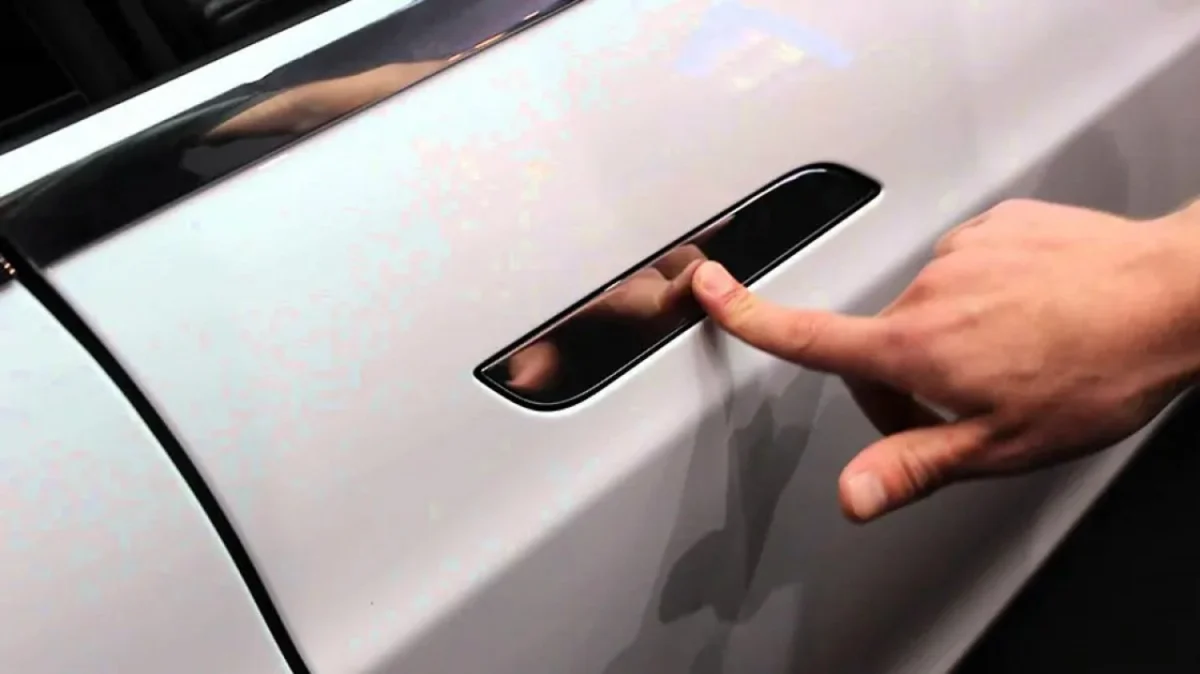
In a move that signals a seismic shift in global automotive design priorities, the Chinese government has officially initiated a crackdown on concealed and electrically operated car-door handles. Citing grave concerns regarding occupant safety during emergencies, China has announced that it will prohibit the use of concealed door handles on all new passenger vehicles starting in 2027. This makes China the first major automotive market to phase out a design feature that has, for the past decade, been synonymous with modern electric vehicle (EV) luxury and aerodynamic efficiency.
The regulatory shift is accompanied by the largest automotive recall in China’s history. Tesla, along with eight other prominent manufacturers, has filed recall notices with the State Administration for Market Regulation (SAMR), collectively affecting approximately 4.3 million vehicles. This massive corrective action underscores a growing tension in the industry: the conflict between high-tech "minimalist" design and the fundamental mechanical reliability required to save lives in the event of a catastrophic collision.
Main Facts: A Regulatory Reckoning for Automotive Design
The crux of the issue lies in the functionality of "pop-out" or "flush" door handles during an electrical failure. While these handles offer a sleek profile and reduce wind resistance—thereby slightly extending the range of electric vehicles—they rely on complex sensors, motors, and the vehicle’s 12V battery system to deploy. In the event of a high-impact crash or a thermal runaway event (battery fire), these systems frequently fail.
Key Statistics of the Recall:
- Total Vehicles Affected: Approximately 4.3 million units.
- Tesla’s Share: 2.98 million vehicles, including the Model 3, Model Y, Model S, and Model X (both imported and locally manufactured).
- Xiaomi’s Involvement: 390,000 units of the SU7 series.
- Other Major Players: Leapmotor (371,000 units), Xpeng (264,000 units), and Geely Holding.
- The Mandate: Total ban on concealed door handles for new models entering the Chinese market from 2027.
The recall primarily addresses the difficulty occupants and first responders face when attempting to locate or operate emergency mechanical release handles. In many modern EVs, the mechanical override is hidden behind plastic panels or requires a specific, non-intuitive physical maneuver that is difficult to execute under the stress of a smoke-filled cabin or a jammed door frame.
Chronology: From Aesthetic Innovation to Safety Liability
The trajectory of the concealed door handle follows the rise of the modern electric vehicle era. Understanding how we reached this point requires looking at the design’s evolution and the tragic incidents that prompted government intervention.
2012 – The Tesla Influence: Tesla popularized the motorized flush handle with the launch of the Model S. It was marketed as a futuristic feature that improved the car’s drag coefficient. As Tesla grew into a global powerhouse, Chinese startups and traditional OEMs (Original Equipment Manufacturers) began imitating the design to signal "high-tech" status.
2020-2023 – Rising Incidents: As the volume of EVs on Chinese roads surged, reports began to surface of occupants becoming trapped inside vehicles after accidents. In several instances, bystanders were filmed trying to smash windows with rocks or tools because the exterior door handles remained retracted and locked following a collision.
Early 2024 – The Xiaomi SU7 Fatality: A turning point in public perception occurred following a high-profile accident involving a Xiaomi SU7. The driver tragically died after the vehicle crashed and caught fire. Eyewitness reports and viral videos suggested that rescuers were unable to open the doors from the outside, sparking a national debate on social media about whether "smart" features were compromising basic safety.
August 2026 – The Regulatory Hammer: Following months of investigation, the Chinese State Administration for Market Regulation issued its findings. This led to the simultaneous filing of recalls by nine major automakers and the announcement of the 2027 ban.
Supporting Data: The Mechanics of Failure
The technical challenge with concealed handles is two-fold: exterior accessibility and interior egress.
Exterior Accessibility
Traditional "pull-style" handles are mechanical. Even if a door is slightly deformed in a crash, a human can apply significant leverage to the handle. In contrast, many flush handles require an electrical signal to "present" themselves. If the vehicle’s power is cut—a standard safety protocol in many EVs during a crash to prevent fire—the handles may stay retracted. This leaves rescuers with no physical point of contact to pull the door open, forcing them to rely on heavy extraction tools (the "Jaws of Life") which costs precious seconds.

Interior Egress
While most vehicles have a mechanical emergency release inside, they are often poorly marked to maintain a clean interior aesthetic. Data from the recall filings suggest that in high-stress environments, passengers often forget where the mechanical latch is located, instinctively reaching for the electronic button that no longer functions.
Manufacturer Breakdown
| Manufacturer | Affected Units (Approx.) | Primary Remedy |
|---|---|---|
| Tesla | 2,980,000 | OTA Software Update (Auto-window drop) + Labeling |
| Xiaomi | 390,000 | Improved marking of mechanical releases |
| Leapmotor | 371,000 | Physical inspection and labeling |
| Xpeng | 264,000 | Software optimization and educational campaigns |
| Geely | 150,000+ | Mechanical latch accessibility updates |
Official Responses and Proposed Solutions
The response from the automotive industry has been a mix of technological "workarounds" and a quiet admission that design priorities must change.
Tesla’s "Window-Drop" Solution
Tesla has opted for a digital-first remedy. Through an over-the-air (OTA) software update, Tesla vehicles will now be programmed to automatically roll down all windows immediately upon detecting a severe collision. The logic is that if the doors remain locked or the handles fail to deploy, the open windows provide an immediate path for escape or rescue. However, critics argue that this does not address scenarios where the electrical system is completely destroyed or submerged in water before the command can be executed.
SAMR’s Stance
The Chinese State Administration for Market Regulation stated that the recall is a "preventive action." The regulator emphasized that while not every vehicle will experience a failure, the "lack of intuitive operation" constitutes a defect under Chinese consumer protection laws. By mandating a return to visible, mechanical handles by 2027, the government is prioritizing the "golden minutes" of emergency rescue over aerodynamic gains.
The U.S. Perspective (NHTSA)
The National Highway Traffic Safety Administration (NHTSA) in the United States has also begun scrutinizing these designs. While no mandatory recall has been issued in the U.S. yet, the agency is reportedly reviewing Federal Motor Vehicle Safety Standard (FMVSS) 206, which governs door locks and retention components. The Chinese recall is expected to put significant pressure on Western regulators to follow suit.
Implications: A New Era of "Functional" Design
The implications of China’s 2027 ban cannot be overstated. As the world’s largest automotive market, China dictates global manufacturing trends. Automakers like BMW, Mercedes-Benz, and Hyundai, who have recently moved toward flush handles, will now have to decide whether to maintain two different door designs for different markets or revert to traditional handles globally to achieve economies of scale.
1. The Death of the "Minimalist" Exterior
The 2027 ban likely marks the end of the ultra-smooth side profile in car design. We are likely to see a return to the "grab-style" handle, though perhaps redesigned to be more aerodynamic than the bulky handles of the 1990s. This represents a rare moment where regulation has directly rolled back a major aesthetic trend.
2. Aerodynamics vs. Safety
Engineers are now faced with a difficult trade-off. Flush handles can improve a car’s range by 1% to 3% by reducing turbulence along the side of the vehicle. In the hyper-competitive EV market where "range anxiety" is a top consumer concern, losing even 5-10 miles of range is a significant blow. Manufacturers will have to find that lost efficiency elsewhere—likely through more advanced wheel designs or underbody shielding.
3. Re-educating the Consumer
The recall highlights a failure in consumer education. For decades, opening a car door was an intuitive, subconscious act. The introduction of "hidden" latches turned a basic safety function into a puzzle. The requirement for warning labels and clearer markings on 4.3 million cars is a stark admission that "smart" design often fails the "common sense" test in a crisis.
4. Global Regulatory Domino Effect
China’s move sets a precedent. Historically, when one major market (like the EU or China) mandates a safety feature, others follow to ensure global standardization. If the NHTSA and Euro NCAP adopt similar stances, the flush door handle may soon become a relic of a brief, experimental era in automotive history.
Conclusion
The massive recall of 4.3 million vehicles in China is more than just a technical fix; it is a philosophical pivot for the automotive industry. It serves as a reminder that as cars become increasingly like "computers on wheels," they must still function as mechanical lifeboats in their most critical moments. By 2027, the "pop-out" handle—once a symbol of the future—will be a thing of the past in China, replaced by the humble, reliable, and life-saving mechanical pull. For the rest of the world, the message is clear: innovation is only progress if it doesn’t come at the cost of basic survival.
