

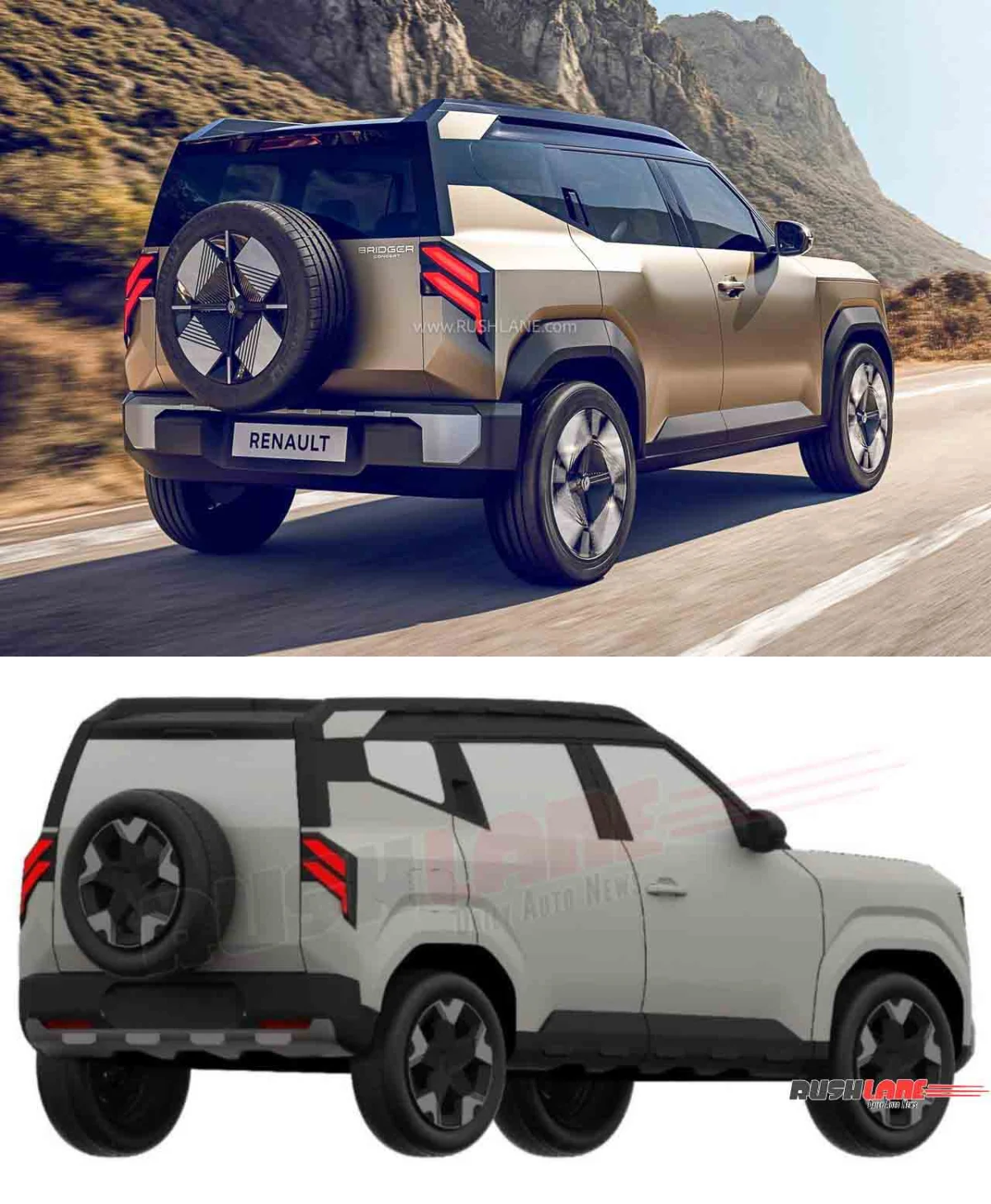
Main Facts: A Bold Entry into the Lifestyle SUV Segment
Renault India is currently at the precipice of a significant brand transformation. Long known for its mass-market favorites like the Kwid, Triber, and Kiger, the French automaker is now shifting gears toward more premium, specialized segments. The most recent and perhaps most exciting development in this "product offensive" is the patenting of the Renault Bridger SUV design in India.
The Bridger is positioned as a sub-4-meter lifestyle SUV, a niche but rapidly growing segment that prioritizes rugged aesthetics, off-road capability (or the appearance thereof), and a distinct "personality" that differs from the standard family crossover. Based on the recently revealed patent filings, the Bridger appears to be moving swiftly from a futuristic concept to a production-ready reality.
Key highlights of the Bridger include:

- Platform: It is built on the Renault Group Modular Platform (RGMP), which is a localized version of the global CMF-B architecture.
- Design Philosophy: It maintains an upright, "boxy" silhouette reminiscent of classic off-roaders, featuring a tailgate-mounted spare wheel and flared wheel arches.
- Market Positioning: It is set to compete directly with the Maruti Suzuki Jimny and the upcoming production version of Mahindra’s Vision S.
- Manufacturing: The vehicle is slated to be designed, developed, and manufactured in India, serving both the domestic market and global export hubs.
Chronology: From "Renaulution" to the Indian Patent
To understand the significance of the Bridger, one must look at the timeline of Renault’s renewed commitment to the Indian subcontinent.
February 2023: The Alliance Investment
Renault and its alliance partner, Nissan, announced a fresh investment of approximately ₹5,300 crore (USD 600 million) for the Indian market. This investment was earmarked for the development of six new models, including two A-segment electric vehicles and four SUVs (two for each brand).
Early 2024: The RGMP Reveal
Renault officially showcased its new platform strategy for emerging markets. Two primary platforms were highlighted: the RGEP (for entry-level and electric vehicles) and the RGMP (Renault Group Modular Platform). The RGMP was confirmed as the foundation for the next-generation Renault Duster and a new 7-seater SUV, as well as the sub-4m Bridger.

May 2024: The Concept and Patent Filings
Following the global reveal of the Bridger in its concept guise, Renault filed for design patents in India. The transition from the concept’s "show car" flourishes to the patent’s more utilitarian details suggests that the company is finalizing the production specifications. This move indicates that the Bridger could hit Indian roads as early as late 2025 or early 2026, following the launch of the new Duster.
Supporting Data: Design Evolution and Technical Specifications
The patent images provide a treasure trove of information regarding how the Bridger has evolved from its concept stage to a version that can be mass-produced while adhering to safety and cost constraints.
Exterior Design Analysis
The Bridger retains the "textbook SUV proportions" that made the concept a viral sensation. It features a flat, vertical fascia that gives it a commanding presence despite its sub-4-meter length.

- The Front End: The patent reveals a striking LED DRL signature that integrates seamlessly with the grille. A notable "bull-bar-like" styling element is incorporated into the front bumper, emphasizing its rugged credentials. Interestingly, the patent shows a more traditional bonnet design with new shut lines, replacing the more expensive clamshell bonnet seen on the concept.
- The Side Profile: The flared haunches and squared-off wheel arches remain, providing space for high-profile all-terrain tires. One of the most distinct features is the placement of the rear door handles on the C-pillars, a design choice that gives the five-door SUV a sleeker, three-door-like appearance.
- The Rear: The "lifestyle" appeal is cemented by the tailgate-mounted spare wheel. The tailgate itself is side-hinged, a practical choice for off-roaders. The LED tail lights follow a signature pattern that mimics the front DRLs, creating a cohesive lighting identity.
The "Dual Filler Cap" Mystery
Perhaps the most intriguing detail in the patent filings is the presence of two fuel filler caps—one on each rear flank. In the automotive industry, this typically points to two possibilities:
- Plug-in Hybrid (PHEV): One side houses the petrol tank inlet, while the other houses the charging port.
- Universal Tooling: Renault may be patenting a single body shell designed to accommodate both Internal Combustion Engine (ICE) and Battery Electric Vehicle (EV) variants, with the port placement depending on the powertrain.
Given Renault’s global push toward electrification, a Bridger EV or a strong hybrid variant seems highly plausible, even if the initial launch focuses on petrol engines.
Powertrain and Performance
Under the hood, the Bridger is expected to debut Renault’s new 1.2L Turbo Petrol engine. This engine is designed to offer a balance of fuel efficiency and the low-end torque required for a vehicle of this stature.

- AWD Capability: While many sub-4m SUVs in India are strictly front-wheel drive, rumors suggest the RGMP platform allows for an All-Wheel Drive (AWD) setup. If Renault equips the Bridger with AWD, it would significantly elevate its status against the Maruti Jimny.
- Transmission Options: Expect a choice between a 6-speed manual and a sophisticated dual-clutch transmission (DCT) or a refined CVT, catering to both enthusiasts and urban commuters.
Official Responses: Renault’s Strategic Vision
While Renault India officials have been tight-lipped about the exact launch date of the Bridger, their broader corporate communications highlight the vehicle’s importance.
In recent press briefings, Renault India’s leadership emphasized that the company is "moving away from being just a value-driven brand to a value-and-aspiration-driven brand." The Bridger is the embodiment of this shift. Venkatram Mamillapalle, MD and CEO of Renault India, has previously noted that the company’s new platform strategy (RGMP) is central to achieving a higher market share in India, with a target of returning to a 5% share in the medium term.
Renault’s global design team has also noted that the Bridger was developed with heavy input from their Mumbai-based design studio. This ensures that the vehicle meets the specific ergonomic and aesthetic preferences of Indian buyers—such as high ground clearance, a powerful air conditioning system (the patent notably lacks a sunroof, likely to improve cooling efficiency and structural rigidity), and a "big car" feel within a compact footprint.

Implications: Changing the Dynamics of the Indian Market
The arrival of the Renault Bridger carries several significant implications for the Indian automotive landscape and Renault’s global operations.
1. Challenging the Status Quo
For years, the sub-4m segment was dominated by "soft-roaders"—vehicles that looked like SUVs but lacked any real ruggedness. The Maruti Suzuki Jimny broke that mold, and the Mahindra Thar (though slightly larger) proved there is a massive appetite for lifestyle vehicles. The Bridger allows Renault to enter this high-margin niche, offering a more modern, tech-forward alternative to the Jimny’s retro appeal.
2. The "Make in India" Export Powerhouse
The Bridger isn’t just for India. By manufacturing it locally on the modular RGMP platform, Renault can achieve economies of scale that make the vehicle highly competitive in Latin America, Africa, and Southeast Asia. India is increasingly becoming Renault’s primary export hub for right-hand-drive markets, and the Bridger will be a cornerstone of that strategy.

3. Democratizing Advanced Platforms
The use of the RGMP (CMF-B) platform is a win for Indian consumers. This platform is known for its high safety ratings and superior ride and handling balance in European markets. Bringing this technology to a sub-4m SUV means Indian buyers will no longer have to compromise on global quality standards due to local tax brackets.
4. Filling the Gap in the Portfolio
Currently, there is a large price and size gap between the Renault Kiger and the upcoming new Duster. The Bridger fits perfectly in this "missing link," providing an aspirational step-up for Kiger owners who want something more rugged without moving to a full-sized mid-size SUV.
Conclusion
The patenting of the Renault Bridger in India is more than just a legal formality; it is a declaration of intent. By combining a rugged, iconic design with a modern modular platform and a localized supply chain, Renault is preparing to disrupt the lifestyle SUV segment. Whether it arrives as a pure petrol play or a pioneering PHEV, the Bridger is poised to be a pivotal model that could redefine Renault’s fortunes in one of the world’s most competitive automotive markets. As the industry moves toward the end of the decade, the Bridger stands as a testament to the fact that in India, the love affair with the SUV is only getting started.
