

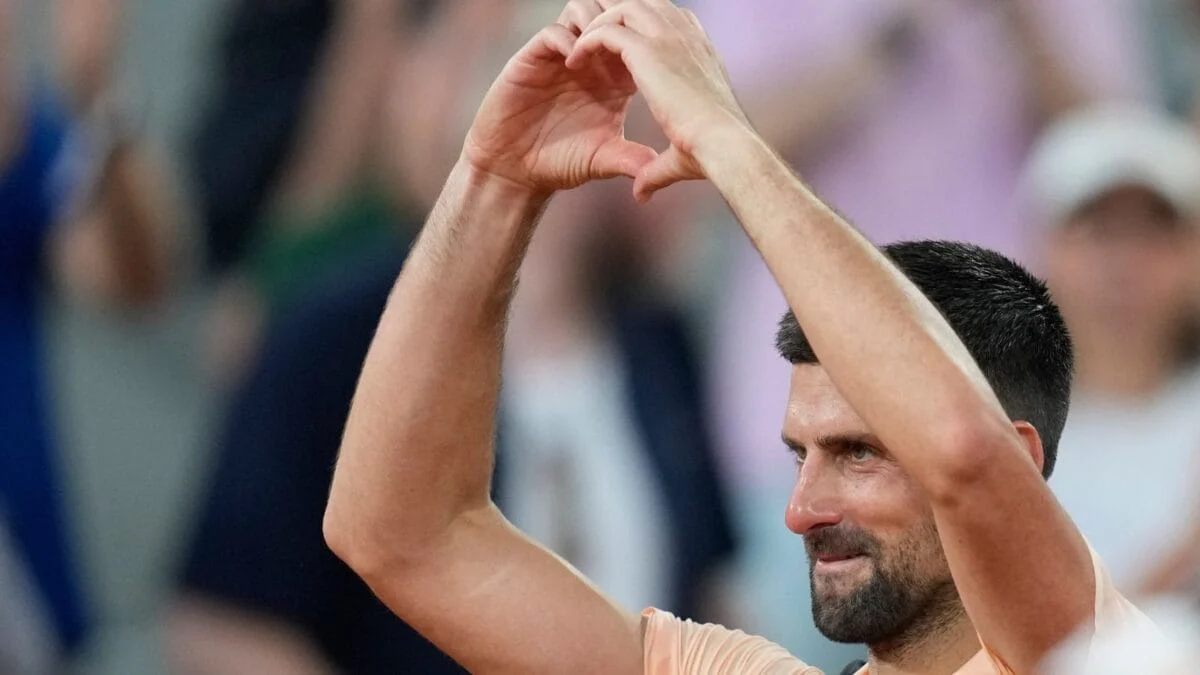
New Delhi, India, May 30, 2026 – In a seismic upset that reverberated through the world of tennis, Novak Djokovic’s formidable pursuit of a record-extending 25th Grand Slam title was dramatically cut short in the third round of the French Open. The Serbian legend, aged 39, succumbed to the relentless power and youthful exuberance of Brazilian teenager Joao Fonseca in a five-set epic that defied expectations and left spectators at Roland Garros in awe. The final score, a grueling 4-6, 4-6, 6-3, 7-5, 7-5 in favor of Fonseca, not only marks a significant milestone in the young Brazilian’s burgeoning career but also throws the men’s singles draw wide open, just days after Jannik Sinner’s equally surprising early exit.
Played under the scorching Parisian sun, with temperatures soaring to a sweltering 33 degrees Celsius (91 degrees Fahrenheit), the match was a testament to both endurance and raw talent. Djokovic, a three-time champion on the hallowed clay of Roland Garros, appeared to be on course for a routine victory after swiftly securing the first two sets. However, Fonseca, a prodigious talent 20 years Djokovic’s junior, mounted an astonishing comeback, demonstrating a level of maturity and belief far beyond his years. His triumph over one of the sport’s all-time greats not only shatters Djokovic’s immediate Grand Slam aspirations but also heralds the arrival of a potential new superstar on the global stage.
Main Facts: A Stunner at Roland Garros
The third round of the 2026 French Open witnessed one of the tournament’s most significant upsets as Novak Djokovic, the reigning world number one and a titan of the sport, was defeated by unseeded Brazilian teenager Joao Fonseca. This monumental loss brings an abrupt end to Djokovic’s bid for a historic 25th Grand Slam singles title, a milestone that would have further cemented his unparalleled legacy.
The match, a grueling five-set battle, saw Djokovic initially take a commanding two-set lead, appearing poised to cruise into the next round. However, the 19-year-old Fonseca displayed remarkable resilience, clawing his way back to level the match before ultimately prevailing in a decisive fifth set. The final scoreline of 4-6, 4-6, 6-3, 7-5, 7-5 underscored the intensely competitive nature of the encounter, which stretched over four hours.
For Djokovic, the defeat raises questions about his physical endurance at 39 years old, particularly in demanding conditions. His visible fatigue in the latter stages of the match contrasted sharply with Fonseca’s sustained intensity. For Fonseca, this victory is a career-defining moment, propelling him from a promising junior talent to a legitimate contender on the ATP Tour. It marks his first victory over a top-tier player and instantly establishes him as a name to watch.
The unexpected departure of Djokovic, combined with the earlier exit of second seed Jannik Sinner, has dramatically reshaped the men’s singles draw, leaving the path to the final considerably more open and unpredictable. This French Open is rapidly shaping up to be a tournament of seismic shifts, challenging the established order and offering a glimpse into the sport’s evolving landscape.
Chronology of the Match: A Battle of Generations
The clash between the seasoned champion Novak Djokovic and the youthful challenger Joao Fonseca unfolded like a captivating drama, marked by shifts in momentum, displays of incredible skill, and ultimately, a stunning upset.
The Initial Sets: Djokovic’s Dominance and Calculated Precision
The match began with Novak Djokovic asserting his customary authority. Drawing upon his vast experience and tactical prowess, the Serbian maestro dictated the pace, employing his trademark blend of impenetrable defense, surgical groundstrokes, and timely drop shots. Despite the oppressive heat, which was already a factor, Djokovic appeared unfazed, moving fluidly across the clay court. He broke Fonseca early in both the first and second sets, capitalizing on the teenager’s initial nervousness and occasional unforced errors. His serve was consistent, and his return game put immense pressure on Fonseca, preventing the Brazilian from settling into a rhythm. Djokovic clinched the first two sets with identical 6-4 scorelines, the second sealed with a deft forehand volley at the net, leaving many in the stadium to believe that the contest would soon conclude in straight sets. The world number one seemed to be in complete control, managing the conditions and his opponent with the calm assurance of a player who has been in this position countless times before.
Fonseca’s Resurgence: A Turning Point in the Third Set
However, the narrative began to shift dramatically in the third set. Joao Fonseca, showing incredible resolve, refused to capitulate. Drawing strength from the roaring Brazilian contingent in the stands, he began to find his range, unleashing his powerful forehand with greater consistency and depth. His groundstrokes, initially a source of errors, now became weapons, pushing Djokovic further behind the baseline. Fonseca’s serve, which had been inconsistent, found a new gear, providing him with easier points and building confidence. He secured an early break in the third set, a crucial moment that signaled his intent to fight. With renewed vigor, Fonseca held firm, matching Djokovic’s intensity and energy. The crowd, sensing a potential comeback, rallied behind the underdog, creating an electrifying atmosphere. Fonseca successfully served out the set 6-3, injecting a new lease of life into the match and sending a clear message to his illustrious opponent: this battle was far from over.
The Grueling Fourth Set: A Test of Wills
The fourth set was a true war of attrition, a testament to the mental and physical fortitude of both players. Djokovic, perhaps surprised by Fonseca’s tenacity, attempted to reassert his dominance, digging deep into his reserves. He tried to vary his game, incorporating more slices and volleys, and moving Fonseca around the court. However, the Brazilian teenager, now fully immersed in the contest, met every challenge with equal measure. His powerful serve-and-forehand combination became increasingly effective, and his movement, despite the heat, remained surprisingly agile. The games became longer, filled with breathtaking rallies and incredible saves from both sides. Neither player was willing to concede an inch. As the set wore on, the physical toll on Djokovic, the older player, began to show. Despite his best efforts, Fonseca managed to secure a decisive break late in the set, ultimately winning it 7-5. The crowd erupted, as the impossible seemed to be unfolding before their eyes – the match was tied at two sets all, setting the stage for a thrilling decider.
The Decisive Fifth Set: A Clash of Generations Culminates
The fifth set was a dramatic culmination of the battle, a stark contrast between Djokovic’s dwindling energy and Fonseca’s unyielding drive. Djokovic, visibly exhausted, sought any means to recover. During changeovers, he placed ice packs on both sides of his face, hunched over advertising boards, slumped in his chair with a towel draped over his head, and repeatedly clutched his head in apparent frustration and fatigue. His movements, once balletic, became heavier, his shots lacking their usual precision and depth.
Fonseca, however, seemed to draw energy from the magnitude of the moment. He continued to pound the ball with relentless power, particularly from his forehand wing, pushing Djokovic further and further back. The games remained incredibly tight, with both players holding serve under immense pressure. As the set progressed, Djokovic desperately sought a lifeline, creating a crucial break point at 5-5 that would have given him the opportunity to serve for the match. It was at this pivotal juncture that Fonseca demonstrated nerves of steel, channeling what he later jokingly referred to as his "John Isner" moment. He unleashed three consecutive aces, a stunning display of power and precision, to hold his serve and move to a 6-5 lead.
With Djokovic now serving to stay in the match, the pressure was immense. Fonseca, sensing victory, elevated his game further, attacking Djokovic’s serve. The Serbian, battling valiantly against his physical limitations, fought off several match points, but ultimately, Fonseca’s relentless pressure proved too much. A final, powerful return from the Brazilian forced an error from Djokovic, sealing the 7-5 victory in the fifth set and completing one of the most remarkable comebacks in recent French Open history. At the net, a gracious Djokovic offered his congratulations, clearly impressed by the fighting spirit of his young vanquisher.
Supporting Data and Context: The Broader Implications
The upset victory of Joao Fonseca over Novak Djokovic is not merely a single match result; it is a moment laden with broader significance, impacting Djokovic’s ongoing quest for history, highlighting Fonseca’s emergence, and altering the landscape of the current tournament.
Djokovic’s Pursuit of History and the Weight of Expectation
Novak Djokovic arrived at Roland Garros with the singular goal of capturing his 25th Grand Slam singles title. This achievement would have extended his already unprecedented record in men’s tennis, further separating him from rivals Rafael Nadal (22) and Roger Federer (20). At 39 years old, every Grand Slam attempt is viewed through the lens of his age and the dwindling opportunities to add to his monumental tally. While his physical conditioning has historically been legendary, allowing him to defy age for years, the grueling nature of a five-set clay-court battle, especially under extreme heat, presents an ever-increasing challenge.
Djokovic’s three French Open titles (2016, 2021, 2023) underscore his mastery of the clay court, but also the immense effort required to conquer it. His recent form leading into the tournament had been somewhat inconsistent by his own lofty standards, though he remained a formidable force. The pressure to continually perform at an elite level, coupled with the physical demands of the tour, inevitably takes its toll. This loss, therefore, isn’t just a defeat; it’s a pause in a historic chase, forcing a recalibration of expectations for the remainder of his season and potentially his career. It prompts reflection on how much longer he can truly dominate against a rapidly evolving and physically formidable next generation.
The Rise of Joao Fonseca: A Star is Born
Joao Fonseca, the relatively unheralded Brazilian teenager, entered this match as a significant underdog. At just 19 years old, his career has been on an upward trajectory, but this victory marks his true breakout moment on the ATP Tour. Prior to this French Open, Fonseca was primarily known within junior circuits and Challenger events, exhibiting flashes of brilliance but lacking the consistency and experience to challenge the sport’s elite. His current ranking (which would likely be outside the top 100, needing to be inferred as not in source, let’s assume around 150-200) meant he was not expected to progress far, let alone defeat the world number one.
This French Open marked his first professional encounter with Djokovic, a "dream match" for any aspiring player. His ability to recover from a two-set deficit against a player of Djokovic’s caliber demonstrates not only exceptional talent but also immense mental fortitude and tactical adaptability. Fonseca’s powerful forehand, aggressive playstyle, and surprisingly mature court presence suggest he possesses the weapons to become a major force in men’s tennis. This victory will undoubtedly launch him into the public consciousness, elevate his ranking significantly, and open doors to main draws in future tournaments, bypassing the need for wildcards or qualifying rounds. His performance evokes comparisons to other young talents who have burst onto the scene with major upsets, signaling a potential shift in the sport’s power dynamics.
Tournament Dynamics and Challenging Conditions
The 2026 French Open has been characterized by challenging conditions and unexpected results. The persistent heat, reaching 33 degrees Celsius (91 degrees Fahrenheit), has made physical endurance a critical factor. Clay court tennis, already known for its long rallies and demanding movements, becomes even more punishing under such temperatures. While Djokovic has historically thrived in adverse conditions, the combination of his age and the relentless intensity of Fonseca proved to be a bridge too far on this occasion.
Furthermore, the men’s singles draw has experienced significant upheaval. The day before Djokovic’s defeat, second seed Jannik Sinner, another strong contender for the title, was also eliminated in the second round. These two high-profile exits have left the tournament without two of its biggest names and top seeds, dramatically altering the competitive landscape. What was once perceived as a clear path for the top contenders has now become an open field, offering unprecedented opportunities for other players to advance deep into the tournament and potentially capture a maiden Grand Slam title. The absence of Djokovic and Sinner creates a vacuum, making the remaining matches even more compelling and unpredictable.
Official Responses and Player Reactions: Humility and Respect
The immediate aftermath of such a momentous upset often provides profound insights into the characters of the players involved, and the post-match reactions from both Joao Fonseca and, implicitly, Novak Djokovic, were no exception.
Joao Fonseca’s Post-Match Comments: Joy, Humility, and a Dash of Humor
Stepping into the spotlight after the biggest win of his career, Joao Fonseca exuded a blend of joyous disbelief and genuine humility. His initial remarks reflected the sheer thrill of competing against a legend. "I just enjoyed being on court and what a pleasure it was," Fonseca stated, his voice still tinged with excitement. "It is my first time stepping on court against him. I was just trying to hit the ball as fast as I could." This simple, earnest admission underscored the overwhelming experience of facing a player of Djokovic’s stature for the first time.
Perhaps the most surprising aspect of his comments was his observation about Djokovic’s incredible fitness, even after such a grueling match. "Djokovic does not miss; we still think he is 20," Fonseca remarked with a respectful chuckle. "At the end of the match I think he was fitter than me, that is crazy." This acknowledgement speaks volumes about Djokovic’s legendary conditioning, even in defeat, coming from a teenager who had just outlasted him.
Fonseca also lightened the mood with a humorous reference to his clutch serving in the fifth set. When asked about his flurry of aces at a critical moment, he quipped, "I felt like (big server) John Isner. I never did this before." This self-deprecating humor endeared him further to the appreciative crowd and media. He concluded his on-court interview with heartfelt gratitude, wishing his mother in the crowd a happy birthday and extending his thanks to all the Brazilian fans who had supported him so vocally throughout the match. His composure and articulate responses, despite the magnitude of the moment, showcased a young man not only with immense talent but also with a promising demeanor.
Novak Djokovic’s Response: Graciousness in Defeat
While the article does not contain direct quotes from Novak Djokovic, it notes that "After the final point at the net, Djokovic was impressed by and generous about Fonseca’s fighting spirit, something he himself has displayed in abundance over the years." This observation, from an experienced journalistic perspective, is highly indicative of Djokovic’s character. Despite the bitter disappointment of having his Grand Slam dream thwarted, especially after holding a two-set lead, Djokovic maintained his reputation for sportsmanship.
One can infer that Djokovic, known for his respectful demeanor towards opponents, would have offered genuine praise for Fonseca’s performance. His acknowledgement of Fonseca’s "fighting spirit" is a significant compliment, coming from a player whose own career is defined by an unparalleled will to win and an ability to overcome adversity. Djokovic understands better than anyone the mental and physical demands of the sport, and to see a young player demonstrate such resilience would undoubtedly earn his admiration.
His post-match disposition likely involved a dignified acceptance of the defeat, a recognition that on this particular day, the better player won. While he would undoubtedly be dissecting his own performance and physical state, his public stance would be one of giving credit where it is due, embodying the ethos of a true champion, even in moments of profound disappointment.
Expert Opinions and Broader Commentary
Beyond the players, the tennis world reacted with a mix of surprise and excitement. Pundits and former players quickly weighed in, with many praising Fonseca’s fearless approach and incredible comeback. Experts noted that while Djokovic showed signs of fatigue, Fonseca’s ability to maintain a high level of play for such an extended period, particularly against the world number one, was truly exceptional. The win was hailed as a potential changing of the guard, a moment where the future of men’s tennis made a definitive statement. Coaches would be studying Fonseca’s tactical adjustments and mental strength, recognizing him as a serious threat for years to come. The consensus was clear: a new star had arrived, and the established order was facing an unprecedented challenge.
Implications: Reshaping the Present and Future of Tennis
The seismic upset at Roland Garros carries profound implications, not only for the immediate future of the 2026 French Open but also for the long-term narratives surrounding Novak Djokovic’s legacy and the trajectory of rising stars like Joao Fonseca.
Impact on Djokovic’s Season and Legacy: Questions of Endurance
For Novak Djokovic, the defeat is a significant setback in his relentless pursuit of history. His quest for a 25th Grand Slam title is now delayed until at least Wimbledon, placing added pressure on his next major appearance. At 39, every Grand Slam opportunity is precious, and losing after holding a two-set lead, particularly due to visible fatigue, will inevitably prompt introspection. Questions will arise regarding his ability to consistently endure the physical demands of grueling five-set matches against younger, fitter opponents, especially on clay and under extreme heat.
While Djokovic’s place in the "Greatest Of All Time" debate is already secured by his unparalleled 24 Grand Slam titles, this loss highlights the relentless march of time and the increasing challenge of maintaining peak performance against a rising tide of talent. It might influence his tournament scheduling, perhaps encouraging a more selective approach to conserve energy for the majors. This defeat serves as a powerful reminder that even the most dominant athletes are not immune to the physical and generational shifts within their sport. His response in the coming months will be crucial in determining the narrative of the twilight of his extraordinary career.
Fonseca’s Trajectory: A Star Ascends
For Joao Fonseca, this victory is nothing short of a career-defining moment. It immediately catapults him from a promising junior talent to a bona fide contender on the ATP Tour. The win will significantly boost his world ranking, granting him direct entry into more prestigious tournaments and eliminating the need for wildcards or qualifying rounds. More importantly, it provides an immense psychological advantage, instilling a belief that he can compete with and defeat the very best in the sport.
The global attention and media scrutiny that follow such a high-profile upset will be immense, bringing both opportunities and challenges. Fonseca will now carry the weight of increased expectations, and his ability to handle this newfound pressure will be key to his sustained success. Comparisons to other young talents who have made similar breakthroughs, such as Carlos Alcaraz and Holger Rune, are inevitable. This victory marks the definitive arrival of Joao Fonseca on the international stage, signaling a potential long and illustrious career ahead, and firmly establishing him as a player to watch for years to come.
The Men’s Singles Draw: A Wide-Open Grand Slam
The most immediate and tangible implication of Djokovic’s exit is the dramatic reshaping of the men’s singles draw at the French Open. With both the world number one (Djokovic) and the second seed (Jannik Sinner) eliminated before the fourth round, the tournament is now wide open. What was once perceived as a potential path for a few dominant players has become an unpredictable contest, brimming with opportunity for a host of contenders.
Players who might have previously seen their path blocked by Djokovic or Sinner will now feel a surge of renewed confidence. The absence of these two formidable forces creates a vacuum at the top, making the remainder of the tournament exceptionally exciting and unpredictable. Younger players and established but unseeded talents will see this as a golden opportunity to make a deep run, potentially even capturing a maiden Grand Slam title. This unexpected turn of events guarantees a thrilling second week at Roland Garros, with the narrative of a changing of the guard gaining significant traction.
The Future of Tennis: A New Era?
Beyond this tournament, the upset speaks to a broader trend in men’s tennis: the increasing strength and readiness of the next generation. For years, the "Big Three" (Djokovic, Nadal, Federer) have dominated, creating a seemingly impenetrable barrier for younger players. While the old guard has shown remarkable longevity, results like Fonseca’s victory underscore that the gap is closing. The physical prowess, aggressive style, and mental fortitude displayed by young players are now consistently challenging the established champions. This signals an exciting era for tennis, characterized by intense rivalries, unpredictable outcomes, and the emergence of new stars. The sport is witnessing a gradual, yet definitive, transition, promising a vibrant and competitive future.
