

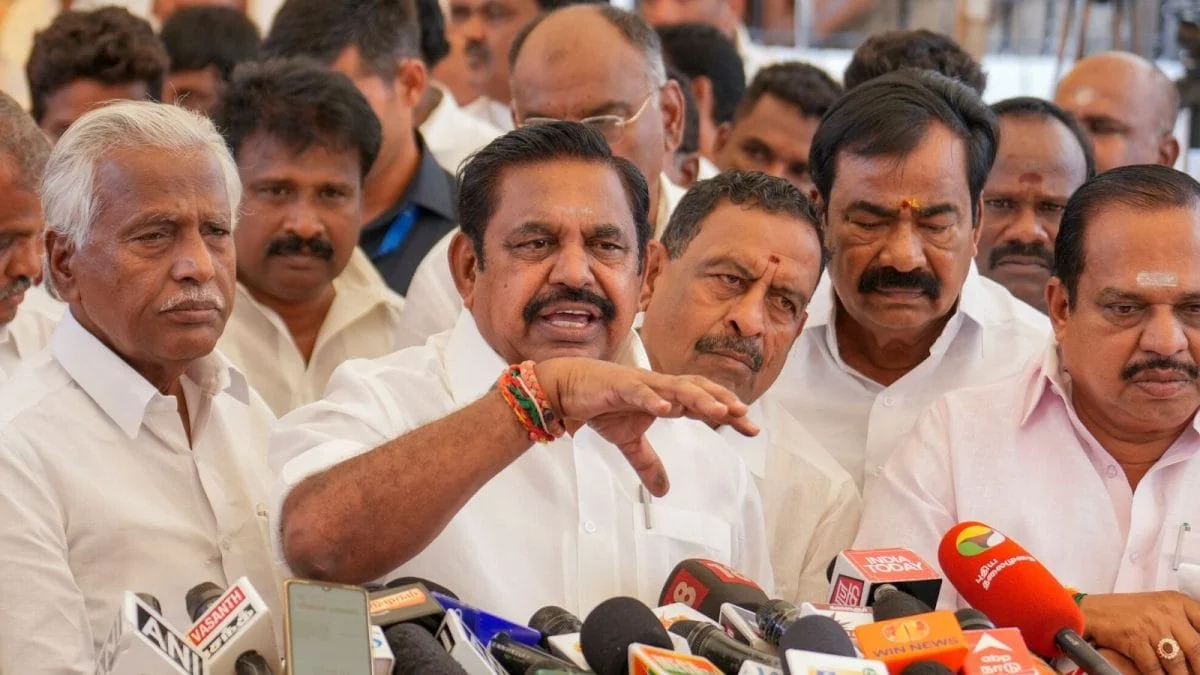
The latest exodus compounds the severe challenges faced by the AIADMK, which has been reeling from a dismal performance in the recent 2026 Assembly elections. The party’s struggles were starkly highlighted just weeks ago, on May 13, when a crucial floor test for the TVK government saw an unprecedented 24 rebel AIADMK MLAs defy the party whip to lend their support to Chief Minister Vijay. These sequential setbacks not only underscore deep-seated internal dissent but also signal a significant realignment of political power within the Dravidian heartland, potentially reshaping the state’s legislative landscape for years to come.
A Deepening Crisis for AIADMK
The defection of K Maragatham, D Jayakumar, and V Sathyabama to the TVK is more than just a numerical loss; it represents a profound psychological blow to the AIADMK’s leadership and its remaining cadre. Their decision to abandon the party, particularly from the already dissenting camp of C Ve Shanmugam, indicates a widening chasm within the AIADMK and a growing perception of its political vulnerability. By-elections are now anticipated for these three constituencies, along with Tiruchirappalli (East), within the next six months, setting the stage for another electoral test for a party already struggling to maintain its base.
The AIADMK, under Edappadi K Palaniswami, has found itself in a precarious position since the 2026 Assembly elections. The party, which once commanded a formidable majority and held sway over state politics for decades, was relegated to a distant second, securing only 47 out of the 234 seats. This electoral drubbing stripped Palaniswami of his status as the incumbent Chief Minister and, crucially, weakened his claim as the undisputed leader of the anti-DMK front. The subsequent internal rebellion, which culminated in the May 13th floor test, exposed the fragility of his control and the deep-seated resentment among certain factions of the party. The latest defections are a direct consequence of this internal strife, fueled by a combination of electoral defeat, leadership questions, and the allure of a rising political entity in the TVK.
Chronology of Dissension: The Road to May 25th
The current turmoil within the AIADMK is not an isolated incident but rather the culmination of a series of events that have unfolded rapidly since the 2026 Assembly elections.
The 2026 Assembly Elections: A Paradigm Shift
The 2026 Assembly elections were a watershed moment for Tamil Nadu politics. The AIADMK, campaigning under the leadership of Edappadi K Palaniswami, failed to connect with the electorate effectively, securing a mere 47 seats. This performance was a far cry from its previous mandates and reflected a significant erosion of public trust and support. Analysts pointed to various factors, including the absence of charismatic leaders like J Jayalalithaa and M G Ramachandran, anti-incumbency sentiments, and a perceived lack of clear vision for the state’s future.
In stark contrast, C Joseph Vijay’s Tamilaga Vettri Kazhagam (TVK) emerged as a formidable new player, rocking the political establishment by securing 108 seats. While this made TVK the single largest party, it fell 10 seats short of the absolute majority mark of 118 in the 234-member Assembly. This outcome triggered intense post-poll negotiations and alliance-building efforts, creating an environment ripe for political maneuvering and opportunistic realignments. The TVK’s impressive debut highlighted the public’s yearning for fresh leadership and a departure from traditional political narratives, particularly among younger voters and first-time electors drawn to Vijay’s populist appeal.
Post-Poll Negotiations and the Crucial Floor Test
With TVK falling short of a majority, the political landscape became highly volatile. The formation of the government hinged on securing additional support. It was during this critical phase that the deep fissures within the AIADMK became glaringly apparent. On May 13, during a crucial floor test, an astonishing 24 rebel AIADMK MLAs broke ranks with the party whip, choosing to extend their support to Chief Minister Vijay’s nascent TVK government. This act of defiance was a direct challenge to Palaniswami’s authority and provided the TVK with the necessary numbers to confidently prove its majority. The rebellion pushed TVK’s effective tally to 144 lawmakers, a comfortable majority, but one built on the shaky ground of cross-party support and internal dissent within the opposition.
The decision of these 24 MLAs to vote against their own party’s directive sparked immediate disciplinary proceedings within the AIADMK, including discussions around invoking the stringent anti-defection law. The Speaker’s office was tasked with examining the legitimacy of these votes and the subsequent petitions for disqualification, adding another layer of legal and political complexity to the unfolding drama.
Internal Upheaval within AIADMK: Seeds of Discontent
The electoral defeat and the subsequent floor test rebellion intensified the internal power struggle within the AIADMK. C Ve Shanmugam, a prominent leader, publicly accused AIADMK supremo Edappadi K Palaniswami of secretly allying with the arch-rival Dravida Munnetra Kazhagam (DMK) to facilitate the TVK’s government formation. This accusation, though unverified, resonated with a faction of the party that felt marginalized and disillusioned with Palaniswami’s leadership.
Several senior leaders openly criticized EPS’s "dictatorial" functioning style, alleging that he made unilateral decisions regarding alliances and candidate selection without adequate consultation with party veterans. The rebel faction articulated a clear demand: EPS must be removed from leadership to "restore the party as per the vision of MG Ramachandran and J Jayalalithaa." They argued that the party was straying from its foundational principles and losing its connection with the grassroots, leading to its current state of disarray. These calls for a leadership change underscore the deep ideological and personal rifts that have plagued the AIADMK since the demise of its charismatic leader, J Jayalalithaa.
The Latest Blow: May 25th Defections
The events of May 25th represent the most recent and perhaps most tangible manifestation of this internal turmoil. The formal resignation of K Maragatham, D Jayakumar, and V Sathyabama, followed by their public declaration of allegiance to the TVK, signifies a further fracturing of the AIADMK. Their departure is not merely a symbolic gesture but a strategic move that weakens the AIADMK’s legislative presence and strengthens the TVK’s position, even if indirectly. These defections, originating from an already rebellious camp, suggest that the initial dissent was not merely about a floor test but a fundamental shift in political loyalty and belief in the AIADMK’s future under its current leadership.
Supporting Data and Political Landscape Analysis
The current political developments in Tamil Nadu are best understood by analyzing the numerical impact, the historical context of AIADMK’s factionalism, the rise of TVK, and the legal implications of the anti-defection law.
Numerical Impact and Legislative Strength
The Tamil Nadu Legislative Assembly has 234 elected members, with the majority mark set at 118.
- AIADMK’s Pre-election Strength: N/A (implied from 2026 election results)
- AIADMK’s Post-2026 Election Strength: 47 seats
- AIADMK’s Strength Post-May 13 Rebellion (24 MLAs): Effectively 23 loyalists for voting purposes.
- AIADMK’s Strength Post-May 25 Defections (3 MLAs): 44 seats (officially), but even fewer loyalists if the 24 rebels are considered alienated.
- TVK’s Post-2026 Election Strength: 108 seats
- TVK’s Strength Post-May 13 Floor Test (with 24 rebel AIADMK MLAs): 108 (TVK) + 24 (rebel AIADMK) = 132 seats. This comfortably surpassed the majority mark of 118, allowing CM Vijay to form the government.
- TVK’s Strength Post-May 25 Defections: The three defectors technically bolster TVK’s official count to 111, while further weakening AIADMK. However, the 24 rebel MLAs from May 13 are still under anti-defection scrutiny. If these three defectors are formally recognized by the Speaker as having joined TVK, and if their resignations are accepted, their seats become vacant, leading to by-elections. If they join TVK without resigning, they risk disqualification under the anti-defection law, which could then lead to by-elections. The news suggests they submitted resignations, making the by-election route more probable.
This intricate numerical dance highlights the precarious balance of power and the fluidity of political allegiances. The AIADMK’s official strength of 44 makes it a significantly diminished opposition force, struggling to effectively counter the ruling TVK.
Historical Context of AIADMK Factionalism
The AIADMK has a long history of internal power struggles and factionalism, particularly in the vacuum created after the demise of its charismatic leaders. The party was founded by M.G. Ramachandran (MGR) after he broke away from the DMK. Following MGR’s death in 1987, the party split into factions led by his wife Janaki Ramachandran and J Jayalalithaa, only to reunite under Jayalalithaa’s undisputed leadership. After Jayalalithaa’s passing in 2016, a similar power vacuum emerged, leading to a bitter feud between O Panneerselvam (OPS) and Edappadi K Palaniswami (EPS). While EPS eventually consolidated power, the underlying tensions and ambitions of various leaders were never fully quelled. The current rebellion and defections can be seen as a continuation of this historical pattern, exacerbated by the party’s electoral misfortunes. The legacy of MGR and Jayalalithaa, once a unifying force, is now ironically invoked by rebel factions seeking to challenge the current leadership, arguing that EPS has deviated from their vision.
The Rise of TVK
The rapid ascent of C Joseph Vijay and his Tamilaga Vettri Kazhagam is a remarkable phenomenon in Tamil Nadu politics. Following a well-trodden path of celebrity-turned-politician, Vijay leveraged his immense popularity as a film star to galvanize a significant portion of the electorate, particularly the youth. His political messaging, though not extensively detailed in the provided article, is likely to have focused on anti-corruption, welfare schemes, and a promise of a new era of governance, resonating with voters tired of traditional political rhetoric. The TVK’s ability to attract rebel MLAs from the AIADMK suggests a perceived strength and viability, offering a new political home for those disillusioned with their former party or seeking to align with a rising power. This rise also signals a shift in voter preference, indicating a willingness to experiment with new political alternatives.
The Anti-Defection Law
The anti-defection law, enshrined in the Tenth Schedule of the Indian Constitution, is a critical piece of legislation designed to prevent political defections. It stipulates that an MLA can be disqualified if they voluntarily give up membership of their political party or vote or abstain from voting in the House contrary to any direction issued by their political party without obtaining prior permission. The Speaker of the Assembly is the final authority in deciding disqualification petitions.
In the context of the 24 rebel AIADMK MLAs who voted for the TVK government on May 13, the anti-defection law looms large. The AIADMK has undoubtedly initiated disciplinary proceedings and filed petitions for their disqualification. If disqualified, their seats would become vacant, necessitating by-elections. For the three MLAs who formally resigned and joined TVK, the situation is slightly different. If their resignations are accepted, their seats become vacant, and by-elections are held. However, the timing and the Speaker’s discretion play a crucial role. The Speaker’s decision on these matters could significantly impact the numerical balance in the Assembly and the political fortunes of both parties. The law aims to bring stability to governance but often becomes a tool in political power plays.
Official Responses and Alliance Dynamics
The political fallout from these defections has elicited varied responses from the key players, further illustrating the complex web of alliances and antagonisms in Tamil Nadu.
AIADMK’s Stance (Implicit)
While the article does not provide a direct quote from Edappadi K Palaniswami or other top AIADMK leaders regarding the latest defections, their actions speak volumes. The initiation of disciplinary proceedings against the 24 rebel MLAs after the floor test, and the implicit pressure on the Speaker to act on anti-defection petitions, highlight the party’s efforts to curb further dissent and maintain its structural integrity. EPS’s leadership is under immense scrutiny, and his challenge now is to consolidate the remaining loyalists, prevent further erosion, and project an image of stability amidst the chaos. Any public statement would likely condemn the defections as opportunistic and reiterate the party’s commitment to its principles, while privately, the focus would be on damage control and strategizing for the upcoming by-elections. The silence from EPS could also be interpreted as a strategic move to avoid fanning the flames of controversy, or a reflection of the deep introspection and crisis management currently underway within the party’s inner circles.
TVK’s Position and Outreach
The Tamilaga Vettri Kazhagam, under Chief Minister C Joseph Vijay, has benefited directly from the AIADMK’s internal strife. The support from rebel MLAs allowed TVK to form the government, and the latest defections further solidify its standing. Tamil Nadu Minister Aadhav Arjuna, a prominent voice within the TVK, clarified the ruling party’s position, insisting that the alliance remains united. His statement that the Chief Minister wants the Cabinet to function "like one family" is a clear attempt to project an image of cohesion and stability, crucial for a government that relies on a diverse support base. This rhetoric aims to reassure both its core voters and its new allies, including the defecting AIADMK members and the Left parties, that the TVK can provide stable governance despite its unconventional path to power. The TVK’s strategy appears to be one of inclusive politics, embracing those who have chosen to align with its vision, while carefully navigating the sensitivities of its broader coalition.
The CPM’s Cautionary Note
A crucial aspect of TVK’s government formation strategy involves the "outside support" extended by the Communist Party of India (Marxist) (CPM). The CPM’s support came with a significant caveat: they warned Chief Minister Vijay that they might reconsider their backing if the rebel AIADMK leaders were accommodated in the government. The reason for this caution was explicitly stated: the Left parties had extended support to the TVK government to prevent the "backdoor entry of the BJP’s rule."
This statement is highly significant in the context of Tamil Nadu politics. The Bharatiya Janata Party (BJP) has historically struggled to gain a significant foothold in the Dravidian state, often perceived as an outsider party with an ideology clashing with Tamil cultural and linguistic identity. The CPM’s concern highlights the persistent fear among regional parties and the Left that the BJP might leverage internal political instability to establish its presence, potentially through alliances with disgruntled factions. By warning against accommodating the rebel AIADMK leaders, the CPM is essentially urging TVK to maintain its ideological distance from any elements that might be seen as amenable to a future alliance with the BJP, thereby preserving the secular and regional character of the government. This condition puts Vijay in a delicate balancing act: he needs the numbers from the rebels but must also respect the ideological red lines drawn by his key external supporters.
Broader Alliance Implications
The current defections and realignments have profound implications for the broader alliance dynamics in Tamil Nadu. The DMK, currently the primary opposition to the AIADMK (though numerically superior to the AIADMK’s loyalist faction), observes these developments with keen interest. A weakened AIADMK could potentially pave the way for the DMK to consolidate its own position further, though the rise of TVK also presents a new formidable competitor. The shifting loyalties within the AIADMK, and the TVK’s reliance on diverse support, mean that future political alliances could be more fluid and less predictable than in previous decades. The traditional bipolar contest between AIADMK and DMK appears to be giving way to a more multi-polar political landscape, with TVK emerging as a strong third pole.
Implications for Tamil Nadu Politics
The events of May 25, 2026, and the preceding weeks, are not mere episodic political incidents; they represent a critical juncture that will shape the future trajectory of Tamil Nadu politics.
Future of AIADMK
The future of the AIADMK under Edappadi K Palaniswami looks increasingly bleak. With its legislative strength dwindling to 44 seats, and a significant portion of its elected representatives either openly rebellious or having defected, the party faces an uphill battle to regain its former glory. Can EPS effectively quell the internal rebellion, restore party discipline, and prevent further defections? The calls for his removal from within his own party suggest a deep crisis of confidence in his leadership. If the party continues to fragment, it risks losing its status as a credible opposition force, potentially paving the way for the DMK to further solidify its position or for TVK to emerge as the undisputed alternative. The AIADMK’s ability to reconnect with its grassroots and articulate a compelling vision for the future will be crucial for its survival.
Strengthening of TVK
Conversely, the Tamilaga Vettri Kazhagam has emerged significantly strengthened from this political upheaval. By successfully forming the government with cross-party support and now attracting defectors, CM Vijay has demonstrated his political acumen and the TVK’s growing influence. The consolidation of support, even from former rivals, provides a more stable legislative base for his government. However, managing this diverse coalition, particularly given the CPM’s strict conditions, will be a significant challenge. The TVK must prove its ability to deliver on its promises and maintain unity among its disparate elements to sustain its momentum and solidify its position as a dominant political force.
The By-Election Factor
The upcoming by-elections for four constituencies (including the three seats vacated by the defecting MLAs and Tiruchirappalli (East)) will serve as crucial litmus tests. For the AIADMK, these elections represent an opportunity to halt its decline and demonstrate residual public support. For the TVK, they are a chance to convert its legislative gains into popular mandates, further legitimizing its rise. The results of these by-elections will be closely watched, as they could provide an early indication of the public’s mood and the potential for a continued shift in political allegiances. They will also determine if the AIADMK can prevent a complete rout and if the TVK can build a more robust, independent majority.
Shifting Power Dynamics
The events underscore a significant shift in the power dynamics of Tamil Nadu. The era of the AIADMK and DMK dominating the political landscape appears to be waning, at least for now. The rise of TVK introduces a new, potent force that is challenging the established order. This multi-polar environment could lead to more complex coalition politics, ideological realignments, and a greater emphasis on individual leaders’ charisma and popular appeal. The state’s political discourse may also evolve, moving beyond the traditional Dravidian narratives to incorporate newer issues and platforms championed by parties like TVK.
Governance Challenges
For the TVK government, the challenge now lies in effective governance. While securing a legislative majority is one thing, delivering on promises and maintaining public trust amidst a diverse and potentially fractious support base is another. Chief Minister Vijay must skillfully navigate the expectations of his core voters, the demands of the defecting AIADMK MLAs, and the ideological red lines drawn by allies like the CPM. Any misstep could trigger further instability and undermine the nascent government’s credibility. The "one family" rhetoric articulated by Minister Aadhav Arjuna will be put to the ultimate test as the TVK embarks on its legislative journey.
In conclusion, the AIADMK stands at a precipice, its future uncertain as internal dissent and defections continue to chip away at its foundation. Edappadi K Palaniswami faces the daunting task of reuniting a fractured party and restoring its relevance in a rapidly changing political landscape. Meanwhile, C Joseph Vijay’s TVK has seized the moment, consolidating power and emerging as a formidable new player, albeit one with its own set of challenges in managing a diverse coalition. The coming months, particularly with the looming by-elections, will be crucial in determining whether this represents a temporary setback for the AIADMK or a more permanent reshaping of Tamil Nadu’s political destiny. The state watches intently as its political drama unfolds, promising further twists and turns in this captivating narrative of power, loyalty, and ambition.
