

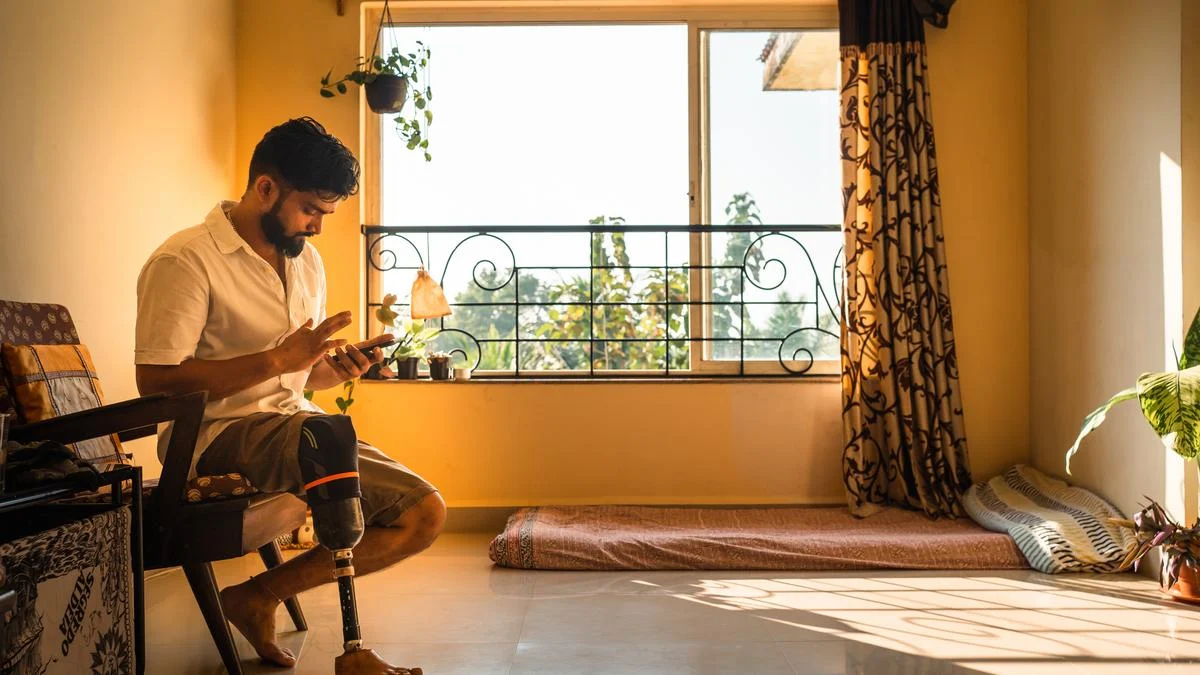
New Delhi, India – The British documentary Sex, Me and Disability, which last year offered an unflinching look at a man with Duchenne muscular dystrophy navigating the complexities of dating and intimacy, sparked considerable discussion. For viewers in India, however, the documentary’s existence itself was perhaps more remarkable than its subject matter. While inspirational narratives of individuals with disabilities overcoming extraordinary odds are readily embraced, the reality of their desires, romantic aspirations, and the everyday awkwardness of seeking companionship remains largely unexplored and often uncomfortable territory in Indian discourse.
This stark contrast highlights a pervasive societal tendency to relegate individuals with disabilities to a realm of perpetual inspiration, a narrative that, while well-intentioned, often inadvertently erases their full humanity and the fundamental human drive to be desired. The article delves into this nuanced reality, exploring the challenges faced by disabled individuals in the Indian dating scene, the societal attitudes that contribute to these hurdles, and the emerging voices advocating for a more inclusive understanding of disability that encompasses love, intimacy, and belonging.
The Paradox of Visibility and Invisibility: Disability and Desire in India
In India, conversations surrounding disability often remain confined to the safely inspirational. We celebrate the triumphs of para-athletes, the academic achievements of those who excel against the odds, and the motivational speeches delivered by resilient individuals. This focus, while acknowledging achievements, inadvertently creates a dichotomy. On one hand, we champion extraordinary feats; on the other, we shy away from the mundane, yet deeply human, experiences of those with disabilities – their romantic pursuits, their dating anxieties, and their yearning for connection.
This was vividly illustrated by the experience of a Delhi-based chartered accountant, who, despite his professional success, personal independence, and vibrant social circle, found the realm of dating to be an insurmountable challenge. Born with cerebral palsy, which affects his movement and muscle coordination, his condition manifests as a slight limp and stiffness in one arm. While he navigates complex tax regulations with ease and travels extensively, the simple act of finding a romantic partner proved elusive.

His story, shared with poignant honesty, recounts a particularly painful encounter at the age of 25. After weeks of online conversation, he met a woman who, he believed, shared a connection. When he tentatively asked for a second date, he was met with a confession that shattered his hopes: she had agreed to the date out of pity, not romantic interest. While he could muster a wry laugh, acknowledging her honesty, the underlying hurt of being seen as an object of charity rather than a potential partner was palpable. "I just want someone to share things with," he expressed, a sentiment as universal as it is often denied to individuals with disabilities.
This experience underscores a critical observation: perhaps the most profound cruelty in how Indian society perceives disability is not the exclusion from public spaces, though that remains a significant issue. It is the pervasive, often unconscious, assumption that individuals with disabilities exist in a vacuum, somehow beyond the realm of personal desire and romantic aspiration. This perspective positions them as objects of care or admiration, but rarely as individuals who experience the full spectrum of human emotions, including the desire to be loved and to love in return.
The Digital Minefield: Dating Apps and the Amplification of Ableism
The advent of dating apps was heralded as a democratizing force in romance, promising to expand social circles and connect individuals beyond geographical or social limitations. However, for many users with disabilities, these platforms have, paradoxically, become a new arena for encountering ableism and the familiar sting of rejection.
A significant survey commissioned by the Australian disability support platform Mable revealed a stark reality: three out of five people with disabilities reported difficulties in finding a romantic partner. Furthermore, a staggering 81% expressed a preference for not disclosing their disability immediately, a decision driven by the pervasive fear of immediate rejection. This fear is not unfounded. A 2022 study published in Cyberpsychology, a journal dedicated to social science research on cyberspace, shed light on this digital dilemma. While acknowledging that digital platforms offer valuable opportunities for disabled individuals to pursue relationships and mitigate social isolation, the research also highlighted their exposure to novel forms of ableism and the increased burden of self-monitoring.

The very architecture of many dating apps, which often prioritize physical appearance and immediate attraction, can inadvertently disadvantage individuals with visible disabilities. The pressure to present a curated, often idealized, version of oneself is amplified when one’s physical characteristics are subject to societal prejudice. This can lead to a constant internal negotiation: when to disclose, how to disclose, and the anxiety-inducing wait for a response that may never come, or worse, may come with a thinly veiled excuse.
Challenging the Status Quo: Voices for a More Inclusive Discourse on Love and Disability
Amidst these challenges, a growing movement is actively working to dismantle these entrenched attitudes and advocate for a more holistic understanding of disability. Activists and individuals are pushing conversations into territory that has long been deemed uncomfortable or taboo in India: love, desire, intimacy, and the fundamental right to belong.
Nu Misra, a queer, non-binary disability justice activist and the founder of Revival Disability India, has been at the forefront of this movement. Through essays, community discussions, and advocacy, Nu has consistently challenged the prevailing narrative that tends to infantilize or desexualize disabled individuals, viewing them through a lens of pity rather than possibility. Revival Disability India actively seeks to reframe these conversations, asking pointed questions: Who gets to flirt? Who experiences the thrill of a crush, the sting of being ghosted, the joy of falling in love, or the pain of heartbreak? By centering these deeply human experiences, Nu and Revival are working to shift the focus from mere access to public spaces to access to the full spectrum of human relationships.
Anushka Pathak, a 29-year-old Mumbai resident, embodies the lived experience of these challenges. At 15, she lost her right arm in a bus accident. While disability taught her the art of adaptation, dating introduced her to a different, often disheartening, lesson: the speed at which people reduce disabled individuals to pre-defined narratives rather than seeing them as complex individuals.

On popular dating apps like Tinder, Bumble, and Hinge, Anushka found herself routinely explaining her accident. She even developed a pre-written response to save her time and emotional energy. The interactions that followed were often a mix of intrusive questions about her body, expressions of surprise that she lived independently or frequented the gym, and condescending compliments that often included phrases like "I would marry you despite your disability." In one particularly jarring instance, a man admitted he had asked her out as part of research for a sociology paper on disability and relationships. "I genuinely didn’t know whether to laugh or be offended," she recounted. Others, while expressing liking her, ultimately cited an inability to "justify" a relationship to their families, a thinly veiled expression of societal disapproval.
The Intricacies of Intimacy: Navigating Sensory and Logistical Hurdles
The challenges extend beyond mere romantic attraction and into the practicalities of intimacy and relationship building. Intimacy coach Aili Seghetti shared the experience of working with a visually impaired man in his late twenties. After the end of a long-term relationship, he re-entered the dating world, only to find that many women would cancel plans upon learning of his blindness, often resorting to vague excuses.
Eventually, he made the difficult decision to disclose his disability on his dating profile, a move born out of a desire for authenticity and a recognition that concealing it would inevitably lead to more painful revelations later. However, even this proactive step did not guarantee smooth sailing. Traditional dating apps proved ineffective, prompting him to explore events like speed dating, singles mixers, and social gatherings. Yet, even before the social interactions could begin, he faced significant sensory and logistical stress. His anxieties were not solely rooted in the fear of rejection, but also in the profound worry that he might be overlooked, unable to initiate conversations, or navigate the often chaotic environment of social events.
Seghetti observed that many individuals, when faced with the perceived "complication" of disability, opt for outright rejection, pushing disabled individuals further into isolation. "Nobody wants to take responsibility for delivering rejection," she noted, highlighting the often brutal judgment of the dating world, where "high-quality" matches are frequently defined by superficial criteria like appearance, education, and income.

The Enduring Quest for Connection
In a culture that often views disability as an inherent complication, the pursuit of love and connection can become an arduous journey, often feeling less like a search for romance and more like a fundamental plea to be seen. The experiences of the chartered accountant, Anushka Pathak, and the visually impaired man, as well as the insights from activists like Nu Misra and coaches like Aili Seghetti, paint a clear picture: the desire for connection, intimacy, and romantic partnership is a universal human experience that transcends physical or cognitive differences.
The conversation needs to shift beyond inspirational anecdotes to acknowledge the everyday realities of disabled individuals seeking companionship. It requires a conscious effort to dismantle ableist assumptions, to see individuals with disabilities not as objects of pity or awe, but as complex, desiring beings. The digital realm, while presenting its own set of challenges, also holds the potential for greater connection if designed and navigated with inclusivity at its core. Ultimately, fostering a society that truly embraces diversity means recognizing and validating the romantic and intimate lives of all its members, regardless of their abilities. The journey for love, in the age of dating apps and evolving social norms, remains a fundamental human quest, and it is a quest that individuals with disabilities are as entitled to as anyone else.
