

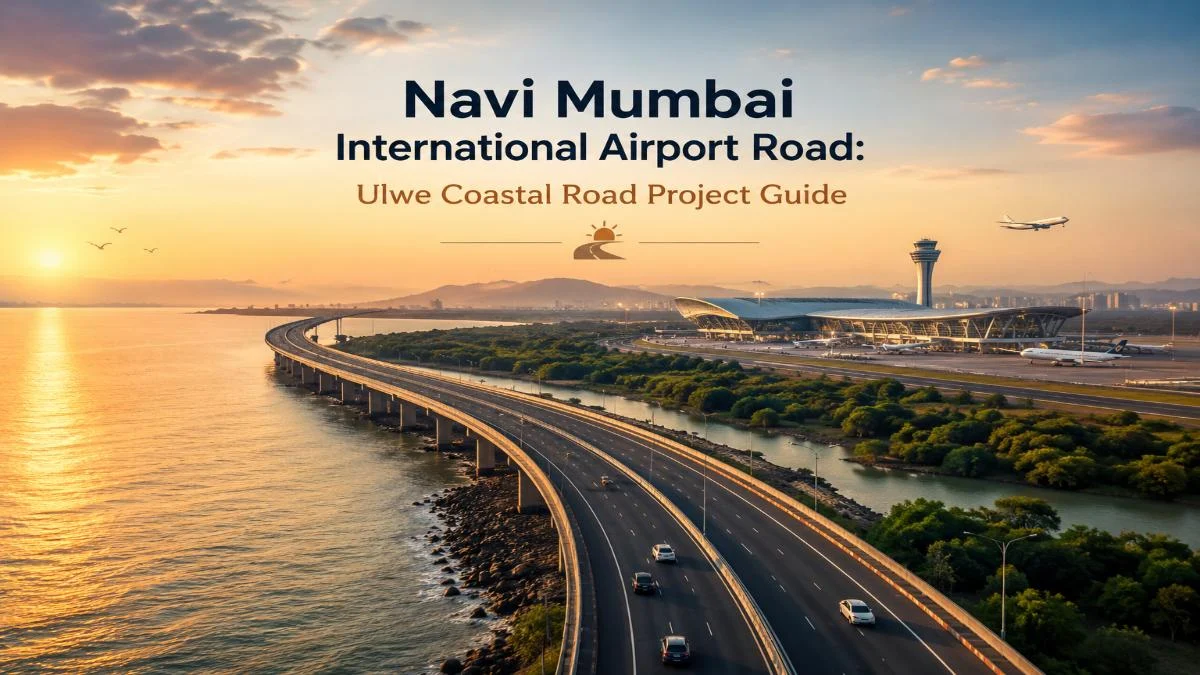
The infrastructure landscape of the Mumbai Metropolitan Region (MMR) is undergoing a seismic shift. At the heart of this transformation is the Navi Mumbai International Airport (NMIA) Road, a high-speed corridor being developed under the aegis of the Ulwe Coastal Road project. This ambitious venture, spearheaded by the City and Industrial Development Corporation of Maharashtra Ltd (CIDCO), represents more than just a stretch of asphalt; it is the "missing link" that will seamlessly connect South Mumbai’s historic core to the future of Indian aviation.
By bridging the Mumbai Trans Harbour Link (MTHL)—famously known as the Atal Setu—directly to the upcoming international airport, the project promises to redefine transit times, bypass industrial bottlenecks, and catalyze a real estate boom in the satellite city of Navi Mumbai.
1. Project Overview: The Vital Statistics
The Navi Mumbai International Airport Road is an engineering response to the logistical challenges of connecting a massive greenfield airport to a dense urban metropolis. Below are the critical technical and financial details of the project:
Key Project Facts
| Feature | Specification |
|---|---|
| Official Project Name | Ulwe Coastal Road / Navi Mumbai International Airport Road |
| Executing Authority | CIDCO (City and Industrial Development Corporation) |
| Lead Contractor | J. Kumar-J. M. Mhatre Joint Venture (JV) |
| Total Length | 7 km (5.8 km Coastal Road + 1.2 km Airport Link Road) |
| Configuration | 6-lane divided carriageway (3 lanes on each side) |
| Structural Design | Elevated on stilts (to ensure mangrove conservation) |
| Primary Interchange | Six-ramp signal-free cloverleaf at Shivaji Nagar, Ulwe |
| Estimated Cost | ₹1,400 crore to ₹1,600 crore |
| Current Progress | ~60% for Phase 1; ~30% for Phase 2 |
| Anticipated Completion | August 2026 (Operational by Oct-Nov 2026) |
2. Chronology: From Concept to Construction
The journey of the Ulwe Coastal Road has been marked by rigorous environmental scrutiny and significant design overhauls.
- Initial Planning & Rejection: Originally, the road was proposed as a ground-level highway. However, environmentalists and regulatory bodies raised concerns regarding the destruction of sensitive mangrove patches along the Ulwe coastline.
- Design Pivot: To secure the necessary Coastal Regulation Zone (CRZ) clearances, CIDCO redesigned the entire corridor to be built on stilts. While this doubled the project cost from an initial ₹700 crore to nearly ₹1,600 crore, it ensured the survival of over 3,700 mangroves.
- Regulatory Approvals: The project required a complex web of permissions, including the diversion of 32.69 hectares of forest land and coordination with the Maharashtra Maritime Board.
- Construction Milestone: As of late 2024, the project is in full swing. Phase 1, focusing on the main coastal stretch, has crossed the 60% completion mark, while Phase 2, involving the intricate airport links and interchanges, is approximately 30% complete.
3. Engineering Marvel: The Route and Design Philosophy
The Navi Mumbai International Airport Road is designed to act as a "closed-loop" system for airport-bound traffic, ensuring that travelers do not get entangled in the heavy freight traffic associated with the Jawaharlal Nehru Port Trust (JNPT).
The Strategic Alignment
The route begins at Belapur, specifically on Aamra Marg (NH 348A). From there, it threads through the emerging nodes of Seawoods, Ulwe, Bamandongri, and Targhar. It culminates at Shivaji Nagar, where it meets the MTHL (Atal Setu) interchange.
A crucial component is the 1.2-km Airport Link Road. This segment is entirely elevated, crossing over the Nerul-Uran railway line and Aamra Marg to provide a direct "ramp-to-terminal" experience.
The Shivaji Nagar Cloverleaf
One of the project’s most sophisticated features is the six-ramp signal-free cloverleaf interchange at Shivaji Nagar in Gavhan village. This interchange is engineered to:
- Separate airport-bound traffic from local Ulwe commuters.
- Provide a dedicated exit for vehicles coming from Atal Setu.
- Segregate passenger vehicles from the thousands of heavy trucks moving toward JNPT.
Environmental Stewardship
By opting for a stilt-based design, CIDCO has mitigated the impact on the local ecosystem. The layout follows strict Bombay High Court directives to safeguard 3,728 mangroves. Furthermore, the project includes provisions for compensatory mangrove plantation and the maintenance of natural water channels to ensure the local fishing communities’ livelihoods are not disrupted.
4. Supporting Data: The Impact on Travel Time
The primary objective of this project is the drastic reduction of travel time. Currently, motorists coming from South Mumbai via the Atal Setu must take a circuitous detour through the Chirle interchange on NH-4B and Gavaan Phata. This route adds 15–20 minutes to the journey and exposes travelers to heavy industrial traffic.
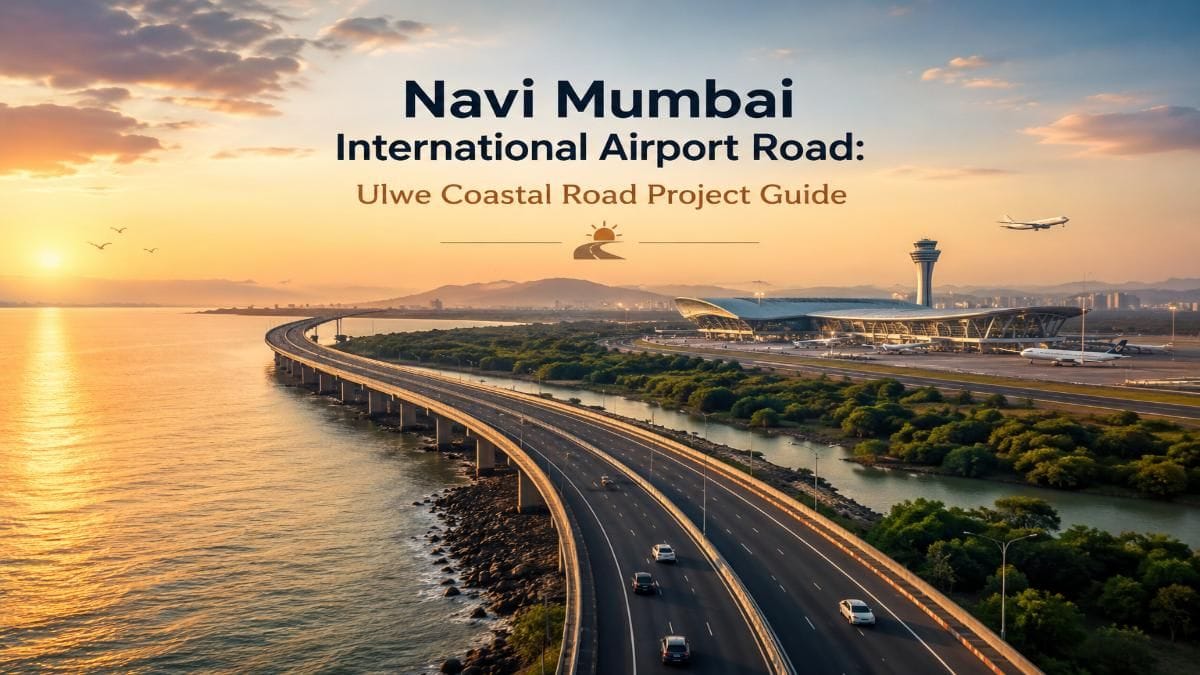
Travel Time Comparisons:
- South Mumbai to NMIA: Currently ~70–90 minutes; Post-completion <40 minutes.
- Atal Setu (Ulwe Exit) to NMIA: Currently ~25 minutes (via detour); Post-completion 10 minutes.
- Navi Mumbai Nodes (Kharghar/Belapur) to NMIA: Reduced by 15–20 minutes through the bypass of local signals.
The road is designed to handle a capacity of 70,000 vehicles per day, making it one of the highest-capacity airport access roads in the country.
5. Official Responses and Collaborative Efforts
CIDCO officials have emphasized that the Ulwe Coastal Road is the "linchpin" of the Navi Mumbai project. In various statements, the authority has highlighted the following:
- Railway Coordination: CIDCO is working closely with Central Railway for the construction of the overbridge across the Nerul-Uran line, a critical node that requires precise engineering windows (mega-blocks) to ensure minimal disruption to train services.
- Community Engagement: In response to concerns from the local fishing community regarding access to the sea, CIDCO has formed a dedicated compensation panel and modified certain pier placements to keep traditional water channels open.
- Economic Vision: Officials view this road as the first step in creating a "Third Mumbai"—a planned urban expansion that leverages the airport and the MTHL to create a new global business hub.
6. Implications: Real Estate, Economy, and Future Connectivity
The completion of the Navi Mumbai International Airport Road will have far-reaching consequences for the region’s socio-economic fabric.
Real Estate Appreciation
The corridor has already become a central pillar of real estate marketing in Navi Mumbai. Builders in Ulwe, Dronagiri, and Targhar are seeing a surge in inquiries, with many projects marketed specifically on their proximity to the "5-minute airport link."
- Target Demographics: There is an expected influx of airline staff, logistics professionals, and South Mumbai residents looking for "second homes" or investment properties that are now more accessible than the western suburbs.
- Commercial Hubs: Areas like Kharghar and CBD Belapur are expected to evolve into corporate satellite hubs, as the coastal road will cut travel times between these business districts and the airport.
Multimodal Integration
The road is only the first phase of a broader connectivity master plan:
- Metro Line 8 (Gold Line): This proposed metro line will eventually provide a 30-minute rail link between the existing Chhatrapati Shivaji Maharaj International Airport (CSMIA) and NMIA by 2029.
- Water Taxis: The Maharashtra Maritime Board is studying the feasibility of a water taxi service from the Radio Club Jetty in Colaba to a terminal near the airport, providing a scenic and rapid alternative for commuters.
- The Pune Connection: Travelers from Pune and Western Maharashtra will benefit from the MSRDC cloverleaf, which will funnel traffic from the Mumbai-Pune Expressway directly toward the NMIA access points.
The "Atal Setu" Synergy
The true value of the Ulwe Coastal Road is realized only when paired with the Atal Setu. For residents of South Mumbai, Dadar, Worli, and Chembur, the Navi Mumbai International Airport will essentially become their "primary" airport. In many cases, reaching NMIA via the Atal Setu and the new coastal road will be faster and more predictable than navigating the infamous traffic of the Western Express Highway to reach the Santacruz/Sahar airport.
7. Challenges and the Path to 2026
Despite the progress, the project faces ongoing challenges. The sheer complexity of building on stilts over marshy terrain requires specialized equipment and constant monitoring of soil stability. Furthermore, the final 30% of Phase 2 involves the most intricate interchange work, which must be completed without disrupting the existing traffic on NH 348A.
However, with the contractor (J. Kumar-J. M. Mhatre JV) having a proven track record in Mumbai’s metro and bridge projects, CIDCO remains confident in meeting the August 2026 target for structural completion.
Conclusion
The Navi Mumbai International Airport Road is a testament to modern urban planning that balances economic necessity with environmental preservation. By creating a high-speed, signal-free conduit between the Atal Setu and the new airport, CIDCO is effectively shrinking the geography of the MMR. As 2026 approaches, the project stands as a symbol of Mumbai’s evolution into a polycentric mega-city, where the shores of Ulwe and the skyscrapers of Nariman Point are finally brought within a 40-minute reach.
