

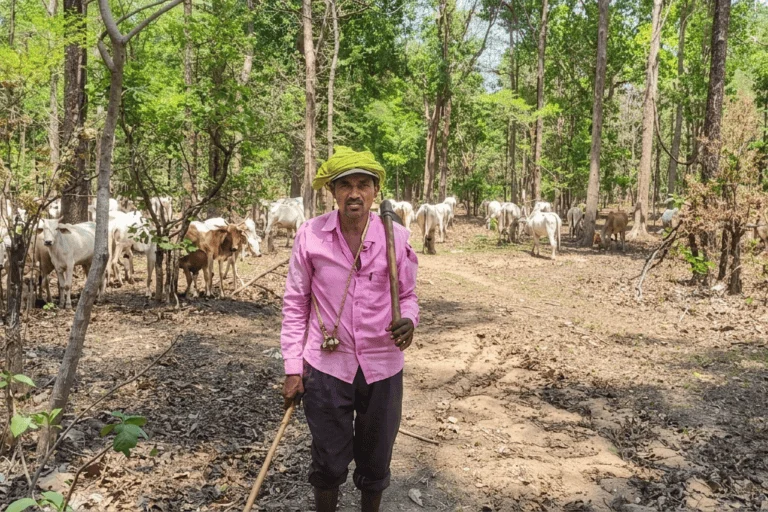
In the dense, teak-filled forests of Madhya Pradesh, a centuries-old profession is quietly vanishing. As traditional herders abandon their sticks for urban labor, the delicate architecture of human-wildlife coexistence is beginning to crumble, leaving both tigers and rural livelihoods at risk.
The Kanha-Pench Corridor is more than just a stretch of woodland; it is a vital ecological artery. Spanning approximately 5,900 square kilometers across the Central Indian Highlands, this landscape represents roughly 2% of the total area of Madhya Pradesh. It serves as a critical bridge for wildlife, allowing the genetic exchange between two of India’s most iconic tiger reserves: Kanha and Pench.
However, this corridor is not a pristine wilderness. It is a mosaic of open forests, village commons, and farmlands, home to over 400 human settlements. According to the 2022 Status of Tigers report, at least 97 tigers have been recorded within this corridor. In such a densely populated landscape, the presence of apex predators is a constant reality. Yet, the mechanism that has allowed humans and tigers to share this space for generations—the traditional herder—is facing an existential crisis.
Main Facts: A Landscape of Conflict and Compensation
The scale of human-wildlife interaction in Madhya Pradesh is staggering. In the fiscal year 2024–2025, news reports indicated that over 14,000 cattle were killed by tigers and leopards across the state. In the Kanha-Pench corridor specifically, these incidents are not merely statistics; they are economic catastrophes for the tribal and Dalit communities who depend on livestock for milk, manure, and traction.
To mitigate this, the Madhya Pradesh Forest Department operates an extensive compensation scheme. In 2024–2025 alone, the state distributed ₹13.18 crores (₹131 million) to victims of wildlife conflict. Payouts for cattle loss typically range from ₹7,000 to ₹24,000, depending on the type and age of the animal.
![As herders quit, the skills that helped human-tiger coexistence, disappear [Commentary]](https://imgs.mongabay.com/wp-content/uploads/sites/30/2026/08/09231610/6_Thakre-1200x688.png)
While the financial figures are well-documented, the labor required to access these funds is often ignored. Compensation is predicated on "proof of predation." A carcass must be found, verified by forest officials, and protected from tampering. This is where the herder becomes indispensable. They are the detectives of the forest, the mediators of state-society relations, and the primary buffers against retaliatory violence toward wildlife.
Chronology: The Evolution and Erosion of a Profession
The Golden Age of Coexistence
For decades, the herding families of the Seoni and Balaghat districts lived in a state of watchful equilibrium with the forest. A decade ago, almost every village in the corridor boasted two or three dedicated herding families. These individuals—predominantly from the Yadav, Gond, and Pradhan communities—possessed a sophisticated understanding of forest phonology and animal behavior.
The Rise of Modern Pressures (2010–Present)
Over the last 15 years, the profession has faced a multi-pronged assault. Ecological changes, such as the proliferation of teak plantations and the establishment of "closed coupes" (fenced-off areas for reforestation), have squeezed available grazing land. Simultaneously, the tiger population has rebounded due to successful conservation efforts, increasing the frequency of encounters.
The Current Crisis
A recent study of 75 villages in the corridor revealed a startling trend: only 18 villages still have a dedicated herder. The majority of the youth in these communities are opting for daily wage labor in cities like Nagpur or Jabalpur, viewing herding as a high-risk, low-reward occupation.
Supporting Data: The Economics of the Forest Floor
The decline of the herder is rooted in a harsh economic reality. Despite the high risks involved, the wages for herders remain stagnant and fragmented.
![As herders quit, the skills that helped human-tiger coexistence, disappear [Commentary]](https://imgs.mongabay.com/wp-content/uploads/sites/30/2026/08/10093648/2_Bablu-768x512.jpg)
- Monthly Earnings: Herders typically earn between ₹5,000 and ₹7,000 per month.
- Service Rates: Grazing rates are approximately ₹70 per calf and up to ₹200 per adult buffalo or ox.
- Risk vs. Reward: For this meager sum, herders spend 8–10 hours a day in tiger-dense territory.
- Labor Intensity: Beyond grazing, herders must spend entire days guarding carcasses or assisting forest officials in "burning" dead cattle to prevent villagers from poisoning the remains in retaliation.
This "unpaid labor" of conservation is what makes the state’s compensation system functional. Without the herder to locate a kill within the 24-to-48-hour window required for verification, the compensation claim often fails.
The Herder’s Craft: Reading the Forest’s Radar
To understand what is being lost, one must look at the specialized knowledge herders like Bablu Yadav and Dasharam Thakre bring to the landscape.
Biological Alarm Systems
Herders do not rely on sight alone. They interpret the "alarm calls" of the forest—the specific cries of drongos, langurs, and peacocks that signal a predator on the move. Even the cattle themselves act as a radar system. Bablu Yadav, a veteran herder from Devjhiri village, notes that adult bovines shuffle into a protective circle around their young and emit a specific "moo" when a tiger is near.
The "Maatam" or Mourning
When a cow goes missing, herders use the herd’s behavior to find the body. Dasharam Thakre of Borghundi village describes a phenomenon known as maatam (mourning). When cattle are led back to the vicinity of a kill site, they become agitated and vocalize in a distinct manner. By following these behavioral cues, herders can locate a carcass hidden in thick undergrowth, identifying bloodstains and drag marks that an untrained eye would miss.
Official Responses and Administrative Friction
The relationship between the "janta" (people) and the "shasan" (administration) is often strained. While the Forest Department views "closed coupes" as essential for ecological restoration, herders see them as bureaucratic traps.
![As herders quit, the skills that helped human-tiger coexistence, disappear [Commentary]](https://imgs.mongabay.com/wp-content/uploads/sites/30/2026/08/09232007/3._Grazing-trail-768x512.jpg)
The Trap of the Closed Coupe
If a tiger kills a cow inside a closed coupe—a restricted area—the owner may be denied compensation or even fined for illegal grazing. Deviprasad Chauhan, a herder from Jam village, explains that this creates an atmosphere of mistrust. When the administration is perceived as rigid or unsympathetic, the anger that should be directed at the bureaucracy is often redirected toward the tiger.
The Mediation Role
Herders serve as a vital "buffer" during these moments of tension. They communicate the rules of the forest department to the villagers and, conversely, advocate for the villagers’ needs to the officials. They are the diplomats of the corridor, preventing "simmering sentiments" from boiling over into active conflict or the poisoning of predators.
Implications: The High Cost of a Vanishing Ethos
The disappearance of the herder has profound implications for the future of tiger conservation in India.
1. The Socio-Economic Burden on Women and the Poor
When a professional herder quits, the responsibility of grazing falls back onto the individual households. This disproportionately affects women, who must add grazing to an already exhausting list of domestic duties. Furthermore, poorer families—who may only own one or two cows—are the hardest hit. Without a professional herder’s protection, they are more likely to lose their primary source of nutrition and income.
2. The Loss of the "Vardani" Ethos
Perhaps the most significant loss is cultural. Many veteran herders view the death of cattle at the hands of a tiger as vardani—a sacrifice with divine sanction or the "will of the forest deity." This traditional belief system provides a psychological framework for accepting loss without seeking revenge. As "lay agriculturalists" replace professional herders, this spiritual tolerance is being replaced by a purely transactional view of nature, where a lost cow is simply a lost asset that demands a culprit.
![As herders quit, the skills that helped human-tiger coexistence, disappear [Commentary]](https://imgs.mongabay.com/wp-content/uploads/sites/30/2026/08/10093934/8_other_tasks-768x512.jpg)
3. Increased Risk of Retaliatory Killings
The success of the Kanha-Pench corridor depends on the "tolerance" of the local population. If the mechanism for locating carcasses and securing compensation breaks down, the financial frustration of the villagers could lead to a resurgence of retaliatory poisonings—a threat that could undo decades of tiger population growth.
4. A Vacuum in Conservation Science
Conservation programs often focus on "hard science"—GPS collars, camera traps, and census numbers. However, the herder’s disappearance reveals a "knowledge vacuum." The intergenerational transfer of forest lore is stopping. The new generation of "rotational grazers" does not know how to read the signs of the forest, making them—and their livestock—far more vulnerable to attacks.
Conclusion: Recognizing the Human Element
The Kanha-Pench Corridor is a testament to the possibility of coexistence, but it is a fragile one. The 97 tigers recorded in the region do not exist in a vacuum; they exist because of a social contract maintained by the men and women who walk the forest every day.
If tiger conservation is to remain sustainable, the "unpaid labor" of the herder must be recognized and supported. This may require formalizing the role of herders within the Forest Department’s framework, increasing grazing wages through community funds, or creating better insurance models that do not rely solely on the physical verification of a carcass.
As the scent of the forest changes and the "alarm calls" of the langurs go unheeded, the vanishing herder leaves behind a silence that should worry conservationists as much as any poaching report. Coexistence is not just a biological state; it is a practiced skill. And in the heart of India, that skill is slipping away.
