

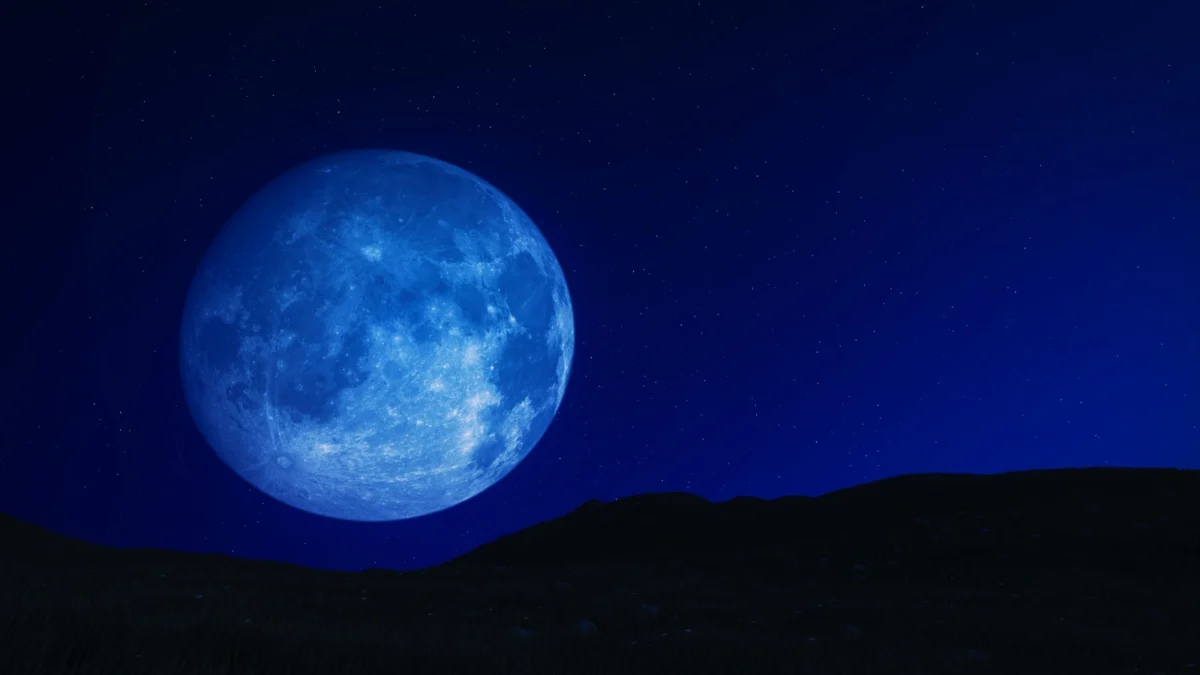
The night sky of May 2026 is set to conclude with a rare astronomical flourish. On the evening of May 31, skywatchers across the globe will witness a "Blue Moon"—a celestial phenomenon that occurs when a single calendar month plays host to two full moons. While the term is frequently used in common parlance to denote rarity, the upcoming event offers a unique opportunity for both professional astronomers and amateur stargazers to engage with the mechanics of our lunar neighbor.
As the second full moon of the month, the May 31 event follows the "Flower Moon" which occurred on May 1. This double-feature in the lunar calendar is a result of the slight discrepancy between our Gregorian calendar months and the natural synodic cycle of the Moon. For observers in India and across the Eastern Hemisphere, the event promises a striking visual display, particularly during the moonrise phase, where atmospheric conditions will transform the lunar orb into a glowing beacon of gold and amber.
Main Facts: Defining the Blue Moon Phenomenon
To understand the significance of the May 31 event, one must first navigate the dual definitions of a "Blue Moon." In modern astronomy, the term generally refers to one of two things: a Monthly Blue Moon or a Seasonal Blue Moon.
The Monthly Blue Moon
The event occurring this May is a "Monthly Blue Moon." This is the most commonly understood definition, referring to the second full moon in a single calendar month. Because the lunar cycle (the time between one full moon and the next) is approximately 29.5 days, and most months are 30 or 31 days long, it is mathematically inevitable that, eventually, a full moon will fall on the first or second day of the month, leaving enough room for another full moon before the month concludes.
The Seasonal Blue Moon
Less commonly discussed but equally significant to astronomers is the "Seasonal Blue Moon." An astronomical season (the period between a solstice and an equinox) typically contains three full moons. However, because of the lunar cycle’s timing, some seasons contain four. In these instances, the third full moon of that four-moon season is designated as the Blue Moon. The next seasonal Blue Moon is projected to occur on May 20, 2027.
The Optical Illusion: Why It Isn’t Actually Blue
Despite the evocative name, the Moon will not take on a cerulean hue. The term "Blue Moon" is believed to have originated from a linguistic evolution of the Old English word belewe, meaning "to betray," referring to the "betrayer moon" that disrupted the traditional Lenten fasting schedule.
Visually, the May 31 moon will appear much like any other full moon, though its appearance near the horizon will be influenced by Rayleigh scattering. This phenomenon occurs when shorter wavelengths of light (blue) are scattered by the Earth’s atmosphere, allowing longer wavelengths (red and orange) to pass through. Consequently, as the Blue Moon rises on the evening of May 30 and 31, it will likely glow with a warm, honey-colored radiance rather than the cool blue its name suggests.
Chronology of the May 2026 Lunar Cycle
The path to the Blue Moon began on the very first day of the month, setting the stage for a rare double-lunar event.
- May 1, 2026: The Flower Moon: The month opened with the first full moon, traditionally known in many cultures as the Flower Moon, signifying the abundance of spring blooms. Its early arrival on the 1st was the prerequisite for the Blue Moon at the month’s end.
- May 8 – May 22, 2026: The Waning and Waxing Phases: Following the Flower Moon, the lunar cycle progressed through its third quarter, new moon, and first quarter phases. During this period, the Moon moved through its elliptical orbit, reaching its furthest point from Earth (apogee) before beginning its return journey toward perigee.
- May 30, 2026: The "Best Viewing" Window: While the astronomical peak of the full moon is May 31, experts suggest that the evening of May 30 will offer the most dramatic viewing. As the Moon rises shortly after sunset, it will appear larger and more colorful due to the "Moon Illusion"—an optical trick where the brain perceives the Moon as larger when compared against terrestrial objects like trees or buildings on the horizon.
- May 31, 2026: The Blue Moon Peak: The Moon reaches 100% illumination. In India, the Moon will rise in the eastern sky shortly after dusk, remaining visible throughout the night as it traverses the celestial dome.
Supporting Data: The Mathematics of Rarity
The occurrence of a Blue Moon is a masterclass in celestial mechanics and the limitations of the human calendar. Our standard calendar year consists of 365 days (366 in leap years), while 12 lunar cycles take only about 354 days. This 11-day discrepancy means that every two to three years, an "extra" full moon must occur to realign the lunar phases with the solar year.
The Metonic Cycle
The recurrence of Blue Moons is tied to the Metonic Cycle—a period of approximately 19 years after which the phases of the Moon recur on the same days of the year. Within one 19-year Metonic cycle, there are typically seven Blue Moons.
Historical and Future Frequency
The rarity of the event is reflected in the upcoming schedule:
- Last Monthly Blue Moon: August 31, 2023.
- Current Event: May 31, 2026.
- Next Monthly Blue Moon: December 31, 2028 (A rare New Year’s Eve Blue Moon).
- Next Seasonal Blue Moon: May 20, 2027.
Because February has only 28 or 29 days, it is the only month that can never experience a Monthly Blue Moon. In fact, roughly once every 19 years, February has no full moon at all—a phenomenon known as a "Black Moon"—which usually results in two Blue Moons occurring in the surrounding months (January and March).
Official Responses and Expert Perspectives
Astronomers and space agencies have begun issuing guidance for the public to maximize the educational value of the event. While a Blue Moon does not hold specific scientific "danger" or unique gravitational effects beyond a standard full moon, it serves as a vital tool for public outreach.
Dr. Aris Voulgaris, an international researcher of celestial phenomena, notes: "The Blue Moon is a cultural bridge to science. While the physics of the orbit remains constant, the ‘Blue Moon’ label captures the public imagination, encouraging people to look up and contemplate the scale of our solar system. From a technical standpoint, the May 31 event is an excellent time for high-resolution lunar photography because the Moon’s position in late May offers a relatively stable atmospheric window in many parts of the world."
The Nehru Planetarium in New Delhi has indicated plans to host public viewing sessions. Spokespersons for the observatory emphasize that the event is a "naked-eye spectacle," requiring no specialized equipment. However, they recommend that enthusiasts use binoculars to observe the "terminator line"—the shadow line where day meets night on the lunar surface—which highlights the craters and mountain ranges in stark relief.
NASA’s Lunar Reconnaissance Orbiter (LRO) team often uses these periods of high public interest to highlight ongoing lunar research. While the LRO observes the Moon constantly, the agency uses these events to educate the public on Rayleigh scattering and the history of lunar nomenclature, debunking myths that the Moon changes color due to mystical reasons.
Implications: Culture, Science, and the Future of Lunar Observation
The May 2026 Blue Moon carries implications that extend beyond simple stargazing. It impacts cultural scheduling, scientific literacy, and the growing field of astrophotography.
Cultural and Psychological Impact
The phrase "once in a blue moon" has permeated the English language to describe rare occurrences. Psychologically, events like these foster a sense of "collective effervescence"—a term used by sociologists to describe the feeling of belonging and excitement when a large group of people experiences the same phenomenon simultaneously. In an increasingly digital age, the Blue Moon provides a rare moment of shared physical reality.
Advancements in Astrophotography
The 2026 event will likely see a surge in high-quality imagery shared across social media. With the advancement of smartphone sensor technology and the availability of affordable tracking mounts, the May Blue Moon will be one of the most documented lunar events in history. Experts suggest that photographers use a "long lens" (at least 300mm) and a tripod to capture the crisp details of the lunar mare (the dark plains) and the Tycho crater.
The Gateway to Future Exploration
The timing of the Blue Moon is also significant in the context of the modern space race. With NASA’s Artemis program and ISRO’s continued lunar ambitions (following the success of Chandrayaan-3), public interest in the Moon is at an all-time high. Celestial events like the Blue Moon serve as a reminder of the Moon’s accessibility and its role as a "stepping stone" for human exploration of Mars and beyond.
Conclusion: Preparing for the Night Sky
As May 31, 2026, approaches, the global community is encouraged to find a vantage point with a clear view of the eastern horizon. Whether viewed from the bustling streets of Mumbai, the plains of the American Midwest, or the observatories of Europe, the Blue Moon remains a testament to the clockwork precision of our universe.
While it won’t be blue, and it won’t change the course of human history, the May Blue Moon offers something perhaps more valuable: a moment of quiet reflection and a reminder that even in a rapidly changing world, the rhythms of the cosmos remains constant. For those who miss this weekend’s display, the wait for the next monthly Blue Moon will last until the final hours of 2028—making this May event an opportunity not to be missed.
