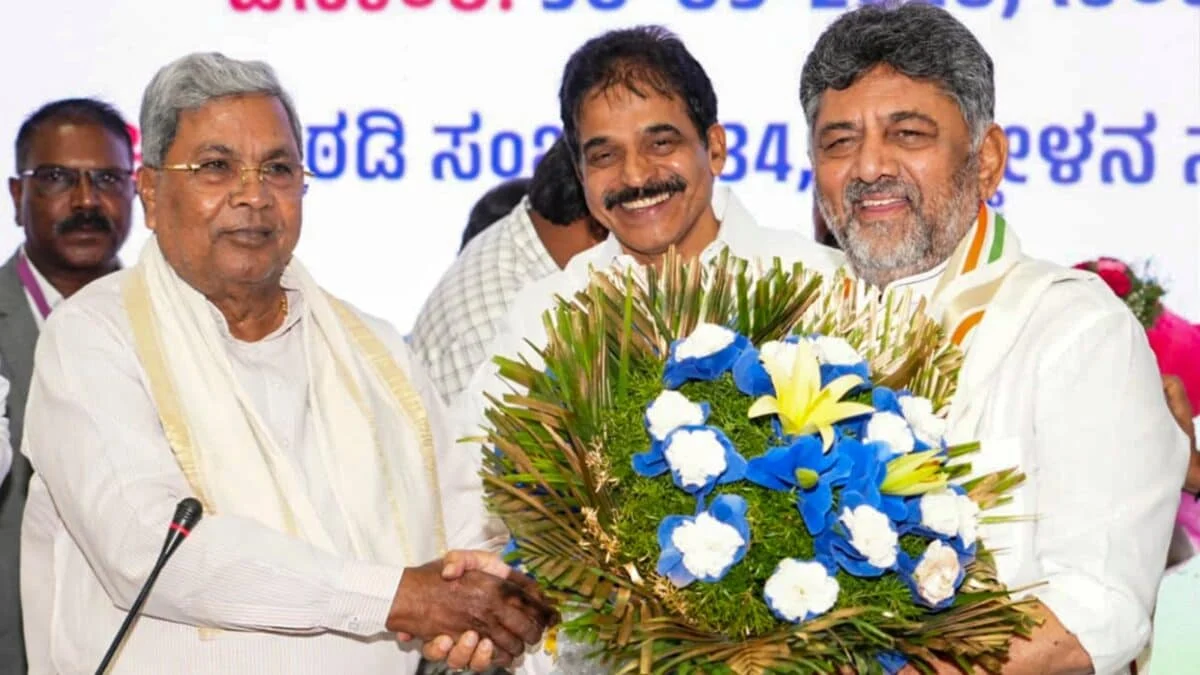
Bengaluru, India – After weeks of intense political speculation and high-stakes negotiations, D.K. Shivakumar, the dynamic and resourceful Karnataka Congress chief, was unanimously elected as the leader of the Congress Legislature Party (CLP) on Saturday. This decisive move clears the path for the much-anticipated ‘DKS Sarkar’ to take the reins of power, with Shivakumar formally staking claim to form the next government in the state. The announcement, made following a crucial CLP meeting at Bengaluru’s iconic Vidhan Soudha, signals a new chapter for Karnataka politics and solidifies the Congress party’s unified front after its resounding victory in the recent Assembly elections.
The formal election of Shivakumar, a key architect of the Congress’s impressive electoral triumph in 2023, culminates a period of delicate internal deliberations. His ascent to the top executive position follows a strategic resolution of leadership aspirations within the party, particularly concerning the experienced outgoing Chief Minister, Siddaramaiah. The stage is now set for Shivakumar to be sworn in as the Chief Minister of Karnataka on June 3, 2026, at a ceremony scheduled for 4:05 PM on the premises of Lok Bhavan, as confirmed by Governor Thaawarchand Gehlot.
The Culmination of a Protracted Process: From Electoral Triumph to Leadership Consensus
The journey to Shivakumar’s anointment has been a testament to the complex internal dynamics of a political party navigating a decisive mandate. Following the Congress party’s spectacular win in the 2023 Karnataka Assembly elections, which saw them secure 135 seats, comfortably crossing the majority mark, attention immediately shifted from electoral triumph to leadership selection. Both D.K. Shivakumar and Siddaramaiah, pivotal figures in the party’s success, emerged as strong contenders for the Chief Minister’s post, each commanding significant support within the legislative body and among various party factions.
The initial euphoria of victory soon gave way to a period of palpable tension as the high command in New Delhi embarked on extensive consultations. This phase involved marathon talks, shuttle diplomacy, and intricate negotiations led by senior Congress leaders, including AICC General Secretary in charge of Karnataka Randeep Singh Surjewala and Congress General Secretary KC Venugopal. Rahul Gandhi, a prominent voice in the party, was also understood to have played a crucial role in brokering a consensus. The discussions were aimed at not only selecting a leader but also charting a stable course for the new government, including persistent talks of a potential power-sharing arrangement between Siddaramaiah and Shivakumar that would involve a transfer of power after 2.5 years.
The delicate balance required to accommodate the aspirations of both stalwarts underscores the Congress party’s strategic imperative to project unity and strength. Siddaramaiah, with his extensive administrative experience and popularity among certain backward classes, and Shivakumar, with his formidable organizational skills and financial acumen, represented two indispensable pillars of the party’s state unit. The eventual resolution, culminating in Shivakumar’s unanimous election, highlights the party’s ability to forge internal cohesion, at least publicly, under the guidance of its central leadership. This period of intense negotiation, though protracted, was crucial in laying the groundwork for a seemingly smooth transition and preventing any outward display of discord that could undermine the incoming administration.
Inside the Vidhan Soudha: A Display of Unity and Strategic Transition
The highly anticipated Congress Legislature Party (CLP) meeting on Saturday at Bengaluru’s Vidhan Soudha was a meticulously orchestrated event designed to project unity and formalize the leadership transition. The gathering, observed closely by political analysts and the public alike, saw a full attendance of Congress legislators, reaffirming the party’s collective endorsement of the chosen path.
The meeting commenced with the presence of key central observers and state leaders. CLP Secretary Allamprabhu Patil, AICC General Secretary in charge of Karnataka Randeep Singh Surjewala, and Congress General Secretary KC Venugopal were instrumental in overseeing the proceedings, ensuring adherence to party protocols. The atmosphere, while charged with the weight of the decision, was ultimately characterized by a choreographed display of consensus.
The proceedings unfolded with the unanimous passage of three pivotal resolutions, each designed to systematically pave the way for D.K. Shivakumar’s formal election as the legislative leader:
-
Resolution to Empower the High Command: The first and arguably most crucial resolution was proposed by the outgoing Chief Minister, Siddaramaiah. He moved that the selection of the new CLP leader be entrusted entirely to the Congress high command. This strategic move, seconded by senior Congress leader and Karnataka Home Minister G. Parameshwara, was passed unanimously by a show of hands. This resolution effectively transferred the locus of decision-making to the party’s central leadership, signaling the state unit’s deference and trust in their collective wisdom. It also served to preempt any potential floor dissent, channeling all authority upwards.
-
Nomination of D.K. Shivakumar: Following the passage of the first resolution, Siddaramaiah once again took the lead, this time proposing the name of D.K. Shivakumar for the esteemed post of CLP leader. This proposal, a powerful gesture of endorsement from his long-standing colleague and former rival for the top job, was again seconded by Parameshwara. The proposal received immediate and unanimous approval from all legislators present, formally electing Shivakumar as the CLP leader. This moment was particularly significant, publicly cementing the end of any leadership tussle and showcasing a united front.
-
Vote of Thanks to Siddaramaiah: In a move that underscored the spirit of camaraderie and respect within the party, D.K. Shivakumar, immediately after his election, moved a resolution to thank Siddaramaiah for his invaluable leadership and immense contributions to the party and the state. This resolution was adopted amidst a resounding display of unity, with legislators applauding and reaffirming their appreciation for Siddaramaiah’s tenure and his graceful facilitation of the transition. This exchange symbolized a harmonious transfer of power, projecting an image of a cohesive and mature political entity.
The meticulous execution of these resolutions ensured that Shivakumar’s elevation was not only procedurally sound but also carried the full weight of collective endorsement, both from the state legislators and the national party leadership.
Staking Claim: The Formalities and the Path to the Oath
With his unanimous election as the CLP leader, D.K. Shivakumar promptly proceeded to fulfill the constitutional formalities required to form the new government. Accompanied by outgoing Chief Minister Siddaramaiah and other senior state leaders, Shivakumar met with Governor Thaawarchand Gehlot at Lok Bhavan. During this meeting, he formally staked his claim to form the next government in Karnataka.
The interaction with the Governor was swift and decisive. Governor Gehlot, acknowledging the mandate of the people and the unanimous election of Shivakumar as the leader of the legislative party, extended an invitation for him to take the oath as the Chief Minister of the state. The oath-taking ceremony has been scheduled for 4:05 PM on June 3, 2026, at the Lok Bhavan premises, marking a precise and ceremonial transfer of power.
In his official letter to the Governor staking his claim, Shivakumar meticulously detailed the strength of the Congress Legislature Party. He stated that the Karnataka CLP consists of a formidable 135 members from the Indian National Congress, augmented by the support of 2 associated members and 1 Raita Sangha MLA, thereby clearly demonstrating the comfortable majority he commands to form a stable government. This comprehensive enumeration left no ambiguity regarding the legitimacy and numerical strength of the incoming administration. The promptness and formality of this process underscored the Congress party’s readiness to assume governance and embark on its new mandate.
A New Era for Karnataka: D.K. Shivakumar’s Ascent
D.K. Shivakumar’s elevation to the Chief Minister’s office marks a significant milestone in his illustrious, often turbulent, political career. Born into a Vokkaliga family in Kanakapura, Shivakumar has carved out a formidable reputation as a shrewd political strategist, an indefatigable organizer, and a crisis manager for the Congress party. His journey, spanning over three decades, has seen him rise from a student leader to one of the most powerful figures in Karnataka politics.
Known for his "troubleshooter" image, Shivakumar has consistently demonstrated an uncanny ability to navigate complex political landscapes and deliver results for his party. His resourcefulness was particularly evident during critical junctures, such as herding Congress MLAs to prevent defections in Goa and Gujarat, and his steadfast loyalty to the Gandhi family. These attributes have earned him the trust and confidence of the Congress high command, despite facing numerous legal challenges and investigations that have often put him in the national spotlight.
As the President of the Karnataka Pradesh Congress Committee (KPCC), Shivakumar played an instrumental role in rejuvenating the party’s cadre and spearheading the aggressive and successful campaign for the 2023 Assembly elections. His relentless campaigning, strategic planning, and ability to connect with diverse voter bases were crucial in converting anti-incumbency sentiment against the BJP into a decisive mandate for the Congress. His vision for Karnataka, as articulated during the campaign, centers on fulfilling the party’s five ‘guarantees’ aimed at social welfare and economic upliftment, alongside fostering robust industrial growth and infrastructure development. His leadership is expected to bring a blend of administrative dynamism and political astuteness to the state’s highest office.
Siddaramaiah’s Legacy and a Graceful Transition
The smooth transition of power was significantly facilitated by the statesmanlike conduct of outgoing Chief Minister Siddaramaiah. A seasoned politician with a rich background in state governance, Siddaramaiah has served as Chief Minister of Karnataka for a full term (2013-2018) and holds a prominent position in the state’s political narrative, particularly among the Ahinda (minorities, backward classes, and Dalits) communities. His decision to propose Shivakumar’s name for the CLP leadership was a powerful gesture, demonstrating adherence to party discipline and a commitment to unity.
Following the CLP meeting, Siddaramaiah publicly congratulated D.K. Shivakumar, showering praise on his "indomitable dynamism, organisational acumen, and unwavering loyalty." Through his social media platforms and public statements, Siddaramaiah expressed profound confidence in Shivakumar’s capabilities to lead the state. He articulated his belief that Shivakumar possesses the necessary leadership qualities to "steer Karnataka’s development trajectory forward" and to "uphold the party’s ideological values amidst the prevailing national socio-political challenges."
This public endorsement from Siddaramaiah is vital. It not only provides a strong foundation of legitimacy for the new Chief Minister but also sends a clear message to party workers and the electorate that the Congress unit in Karnataka is united and focused on governance. His graceful step aside, despite his own significant political clout and experience, is a testament to his commitment to the party’s larger interests and his understanding of the need for a cohesive leadership to deliver on the electoral promises. Siddaramaiah’s role in the transition ensures that the party’s collective strength remains intact, crucial for facing the challenges ahead.
Official Reactions and Political Commentary
The leadership change in Karnataka has naturally elicited a range of responses from within the Congress party and from the opposition, reflecting the diverse perspectives on this pivotal political development.
Shivakumar’s Pledge:
Newly elected CLP leader D.K. Shivakumar, in his immediate reaction, conveyed a sense of profound responsibility and humility. He stated that he was "humbled" to be unanimously elected as the Leader of the Congress Legislature Party at the Vidhana Soudha meeting. In a public statement, he reiterated the party’s unwavering commitment to the people of Karnataka, assuring them that the new government would serve with "dedication, integrity, and purpose." His words aimed to reassure the electorate that the party would prioritize governance and the fulfillment of its extensive manifesto promises. He also posted on X (formerly Twitter) expressing his gratitude and confirming the meeting with the Governor, alongside Siddaramaiah and other leaders.
Siddaramaiah’s Endorsement:
As mentioned, Siddaramaiah’s public congratulations were effusive and strategically important. His praise for Shivakumar’s "dynamism, organizational acumen, and unwavering loyalty" went beyond mere pleasantries, highlighting the qualities that the Congress believes will be crucial for effective governance and party consolidation. His emphasis on Shivakumar’s ability to navigate "national socio-political challenges" also hinted at the broader political landscape and the role Karnataka plays in the national narrative.
BJP Takes a Swipe at the Leadership Change:
While the Congress leaders celebrated the smooth transition, the principal opposition, the Bharatiya Janata Party (BJP), wasted no time in launching a critique. BJP national spokesperson Shehzad Poonawalla took a sharp swipe at the leadership change, dismissing it as a mere cosmetic alteration that would not fundamentally alter the "character" of a government he alleged was "mired in corruption."
Poonawalla asserted that the Congress’s decision to replace Siddaramaiah with Shivakumar reflected an implicit acknowledgment by the party that Siddaramaiah’s previous governance had "failed on multiple fronts." He sarcastically remarked, "Therefore, they have had to replace him. Otherwise, 2028 (assembly elections) is gone," implying that the change was a desperate measure to salvage the party’s future prospects rather than a genuine move towards better governance. The BJP’s immediate response indicates their strategy to maintain pressure on the new Congress government from day one, focusing on issues of corruption and perceived administrative failures, and attempting to sow seeds of doubt about the stability and effectiveness of the new leadership. This sets the stage for a robust and challenging political dynamic in the state assembly.
The Road Ahead: Challenges and Expectations for the ‘DKS Sarkar’
The ‘DKS Sarkar’ inherits a state with immense potential but also faces a myriad of challenges, both immediate and long-term. D.K. Shivakumar’s leadership will be tested on several fronts, ranging from delivering on ambitious electoral promises to navigating complex political dynamics.
1. Fulfilling Electoral Guarantees: The Congress swept to power on the back of five ambitious ‘guarantees’ – ‘Gruha Jyothi’ (200 units of free electricity), ‘Gruha Lakshmi’ (₹2,000 monthly assistance to women head of households), ‘Anna Bhagya’ (10 kg rice free to every member of a BPL household), ‘Yuva Nidhi’ (unemployment allowance for graduates and diploma holders), and ‘Shakti’ (free travel for women in public transport buses). Implementing these schemes effectively and sustainably will be the most immediate and significant challenge. The financial implications are substantial, and the government will need to find innovative ways to mobilize resources without unduly burdening the state exchequer or hindering development projects. Public expectations are sky-high, and any perceived delay or dilution could lead to discontent.
2. Economic Development and Investment: Karnataka, particularly Bengaluru, is a technology and economic powerhouse. The new government must ensure that this momentum is not just maintained but accelerated. Attracting new investments, fostering a conducive business environment, addressing infrastructure bottlenecks (especially in urban centers), and promoting job creation will be crucial. Shivakumar, known for his administrative acumen, will be expected to drive economic growth and ensure equitable development across all regions of the state, including the rural and less developed areas.
3. Maintaining Party Unity: While the leadership transition has been presented as smooth and unanimous, the underlying power-sharing discussions and the aspirations of various factions within the Congress remain. Shivakumar will need to adeptly manage these internal dynamics, ensuring that all MLAs and senior leaders feel adequately represented and engaged. Dissidence or factionalism could emerge if expectations are not met, potentially destabilizing the government. His ability to carry everyone along will be key to the longevity and stability of his administration.
4. Tackling Corruption and Good Governance: The BJP’s immediate attack on the ‘character’ of the government highlights the persistent issue of corruption in state politics. Shivakumar’s administration will be under intense scrutiny to deliver transparent and accountable governance. Addressing public perception regarding corruption and implementing robust anti-graft measures will be vital to build public trust and counter opposition narratives.
5. Inter-State Relations and Water Disputes: Karnataka is involved in long-standing inter-state water disputes, particularly with Tamil Nadu over the Cauvery River. The new Chief Minister will need to skillfully manage these sensitive issues, advocating for the state’s interests while maintaining cordial relations with neighboring states.
6. Opposition Scrutiny and National Implications: The BJP, now in opposition, will undoubtedly act as a vigilant and aggressive force, seeking to highlight any missteps by the new government. The performance of the ‘DKS Sarkar’ in Karnataka will also have significant national implications for the Congress party. As one of the few major states where the Congress holds power, Karnataka’s success or failure will influence the party’s narrative and its prospects in the upcoming 2029 general elections. A strong and stable government in Karnataka could provide a much-needed boost to the Congress’s national revival efforts.
The ascension of D.K. Shivakumar marks a pivotal moment for Karnataka. His leadership, backed by a unified Congress, carries the hopes and expectations of millions. The coming months will reveal how effectively the ‘DKS Sarkar’ navigates these complex challenges and delivers on its promise of a prosperous and equitable Karnataka.