

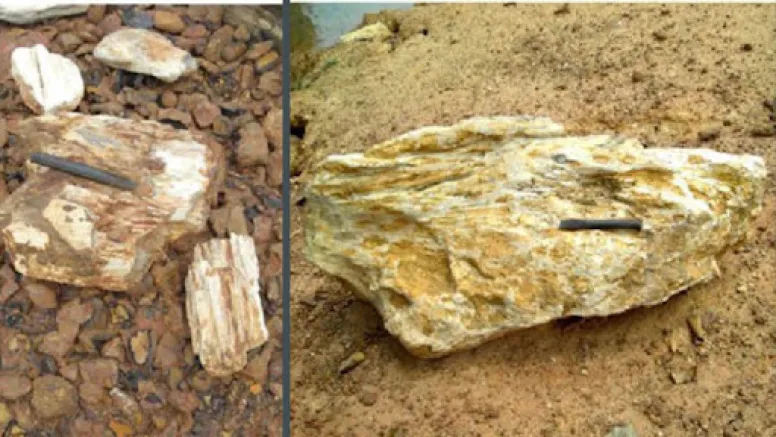
BIRBHUM, WEST BENGAL – In the sun-scorched, rust-colored earth of the Birbhum district, a team of Indian researchers has unearthed a botanical treasure that bridges a five-million-year gap in Earth’s history. The discovery of a remarkably preserved fossilized palm, identified as a new species named Palmoxylon mioflabellifer, provides the first concrete "missing link" in the evolutionary saga of the Palmyra palm—a tree that remains a cultural and ecological cornerstone of the Indian landscape today.
Beyond the identification of a single species, the find serves as a portal into a lost world. It suggests that the Bengal Basin once functioned as a vital "prehistoric highway," a lush, tropical corridor that allowed ancient flora to migrate between Central India and Southeast Asia. This discovery, led by scientists from the University of Calcutta, Sonarpur Mahavidyalaya, and Sidho Kanho Birsha University, offers a profound look at how tectonic shifts and climatic transformations shaped the biodiversity of the modern world.
I. Main Facts: Unveiling Palmoxylon mioflabellifer
The discovery centers on the recovery of silicified wood—plant matter that has undergone a multimillion-year process of turning into stone through the infusion of silica. The specimens were located near the village of Muluk in the western Bengal Basin.
The Identity of a Prehistoric Giant
The new species, Palmoxylon mioflabellifer, is the direct ancestor of the modern Palmyra palm (Borassus flabellifer). While the modern Palmyra is known for its towering height and iconic fan-shaped leaves, its ancestor lived during the Late Miocene to Pliocene epoch, approximately 5 million years ago.
A Collaborative Effort
The research was a multidisciplinary endeavor involving several of West Bengal’s premier academic institutions. The team combined expertise in geology, paleobotany, and microscopic analysis to verify that the specimens were not merely fragments of known fossils but a distinct, previously undocumented species.

Key Anatomical Markers
What sets Palmoxylon mioflabellifer apart from its fossil relatives are its "cellular fingerprints." Under high-magnification microscopy, the researchers identified:
- Tabular Parenchyma: Specialized storage cells arranged in precise one-to-two-layer rings around the tree’s vascular bundles.
- Reniform Protective Caps: Kidney-shaped structures that protected the plant’s internal "plumbing."
- Rounded Median Sinus: A specific notch in the vascular system that distinguishes it from other known fossils like P. pantii and P. sinuosum.
II. Chronology: From the Miocene to the Modern Day
The timeline of this discovery spans five million years of geological history, but the physical recovery of the fossils relied on the specific seasonal rhythms of modern-day West Bengal.
1. The Late Miocene-Pliocene Epoch (Approx. 5 Million Years Ago)
During this era, the Indian subcontinent was undergoing dramatic changes. The Himalayas were rising rapidly to the north, altering global weather patterns and intensifying the monsoon system. In this humid, high-rainfall environment, the Bengal Basin was a dense, tropical rainforest where the Palmoxylon mioflabellifer thrived.
2. The Process of Silicification
As these ancient palms died, they were buried under layers of sediment in the Bengal Basin. Over millennia, mineral-rich groundwater saturated the wood. The organic cellular structure was slowly replaced by silica, preserving the tree’s internal architecture in stone-cold detail, effectively freezing the plant in time.
3. The Field Surveys (Recent Years)
The research team focused their efforts on the western Bengal Basin, specifically targeting the "honeycomb lateritic soil" characteristic of the Birbhum district. This soil is known for its high iron and aluminum content, but it is also a graveyard for prehistoric life.

4. The Summer Breakthrough
The fossils were not found through deep industrial excavation but through the observation of natural cycles. During the peak of the Indian summer, as local ponds dried up and the upper crust of the eroded soil cracked, the heavy, stone-like wood fragments were exposed at the bottom of basins. The team recovered three primary specimens during these windows of opportunity.
III. Supporting Data: Microscopic Analysis and Geological Context
To confirm the discovery, the researchers moved from the dusty fields of Birbhum to the high-tech laboratories of Kolkata. The data gathered during this phase provided the empirical backbone of the study.
The Art of Thin-Sectioning
Because the fossils are as hard as rock, they cannot be sliced with traditional blades. The team utilized specialized diamond-tipped rock-cutting machines to produce sections of the wood that were "paper-thin"—transparent enough for light to pass through under a microscope.
Comparative Taxonomy
The researchers compared the internal anatomy of the Birbhum specimens against an extensive database of palm fossils. The presence of specific "satellite bundles" in P. sinuosum and the concave notches in P. pantii allowed the team to rule those species out. The unique combination of a rounded median sinus and the specific arrangement of storage cells in the Birbhum fossil confirmed it as a new species.
Geological Indicators
The sediment layers where the fossils were found—lateritic conglomerates—indicate a period of fluctuating water tables and intense chemical weathering. This supports the theory that the region once experienced heavy, seasonal tropical rains, which are necessary for the formation of such soil types and the growth of large palm forests.

IV. Official Responses and Academic Reception
While the discovery was spearheaded by regional universities, its implications have resonated throughout the Indian scientific community.
Dr. Subir Bera, a lead researcher involved in the study, emphasized the rarity of such well-preserved specimens. "To find the cellular architecture so intact after five million years is a gift to paleobotany," he noted in a summary of the findings. "It allows us to move beyond guesswork and see exactly how these plants functioned in a high-humidity environment."
Paleontological Circles: Experts in the field of Indian paleobotany have hailed the naming of Palmoxylon mioflabellifer as a significant addition to the Arecaceae (palm) family record. The etymology—combining ‘mio’ (for Miocene) and ‘flabellifer’ (the species name of the modern Palmyra)—has been praised for clearly illustrating the evolutionary lineage.
Conservationists: Modern ecologists have also taken note. The Palmyra palm is currently a vital species for preventing soil erosion and providing livelihoods in rural India. Understanding its ancient resilience to climate shifts provides valuable data for modern conservation efforts in the face of current global warming.
V. Implications: The "Prehistoric Highway" and Future Research
The discovery of Palmoxylon mioflabellifer is more than a botanical footnote; it is a key to understanding the biogeographic history of Southern Asia.

The Bengal Basin as a Dispersal Corridor
One of the most significant implications of the study is the role of West Bengal as a "dispersal corridor." Scientists have long debated how tropical species moved between the Indian mainland and the islands of Southeast Asia. This fossil provides evidence that the Bengal Basin was a hospitable, lush bridge that allowed species to migrate as the Indian plate continued its collision with Eurasia.
Reconstructing Ancient Climates
The existence of this palm species proves that the Birbhum region was once a tropical rainforest with high annual rainfall. This contrasts sharply with the semi-arid, heat-stressed environment often seen in parts of the district today. By studying these fossils, climatologists can better model how the rising Himalayas eventually led to the drying of certain parts of the interior, while keeping the coastal corridors humid.
A Roadmap for Future Discoveries
The success of the Birbhum survey suggests that other "missing links" may be hiding in the lateritic soils of West Bengal. The research team hopes that this discovery will lead to:
- Increased Funding: For more systematic surveys of the western Bengal Basin before urban expansion covers potential fossil sites.
- Paleobotanical Mapping: Creating a comprehensive map of how India’s forests have shifted over the last 20 million years.
- Climate Resilience Studies: Using ancient plant DNA (where possible) or structural data to understand how palms survived previous eras of rapid environmental change.
In the quiet village of Muluk, the stone remains of an ancient palm have finally spoken. They tell a story of a green, vibrant India that served as a cradle for the tropical forests of Asia—a story that began five million years ago and continues to unfold in the shade of the modern Palmyra palms that still dot the horizon.
