

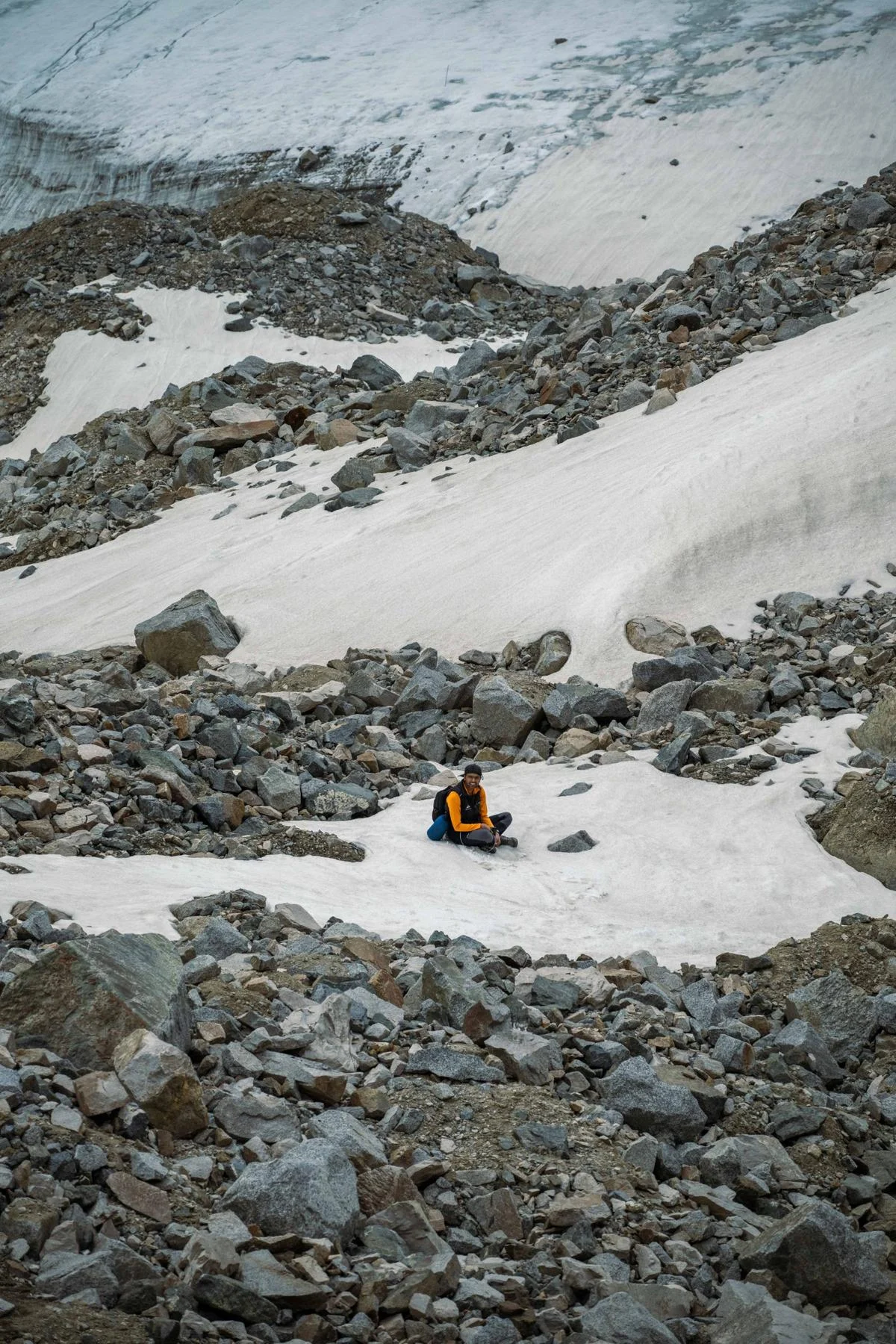
KATHMANDU / NEW DELHI — In the high-altitude theater of the Himalayas, where the line between life and death is often as thin as the mountain air, the story of Anurag Maloo has transitioned from a harrowing survival tale into a clarion call for environmental action. In April 2023, Maloo was clinically dead for nearly four hours after falling into a deep glacial crevasse on Mount Annapurna. Today, he is the architect of a major climate initiative, leveraging his "second life" to protect the very glaciers that nearly claimed him.
His journey from a 70-meter icy tomb to the halls of the World Economic Forum represents a unique intersection of extreme mountaineering, medical miracle, and urgent climate diplomacy.
I. The Chronology of a Miracle: 72 Hours in the Deep Freeze
The events of April 2023 began as a standard, albeit ambitious, expedition. Anurag Maloo, an experienced climber and social entrepreneur with over 15 years in the venture capital and startup ecosystem, was attempting to summit Mount Annapurna, the world’s tenth-highest peak and arguably its most dangerous.
The Fatal Misstep
On April 17, 2023, Maloo was approximately 150 meters from the summit. As weather conditions deteriorated—a common and deadly occurrence on Annapurna—he made the pragmatic decision to turn back. However, during the descent from Camp 3, at an altitude of nearly 6,000 meters, disaster struck. In a moment of high-altitude fatigue, Maloo mistakenly clipped his carabiner into a "dead" or wrong fixed rope.
The rope gave way, and Maloo plummeted 70 meters (approximately 230 feet) into a narrow, vertical crevasse—a "frozen gut" within the glacier.

Survival Against the Odds
For the next three days, Maloo remained trapped in a cathedral of ice. The conditions were lethal:
- Temperature: Hovering around -40°C (-40°F).
- Resources: No food, no water, and no means of communication with the outside world.
- Psychological State: His only companion was his GoPro camera, which he used to record his final thoughts, believing he would not be found alive.
On the fourth day, a specialized team of Polish rescuers and Nepali Sherpas located him. When they finally extracted his body from the glacier, he was unresponsive.
The Resurrection in Pokhara
Upon arrival at a hospital in Pokhara, medical professionals found no pulse or signs of life; Maloo was declared clinically dead. What followed is now a landmark case in extreme medicine. Teams of doctors performed cardiopulmonary resuscitation (CPR) for nearly four hours. In most medical contexts, CPR is ceased after 30 to 45 minutes of no response. However, the hypothermic state of his body had preserved his vital organs—a phenomenon often described in medicine as "you aren’t dead until you’re warm and dead."
His successful resuscitation and subsequent recovery have since been documented in prestigious publications, including the Air Medical Journal and ScienceDirect, as one of the longest and most successful CPR interventions in recorded history.
II. Supporting Data: The Melting Third Pole
During his long recovery, Maloo’s perspective shifted from individual achievement to collective survival. He realized that while he survived 72 hours in a glacier, the glaciers themselves might not survive the next 72 years.

The data supporting his concerns is stark and scientifically vetted:
- Volume Loss: Himalayan glaciers have lost more than 40% of their ice volume since the year 2000.
- Acceleration: The rate of ice loss across the Hindu Kush Himalaya (HKH) region has doubled in the last two decades.
- Global Projections: Current climate models suggest that at least half of the world’s glaciers could disappear by the end of the 21st century if current warming trends continue.
- Human Impact: The HKH region, often called the "Third Pole," provides freshwater to nearly 2 billion people downstream. The loss of these "water towers" threatens the agriculture, energy, and drinking water of one-fourth of the human population.
III. The Voice of Glaciers Foundation (TVGF)
In 2025, Maloo channeled his experience into the creation of The Voice of Glaciers Foundation (TVGF). Having been named a Young Global Leader by the World Economic Forum, Maloo is using his platform to bridge the gap between scientific data and public consciousness.
The foundation is built upon three strategic pillars designed to address the "glacier crisis" through a multidisciplinary lens:
1. Cultural and Public Consciousness
Maloo argues that glaciers are often viewed as "scientific abstractions" or distant backdrops for postcards. TVGF aims to bring glaciers into the mainstream cultural discourse.
- Initiatives: Glacier festivals, public art installations, and awareness campaigns targeted at urban populations whose water and power are derived from glacial melt.
- Goal: To make glacier preservation as recognizable a cause as forest conservation or ocean plastic reduction.
2. Digital Public Infrastructure and AI
Leveraging his background in tech and startups, Maloo is pushing for a technological revolution in mountain monitoring.

- Glacier Risk Intelligence: TVGF is developing an open national platform that utilizes satellite imagery and Artificial Intelligence to create "digital twins" of glacier systems.
- Early Warning Systems: By translating complex data into actionable community intelligence, the foundation hopes to create multi-hazard warning systems for Glacial Lake Outburst Floods (GLOFs) and other climate-induced disasters.
3. Mobilization of Capital
The third pillar focuses on the financial mechanics of conservation. Maloo is working to integrate glacier health into Corporate Social Responsibility (CSR) and philanthropic portfolios.
- Mainstreaming Sustainability: He advocates for upstream mountain ecosystems to be treated as a primary sustainability priority, alongside carbon credits and biodiversity offsets.
- Venture Philanthropy: Applying venture capital principles to ensure that funds are directed toward high-impact, scalable technological solutions for glacier monitoring.
IV. Official and Professional Responses
The medical community continues to study Maloo’s recovery as a miracle of modern physiology. Dr. Jyotindra Sharma, who was involved in the early stages of his treatment, noted that the case redefines the limits of human endurance and medical intervention in hypothermic arrests.
On the environmental front, experts from the International Centre for Integrated Mountain Development (ICIMOD) have lauded Maloo’s transition from survivor to advocate. They note that personal narratives like Maloo’s are essential for "humanizing" climate data that often feels too vast for the average citizen to comprehend.
"In the hospital, I realized that this life doesn’t just belong to me but is meant for something larger than myself," Maloo stated in a recent interview. This sentiment has resonated with international policy-makers, leading to his recognition as a Young Global Leader in 2025.
V. Implications: Water Security as Civilizational Security
The implications of Maloo’s work and the crisis he highlights extend far beyond the mountaineering community. The "glacier problem" is, in reality, a "civilization problem."

Water and Food Security
As glaciers retreat, river flows will initially increase (leading to flooding) and then drastically decrease. This volatility threatens the irrigation systems of the Indo-Gangetic plain, one of the world’s most productive agricultural regions. Without the regulating effect of glaciers, seasonal water scarcity could lead to mass migration and regional instability.
Energy Security
South Asia relies heavily on hydropower generated from Himalayan rivers. Rapid glacial melt and the resulting siltation or unpredictable flow patterns threaten the viability of billions of dollars in energy infrastructure.
The Survivor’s Responsibility
Maloo’s approach is defined by what he calls "the next immediate step." During his rehabilitation, when he could barely stand, he focused only on the most immediate physical goal. He has applied this philosophy to TVGF: rather than being paralyzed by the scale of climate change, the foundation focuses on the immediate "next steps" of data collection, public awareness, and risk mitigation.
Conclusion
Anurag Maloo’s story is a rare bridge between the extreme physical world and the complex world of climate policy. It took a man being pulled from the "frozen gut" of a glacier to remind the world of the fragility of the ice that sustains us.
As the Voice of Glaciers Foundation gains momentum, its core message remains clear: the survival of the glaciers is inextricably linked to our own. While Maloo was fortunate to have 72 hours of life-saving intervention, the world’s glaciers may not have 72 years unless a similar level of urgency is applied to their preservation. The "miracle on Annapurna" was just the beginning; the real work lies in ensuring that the water towers of the world do not become a memory recorded only on a GoPro in the dark.
