

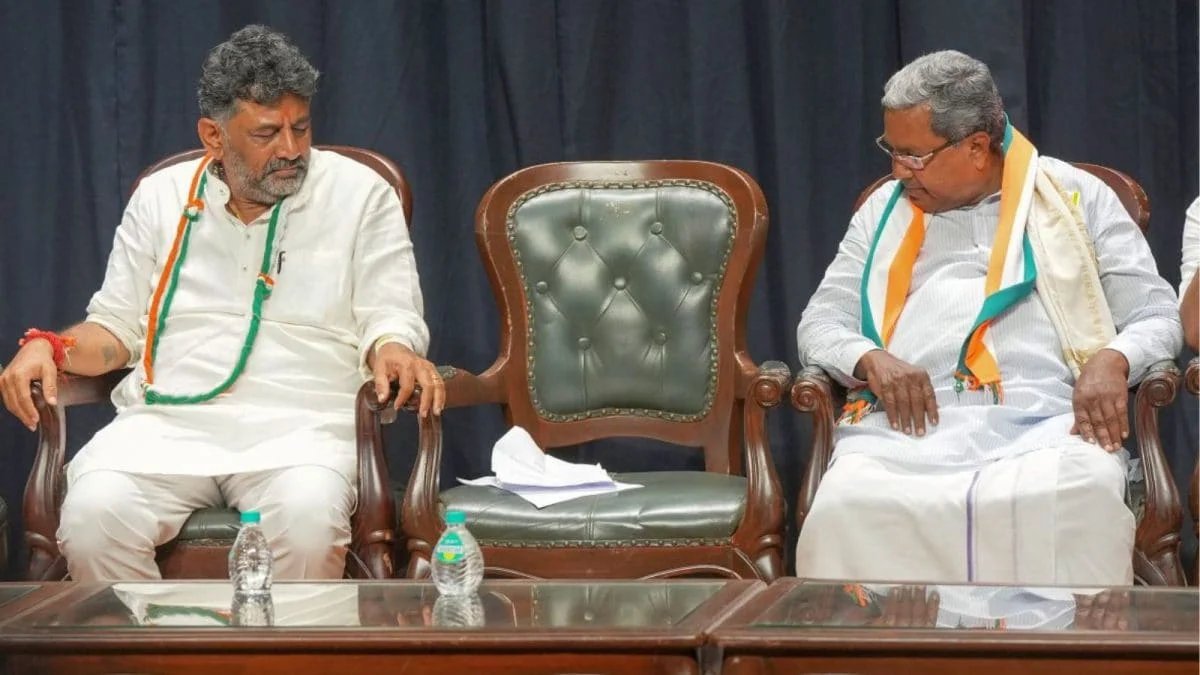
New Delhi, India – The delicate equilibrium of power within the Karnataka Congress, painstakingly maintained for three years, now teeters on the brink as Chief Minister Siddaramaiah and Deputy Chief Minister D.K. Shivakumar arrived separately in New Delhi on Monday. Their visits, ostensibly for routine consultations, have ignited a fresh wave of intense speculation across the state and within national political circles regarding a potential leadership transition, a cabinet reshuffle, or even the emergence of a dark horse candidate. The Congress high command, long wary of upsetting either of its formidable Karnataka strongmen, finds itself at a pivotal juncture, compelled to make a definitive call that could shape the party’s fortunes for the crucial 2028 Assembly elections.
The underlying tension, a familiar leitmotif in Karnataka politics since the Congress’s resounding victory in 2023, has once again resurfaced with unprecedented urgency. With the government having completed three years in office, leaving a mere two years until the next state polls, the party leadership can no longer afford to defer a decision that increasingly impacts governance and internal cohesion. The high-stakes meetings scheduled with the central leadership are anticipated to finally bring clarity to an issue that has cast a long shadow over the state’s political landscape.
Main Facts: A High-Stakes Delhi Sojourn
The arrival of Chief Minister Siddaramaiah and his deputy D.K. Shivakumar in the national capital has set the stage for what many insiders are describing as a make-or-break moment for the Congress in Karnataka. Both leaders, accompanied by their respective confidantes and key supporters, landed in Delhi on Monday evening, fueling the long-standing narrative of a deep-seated rivalry for the state’s top executive post. While public statements from both camps have attempted to downplay the significance of the visit, attributing it to discussions on upcoming Rajya Sabha and Legislative Council elections, the timing, three years into the government’s tenure, suggests a more profound agenda.
The Congress leadership, including party president Mallikarjun Kharge and senior leader Rahul Gandhi, is expected to engage in crucial deliberations with the duo. The central dilemma revolves around the long-rumoured power-sharing agreement, which allegedly stipulated that Siddaramaiah would lead for the first half of the term, with Shivakumar taking over for the latter half. While never officially confirmed, this purported arrangement has been a constant source of political intrigue and a significant factor in the periodic resurfacing of leadership debates.
The party’s central leadership has, for nearly three years, adopted a strategy of non-intervention, hoping to maintain unity and stability. However, this cautious approach has inadvertently created an environment of ambiguity, which, as admitted by some senior state ministers, has begun to affect administrative efficiency and party morale. The pressure to resolve this internal conflict is immense, not least because Karnataka remains one of the few large states where the Congress holds independent power, making its stability paramount for the party’s national ambitions.
Chronology: A Power Tussle Through the Years
The leadership conundrum in Karnataka is not a recent phenomenon but rather a simmering issue that dates back to the very formation of the current government.
May 2023: The Victory and the Volatility
Following a spectacular victory in the 2023 Assembly elections, where the Congress secured a comfortable majority, the immediate challenge for the high command was to choose between two towering figures: Siddaramaiah, a veteran mass leader with extensive administrative experience and a proven track record, and D.K. Shivakumar, the dynamic state party president credited with galvanizing the party machinery and meticulous election management. The intense lobbying by both camps led to a four-day stalemate, during which both leaders camped in Delhi, meeting with the central leadership. Eventually, the high command brokered a compromise, appointing Siddaramaiah as Chief Minister and Shivakumar as his Deputy, with the latter also retaining his post as Karnataka Pradesh Congress Committee (KPCC) President. Unconfirmed reports, widely circulated and implicitly acknowledged by Shivakumar’s camp, suggested a power-sharing formula, with a rotational chief ministership after 2.5 years. This unwritten agreement has been the ghost in the machine of Karnataka politics ever since.
Post-Formation: Persistent Speculation
Throughout the first three years of the government’s tenure, the leadership question has periodically flared up. Statements from MLAs, ministers, and even district-level leaders, often in support of either Siddaramaiah or Shivakumar, have consistently reignited the debate. These public pronouncements, though often dismissed as individual opinions, have kept the issue alive, creating an undercurrent of uncertainty within the administration and among party cadres. Each significant milestone, be it a cabinet expansion, a legislative session, or even internal party meetings, has been scrutinised for clues regarding the impending leadership change.
Early 2024: Lok Sabha Elections and Renewed Pressure
The 2024 Lok Sabha elections served as a critical stress test for the Congress government in Karnataka. Despite being in power, the party’s performance was underwhelming, securing only 9 out of the state’s 28 parliamentary seats. While various factors contributed to this outcome, internal discord and the perceived lack of absolute unity between the top two leaders were widely cited as significant impediments. The Lok Sabha results intensified calls from within the party for the high command to address the leadership issue decisively, arguing that continued ambiguity would be detrimental to the party’s prospects in the upcoming 2028 Assembly elections.
May 2026: The Three-Year Mark and the Delhi Summit
The completion of three years in office by the Congress government in May 2026 has served as the unofficial trigger for the current round of high-level consultations in Delhi. With only two years remaining until the next Assembly elections, the window for a smooth and effective transition, if one is indeed planned, is rapidly closing. The stakes are higher than ever, as the party needs to present a united and stable front to the electorate. The separate visits of Siddaramaiah and Shivakumar to the capital, following a flurry of internal meetings and discussions in Bengaluru, underscore the gravity of the situation and the immediate need for a resolution from the Congress central leadership.
Supporting Data: The Political Chessboard and Electoral Realities
The Congress high command’s predicament is not merely about managing individual ambitions but navigating a complex political landscape shaped by social coalitions, electoral performance, and strategic imperatives.
The Political Calculus: Stakes for 2028
Karnataka is a crucial bastion for the Congress, representing one of its few large state governments. Retaining power in 2028 is paramount for the party’s national rejuvenation efforts. The decision regarding leadership will profoundly impact the party’s unity, campaign strategy, and ability to counter the formidable challenge posed by the BJP. Any misstep could fracture crucial voter bases and hand an advantage to the opposition. The two-year lead-up to the next Assembly polls is a critical period for consolidating achievements, addressing anti-incumbency, and presenting a cohesive vision.
Electoral Performance and Internal Discord
The outcome of the 2024 Lok Sabha elections provided a stark reminder of the consequences of internal friction. Despite the state government’s populist schemes and welfare programmes, the Congress managed to win only 9 of the 28 Lok Sabha seats. Political analysts and internal party assessments largely attributed this underperformance, in part, to the lingering perception of disunity at the top. Voters, it is argued, are often swayed by the image of a stable and united leadership. The infighting, even if subtle, can lead to a lack of coordinated efforts, dampen cadre enthusiasm, and create confusion among the electorate. A decisive resolution now could allow the party ample time to present a united front and consolidate its base before 2028.
The AHINDA and Vokkaliga Dynamics
At the heart of Karnataka’s electoral success for the Congress lies the delicate balance of social coalitions. Siddaramaiah is widely regarded as the architect and face of the powerful AHINDA (Alpasankhyataru – minorities, Hindulidavaru – backward classes, and Dalitaru – Dalits) social coalition. This formidable bloc, representing a significant portion of the state’s population, has been a bedrock of Congress support. His appeal among these communities is unparalleled, making him an indispensable figure for electoral success.
On the other hand, D.K. Shivakumar commands substantial influence among the Vokkaliga community, a dominant and politically significant caste group in Karnataka, accounting for roughly 10-15% of the state’s population, particularly strong in the Old Mysore region. The Vokkaliga vote bank is crucial for any party aiming for power, and Shivakumar’s leadership is seen as vital for consolidating this support. Alienating either leader risks fragmenting these critical vote banks, a prospect the Congress cannot afford. The challenge, therefore, is to craft a solution that respects the influence and aspirations of both leaders while maintaining the integrity of these crucial social alliances.
Siddaramaiah’s Enduring Appeal
Siddaramaiah, a seasoned politician with over four decades of public life, has an undeniable mass appeal. His administrative experience, particularly his previous stint as Chief Minister from 2013-2018, is a significant asset. He is perceived as a pro-poor leader, adept at implementing welfare schemes, and his calm, composed demeanour often contrasts with the more aggressive style of his deputy. His leadership is seen as stable and experienced, offering continuity and a familiar face to the electorate. For many, he embodies the Congress’s commitment to social justice and inclusive governance.
Shivakumar’s Organisational Prowess
D.K. Shivakumar is widely acknowledged as the Congress’s chief troubleshooter, a formidable fundraiser, and an astute political strategist. His organisational skills, demonstrated during the 2023 Assembly elections where he meticulously managed campaign logistics and candidate selection, were instrumental in the party’s victory. As KPCC President, he commands the party machinery and has a strong network of loyalists. Beyond Karnataka, his reputation as a crisis manager has seen him deployed by the high command to resolve issues in other states, underscoring his value to the national party. His dynamism and aggressive campaigning style are seen as crucial for energizing the party’s base and countering the opposition’s narrative.
Official Responses: Decoding the Public Stance
The gravity of the situation has prompted a range of responses from Congress leaders, with some attempting to downplay the issue while others have openly acknowledged the need for resolution.
Congress president Mallikarjun Kharge, when pressed for comments on the Karnataka developments, maintained a non-committal stance, stating, "I cannot comment on this. Rahul Ji will talk about these things." This deflection indicates the sensitivity of the matter and the likely involvement of the highest echelons of the party in the decision-making process.
Chief Minister Siddaramaiah himself, upon his arrival in Delhi, brushed aside speculation surrounding a leadership change with a terse, "Speculations are always there." His composed response, while characteristic, does little to quell the intense political chatter.
In contrast, sources quoted by ANI suggest that "clarity on the issue could emerge within the next two to three days," indicating that the Delhi meetings are indeed focused on finding a definitive resolution. Beyond the leadership question, these discussions are also expected to encompass the strategic allocation of seats for the upcoming Rajya Sabha elections, a potential Cabinet reshuffle to address performance or regional imbalances, and strategies for the Legislative Council polls.
Karnataka minister Priyank Kharge, attempting to diffuse the tension, publicly stated that the Chief Minister and Deputy Chief Minister were primarily summoned to discuss Rajya Sabha seats and upcoming MLC elections. "We also have a lot of MLC seats opening up in less than 15-20 days. So they will discuss with the high command about that. What is wrong if our leaders, legislators and council members go meet our high command?" he questioned, aiming to present the visit as a routine consultative exercise.
Another minister, Satish Jarkiholi, offered a more candid assessment, acknowledging that the Delhi meeting was aimed at "resolving issues within the party." This admission hints at the underlying challenges the party faces internally. Meanwhile, Congress MLC Nagaraju Yadav insisted on party unity, asserting, "We are all working as family members together… The High Command is strong enough to take the appropriate decision at the appropriate time." Such statements reflect the internal pressure to project an image of solidarity, even amidst deep-seated factionalism.
However, the most direct and perhaps telling admission came from Karnataka Home Minister G. Parameshwara. He made a clear statement that the ongoing uncertainty was beginning to impact the state’s administration. "I believe there shouldn’t be any political ambiguity in our party. It affects administration. So it is in the interest of the state and the people if it is resolved," he stated, providing a crucial insight into the real-world consequences of the protracted leadership debate. His words underscore the urgency with which the high command must now act.
Implications: Scenarios, Governance, and Future Trajectories
The Congress high command’s decision will have far-reaching implications, not just for Karnataka but for the party’s national standing. As the leadership weighs its options, three primary scenarios emerge, each with its own set of advantages and inherent risks.
The Three Scenarios Explored
Scenario 1: Status Quo with Cabinet Reshuffle
The first and perhaps most cautious approach involves maintaining Siddaramaiah as Chief Minister for the remainder of the term while undertaking a significant Cabinet reshuffle. This strategy aims to address dissatisfaction by accommodating more loyalists from both camps, rewarding performance, or balancing regional representation.
- Advantages: Provides continuity and avoids immediate political upheaval. It allows Siddaramaiah to complete his term, fulfilling the mandate initially given to him. A reshuffle could be used to inject fresh energy into the administration and address any perceived underperformance.
- Challenges: This option would likely disappoint D.K. Shivakumar and his supporters, who have consistently signalled their expectation of a power transfer based on the alleged 2.5-year agreement. Their frustration could lead to renewed internal dissent, potentially making the latter half of the government’s tenure more turbulent. It might also be seen as a deferral rather than a resolution, leaving the underlying tensions unaddressed.
Scenario 2: Shivakumar Ascends to Chief Minister
The second, and politically bolder, option would be to honour the unconfirmed power-sharing agreement and hand over the Chief Minister’s post to D.K. Shivakumar. This would mark a significant shift in leadership, placing a new face at the helm for the crucial two years leading up to the 2028 elections.
- Advantages: This move would validate Shivakumar’s claim and reward his significant contributions to the party’s victory in 2023. It could energize his Vokkaliga base and demonstrate the high command’s commitment to honouring agreements, even if informal. Shivakumar’s dynamic leadership could bring a new vigour to the administration and party organisation.
- Challenges: Such a transition could alienate Siddaramaiah’s powerful AHINDA bloc and his loyalists, potentially leading to a backlash or even defections. Managing Siddaramaiah’s transition and ensuring his continued active support would be critical. Furthermore, it could open the party to criticism of instability and internal power struggles, providing ammunition to the opposition.
Scenario 3: The Dark Horse Candidate
A third, though less probable, possibility is the emergence of a consensus candidate from outside the immediate Siddaramaiah-Shivakumar rivalry. This "compromise candidate" would be chosen to break the deadlock and unite the warring factions.
- Advantages: This could potentially bring an end to the protracted rivalry, presenting a united front. A neutral candidate might be able to rally support from both camps and focus solely on governance.
- Challenges: Finding a candidate with sufficient stature, administrative experience, and pan-state appeal to command respect from both Siddaramaiah and Shivakumar, and their respective support bases, would be extremely difficult. One name that occasionally surfaces in political discussions is Mallikarjun Kharge, a veteran Dalit leader from Karnataka and the current Congress President. However, elevating the 83-year-old Kharge to state politics would create fresh challenges for the Congress nationally, necessitating a replacement for his crucial role as party president and complicating the party’s long-term organisational plans. Other potential dark horses would likely lack the necessary political heft to maintain control over two such influential leaders.
Impact on Governance and Administration
The most immediate and critical implication of the protracted leadership uncertainty is its effect on governance. As acknowledged by Home Minister G. Parameshwara, "political ambiguity… affects administration." Policy decisions can be delayed, bureaucratic efficiency can suffer, and long-term planning can be hampered when there is a perceived lack of absolute stability at the top. Ministers and bureaucrats might become hesitant to take bold decisions, fearing that a change in leadership could reverse their initiatives. This can ultimately impact public service delivery and the implementation of welfare schemes, directly affecting the lives of ordinary citizens. A clear resolution is vital to ensure that the government can function optimally and deliver on its promises to the electorate.
Future of Congress in Karnataka
The decision made in Delhi will profoundly shape the future trajectory of the Congress in Karnataka. A well-managed transition or a reaffirmation of the current structure, accompanied by effective internal communication, could strengthen the party, consolidate its voter base, and prepare it for the 2028 Assembly elections. Conversely, a poorly handled decision, or one that alienates a significant faction, could lead to internal sabotage, reduced electoral performance, and a weakening of the party’s organisational structure. The Congress needs both the strategic acumen and fundraising capabilities of Shivakumar, and the mass appeal and social coalition leadership of Siddaramaiah, to remain a dominant force in the state. Finding a formula that keeps both leaders engaged and committed to the party’s collective goal is the ultimate challenge.
National Ramifications
Beyond Karnataka, the outcome of this leadership tussle will have national ramifications for the Congress. As one of its most important state governments, Karnataka is often seen as a model for Congress rule. How the party handles such a sensitive internal matter will reflect on its ability to manage strong regional leaders and maintain discipline. A smooth resolution could project an image of a mature and decisive national leadership, while continued infighting could further undermine its national credibility, particularly after a disappointing performance in the recent Lok Sabha elections. The eyes of the entire party, and its political rivals, are on Delhi, awaiting the high command’s verdict on this critical juncture in Karnataka’s political journey.
The Congress high command stands at a crucial crossroads. The decision it makes in the coming days will determine not only the immediate future of Karnataka’s governance but also the long-term health and electoral prospects of the party in a state that remains one of its most vital strongholds. The choice is no longer whether to act, but how decisively and strategically to resolve a dilemma that has become an undeniable political burden.
