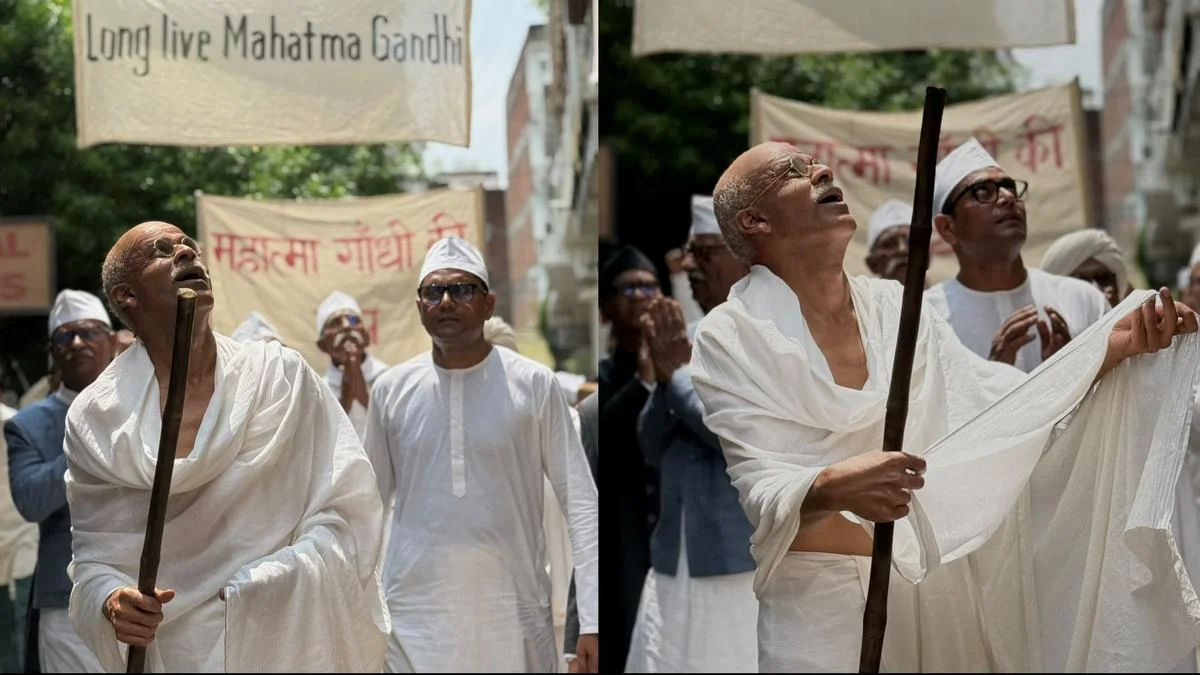
Mumbai, India – September 6, 2026 – The cinematic landscape is abuzz with anticipation as the first look of acclaimed actor Manoj Bajpayee embodying Mahatma Gandhi in filmmaker Sudhir Mishra’s upcoming historical drama has been officially released. The striking image, shared by the production house A Benaras Mediaworks on Sunday, September 6th, marks a significant moment in Indian cinema, presenting Bajpayee in a near-unrecognizable transformation that promises to delve into a pivotal yet often overlooked chapter of India’s independence struggle.
Produced under the banner of A Benaras Mediaworks, spearheaded by the renowned filmmaker Anubhav Sinha, the untitled film is poised to explore a crucial 21-day period during India’s journey towards freedom. This unveiling signifies not just the visual realization of a historical icon but also a commitment to dissecting the complex undercurrents and personal narratives that shaped this transformative era.
Unveiling the Gandhi: A Visual and Thematic Revelation
The initial visual offering presents Manoj Bajpayee, an actor celebrated for his nuanced performances and intense characterizations, in a profound metamorphosis. His portrayal of Gandhi appears to eschew mere physical resemblance, aiming instead for an authentic capture of the Mahatma’s spirit during a particularly introspective and impactful phase of his life. The press release accompanying the first look emphasized the "near-unrecognisable transformation," hinting at the meticulous attention to detail and the dedication to authenticity that has been invested in this project.
This artistic choice to focus on a specific, lesser-documented 21-day period suggests a narrative that moves beyond the widely known events of Gandhi’s life. It signals an intention to explore the internal landscape of the leader, the subtle shifts in his philosophy, and the strategic decisions that, while perhaps not making headlines, profoundly influenced the course of the nation’s destiny.
A Pivotal 21 Days: Delving into Gandhi’s Strategic Reinvention
Filmmaker Sudhir Mishra, known for his intellectually stimulating and often politically charged cinema, elaborated on the film’s thematic core in an earlier statement. He articulated that the narrative would concentrate on a specific 21-day interlude in Mahatma Gandhi’s life, coinciding with the nation’s imminent independence and the burgeoning power dynamics in Delhi.
"This new film focuses on the 21 days in the life of Mahatma Gandhi during India’s independence," Mishra stated. "At a time when the nation was stepping into freedom, and Delhi was becoming the center of power, Gandhi made an unexpected choice: he chose to walk away. But by walking away, he did not retreat. He reinvented himself."
Mishra’s words underscore the central thesis of the film: Gandhi’s deliberate withdrawal from the immediate seat of power was not an act of passive resignation but a strategic maneuver, a form of self-reinvention. While historical records meticulously document the overt political events of that era, this film aims to plumb the depths of what lay beneath Gandhi’s "famous choice." It promises to illuminate the personal journey of a leader at a critical juncture, redefining his path and influence in a newly independent India. This approach suggests a deep dive into the philosophical underpinnings of Gandhi’s actions, exploring the motivations and the intellectual rigor behind his decisions during this critical transition.
The Visionaries Behind the Lens: A Collaboration of Renowned Storytellers
The collaborative forces behind this ambitious project are noteworthy. Sudhir Mishra, a veteran director with a distinguished body of work including critically acclaimed films like Hazaaron Khwaishein Aisi and Dharavi, brings his signature depth and social commentary to the forefront. His previous collaboration with producer Anubhav Sinha on the 2023 film Afwaah showcased their shared commitment to impactful storytelling.
Anubhav Sinha, a filmmaker celebrated for his socially conscious narratives in films such as Mulk, Article 15, and Thappad, lends his production prowess and keen eye for relevant cinema to this project. His production house, A Benaras Mediaworks, has consistently championed films that engage with critical societal and historical themes. The film is also presented by NH Studioz, further broadening its reach and potential impact.
The ensemble cast is further strengthened by the inclusion of Saurabh Shukla in a lead role, an actor whose versatility and gravitas are well-established. The synergy between these creative minds—Mishra’s directorial vision, Sinha’s production acumen, and the talents of Bajpayee and Shukla—suggests a film that is not only historically significant but also artistically compelling.

Supporting Data and Historical Context: The Unfolding Narrative
The choice of a 21-day period is particularly intriguing. While the broad strokes of India’s independence in August 1947 are widely known, the immediate aftermath was a period of immense flux, marked by partition, displacement, and the complex task of nation-building. Gandhi, who had been a central figure in the independence movement, took a different path in the days surrounding the transfer of power. He famously abstained from participating in the grand celebrations in Delhi, choosing instead to focus his energies on quelling communal violence in Bengal.
This period was characterized by Gandhi’s deep concern for the plight of refugees and his relentless efforts to foster peace and reconciliation amidst widespread sectarian strife. His presence in areas ravaged by violence, his fasts, and his tireless advocacy for communal harmony demonstrated a leadership that transcended political maneuvering. This film’s focus on this specific timeframe suggests an exploration of Gandhi’s role as a moral compass and a force for peace during a time of profound national trauma.
The historical context is crucial: India had endured centuries of colonial rule, and the attainment of independence was a monumental achievement. However, the partition of the country along religious lines led to one of the largest and most violent migrations in human history. Delhi, as the newly established capital, was at the epicenter of these events, grappling with the influx of refugees and the escalating communal tensions. Gandhi’s decision to focus on the ground realities, rather than engage directly with the newly formed government’s power structures, highlights his unwavering commitment to the welfare of the common people and his unique approach to leadership, which often prioritized moral imperatives over political expediency.
Official Responses and Industry Reactions
The unveiling of Manoj Bajpayee’s first look has been met with widespread enthusiasm and critical acclaim from the film industry and audiences alike. Social media platforms have been abuzz with praise for Bajpayee’s transformative appearance and the promising thematic depth of the film.
"This is a casting masterstroke," commented a film critic on a prominent entertainment portal. "Manoj Bajpayee has the intensity and gravitas to truly inhabit the persona of Mahatma Gandhi, especially during such a complex period."
Producers Anubhav Sinha and Narendra Hirawat have expressed their commitment to presenting a nuanced and authentic portrayal of this significant historical moment. While detailed production updates are yet to be released, the initial reception suggests a high level of anticipation for the film’s cinematic and narrative achievements.
Implications and Future Projections
The decision to focus on this specific, less-explored chapter of Gandhi’s life has significant implications for how the Mahatma’s legacy will be perceived and understood by contemporary audiences. By delving into his strategic "walk away" and his subsequent reinvention, the film has the potential to offer fresh perspectives on his leadership philosophy and his enduring relevance.
In an era where political discourse can often be polarizing, a film that examines Gandhi’s actions through a lens of introspection and moral purpose could serve as a powerful reminder of the values he championed. The collaboration between Sudhir Mishra and Anubhav Sinha, two filmmakers known for their thought-provoking cinema, suggests that the film will likely be more than just a biographical account; it is expected to be an exploration of leadership, resilience, and the enduring power of humanism in the face of adversity.
The success of this film could also pave the way for further cinematic explorations of lesser-known facets of India’s rich history, encouraging filmmakers to delve into the nuances and complexities that often lie beneath the surface of grand historical narratives. As the production progresses, the industry and audiences will be keenly watching for further insights into this ambitious project, which promises to be a significant contribution to Indian cinema and a profound re-examination of a universally revered figure. The release date for the film has not yet been announced, but the anticipation for this historical drama, anchored by Manoj Bajpayee’s captivating portrayal, is already palpable.