

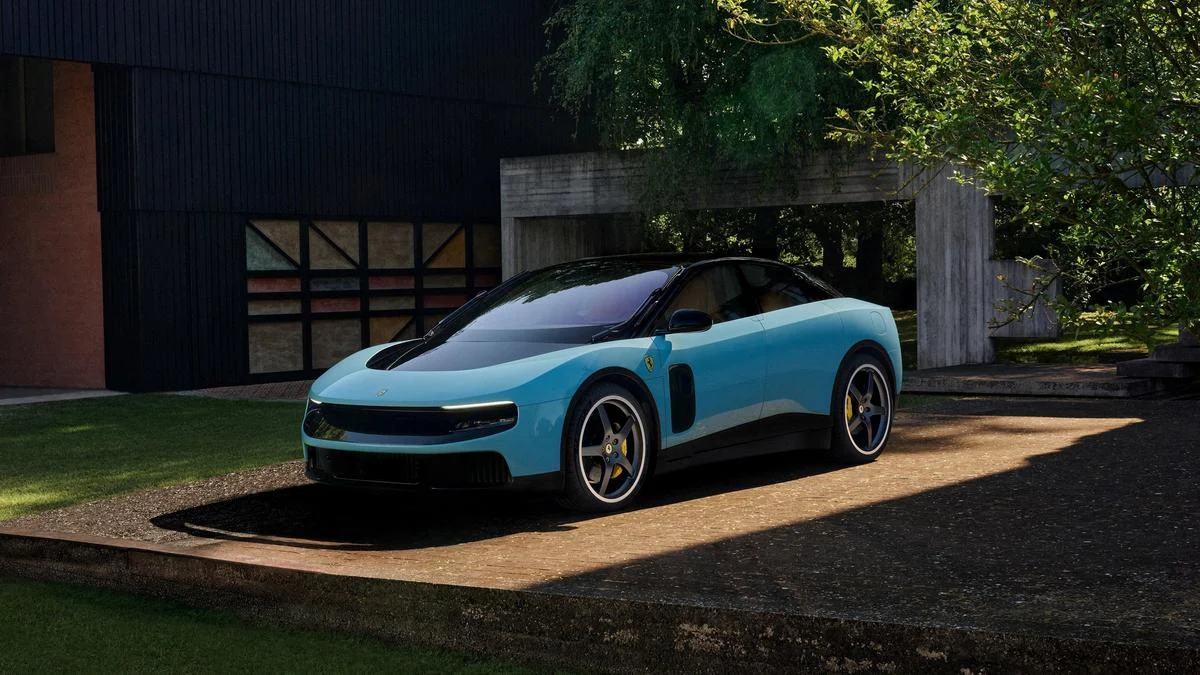
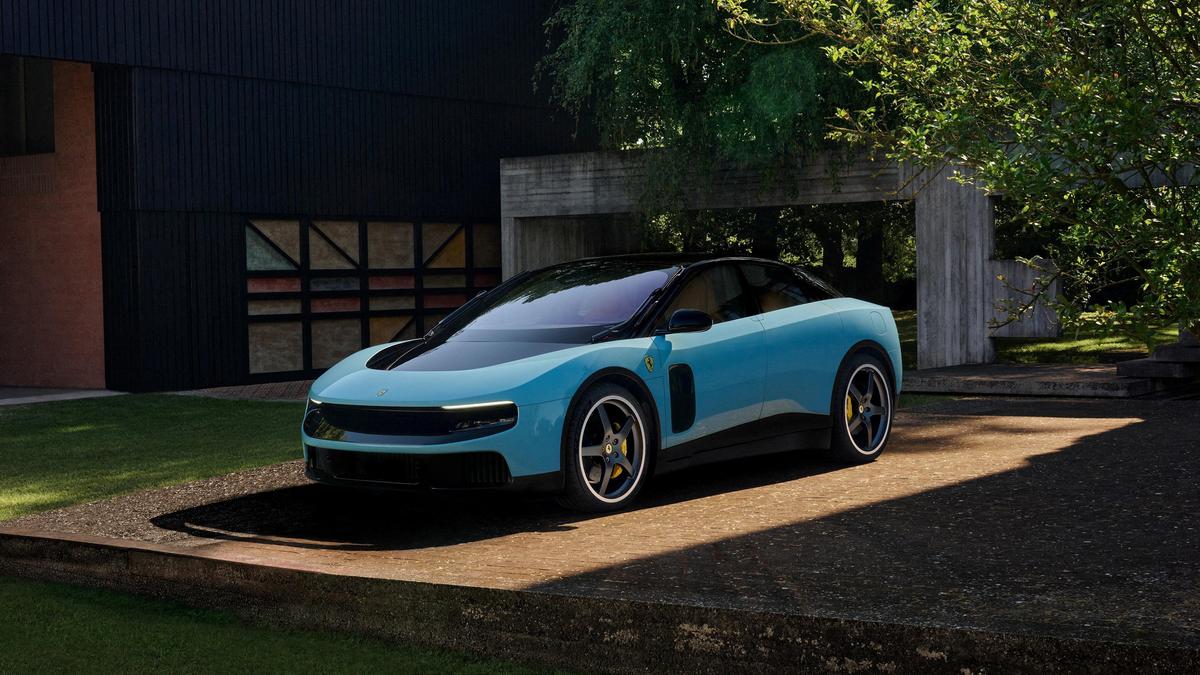
MARANELLO, Italy — In a move that marks the most significant architectural shift in its 79-year history, Ferrari NV has officially pulled the silk off the "Luce," its first-ever fully electric vehicle (EV). The unveiling, which took place late Monday at the company’s newly inaugurated "e-building" in Maranello, signals the Prancing Horse’s definitive, if cautious, entry into the age of zero-emission performance.
Named after the Italian word for "light," the Luce arrives at a crossroads for the luxury automotive sector. While it promises the blistering performance synonymous with the brand, it also introduces a series of "firsts" that challenge long-standing traditions: it is the heaviest Ferrari ever built, only the second four-door in the catalog, and the brand’s first true five-seater.
Main Facts: A New Breed of Prancing Horse
The Ferrari Luce is not merely an exercise in electrification; it is a statement of engineering intent designed to silence critics who argued that a battery-powered Ferrari would lack the visceral thrill of its internal combustion engine (ICE) predecessors.
Performance and Powertrain
The Luce is built upon a bespoke EV architecture developed in-house. According to official technical specifications, the vehicle features a tri-motor setup—one on the front axle and two on the rear—enabling sophisticated torque vectoring. This configuration allows the Luce to sprint from 0 to 100 km/h (62 mph) in a staggering 2.5 seconds, placing it in the same league as the hybrid SF90 Stradale.
The car’s top speed is rated at over 310 km/h (190 mph), an impressive feat for an electric vehicle where high-end velocity often compromises battery thermals. To support this performance, Ferrari has equipped the Luce with a massive 122 kWh battery pack, providing a range of over 530 kilometers (330 miles) on a single charge under the WLTP cycle.
Dimensions and Utility
Perhaps the most striking aspect of the Luce is its silhouette. Following the trail blazed by the Purosangue, the Luce features four doors, but it goes a step further by offering a five-seat configuration. This pivot toward "lifestyle" utility suggests Ferrari is targeting a broader demographic—one that values daily usability alongside track-ready performance.
However, the transition to electric power comes with a physical cost. The Luce tips the scales at 2.26 tonnes (approximately 4,982 lbs). This makes it the heaviest vehicle to ever wear the Ferrari badge, a consequence of the high-energy-density battery required to meet the brand’s range and power requirements.
Chronology: The Road to Maranello’s Electric Era
The journey to the Luce has been a decade-long evolution, marked by Ferrari’s strategic "step-by-step" approach to electrification.
- 2013: The Hybrid Inception. Ferrari introduced the LaFerrari, its first limited-edition hybrid, using a Formula 1-derived KERS system. This proved that electrification could enhance, rather than dilute, performance.
- 2019: Series Production Hybrids. The launch of the SF90 Stradale marked Ferrari’s first plug-in hybrid (PHEV) in regular production, followed by the V6-powered 296 GTB in 2021.
- 2021: The Commitment. Under the leadership of then-new CEO Benedetto Vigna, Ferrari officially committed to unveiling its first fully electric car in 2025 (later slated for a 2026 market debut).
- 2024: The E-Building. Ferrari completed its "e-building" in Maranello, a high-tech facility dedicated to the production of electric motors, battery packs, and power inverters.
- May 2026: The Reveal. After years of speculation and "mule" sightings near the Maranello factory, the Luce is officially unveiled to the public, marking the start of a new chapter.
Supporting Data: The EV Landscape and Luxury Market Shifts
Ferrari’s entry into the EV space comes at a complex time for the global automotive industry. While the mass market has seen a cooling of EV demand, the ultra-luxury segment remains a battleground for technological supremacy.
Comparative Weight and Battery Tech
The Luce’s 122 kWh battery is one of the largest in the passenger vehicle segment, surpassing the Porsche Taycan’s 105 kWh (Performance Battery Plus) and the Tesla Model S Plaid’s 100 kWh. The decision to go with a larger battery highlights Ferrari’s refusal to compromise on range, even at the expense of weight.
To mitigate the 2.26-tonne mass, Ferrari engineers have utilized an "active chassis" system and rear-wheel steering to maintain the "fun-to-drive" factor. The center of gravity is lower than any ICE Ferrari, thanks to the floor-mounted battery, which the company claims provides "unprecedented lateral stability."
Market Targets and Financial Outlook
In 2022, Ferrari’s strategic plan suggested that by 2030, fully electric and hybrid models would make up 80% of its sales, with 40% being pure EVs. However, as noted in the recent launch announcement, the company has recalibrated these expectations. Ferrari now anticipates electric models to account for 20% of its offering by 2030.
This 50% reduction in the EV target reflects a pragmatic response to global infrastructure challenges and the persistent desire among collectors for high-revving naturally aspirated engines. Despite this, Ferrari’s stock remains resilient, with investors viewing the Luce as a necessary hedge against future regulatory bans on internal combustion in key markets like Europe and China.
Official Responses: Preserving the "Soul" of Ferrari
The leadership at Ferrari is well aware of the skepticism surrounding an electric Prancing Horse—specifically regarding the loss of the iconic V12 or V8 exhaust note.
"We are inaugurating a chapter that turns our vision into reality, strengthening Ferrari’s tradition of anticipating and shaping the future," said John Elkann, President of Ferrari, during the unveiling. Elkann emphasized that the Luce is "first and foremost a Ferrari," implying that the brand’s DNA remains intact despite the change in propulsion.
CEO Benedetto Vigna has previously addressed the "sound" issue, noting that Ferrari has patented several "sound signatures" for its electric models. While the Luce does not mimic a V12, it utilizes a sophisticated acoustic system that amplifies the natural frequencies of the electric motors, creating a unique, futuristic "crescendo" as the car accelerates.
"The Luce is about emotion," Vigna stated in a post-launch briefing. "It is not just about moving from point A to point B; it is about the thrill of the drive. Our electric motors are not off-the-shelf components; they are Maranello-bred, designed to deliver power with the same urgency our clients expect."
Implications: What the Luce Means for the Future
The launch of the Luce carries profound implications for the automotive industry and the Ferrari brand itself.
1. The Redefinition of Luxury Performance
Ferrari’s decision to build a four-door, five-seater EV suggests that the future of luxury is moving toward "versatile performance." By entering this space, Ferrari is directly challenging the Porsche Taycan Turbo GT and the upcoming electric replacements from Lamborghini and Aston Martin. It signals that the "supercar" label is expanding to include vehicles that can accommodate a family.
2. The Weight Challenge
The Luce’s 2.26-tonne weight is a lightning rod for debate. It highlights the primary hurdle for performance EVs: the energy-to-weight ratio. How Ferrari’s loyal "Tifosi" respond to this heavier driving dynamic will likely dictate how aggressively the company pursues further EV models. If the Luce can mask its weight through advanced software and suspension, it could set a new benchmark for heavy-duty performance.
3. The Co-existence of E-Fuels and Batteries
By lowering its 2030 EV targets to 20%, Ferrari is signaling that it is not giving up on the internal combustion engine. The company is heavily investing in carbon-neutral e-fuels, which could allow its iconic V12 engines to survive in a net-zero world. The Luce, therefore, is not a replacement for the ICE, but a parallel path.
4. Brand Equity and Exclusivity
The Luce will likely carry a price tag significantly higher than the SF90, with analysts estimating a starting price north of €500,000 ($545,000). By keeping the price point high and the production volumes controlled, Ferrari aims to maintain its exclusivity even as it adopts a technology that is becoming increasingly commoditized in the mass market.
Conclusion
The Ferrari Luce is more than a car; it is a high-stakes gamble on the future of luxury. In the silent surge of the Luce, Ferrari is attempting to prove that "soul" is not found in the combustion of gasoline, but in the precision of engineering and the passion of the drive. Whether the world’s most discerning drivers will embrace a 2.2-tonne silent Ferrari remains to be seen, but as of today, the path to Maranello is officially electrified.
