

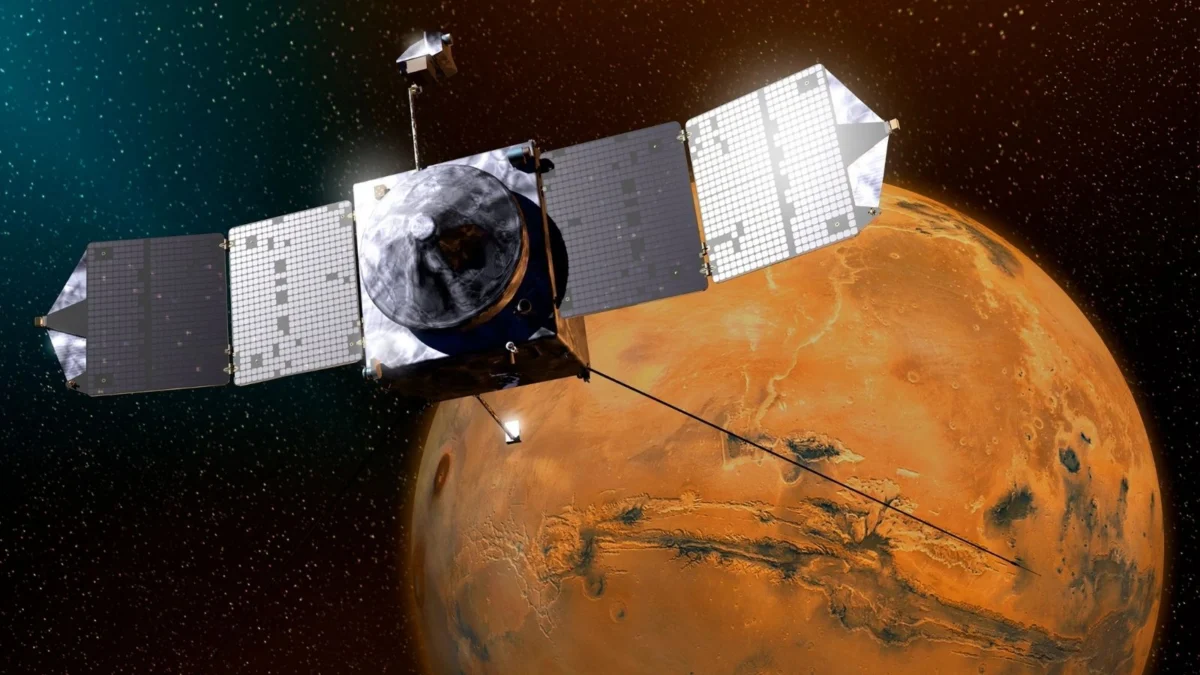
Pasadena, California – June 4, 2026 – After more than eleven years meticulously studying the Martian atmosphere and unraveling the secrets of its ancient climate, NASA has officially declared the Mars Atmosphere and Volatile Evolution (MAVEN) spacecraft unrecoverable. The decision marks the bittersweet end of one of the agency’s most successful Mars missions, which profoundly reshaped humanity’s understanding of how the Red Planet transformed from a potentially habitable, water-rich world into the cold, arid desert we know today.
Contact with MAVEN was inexplicably lost in late 2025, during what was anticipated to be a routine orbital maneuver. Despite months of intensive efforts by a dedicated anomaly review board, the critical Mars orbiter could not be revived. Preliminary investigations suggest an unexpected and rapid change in the spacecraft’s rotation rate led to a catastrophic power drain, silencing MAVEN’s vital communication systems forever.
Main Facts: A Silent Sentinel’s End
NASA’s MAVEN mission, launched in November 2013 and arriving at Mars in September 2014, was designed to investigate the processes that led to the loss of Mars’ atmosphere and water over billions of years. Its primary goal was to determine the rate at which the Martian atmosphere is currently escaping into space and to understand the historical context of this loss. Over its extended operational life, MAVEN provided unprecedented insights, delivering the first direct measurements of how solar wind strips away atmospheric gases, and detecting multiple types of Martian auroras.
The final chapter for MAVEN began on December 6, 2025, when the spacecraft failed to re-establish communication with Earth after passing behind Mars. This routine orbital occultation, a common occurrence for Mars orbiters, usually sees the spacecraft emerge and signal home. However, on this occasion, the global network of radio antennas known as NASA’s Deep Space Network (DSN) received no response.
Following the persistent silence, NASA established an anomaly review board in February 2026. After a thorough analysis that spanned several months, the agency announced on June 3, 2026, that MAVEN was unrecoverable and its mission officially concluded. Although the precise root cause of the failure remains under investigation, a brief fragment of telemetry data received post-incident indicated that MAVEN was spinning at an abnormally high rate. This excessive rotation is believed to have drained the spacecraft’s batteries beyond recovery, leading to the shutdown of its critical communication systems.
"MAVEN has been an extraordinary workhorse, providing an unparalleled dataset that will continue to fuel Mars science for decades," stated Dr. Sarah Jensen, MAVEN Project Scientist at NASA’s Goddard Space Flight Center, in a press conference following the announcement. "While the loss of contact is deeply felt by the entire team, the legacy of its scientific discoveries remains immense and enduring."
Chronology of a Pioneering Mission and Its Sudden Halt
The journey of the Mars Atmosphere and Volatile Evolution (MAVEN) spacecraft began long before its dramatic end, rooted in decades of Mars exploration that hinted at a past far different from the present Red Planet.
Genesis and Launch: November 2013
MAVEN was launched on November 18, 2013, aboard an Atlas V rocket from Cape Canaveral Air Force Station, Florida. The mission represented a critical step in NASA’s Mars Exploration Program, specifically designed to complement the work of previous orbiters and surface missions by focusing on the planet’s upper atmosphere and its interaction with the solar wind. Scientists had long theorized that Mars once harbored a thick atmosphere and liquid water, but the mechanism of its disappearance remained largely speculative. MAVEN was built to provide the empirical data needed to solidify these theories.
Arrival and Primary Mission: September 2014 – September 2015
After a 10-month journey spanning 442 million miles (711 million kilometers), MAVEN successfully entered Mars orbit on September 21, 2014. Following a period of instrument commissioning and aerobraking to fine-tune its elliptical orbit, the spacecraft commenced its primary science mission. For one Earth year, MAVEN systematically collected data on the composition, structure, and escape processes of Mars’ upper atmosphere. Its orbit was specifically designed to dip low into the atmosphere and then swing high, allowing it to sample different atmospheric layers and observe their responses to solar events.
Extended Missions: A Decade of Discovery and Service
MAVEN’s initial success led to multiple mission extensions, transforming its planned one-year scientific campaign into more than a decade of continuous operation. These extensions were not merely about longevity; they significantly expanded MAVEN’s scientific yield and operational utility.
- Deepening Scientific Understanding: MAVEN continued to monitor seasonal changes in the Martian atmosphere, observe its response to numerous solar storms, and refine measurements of atmospheric escape rates. Its long operational life allowed scientists to observe multi-year trends and cycles, providing a more complete picture of atmospheric dynamics.
- Relay Communications: Beyond its primary science objectives, MAVEN took on a crucial secondary role as a communications relay for NASA’s surface assets, including the Curiosity and Perseverance rovers. Its powerful antenna and strategic orbit allowed it to downlink vast amounts of scientific data from the rovers to Earth, significantly enhancing the productivity of these ground missions. This relay capability underscored MAVEN’s multifaceted value to the broader Mars exploration program.
The Critical Incident: December 6, 2025
The mission’s operational period concluded abruptly on December 6, 2025. MAVEN, as part of its routine orbital mechanics, passed behind Mars, entering an occultation period during which direct radio contact with Earth is temporarily blocked. When the spacecraft was expected to emerge from behind the planet and re-establish contact, the Deep Space Network’s vast array of antennas, strategically located in California, Spain, and Australia, detected no signal. Initial attempts to send commands and listen for a carrier signal proved fruitless.
Investigation and Conclusion: February – June 2026
Recognizing the gravity of the situation, NASA promptly initiated a thorough investigation. In February 2026, an anomaly review board comprising top engineers and scientists from NASA centers and partner institutions was convened. Their task was to meticulously analyze all available data, simulate potential failure scenarios, and devise strategies to regain contact.
Over the subsequent months, the board explored numerous possibilities, from minor software glitches to major hardware failures. The breakthrough, albeit a tragic one, came from the analysis of a fleeting fragment of telemetry data received shortly after the initial loss of contact. This data indicated an anomalous and rapid increase in MAVEN’s rotation rate. Such an uncontrolled spin would have profoundly impacted the spacecraft’s ability to orient its solar panels towards the sun, thus preventing the recharging of its batteries.
The board concluded that this excessive and uncontrolled rotation inevitably led to the complete depletion of MAVEN’s batteries. Once power levels dropped below a critical threshold, the spacecraft’s communication system, along with other essential subsystems, would have shut down, rendering MAVEN an inert piece of space debris orbiting Mars. On June 3, 2026, after exhausting all plausible recovery options, NASA made the difficult but necessary decision to officially declare the MAVEN mission at an end.
Supporting Data: MAVEN’s Enduring Scientific Legacy
MAVEN’s eleven-year tenure at Mars was nothing short of a scientific triumph, fundamentally altering our understanding of planetary evolution and atmospheric dynamics. Its suite of advanced instruments provided an unprecedented window into the complex interactions between the Martian atmosphere, the sun, and the planet’s magnetic environment.
Unveiling Atmospheric Sputtering
One of MAVEN’s most significant achievements was providing the first direct, comprehensive evidence of "sputtering" as a major mechanism for atmospheric loss on Mars. Sputtering occurs when energetic particles from the sun, primarily from the solar wind, collide with atoms and molecules in the upper atmosphere. These collisions impart enough energy to the atmospheric particles to eject them into space. MAVEN’s instruments, such as the Neutral Gas and Ion Mass Spectrometer (NGIMS) and the Solar Wind Electron Analyzer (SWEA), directly measured these escaping particles, quantifying the rate at which Mars continues to lose its atmosphere. These measurements were crucial in understanding how Mars transitioned from a potentially warm, wet world billions of years ago to its present cold, dry state. The data confirmed that this process, driven by the sun, has been a relentless force shaping the Martian environment.
Discovering Martian Auroras
Before MAVEN, the concept of auroras on Mars was largely theoretical. Earth’s strong global magnetic field channels solar wind particles to the poles, creating the familiar aurora borealis and australis. Mars, however, lacks a global magnetic field, possessing only localized crustal magnetic anomalies. MAVEN’s Imaging Ultraviolet Spectrograph (IUVS) instrument was instrumental in detecting multiple types of Martian auroras, including diffuse auroras that span large portions of the planet and proton auroras. These discoveries revealed the intricate ways solar particles interact with Mars’ atmosphere even without a global magnetic field, providing new insights into space weather phenomena on weakly magnetized planets. MAVEN also observed how the planet’s magnetic environment changes dynamically in response to solar activity, offering a clearer picture of the planet’s vulnerability to solar storms.
Understanding Solar Wind Interaction
The solar wind, a stream of charged particles continuously emitted by the sun, plays a critical role in stripping away planetary atmospheres. MAVEN’s Magnetometer (MAG) and the Solar Energetic Particle (SEP) instrument provided detailed measurements of the solar wind’s impact on Mars’ upper atmosphere and ionosphere. The mission revealed that even without a global magnetic field, Mars possesses an induced magnetotail, a region of magnetic field lines dragged out by the solar wind, which can act as a conduit for atmospheric escape. MAVEN’s data allowed scientists to quantify how solar flares and coronal mass ejections dramatically increase the rate of atmospheric loss during periods of intense solar activity.
Tracing Mars’ Water History
By understanding the rate and mechanisms of atmospheric escape, MAVEN provided crucial pieces to the puzzle of Mars’ ancient water. Scientists believe that much of Mars’ early water was lost to space as its atmosphere thinned. MAVEN’s measurements of isotopes of hydrogen and other elements in the upper atmosphere offered clues about the planet’s primordial water reservoir and the processes by which it disappeared. These findings have direct implications for understanding the past habitability of Mars and guiding future missions in the search for ancient signs of life.
Contribution to Other Discoveries
The mission’s extensive data archive has proven to be a veritable goldmine for researchers. Earlier this year, MAVEN data contributed to the identification of a previously unknown atmospheric phenomenon on Mars, highlighting the ongoing scientific value of the mission’s archive even as the spacecraft itself operated. This exemplifies how long-duration missions generate datasets that continue to yield discoveries years after their initial collection.
MAVEN carried a sophisticated suite of eight scientific instruments designed to measure various aspects of the Martian atmosphere and the space environment:
- Imaging Ultraviolet Spectrograph (IUVS): Measured global characteristics of the upper atmosphere and ionosphere.
- Neutral Gas and Ion Mass Spectrometer (NGIMS): Measured the composition and isotopes of neutral gases and ions.
- Solar Wind Electron Analyzer (SWEA): Measured solar wind and photoelectrons.
- Magnetometer (MAG): Measured the interplanetary and Martian magnetic field.
- Solar Energetic Particle (SEP) instrument: Measured solar energetic particles.
- SupraThermal And Thermal Ion Composition (STATIC) instrument: Measured thermal and suprathermal ions.
- Langmuir Probe and Waves (LPW) instrument: Measured ionospheric properties and wave activity.
Each of these instruments contributed uniquely to building a comprehensive picture of Mars’ atmospheric evolution, making MAVEN an indispensable part of the overall Mars exploration effort. Its data continues to be a cornerstone for planetary scientists worldwide, informing models, guiding new hypotheses, and setting the stage for future missions.
Official Responses: Bittersweet Reflections and Enduring Legacy
The announcement of MAVEN’s unrecoverable status elicited a blend of sadness and profound appreciation from NASA officials, mission scientists, and the broader space community. The overriding sentiment was one of gratitude for the spacecraft’s exceptional service and groundbreaking contributions.
"This is a bittersweet moment for all of us involved with MAVEN," remarked Dr. Lori Glaze, Director of NASA’s Planetary Science Division, in a public statement. "For over a decade, MAVEN has delivered unparalleled insights into the atmospheric evolution of Mars, profoundly reshaping our understanding of planetary habitability. The dedicated team poured their hearts into this mission, and their achievements will stand as a testament to human ingenuity and perseverance."
The anomaly review board’s findings, while pointing to an unexpected technical failure, also highlighted the inherent challenges of operating spacecraft in the harsh environment of deep space for such extended periods. "The review board concluded that due to this rotation, the batteries on the spacecraft had drained, causing the communications system to lose power and rendering MAVEN in an unrecoverable state," a NASA spokesperson elaborated in a press release. "While we may never pinpoint the exact trigger for the rotational anomaly, the evidence strongly points to a cascading power failure as the ultimate cause."
Mission Principal Investigator Dr. Bruce Jakosky of the University of Colorado Boulder’s Laboratory for Atmospheric and Space Physics (LASP), who spearheaded MAVEN from its inception, reflected on the mission’s incredible journey. "MAVEN exceeded all expectations, operating for far longer than its prime mission and continuously delivering new knowledge. Its data archive is massive, and we expect it to continue yielding discoveries for many years to come. The science team is committed to ensuring that this invaluable resource remains accessible and leveraged by the global scientific community."
Officials also acknowledged MAVEN’s critical role beyond pure science, particularly its service as a relay orbiter for surface missions. "MAVEN was a vital link for our rovers, enabling them to send back incredible volumes of data and imagery that have captivated the world," said a representative from NASA’s Mars Program Office. "Its support was instrumental in the success of both Curiosity and Perseverance, showcasing the collaborative nature of our Mars exploration architecture."
The consensus among NASA leadership is that MAVEN’s mission, despite its sudden and unexpected conclusion, stands as an unqualified success. Its operational longevity and the depth of its scientific output have solidified its place in the pantheon of Mars exploration. The focus now shifts to the meticulous curation and analysis of the vast dataset MAVEN collected, ensuring its legacy continues to inspire and inform future generations of planetary scientists.
Implications: A Lasting Legacy and Future Insights
The conclusion of the MAVEN mission, while marking the end of an operational era, ushers in a new phase of intense data analysis and continued scientific discovery. MAVEN’s extensive contributions will have profound implications for future Mars exploration and our broader understanding of planetary evolution.
Scientific Legacy and Future Research
MAVEN’s most significant legacy is the colossal dataset it amassed over more than eleven years. This archive, encompassing atmospheric composition, escape rates, solar wind interactions, and auroral observations, represents an unparalleled resource for planetary scientists. Researchers will continue to mine this data for decades, uncovering new correlations, refining atmospheric models, and testing new hypotheses about Mars’ past and present.
- Refining Climate Models: MAVEN’s precise measurements of atmospheric escape rates are critical inputs for climate models attempting to reconstruct Mars’ ancient environment. Better models will help scientists understand how long Mars might have retained liquid water and whether conditions conducive to life persisted for significant periods.
- Informing Future Missions: The data gathered by MAVEN will directly inform the design and objectives of future Mars orbiters and landers. Understanding the current atmospheric conditions and solar wind interactions is crucial for missions focusing on atmospheric composition, potential resource utilization (like generating oxygen from CO2), and even human exploration, as the atmosphere impacts entry, descent, and landing, as well as radiation exposure.
- Comparative Planetology: MAVEN’s insights extend beyond Mars, contributing to comparative planetology—the study of how planets form and evolve. By understanding Mars’ atmospheric loss, scientists gain a better perspective on the diverse atmospheric histories of other planets within and beyond our solar system, including Venus, Earth, and exoplanets.
Engineering Lessons and the Challenges of Deep Space
The unexpected end of MAVEN serves as a poignant reminder of the inherent risks and complexities of deep space missions. Operating spacecraft millions of miles from Earth for over a decade pushes the boundaries of engineering and technology. While the exact cause of the rotational anomaly remains elusive, the incident underscores:
- Importance of Redundancy: The need for multiple layers of redundancy in critical systems, particularly power and attitude control.
- Degradation Over Time: The inevitable wear and tear on spacecraft components exposed to radiation, extreme temperatures, and continuous operation in a vacuum.
- Anomaly Response: The necessity of robust anomaly detection systems, flexible ground control teams, and rapid response protocols to troubleshoot unforeseen issues.
The lessons learned from MAVEN’s final moments will undoubtedly feed into the design and operational strategies for upcoming missions, enhancing their resilience and longevity.
The Future of Mars Exploration
MAVEN’s contributions are inextricably linked to the broader, ambitious goals of NASA’s Mars Exploration Program, which aims to understand the Red Planet’s potential for life, characterize its climate and geology, and prepare for human exploration.
- Search for Life: By clarifying the history of Mars’ water and atmosphere, MAVEN has helped narrow down the periods and regions where life might have once thrived, guiding missions like Perseverance in its search for biosignatures.
- Human Exploration: Understanding Mars’ atmospheric dynamics and solar radiation environment is paramount for planning future human missions. MAVEN’s data contributes to assessing radiation hazards and potential strategies for human protection.
- Ongoing Observation: While MAVEN is gone, other orbiters like the Mars Reconnaissance Orbiter (MRO) and Mars Odyssey continue their vital work, and future missions are planned to maintain continuous observation and relay capabilities around Mars. The knowledge gained from MAVEN will ensure these successor missions are even more effective.
The silence from MAVEN marks the physical end of a remarkable scientific endeavor, but its voice will resonate through the scientific community for generations. The insights it provided into the intricate processes that shaped Mars from a potentially vibrant world to its current state are invaluable. MAVEN’s legacy is not just in the data it sent back, but in the profound shift it created in our understanding of planetary atmospheres and the enduring human quest to unravel the mysteries of our solar system. The Red Planet may have claimed another silent sentinel, but MAVEN’s spirit of discovery will continue to inspire the journey ahead.
