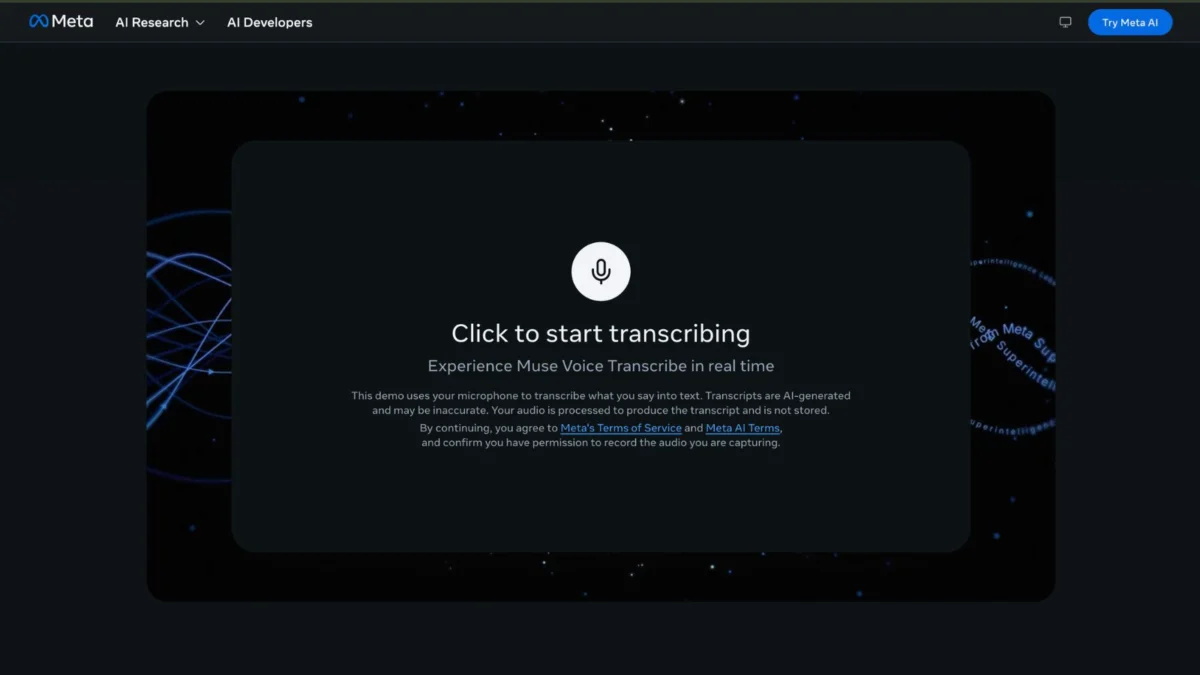
New Delhi, India – September 2, 2026 – In a significant advancement for artificial intelligence and global communication, tech giant Meta has announced the launch of Muse Voice Transcribe, a groundbreaking speech-to-text model capable of transcribing conversations in real-time across multiple languages. Unveiled on Tuesday, September 1, by Meta Superintelligence Labs (MSL), this innovative system represents a new frontier in audio perception, marking MSL’s first foray into real-time audio perception models.
Muse Voice Transcribe distinguishes itself with its ability to seamlessly handle "code-switching" – the common practice of speakers interchanging languages within a single conversation – without requiring separate models or additional processing. This feature, coupled with support for over 70 languages, including five major Indian languages (Hindi, Tamil, Telugu, Malayalam, and Kannada), positions the model as a potential game-changer for diverse linguistic environments, particularly in multilingual nations like India. The model is immediately accessible to developers via Meta’s Model API, underscoring Meta’s commitment to fostering a broader ecosystem of AI-powered applications.
Main Facts: Redefining Real-Time Transcription
Meta’s Muse Voice Transcribe is not merely an incremental improvement; it signifies a substantial leap in the capabilities of AI-driven speech recognition. At its core, the model is engineered to deliver highly accurate, real-time transcription, transforming spoken words into text instantaneously as they are uttered. This streaming transcription capability eliminates the delays associated with traditional batch processing, where an entire audio segment must be captured and processed before text output begins.
One of the most compelling features of Muse Voice Transcribe is its unparalleled multilingual proficiency. With training data encompassing more than 70 languages and 25 validated for launch, the model demonstrates a robust understanding of global linguistic diversity. Crucially, its integrated approach to handling code-switching is a technical marvel. Previous speech-to-text systems often struggled when speakers fluidly transitioned between languages, requiring complex pipelines of multiple language models or post-processing steps that introduced latency and potential errors. Muse Voice Transcribe, developed as a single, unified model, overcomes these challenges, offering a fluid and natural transcription experience that mirrors human conversational patterns.
Furthermore, the model boasts impressive scalability and precision in complex audio environments. It is capable of accurately separating and identifying more than 20 distinct speakers within a single recording, a feature invaluable for transcribing multi-participant meetings, conferences, or interviews. Its ability to process recordings exceeding an hour in length without performance degradation further highlights its robustness and suitability for professional applications.
Meta has also highlighted the model’s intelligent balance between speed and accuracy. Unlike conventional systems that might use a fixed latency setting, Muse Voice Transcribe dynamically adjusts its listening duration on a word-by-word basis. This allows it to rapidly transcribe straightforward speech while dedicating more processing time to words that are acoustically challenging or ambiguous, ensuring both responsiveness and fidelity. This sophisticated mechanism contributes to its superior performance, a claim substantiated by its top ranking on the Artificial Analysis streaming speech-to-text leaderboard as of September 1, 2026.
Available through Meta’s Model API, Muse Voice Transcribe is priced competitively at $3 per 1,000 audio minutes, equating to approximately $0.18 per hour. This accessible pricing structure is expected to encourage widespread adoption among developers and businesses seeking to integrate advanced speech recognition into their products and services. The model is already being leveraged internally by Meta, powering dictation functionalities in Meta AI for Mac and Muse Code, demonstrating its immediate practical utility.
Chronology: The Evolution of Speech AI and Meta’s Contribution
The journey to sophisticated speech-to-text technology like Muse Voice Transcribe is a testament to decades of relentless research and development in artificial intelligence. Early attempts at speech recognition date back to the mid-20th century, with systems capable of recognizing a limited vocabulary under constrained conditions. The advent of statistical models in the 1970s and 80s, followed by Hidden Markov Models (HMMs) and Gaussian Mixture Models (GMMs), significantly improved accuracy, though limitations in handling natural speech, background noise, and speaker variability persisted.
The late 20th and early 21st centuries saw the integration of neural networks, which began to revolutionize the field. However, it was the deep learning revolution of the 2010s that truly unlocked unprecedented breakthroughs. Deep neural networks (DNNs), recurrent neural networks (RNNs), and later transformer architectures, powered by vast datasets and increasingly powerful computational resources, enabled speech recognition systems to achieve human-level accuracy in many scenarios. Companies like Google, Microsoft, and Amazon have been at the forefront, integrating these capabilities into virtual assistants, transcription services, and accessibility tools.
Meta, through its various research initiatives and labs, has been a significant contributor to this evolution. The company has consistently invested heavily in AI research, particularly in areas related to natural language processing, computer vision, and speech recognition, viewing these as foundational to its vision of the metaverse and enhancing human connection. Meta Superintelligence Labs (MSL), a dedicated unit focused on pushing the boundaries of AI, has been a crucible for developing cutting-edge models that aim to replicate and even surpass human cognitive abilities.
The development of Muse Voice Transcribe is a culmination of years of Meta’s internal research, building upon a rich legacy of contributions to AI. The training process for such a complex model, encompassing over 70 languages, would have involved the meticulous collection, annotation, and processing of massive multilingual audio datasets. This undertaking requires not only immense computational power but also deep linguistic expertise to ensure robust performance across diverse phonetics, accents, and grammatical structures. The decision to prioritize code-switching capabilities reflects a keen understanding of real-world communication patterns, especially prevalent in densely multilingual regions.
The official announcement on September 1, 2026, was likely accompanied by detailed technical specifications and a research blog post, as is Meta’s practice, providing transparency into the model’s architecture and training methodologies. This public release through the Meta Model API signals a strategic move to democratize access to this advanced AI, empowering developers worldwide to integrate sophisticated speech recognition into their own innovations. The immediate integration into Meta AI for Mac and Muse Code demonstrates the model’s readiness for production environments and its practical utility within Meta’s own ecosystem.
Supporting Data: Unpacking the Technical Brilliance
The technical underpinnings of Muse Voice Transcribe are what truly set it apart in the crowded field of speech AI. Its capabilities are a direct result of sophisticated machine learning architecture and extensive training.
Multilingual Mastery and Code-Switching Innovation
The claim of supporting over 70 languages is a formidable achievement. For each language, the model must learn distinct phonemes, intonations, and linguistic patterns. The inclusion of five major Indian languages – Hindi, Tamil, Telugu, Malayalam, and Kannada – is particularly strategic. India, with its hundreds of languages and dialects, is a prime example of a market where code-switching is not an exception but a norm. Traditional models often require a user to explicitly select a language or struggle when speakers blend languages. Muse Voice Transcribe’s ability to seamlessly transition between languages within a single utterance without explicit prompting is a major breakthrough. This implies a unified neural network architecture that can simultaneously process and understand multiple linguistic contexts, rather than relying on a series of independent, language-specific modules. This "one model for all" approach significantly reduces complexity, improves efficiency, and enhances the user experience.
Real-Time Streaming and Scalability
The "streaming transcription" feature is critical for applications requiring immediate feedback, such as live captioning, voice assistants, or real-time dictation. Instead of processing an entire audio file after it has concluded, Muse Voice Transcribe processes audio segments as they arrive, continuously updating the text output. This low-latency performance is vital for natural human-computer interaction.
Furthermore, the model’s capacity to differentiate between more than 20 speakers in a single recording is indicative of advanced speaker diarization capabilities. This is achieved through sophisticated algorithms that analyze vocal characteristics and temporal patterns to assign spoken segments to individual speakers. This is not a trivial task, especially in noisy environments or when speakers have similar vocal qualities. For long recordings, exceeding an hour, the model demonstrates robust memory and processing efficiency, maintaining accuracy and coherence over extended periods, which is crucial for archival, legal, and media production contexts.
Intelligent Speed-Accuracy Trade-off
One of the most innovative aspects is how Muse Voice Transcribe intelligently balances speed and accuracy. Many real-time systems face a dilemma: a shorter listening window provides faster output but risks misinterpretations, while a longer window improves accuracy but introduces latency. Muse Voice Transcribe employs a dynamic, word-by-word decision-making process. This means that for easily recognizable words or phrases, it can produce output almost instantly. For more complex, ambiguous, or acoustically challenging segments, it might "listen" for a fraction of a second longer to gather more context before committing to a transcription. This adaptive approach ensures optimal performance, providing quick responses where possible while maintaining high accuracy even for difficult speech.
Performance Benchmarking and API Integration
The claim of ranking first on the Artificial Analysis streaming speech-to-text leaderboard on September 1, 2026, provides an objective validation of Muse Voice Transcribe’s performance. Such leaderboards typically evaluate models based on metrics like Word Error Rate (WER), latency, and robustness across various datasets and conditions. A top ranking indicates superior performance against industry peers.
The decision to release Muse Voice Transcribe via Meta’s Model API is strategic. It allows developers to integrate this powerful AI into their own applications without needing to manage the underlying machine learning infrastructure. The pricing model of $3 per 1,000 audio minutes (or approximately $0.18 per hour) is highly competitive, especially for a model offering such advanced features. For context, many high-quality transcription services can range from $0.50 to $2.00 per minute for human transcription, and even AI services can be higher depending on features. This aggressive pricing aims to accelerate adoption and foster innovation across a wide array of industries.
Official Responses: Meta’s Vision and Commitment
While the initial announcement from Meta did not feature direct quotes from specific individuals, the company’s messaging clearly articulates its vision and the significance of Muse Voice Transcribe.
Statements released by Meta Superintelligence Labs (MSL) underscored the model’s status as their first real-time audio perception model, highlighting its foundational role in their broader AI research agenda. MSL emphasized that the development of Muse Voice Transcribe is a testament to years of dedicated research and engineering, pushing the boundaries of what is possible in AI-driven communication. The focus on a single model managing all capabilities – from multilingual processing to speaker separation – without requiring separate post-processing steps, reflects a pursuit of efficiency, elegance, and robustness in AI design.
Meta’s official communications consistently frame Muse Voice Transcribe as a tool designed to enhance human communication and bridge linguistic divides. The company claims the model is specifically engineered to address the complexities of real-world interactions, particularly in multilingual contexts where code-switching is prevalent. This commitment to practical, user-centric AI solutions aligns with Meta’s overarching goal of building technologies that make connections more seamless and natural.
The decision to publish additional technical information in an accompanying research blog post demonstrates Meta’s commitment to transparency and its contribution to the scientific community. By detailing the model’s architecture, training methodologies, and performance metrics, Meta invites scrutiny and collaboration, fostering an open environment for AI development. This also serves to validate the model’s capabilities and build trust among potential users and researchers.
Furthermore, the immediate integration of Muse Voice Transcribe into Meta AI for Mac and Muse Code showcases Meta’s confidence in its internal applications. This "dogfooding" approach not only validates the model’s readiness but also provides tangible examples of its utility, from enhancing developer workflows with intelligent coding assistance to improving user interaction with Meta’s AI-powered services. The availability through Meta’s Model API also signifies a strategic commitment to democratizing advanced AI tools, empowering a global ecosystem of developers to build innovative applications.
Implications: Reshaping Industries and Empowering Communication
The launch of Muse Voice Transcribe carries profound implications across various sectors, promising to reshape how businesses operate, individuals interact, and information is processed in multilingual environments.
For Businesses and Industries
For enterprises, the model offers unprecedented opportunities for efficiency and accuracy. In call centers, real-time transcription of customer interactions, including code-switched conversations, can immediately provide agents with critical context, improve compliance monitoring, and enhance sentiment analysis. In the media industry, Muse Voice Transcribe can significantly reduce the time and cost associated with generating subtitles, captions, and transcripts for video and audio content, accelerating content production and expanding reach.
Legal and medical transcription, historically reliant on highly specialized human transcribers, could see massive improvements in turnaround times and cost-effectiveness. The ability to handle multiple speakers and long recordings accurately makes it ideal for transcribing court proceedings, depositions, and medical consultations. For global corporations, virtual meetings and conferences spanning multiple languages can now be accurately transcribed in real-time, facilitating cross-cultural collaboration and ensuring comprehensive record-keeping. The financial sector could leverage this for transcribing earnings calls, analyst briefings, and regulatory compliance checks with greater speed and precision.
For Individuals and Accessibility
For individuals, Muse Voice Transcribe promises enhanced accessibility and productivity. For people with hearing impairments, live captioning of conversations, lectures, and broadcasts becomes more reliable and inclusive. Dictation capabilities, already integrated into Meta AI for Mac, will become more powerful and natural, allowing users to effortlessly convert spoken thoughts into text, whether for writing documents, sending messages, or coding. Content creators, podcasters, and YouTubers can generate accurate transcripts for their content more easily, improving SEO and expanding their audience.
For Multilingual Societies, Especially India
The impact on multilingual nations like India cannot be overstated. With its vast linguistic diversity, code-switching is an inherent part of daily communication. Traditional speech AI often struggled to serve this demographic effectively, creating a digital divide for non-English speakers or those who frequently blend languages. Muse Voice Transcribe directly addresses this challenge, making AI tools more relevant and useful for millions. It can empower local language content creation, facilitate cross-lingual communication in business and personal settings, and improve digital inclusion by making technology more accessible to a broader population. This could accelerate the adoption of voice-based interfaces and AI assistants in regional languages, fostering a more equitable digital landscape.
Competitive Landscape and Future of AI
Meta’s entry into the top tier of real-time streaming speech-to-text with Muse Voice Transcribe intensifies competition in the AI market. It positions Meta as a formidable player alongside established leaders like Google (with its Cloud Speech-to-Text), Microsoft (Azure Cognitive Services), and Amazon (AWS Transcribe). This heightened competition is likely to drive further innovation, benefiting end-users with more advanced, affordable, and accessible AI solutions.
Looking ahead, Muse Voice Transcribe signifies a step towards truly intelligent, context-aware communication systems. As AI models become more adept at understanding the nuances of human speech, including emotional tone, intent, and complex linguistic structures, we can anticipate even more natural and intuitive interactions with technology. This technology lays groundwork for advanced voice assistants that can participate in multi-party conversations, real-time language translation that maintains conversational flow, and AI systems that can seamlessly operate across human languages, bringing the vision of a truly global and interconnected digital experience closer to reality.
As with any powerful AI technology, the implications also extend to ethical considerations. Meta’s commitment to publishing technical details in a research blog hints at a responsible approach to AI development. Ongoing vigilance regarding data privacy, potential biases in AI models, and the transparent deployment of these technologies will be crucial as Muse Voice Transcribe finds wider adoption, ensuring that its transformative power is leveraged for positive societal impact.
© IE Online Media Services Pvt Ltd