

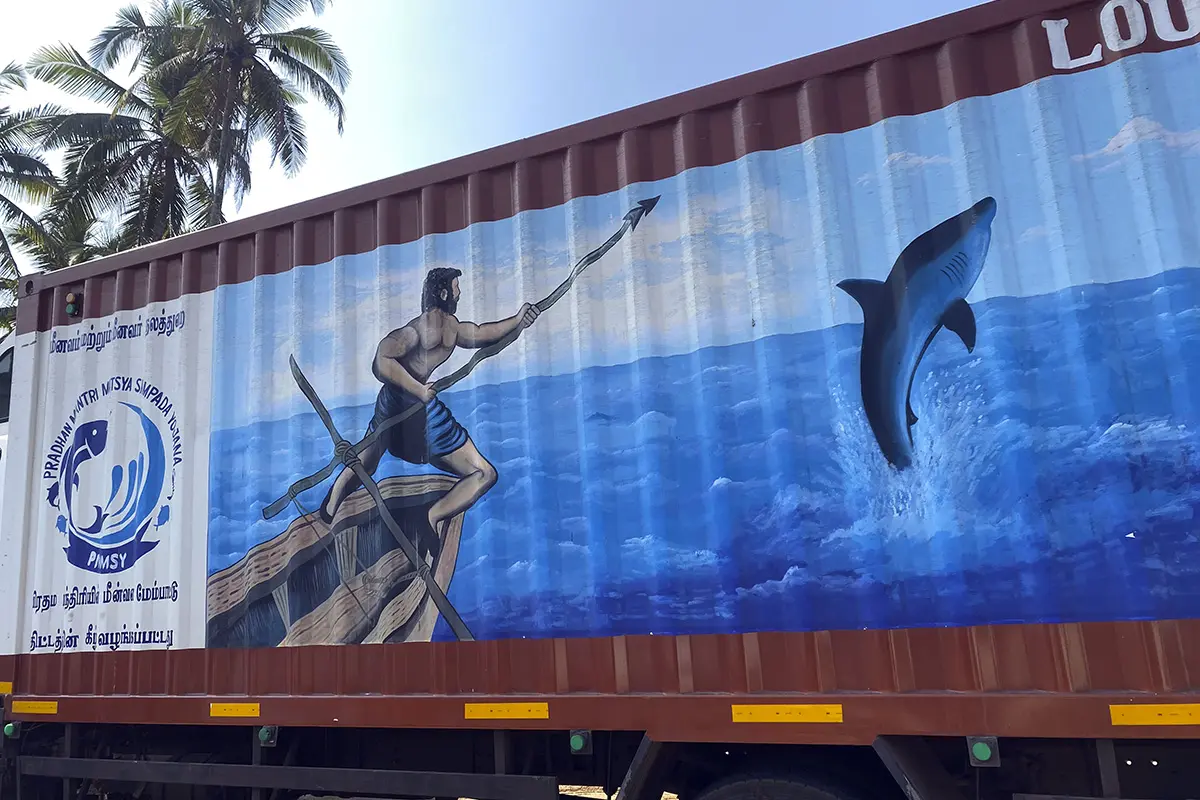
For decades, the horizon has been a boundary for India’s traditional fishing communities. Confined largely to the territorial waters within 12 nautical miles of the coastline, millions of artisanal fishers have relied on a shrinking pool of near-shore resources. Today, the Indian government is attempting to shatter that boundary, urging its fishing fleet to venture into the "Blue Frontier"—the vast, untapped depths of the Exclusive Economic Zone (EEZ) extending up to 200 nautical miles.
The promise is alluring: higher catches of high-value species like Yellowfin Tuna and Skipjack, increased export earnings, and a solution to the over-exploited coastal waters. However, as the 2020-2025 phase of the Pradhan Mantri Matsya Sampada Yojana (PMMSY) reaches its midpoint, a stark disconnect has emerged between the corridors of power in New Delhi and the salt-sprayed docks of Tamil Nadu, Kerala, and Andhra Pradesh.
Through an extensive examination of Right to Information (RTI) replies, Lok Sabha reports, and months of field reporting, it becomes clear that while India’s deep-sea dreams are grand, the vessel to carry them is currently weathering a storm of economic unfeasibility and logistical hurdles.
I. Main Facts: The Vision for a Blue Revolution
At the heart of India’s maritime strategy is the transition from "bottom trawling"—a destructive practice that scrapes the seabed—to "deep-sea fishing," primarily using longlining and gillnetting techniques in the high seas.
The Policy Engine
The primary vehicle for this transition is the Pradhan Mantri Matsya Sampada Yojana (PMMSY), launched in May 2020 with an unprecedented investment of ₹20,050 crore. A significant portion of this is dedicated to the "Modernization of Fishing Vessels," specifically promoting deep-sea fishing units. The government aims to increase fish production to 22 million metric tons by 2024-25 and double export earnings to ₹1,00,000 crore.
The Target Species
Unlike the mixed-bag catch of coastal waters, deep-sea fishing targets "Blue Gold"—oceanic tuna, billfish, pelagic sharks, and oceanic squid. These species command premium prices in international markets, particularly in Japan, Europe, and the United States.
The Conflict of Scale
The central challenge lies in the "who." India’s fishing sector is dominated by small-scale, traditional fishers. Transitioning these individuals into deep-sea operators requires not just a change in gear, but a complete overhaul of their economic model, technical skill set, and risk tolerance.
II. Chronology: From Joint Ventures to PMMSY
The journey into India’s deep seas has been a decades-long saga of policy shifts, often marked by trial and error.
- The 1970s and 80s (The Era of Foreign Charters): Early policies focused on allowing foreign vessels to fish in Indian waters through joint ventures. This period was marked by significant pushback from local communities who feared that large industrial "mother ships" would deplete resources without benefiting the local economy.
- The 1991 New Deep Sea Fishing Policy: This encouraged the chartering of foreign vessels and joint ventures. However, following the Murari Committee recommendations in the mid-90s, the government began rescinding licenses due to protests from traditional fishers.
- 2014: The Meenakumari Committee Report: A controversial turning point. The committee suggested that India’s EEZ could sustain an additional 1,100 deep-sea vessels. It faced massive protests for suggesting that foreign technology and investment were necessary, which fishers saw as a "backdoor entry" for international corporate fleets.
- 2017: The Palk Bay Scheme: Recognizing the conflict between India and Sri Lanka over territorial waters, the government launched a specialized scheme to divert Tamil Nadu fishers from the Palk Strait into deep-sea fishing. This served as a pilot for the larger PMMSY framework.
- 2020-2025: The PMMSY Phase: The current era focuses on indigenous capacity building. Instead of foreign ships, the government is providing subsidies (up to 40% for the general category and 60% for SC/ST/Women) to help local fishers and cooperatives purchase sophisticated deep-sea vessels.
III. Supporting Data: The Economic Barrier
Despite the subsidies, the math of deep-sea fishing remains daunting for the average Indian fisher. Data gathered from field reports and government replies highlights a significant "feasibility gap."
The Cost of Entry
A modern, 24-meter deep-sea tuna longliner equipped with onboard freezing facilities costs between ₹80 lakh and ₹1.2 crore.
- Even with a 60% subsidy (₹48 lakh to ₹72 lakh), a fisher or a group must secure a bank loan for the remaining 40% (₹32 lakh to ₹48 lakh).
- For a community that traditionally operates boats costing ₹5 lakh to ₹15 lakh, this represents a massive leap in debt exposure.
Operating Expenses
Deep-sea expeditions are not day-trips. They last between 15 to 25 days.
- Fuel: A single trip can consume 5,000 to 8,000 liters of diesel. With fluctuating fuel prices, this accounts for nearly 70% of operating costs.
- Labor: Deep-sea vessels require specialized crews of 10-12 people.
- Ice and Provisions: Maintaining the "cold chain" at sea is expensive.
Total operating costs per trip can range from ₹5 lakh to ₹8 lakh. If the catch does not include a high percentage of "Grade A" tuna, the trip often results in a net loss.
The Low Uptake
Lok Sabha reports indicate that in states like Andhra Pradesh and Gujarat, the number of sanctioned deep-sea vessels remains far below the initial targets. In Tamil Nadu, of the hundreds of vessels planned under the Palk Bay scheme, only a fraction are currently operational. Many fishers who took the leap are now struggling to service their bank loans, leading to what some community leaders call a "debt trap in the deep sea."
IV. Official Responses: Bridging the Gap
Government officials and scientists at institutions like the Central Marine Fisheries Research Institute (CMFRI) maintain that the transition is an ecological and economic necessity.
The Sustainability Argument
Officials argue that coastal resources are at a breaking point. "We cannot keep fishing the same three nautical miles and expect different results," says a senior official from the Department of Fisheries. "The deep sea is where the future lies. Our role is to provide the infrastructure—the harbors, the subsidies, and the training."
Technical Support and Safety
To address safety concerns, the government has integrated the NavIC (Navigation with Indian Constellation) system and ISRO-developed satellite communication devices into new vessels. These tools provide weather alerts and help fishers stay within international boundaries, reducing the risk of arrest by neighboring countries.
Simplification of Schemes
In response to the low uptake, the Ministry has reportedly been working on "clustering" models. Instead of individual ownership, the government is encouraging Fisherman Producer Organizations (FPOs) and cooperatives to own and operate vessels, spreading the financial risk across a larger group.
V. Implications: An Uncertain Horizon
The push into the deep sea is more than a policy shift; it is a fundamental transformation of India’s maritime identity. However, the implications of this move are multifaceted and fraught with risk.
Socio-Economic Displacement
There is a growing fear that the high capital requirement will eventually squeeze out traditional fishers, paving the way for corporate-owned industrial fleets. If traditional fishers cannot afford the "entry ticket" to the deep sea, they may be relegated to becoming low-wage laborers on vessels owned by wealthy investors—a reversal of the "owner-operator" model that has sustained Indian fishing for centuries.
The Knowledge Gap
Deep-sea fishing is a science. Locating tuna thermoclines and managing longlines requires skills that are vastly different from coastal net fishing. Without intensive, long-term training programs, even the most modern boats are likely to return to port with empty holds.
Ecological Concerns
While deep-sea fishing is often framed as "sustainable" compared to trawling, it is not without impact. Bycatch—the accidental capture of turtles, dolphins, and non-target sharks—is a significant concern. Furthermore, the carbon footprint of long-range fishing trips is substantially higher than coastal operations.
Conclusion: Keeping the Dream Afloat
India’s deep-sea ambitions stand at a crossroads. The government’s vision of a "Blue Economy" is technically sound but socially and economically fragile. For the 2020-2025 scheme to succeed, policy must move beyond just providing subsidies for hulls and engines. It must address the "missing middle"—the lack of specialized markets, the high cost of fuel, and the overwhelming burden of debt.
As the reporting by Mongabay-India and the Pulitzer Center suggests, the reality of the deep sea is far more turbulent than the policy documents suggest. To keep India’s deep-sea dreams afloat, the focus must shift from the depth of the ocean to the depth of the challenges faced by the fishers themselves. Only when the economics of the deep sea align with the realities of the shore will the "Blue Revolution" truly begin.
