

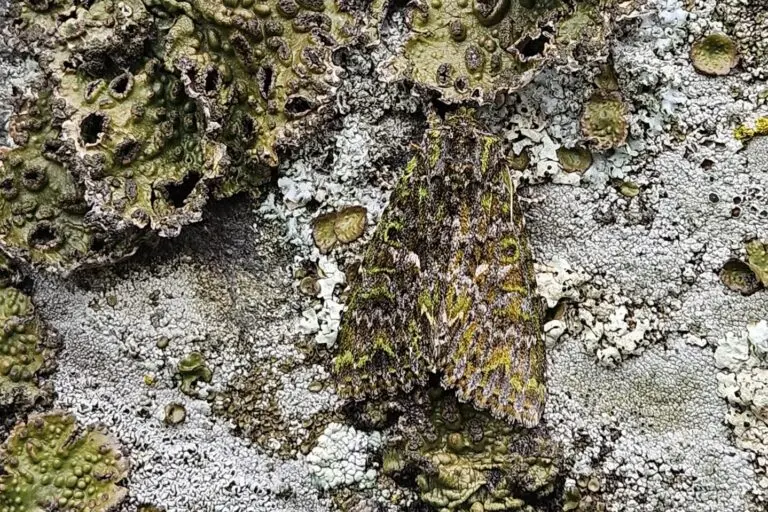
CHAMBA, HIMACHAL PRADESH — In the rugged, wind-swept altitudes of the Himalayan range, a subtle evolutionary drama has been unfolding, largely hidden from the human eye. A recent scientific discovery in the Chamba district of Himachal Pradesh has shed new light on the sophisticated survival strategies of insects, documenting for the first time a moth species utilizing a specific type of umbilicate lichen as a canvas for camouflage.
The findings, published in the prestigious peer-reviewed journal Arthropod-Plant Interactions, detail an observation made at an elevation of approximately 3,200 meters within the Kugti Wildlife Sanctuary. This discovery marks a significant shift in our understanding of "crypsis"—the ability of an organism to avoid observation or detection—by expanding the known repertoire of biological backgrounds used by Lepidoptera (moths and butterflies) to include the complex, leaf-like structures of umbilicate lichens.
I. Main Facts: A Breakthrough in Himalayan Biodiversity
The core of the study revolves around a moth from the family Noctuidae and its relationship with the lichen species Lasallia pertusa. While the association between moths and lichens is a well-documented phenomenon in evolutionary biology, this specific interaction breaks new ground due to the physical characteristics of the lichen involved.
The Subject and the Setting
The observation took place at Duggi, a high-altitude site in the Kugti Wildlife Sanctuary. At 3,200 meters, the environment is characterized by extreme weather, intense UV radiation, and a sparse but specialized ecosystem. In this harsh landscape, survival depends on the ability to remain invisible to predators, primarily visually hunting birds and high-altitude lizards.
A Unique Background
Most previously documented cases of lichen-based camouflage involve crustose lichens (which grow flat against rocks like a coat of paint) or foliose lichens that grow on tree bark. However, Lasallia pertusa is an "umbilicate" lichen. This means it is attached to its rocky substrate at only a single central point, allowing its body (the thallus) to spread out in leaf-like, often perforated lobes. The discovery that a moth would choose such a complex, three-dimensional structure for crypsis suggests a higher level of environmental integration than previously assumed.
Key Scientific Takeaways
- First Documentation: This is the first recorded instance of an insect using L. pertusa as a camouflage background.
- Structural Complexity: The lichen’s irregular, perforated thallus provides a visually "noisy" background that effectively breaks up the moth’s outline.
- Family Identification: The moth was identified as belonging to the Noctuidae family, though the specific species remains unconfirmed due to the lack of a physical specimen.
II. Chronology: From Field Observation to Scientific Record
The journey of this discovery began in the summer of 2025, during a biodiversity survey aimed at documenting the flora and fauna of the lesser-explored regions of the Chamba district.
July 2025: The Initial Sighting
In the peak of the Himalayan summer, a research team led by Sanjay Kumar Unniyal was traversing the rocky terrain near Duggi. At an elevation where oxygen is thin and the vegetation begins to give way to bare rock, the team noticed a peculiar visual alignment. Resting on a patch of Lasallia pertusa—a lichen known for its "pitted" or perforated appearance—was a moth.
The moth was positioned so perfectly that its wings mimicked the texture, color, and shadows cast by the lichen’s irregular surface. The researchers noted that the moth was resting directly on the lichen thallus, which was itself growing on an exposed rock face.
Autumn 2025 – Early 2026: Identification and Analysis
Because the researchers did not collect a physical specimen—adhering to non-invasive observation protocols—the identification process relied on high-resolution photography and consultation with entomological experts.
The moth’s wing patterns, resting posture, and size led experts to place it within the Noctuidae family, a massive group of moths often referred to as "owlet moths." However, the precise species remained elusive. This highlights a common challenge in high-altitude entomology: the difficulty of matching field photographs with existing records of rare or understudied mountain species.
2026: Publication and Peer Review
The data was compiled into a formal paper and submitted to Arthropod-Plant Interactions. The peer-review process focused on the uniqueness of the lichen growth form. While the scientific community is well-aware of "industrial melanism" (the classic case of the peppered moth adapting to soot-covered trees), the use of umbilicate lichens represented a novel ecological niche. The paper was subsequently accepted, providing a formal record of this evolutionary adaptation.
III. Supporting Data: The Science of Crypsis and Lichen Morphology
To understand the significance of this discovery, one must delve into the specific biological and physical properties of both the moth and the lichen.
The Architecture of Lasallia pertusa
Lasallia pertusa is not your average lichen. As an umbilicate lichen, it possesses a large, vegetative body (thallus) that is often circular or lobed. The term "pertusa" refers to the perforations or holes that often dot its surface.

- Visual Heterogeneity: The lichen creates a landscape of light and shadow. The holes in the thallus create dark spots, while the raised edges catch the sunlight.
- Coloration: Typically greyish-green to brown, the lichen’s color palette is a perfect match for the muted tones of the Noctuidae family.
- Substrate: By growing on exposed rocks, the lichen provides a "safe haven" on otherwise barren surfaces where a moth would be easily spotted by a hawk or a lizard.
The Noctuidae Advantage
The Noctuidae family is one of the largest families in the order Lepidoptera, with over 35,000 known species. Many members of this family are nocturnal, meaning they spend their daylight hours motionless.
- Resting Posture: Noctuid moths typically fold their wings in a roof-like or flat manner over their bodies. This posture is essential for crypsis, as it hides the more brightly colored hindwings and presents only the cryptic forewings to the world.
- Disruptive Coloration: The moth in the Chamba study exhibited patterns that likely used "disruptive coloration"—marks that break up the recognizable shape of an insect, making it blend into the "visual noise" of the perforated lichen.
The Mechanism of Background Matching
The study identifies the strategy as "background matching," a subset of crypsis. Unlike "masquerade" (where an animal looks like a specific object, like a twig), background matching requires the animal to resemble the general statistics of its environment. The irregular surface of L. pertusa is particularly effective for this because it lacks a repeating pattern, making it harder for the neural pathways of predators to distinguish a foreign object (the moth) from the background (the lichen).
IV. Official Responses: Insights from the Research Team
Sanjay Kumar Unniyal, one of the lead authors of the paper and a prominent voice in Himalayan ecological research, emphasized the broader significance of the find in an interview with Mongabay-India.
"While we have seen moths mimicking lichens for centuries, the documentation of this specific lichen species—Lasallia pertusa—is a first," Unniyal stated. "What makes this fascinating is not just the act of hiding, but the choice of such a complex host. This isn’t just a flat surface; it’s a three-dimensional environment."
Evolutionary Consequences
Unniyal pointed out that such associations are rarely accidental. "This might have an evolutionary consequence which can only be understood through further studies," he shared. He suggested that if certain moth populations consistently choose L. pertusa, it could lead to specialized wing patterns over generations, a process known as co-evolutionary pressure.
The "Caveat" of Observation
Despite the excitement, the research team remains grounded in scientific rigor. The paper includes an important caveat: the finding is based on a naturalistic observation. To definitively prove that the moth is "safer" on this lichen than on a bare rock, experimental trials would be required. This would involve using "predator-prey" models or avian vision simulations to quantify exactly how much harder it is for a bird to see the moth against the L. pertusa background.
V. Implications: Conservation and the Future of Himalayan Ecology
The discovery at Duggi has implications that reach far beyond a single moth and a single lichen. It touches upon the health of high-altitude ecosystems and the importance of preserving "inconspicuous" biodiversity.
The Importance of Lichens in the Ecosystem
Lichens are often overlooked in conservation efforts, yet they are vital "pioneer species" that break down rocks into soil and provide micro-habitats for countless invertebrates. This study highlights that a "seemingly inconspicuous lichen" can be a cornerstone of an animal’s survival strategy. If lichen populations decline due to air pollution or climate change, the animals that depend on them for camouflage will become more vulnerable to predation, potentially leading to a cascade of local extinctions.
Climate Change and High-Altitude Shifts
The Himalayas are warming at a rate higher than the global average. As temperatures rise, the treeline moves upward, and the distribution of lichens like Lasallia may shift. Understanding the current "baseline" of insect-plant interactions is crucial for predicting how these ecosystems will transform in the coming decades. If the moths cannot find their preferred lichen backgrounds at higher elevations, their camouflage strategies may fail.
The Need for Specimen-Based Research
The fact that the moth could not be identified to the species level underscores the need for more intensive taxonomic work in the Chamba district. High-altitude regions of Himachal Pradesh remain "biodiversity dark spots" where many species are known to science only through photographs or anecdotal reports.
Conclusion: A Call for Further Study
The observation at Kugti Wildlife Sanctuary serves as a reminder of the complexity of the natural world. In the silent struggle for survival at 3,200 meters, the relationship between a moth and a lichen is a testament to the power of evolutionary adaptation.
As Sanjay Kumar Unniyal and his colleagues conclude, this discovery is merely the beginning. Future research will need to delve into the "why" and "how" of this association. Do the moths actively seek out the umbilicate lichen? Is there a chemical attraction, or is it purely visual? Solving these mysteries will require more time in the field, more specimens, and perhaps most importantly, a continued appreciation for the small, camouflaged wonders of the high Himalayas.
Banner image: A moth belonging to the Noctuidae family perfectly aligned with the perforated thallus of Lasallia pertusa lichen in the Chamba district. Image by Sanjay Kumar Unniyal.
