

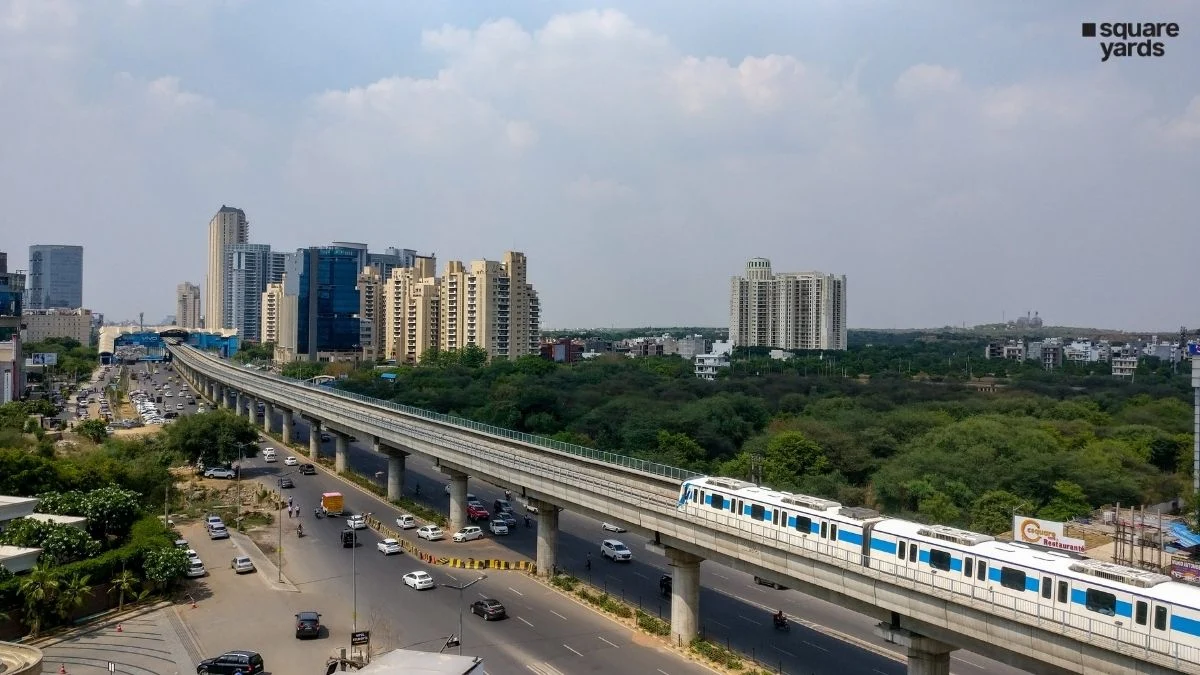
GURUGRAM – In a landmark move that promises to redefine the spatial and economic geography of the National Capital Region (NCR), the Haryana government has officially cleared the final alignment for the Gurugram-Faridabad-Noida Namo Bharat Regional Rapid Transit System (RRTS) corridor. This ambitious ₹15,000 crore infrastructure project is poised to bridge the gap between three of North India’s most significant economic powerhouses, transforming a grueling two-hour commute into a swift 40-minute journey.
The 64-kilometer high-speed rail network, executed by the National Capital Region Transport Corporation (NCRTC), represents more than just a transportation upgrade; it is a strategic intervention designed to decentralize growth, stabilize real estate markets, and integrate the disparate hubs of the NCR into a singular, cohesive economic zone. With construction slated to begin in December 2026, the corridor is already being hailed as the "backbone of the future NCR."
I. Main Facts: A New Era of High-Speed Connectivity
The Gurugram-Faridabad-Noida RRTS corridor is a centerpiece of the Prime Minister’s "Namo Bharat" initiative, which seeks to modernize regional transit through high-frequency, high-speed rail. The project’s core objective is to provide a seamless, reliable, and sustainable alternative to the congested road networks that currently link Haryana and Uttar Pradesh.
Key Project Specifications:
- Total Investment: Approximately ₹15,000 crore.
- Total Length: 64 kilometers of high-speed rail.
- Travel Time Efficiency: Reduction from 120 minutes (by road) to just 40 minutes (by RRTS).
- Station Density: 18 planned stations (8 in Gurugram, 10 in Faridabad/Noida).
- Operational Model: A hybrid RRTS-cum-Metro system, allowing for both long-distance rapid transit and local metro-style access.
- Lead Agency: National Capital Region Transport Corporation (NCRTC).
- Construction Start Date: December 2026.
The corridor is designed to accommodate speeds of up to 160 km/h, though operational speeds will likely average around 100 km/h including stops. By utilizing a hybrid model, the NCRTC ensures that the system serves two distinct demographics: the long-distance commuter traveling between Noida and Gurugram, and the local resident moving between sectors within Faridabad or Gurugram.
II. Chronology: From Blueprint to Groundbreaking
The journey of the Gurugram-Faridabad-Noida RRTS has been one of meticulous planning and inter-state coordination. For years, the lack of direct rail connectivity between Gurugram and Faridabad—two of Haryana’s largest revenue-generating cities—was seen as a significant bottleneck for regional growth.
- Phase 1: Conceptualization (2022–2023): Initial feasibility studies were conducted to determine the viability of a high-speed link. The NCRTC identified that a significant portion of the traffic on the Gurugram-Faridabad Expressway consisted of daily commuters who would benefit from a rail alternative.
- Phase 2: The Hybrid Model Proposal (2024): Recognizing the need for local connectivity, the proposal was amended to include a hybrid RRTS-cum-Metro system. This allowed for higher station density in populated areas without compromising the overall speed of the corridor.
- Phase 3: DPR Finalization (2025): The Detailed Project Report (DPR) was finalized, outlining the precise route, station locations, and technical requirements. This phase involved extensive environmental impact assessments, particularly concerning the Aravalli hills and residential zones.
- Phase 4: Alignment Clearance (May 4, 2026): The Haryana government gave the final nod to the 64 km alignment, locking in the route and clearing the way for the next administrative hurdles.
- Phase 5: Pre-Construction (Mid-2026): The coming months will see the commencement of land acquisition processes, utility shifting, and the floating of global tenders for construction and rolling stock.
- Phase 6: Groundbreaking (December 2026): Construction is officially scheduled to begin, with a multi-year timeline aimed at operationalizing the first phase by the end of the decade.
III. Supporting Data: Technical Integration and Multimodal Hubs
The success of the Namo Bharat corridor lies in its "multimodal integration"—the ability to switch between different modes of transport within a single station. The project is strategically designed to plug into existing and future transit networks.
Integration Points and Interchanges:
- IFFCO Chowk (Gurugram): This will serve as the primary gateway, connecting the new corridor with the existing Delhi Metro Yellow Line and the proposed Delhi-Alwar RRTS.
- Bata Chowk (Faridabad): A critical interchange that links the high-speed corridor to the Delhi Metro Violet Line, providing direct access to Central Delhi.
- Surajpur Junction (Noida/Greater Noida): This hub will connect with the upcoming Ghaziabad-Jewar Airport RRTS, creating a direct high-speed pipeline from Gurugram’s business districts to the Noida International Airport.
- Sector 142-168 (Noida): This stretch will integrate with the Noida Metro (Aqua Line), serving the burgeoning tech and residential sectors along the Noida-Greater Noida Expressway.
Infrastructure Highlights:
- Noise Mitigation: To address concerns in densely populated residential areas, the NCRTC has committed to installing advanced noise barriers along all elevated sections.
- Transit-Oriented Development (TOD): The government has designated specific zones around each station for TOD. This allows for higher Floor Area Ratio (FAR), encouraging the development of mixed-use high-rises, commercial hubs, and pedestrian-friendly zones within a 500-800 meter radius of the stations.
- Rolling Stock: The trains will feature modern amenities, including Wi-Fi, premium seating, and dedicated space for luggage, catering to both office goers and airport-bound travelers.
IV. Official Responses: A Vision for Integrated Growth
Government officials have expressed high confidence in the project’s ability to catalyze the next phase of Haryana’s economic evolution.
Haryana Chief Minister Nayab Singh Saini emphasized the strategic importance of the corridor during the alignment clearance announcement:
"This corridor is not merely a transport project; it is an economic lifeline. By linking the industrial strength of Faridabad with the corporate prowess of Gurugram and the tech hubs of Noida, we are creating a seamless economic corridor. The hybrid RRTS-cum-Metro system ensures that even local commuters benefit from world-class infrastructure, reducing our carbon footprint and easing the pressure on our roads."
NCRTC Officials have noted that the project is a marvel of modern engineering. "The complexity of building a high-speed line through diverse terrains—from the Aravalli foothills to dense urban clusters—requires precision. We are committed to using sustainable construction practices and ensuring that the project meets its December 2026 start date," an NCRTC spokesperson stated.
Urban planning experts have also weighed in, noting that the connection to Jewar Airport via the Surajpur interchange is the project’s "masterstroke." By providing Gurugram residents with a high-speed rail link to the new airport, the project effectively balances the aviation load between IGI Airport and Noida International Airport.
V. Implications: Real Estate, Economy, and Urban Lifestyle
The announcement of the final alignment has already sent ripples through the NCR real estate and commercial sectors. The "RRTS Effect" is expected to mirror the "Metro Effect" seen in the early 2000s, but on a much larger scale due to the higher speeds and regional reach.
1. Real Estate Appreciation
- Gurugram’s Luxury Belt: The 14.5 km integrated section between IFFCO Chowk and Gwal Pahari is expected to see a surge in demand for luxury housing. Areas near Sector-29 and the Millennium City Centre will likely see a premium on commercial rentals as accessibility improves.
- The Rise of Greater Faridabad: Perhaps the biggest beneficiary is Greater Faridabad (Sectors 75–89). Long considered a secondary residential market due to its distance from Noida and Gurugram, the 20-minute connectivity to Noida and 25-minute link to Gurugram will reposition these sectors as primary residential choices for mid-to-high-income professionals.
- Noida’s Tech Corridor: Sectors 142 through 168 in Noida are already hubs for IT and ITES. The RRTS will make these sectors accessible to the talent pool residing in Gurugram and Faridabad, potentially increasing commercial occupancy rates.
2. Economic Synergy
The corridor will facilitate a more fluid labor market. Professionals will no longer be restricted to living in the city where they work. A software engineer working in Noida’s Sector 142 could comfortably live in a spacious apartment in Faridabad or a luxury condo in Gurugram, with a commute shorter than many current intra-city trips. This mobility is expected to drive up productivity and attract more multinational corporations to the region.
3. Industrial Revitalization
Faridabad, traditionally an industrial heavyweight, has often struggled with modern connectivity. The RRTS will link Faridabad’s manufacturing zones directly to the corporate headquarters in Gurugram and the export hubs in Noida. This "Industrial-to-Corporate" link is expected to modernize Faridabad’s business ecosystem, attracting startups and service-sector firms to the city.
4. Environmental and Social Impact
By shifting thousands of daily commuters from private vehicles to high-speed rail, the corridor will significantly reduce CO2 emissions and traffic congestion on the perennially clogged Gurugram-Faridabad road and the DND Flyway. Socially, the project promotes "equitable growth," as it brings world-class infrastructure to previously underserved peripheral areas, raising the standard of living for millions.
5. The "Jewar Factor"
As the Noida International Airport at Jewar nears completion, the RRTS provides the necessary high-speed link to ensure the airport is accessible to the western half of the NCR. This connectivity ensures that the "Aerotropolis" growing around Jewar will have a direct pipeline to the capital and the financial hubs of Haryana.
Conclusion
The clearance of the Gurugram-Faridabad-Noida RRTS alignment marks a pivotal moment in the history of North Indian urban development. By investing ₹15,000 crore into a 64 km stretch of high-speed rail, the government is not just building a track; it is building a future where the borders between NCR cities become invisible. As land acquisition begins and the first pillars rise in December 2026, the region stands on the cusp of a mobility revolution that will define the economic trajectory of the National Capital Region for decades to come.
