

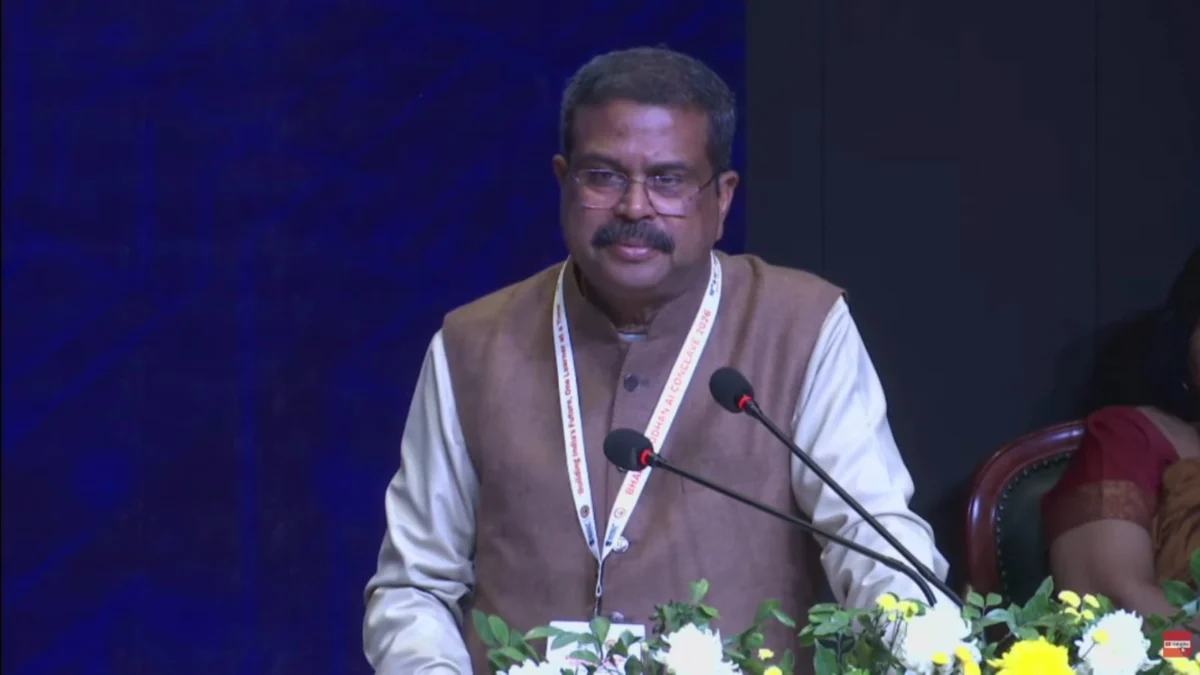
In a notable development reflecting the complex and evolving political landscape of Odisha, Union Education Minister Dharmendra Pradhan recently extended a public appeal to Biju Janata Dal (BJD) president and former Chief Minister Naveen Patnaik. Pradhan urged Patnaik to maintain his alignment with Prime Minister Narendra Modi, a statement heavily laden with political messaging and strategic intent, particularly in the aftermath of the BJD’s significant electoral defeat in June 2024. This appeal underscores the subtle dance of power and influence in Indian politics, even as regional dynamics undergo profound transformations.
Main Facts
The core of the recent political discourse revolves around a statement made by Union Minister Dharmendra Pradhan in Rairakhol, within his Sambalpur parliamentary constituency. Addressing a public gathering, Pradhan directly critiqued Naveen Patnaik and the BJD for their stance on the Constitution (131st Amendment) Bill, 2026. This proposed legislation, which aimed to increase the number of seats in both the Lok Sabha and state Assemblies while simultaneously introducing a 33% reservation for women, failed to garner the necessary two-thirds majority in the Lok Sabha.
A Call for Alignment Amidst Shifting Sands
Pradhan’s appeal was not just a general statement but a targeted message. With senior BJD leader and Deputy Leader of Opposition in the Odisha Assembly, Prasanna Acharya, present at the meeting, Pradhan specifically asked him to "convince" Patnaik. "Naveen babu is a good person, but his party opposed the Bill that had provisions to increase seats in Parliament and state assemblies. We request Prasanna bhai to meet Naveen babu and convince him not to take a fluctuating stand and remain aligned with Modi. Together, we will bring women to the political forefront," Pradhan articulated, clearly outlining the BJP’s desire for the BJD to return to its previous, more cooperative posture.
This public plea assumes significant importance when viewed against the backdrop of recent political realignments in Odisha. The BJD, which governed the state for an uninterrupted 24 years under Patnaik’s leadership before its 2024 electoral loss to the BJP, has lately shown indications of gravitating towards the INDIA bloc. This perceived shift challenges its long-held official policy of "equidistance" from both the BJP and the Congress, prompting speculation about the future direction of regional politics in Odisha and its potential impact on national alliances. Pradhan’s remarks are thus not merely a call for unity but a strategic move to acknowledge and potentially counter the BJD’s evolving political calculus.
Chronology
The relationship between the BJD and the BJP, particularly at the national level, has been characterized by a unique blend of formal independence and practical cooperation. This dynamic has seen significant shifts, especially following the seismic political changes in Odisha in 2024.
The Era of Tacit Alliance: BJD’s Decade of Support
For nearly a decade, despite formally operating outside the National Democratic Alliance (NDA), the Patnaik-led BJD was widely regarded as a dependable, albeit tacit, ally of the BJP at the Centre. This unofficial partnership stood in stark contrast to the often confrontational stance adopted by many other regional parties towards the Union government. Naveen Patnaik, known for his composed demeanor and pragmatic approach, cultivated cordial relations with the BJP’s top leadership, including Prime Minister Narendra Modi. This strategic bonhomie translated into crucial parliamentary support for the Modi government on several occasions.
The BJD consistently backed the BJP-led NDA’s presidential candidates in both 2017 (Ram Nath Kovind) and 2022 (Droupadi Murmu), signaling a clear preference in national leadership choices. More critically, given its substantial strength in the Rajya Sabha—the Upper House of Parliament where many crucial bills face their toughest tests—the BJD played a pivotal role in the passage of several landmark and often controversial pieces of legislation. These included the Citizenship Amendment Act (CAA), which sparked nationwide protests, and the Chief Election Commissioner and Other Election Commissioners Act, 2023, which altered the appointment process for election commissioners.
Furthermore, the BJD also drew criticism from various opposition parties for its support of the National Capital Territory of Delhi (Amendment) Bill, despite often projecting itself as a staunch defender of federalism and states’ rights. A notable instance of its cooperative spirit was facilitating the Rajya Sabha election of Union Minister Ashwini Vaishnaw, a former IAS officer from the Odisha cadre. This occurred even though the BJD technically did not possess the required numbers to independently secure his election, underscoring a deliberate act of political goodwill towards the BJP. This long period of functional alignment allowed the BJP to navigate parliamentary hurdles and often project a broader consensus on key national issues, even without the BJD being a formal alliance partner.
The Watershed Moment: Odisha’s 2024 Elections
The year 2024 marked a dramatic turning point in Odisha’s political history and for the BJD. After 24 years of uninterrupted rule, Naveen Patnaik’s government was ousted, and the BJP swept to power in the state Assembly elections. This defeat was compounded by the BJD’s complete rout in the Lok Sabha elections, where it failed to secure even a single one of Odisha’s 21 parliamentary seats. The electoral debacle was unprecedented and forced a deep introspection within the regional party.
Internally, many BJD leaders privately acknowledged that the party’s perceived proximity and consistent support for the BJP at the Centre might have been a significant contributing factor to its downfall. Voters, perhaps fatigued by a long-standing government and increasingly drawn to the BJP’s national narrative and its promise of ‘double-engine’ growth, might have viewed the BJD as too accommodating to the national ruling party, thus blurring the lines of its regional identity and distinct political platform. The setback was further exacerbated by internal fissures, as two of its Rajya Sabha members, Mamata Mahanta and Sujeet Kumar, defected to the BJP, further highlighting the party’s vulnerability and the shifting loyalties in the state.
The Post-Debacle Realignment: Signs of a New Trajectory
In the wake of its devastating electoral loss, the BJD has visibly begun to reassess and recalibrate its political position, signaling a potential departure from its previous modus operandi.
-
Rajya Sabha Elections: A Glimmer of Opposition Unity
Among the clearest indicators of the BJD’s changing political stance was its decision to align with the Congress during the recent Rajya Sabha elections. For the fourth seat, where no single party commanded a clear majority, the BJD and Congress jointly backed Datteswar Hota, a renowned urologist, against the BJP-backed independent candidate, Dilip Ray. While Ray ultimately won due to cross-voting by 11 legislators from both the BJD and the Congress, the very act of the two traditional rivals aligning marked a significant symbolic shift, hinting at a nascent, albeit fragile, opposition unity against the dominant BJP in the state. -
Constitution (131st Amendment) Bill: A Stand on Federalism
A month after the Rajya Sabha elections, Naveen Patnaik adopted a sharply oppositional stance against the Constitution (131st Amendment) Bill, 2026. His argument centered on the principle of "cooperative federalism," contending that the Bill, by proposing to increase parliamentary and assembly seats based on population, would undermine Odisha’s political voice and redistribute representation in favor of more populous states. He argued that this would effectively reduce the influence of states like Odisha in national legislative processes. Despite no longer having any MPs in the Lok Sabha, Patnaik proactively wrote to all MPs from Odisha, irrespective of party affiliation, urging them to oppose the Bill. He further appealed to the newly installed Chief Minister, Mohan Charan Majhi of the BJP, to convene a special session of the Assembly to discuss and collectively oppose the issue, demonstrating a robust defense of state interests against a central legislative initiative. -
NEET-UG Controversy: Direct Confrontation
Patnaik has also significantly escalated his criticism of the Centre over the cancellation of the NEET-UG examination following widespread allegations of a paper leak. Calling the incident a profound "betrayal of students’ trust," he vociferously demanded accountability from the Union government. In a strong statement posted on X (formerly Twitter), Patnaik wrote, "When the sanctity of examinations is compromised, it is not just a lapse – it is a betrayal of lakhs of aspirants who studied with discipline, sacrificed comforts and devoted sleepless nights to their preparation. This is not the first time NEET papers have been leaked. Such incidents deepen cynicism, heighten anxiety and jeopardise the careers of hardworking students who expect fairness." This direct and public critique of a central government’s handling of a national issue marked a clear departure from his earlier, more conciliatory approach. The BJD has since organized widespread protests across several districts, with party workers directly targeting Union Education Minister Dharmendra Pradhan, holding him responsible for alleged lapses in conducting the examination.
Supporting Data
The political equations in Odisha, while seemingly altered by the 2024 elections, still carry significant nuances that inform the current strategic maneuvers by both the BJP and the BJD.
Electoral Statistics and Enduring Influence
Despite losing power in the Assembly elections, the BJD’s performance in terms of popular vote share paints a picture of enduring influence and a robust organizational base. In the 2024 Assembly elections, the BJD secured 40.22% of the total votes polled. This figure is remarkably close to, and in fact marginally higher than, the BJP’s vote share of 40.07%. This narrow margin underscores that while the BJP successfully translated its vote share into more seats and ultimately formed the government, the BJD retains a significant and loyal voter base across the state. This substantial popular mandate, even in defeat, suggests that Naveen Patnaik continues to command considerable personal popularity and that the party’s organizational structure remains largely intact and effective at the grassroots level. Political observers widely acknowledge that ignoring such a significant electoral footprint would be a strategic miscalculation for any national party looking to consolidate its position in the region.
Legislative Impact: BJD’s Past Pivotal Role
The historical record further highlights the BJD’s strategic importance. Before the 2024 elections, its numerical strength in the Rajya Sabha was often pivotal for the BJP-led NDA government. While the BJP often enjoys a comfortable majority in the Lok Sabha, securing passage for legislation in the Rajya Sabha, where regional parties hold significant sway, can be challenging. The BJD’s consistent support for bills like the Citizenship Amendment Act, the Chief Election Commissioner and Other Election Commissioners Act, and the National Capital Territory of Delhi (Amendment) Bill was not merely symbolic; it was instrumental in ensuring these legislations cleared the parliamentary hurdles. This history demonstrates the tangible impact of BJD’s alignment with the Centre and explains why the BJP would be keen to maintain at least an open channel of communication and potential cooperation, even after the BJD’s state-level defeat. The party’s ability to swing crucial votes in the Upper House, though diminished now with its reduced Lok Sabha presence, still holds potential strategic value in a fragmented political landscape.
Official Responses
The immediate and subsequent responses to Dharmendra Pradhan’s overture and the BJD’s changing stance have provided further insight into the political calculations at play.
Prasanna Acharya’s Measured Rebuttal
Prasanna Acharya, the senior BJD leader and Deputy Leader of Opposition in the Odisha Assembly, offered a measured yet pointed response to Dharmendra Pradhan’s appeal. "Politicians often make statements according to political convenience and party interests. Many such statements are far removed from the ground reality," Acharya stated. His remark subtly dismissed Pradhan’s public appeal as a politically motivated utterance, characteristic of the strategic posturing common in the political arena, rather than a genuine call for unity based on shared principles. This response indicates that the BJD is unlikely to be swayed by such public appeals and remains focused on its own perceived interests and ground realities in the state.
BJD’s Reaffirmed ‘Equidistant’ Stance
Despite the recent signs of rapprochement with the Congress in the Rajya Sabha elections and increased criticism of the Centre, senior BJD leaders privately assert that the party intends to maintain its long-standing "equidistant" policy towards both the BJP and the Congress. A senior BJD leader, speaking anonymously, stated that the party is "unlikely to enter into any formal alliance with the Congress before the next Assembly election." This position suggests that while the BJD might engage in issue-based cooperation or tactical alliances, it is wary of a complete ideological or electoral merger with either national party. The "equidistant" policy has historically allowed the BJD to preserve its regional identity and negotiate favorable terms without being beholden to a national agenda, a strategy it appears keen to revive as it rebuilds.
Patnaik’s Direct Critiques
Naveen Patnaik’s own direct and robust critiques of the Union government on issues like the Constitution (131st Amendment) Bill and the NEET-UG examination speak volumes. His letter to MPs on the federalism issue and his strong condemnation of the NEET controversy on X (formerly Twitter) demonstrate a proactive and assertive leadership post-defeat. These actions indicate a conscious effort to reposition the BJD as a vocal defender of Odisha’s interests and a critical voice against perceived central overreach or mismanagement. His statements are not merely reactive but appear to be part of a broader strategy to reclaim the party’s distinct identity and re-establish its relevance as an opposition force within the state, directly challenging the BJP on issues of governance and state autonomy.
Implications
The recent statements and actions by both Dharmendra Pradhan and Naveen Patnaik carry significant implications for the future political landscape of Odisha and potentially for national politics.
BJP’s Strategic Overture: Keeping Channels Open
Dharmendra Pradhan’s public appeal to Naveen Patnaik, despite the BJP’s recent triumph in Odisha, can be interpreted as a shrewd strategic overture. Political observers suggest that the BJP understands that while the BJD may have lost power, Naveen Patnaik continues to enjoy immense personal popularity across the state. The BJD’s impressive 40.22% vote share in the 2024 Assembly elections, almost matching the BJP’s tally, underscores its formidable electoral base and organizational strength. For the BJP, maintaining at least open channels of communication, or even a cordial relationship with "Naveen Babu," serves several purposes. It could potentially prevent the BJD from fully aligning with the INDIA bloc, thereby complicating the opposition’s efforts at national consolidation. Furthermore, a friendly BJD could still offer legislative support at the Centre on specific issues, should the need arise in a potentially more fragmented Lok Sabha or a closely contested Rajya Sabha. "The BJP would prefer to keep Naveen Babu in good humour," remarked a veteran politician no longer active in electoral politics, highlighting the pragmatic approach of recognizing and respecting a formidable political adversary’s continued influence. This strategy is about long-term stability and ensuring that a strong regional force does not become a permanent, unyielding opposition.
BJD’s Balancing Act: Reclaiming Identity and Future Trajectories
For the BJD, the 2024 electoral debacle was a watershed moment, necessitating a fundamental reassessment of its political identity and future trajectory. The internal acknowledgment that its perceived proximity to the BJP contributed to its downfall has spurred a conscious effort to distance itself from the national ruling party. The BJD’s strong opposition to the 131st Amendment Bill on federalism grounds, its alignment with the Congress in the Rajya Sabha elections, and Patnaik’s direct criticism of the Centre on the NEET issue are all calculated moves to reclaim its distinct regional identity and credibility as an opposition force.
However, the BJD’s stated commitment to an "equidistant" policy also suggests a cautious approach. While it is keen to avoid being seen as a BJP B-team, it is equally hesitant to fully embrace the Congress, likely remembering the historical rivalry and potential electoral implications of such a formal alliance within Odisha. The BJD’s challenge lies in balancing its need to project independence and revive its regional appeal with the practicalities of navigating a political landscape now dominated by the BJP at both state and national levels. Its future strategy will likely involve issue-based politics, strong advocacy for state rights, and tactical alliances rather than a complete ideological shift, as it attempts to rebuild its strength from the opposition benches.
The Evolving Political Landscape of Odisha
The end of Naveen Patnaik’s 24-year rule marks the close of an era in Odisha politics. The rise of the BJP as the dominant force ushers in a new phase of intense political competition. The current dynamics suggest a more fluid and less predictable political environment. The BJD, despite its electoral loss, remains a formidable force with a significant vote share and an established organizational network. Its newfound role as the primary opposition will test its adaptability and resilience. The BJP, now in power, will face the challenge of meeting high public expectations and demonstrating effective governance, while also managing its relationship with a still-influential BJD. This evolving landscape promises continued political vibrancy, with the potential for new alliances, shifts in voter loyalties, and a dynamic interplay between regional and national political narratives.
National Ramifications: A Blueprint for Regional Parties?
The BJD’s experience post-2024 could also serve as a case study for other regional parties across India. Its long-standing strategy of maintaining "equidistance" while often tacitly supporting the ruling party at the Centre allowed it to thrive for decades. However, its ultimate downfall, partly attributed to this very proximity, might lead other regional players to reconsider their own strategies. The BJD’s current moves to assert its independence and critique the Centre could be seen as a blueprint for how regional parties attempt to reclaim their unique identity and electoral space when faced with a powerful national party. This dynamic could influence the broader architecture of opposition unity and federal relations in India, potentially leading to more assertive regional voices and more complex alliance formations in the lead-up to future national elections. The BJD’s journey of introspection and realignment will be closely watched, offering valuable lessons for the intricate dance between regional aspirations and national political forces.
