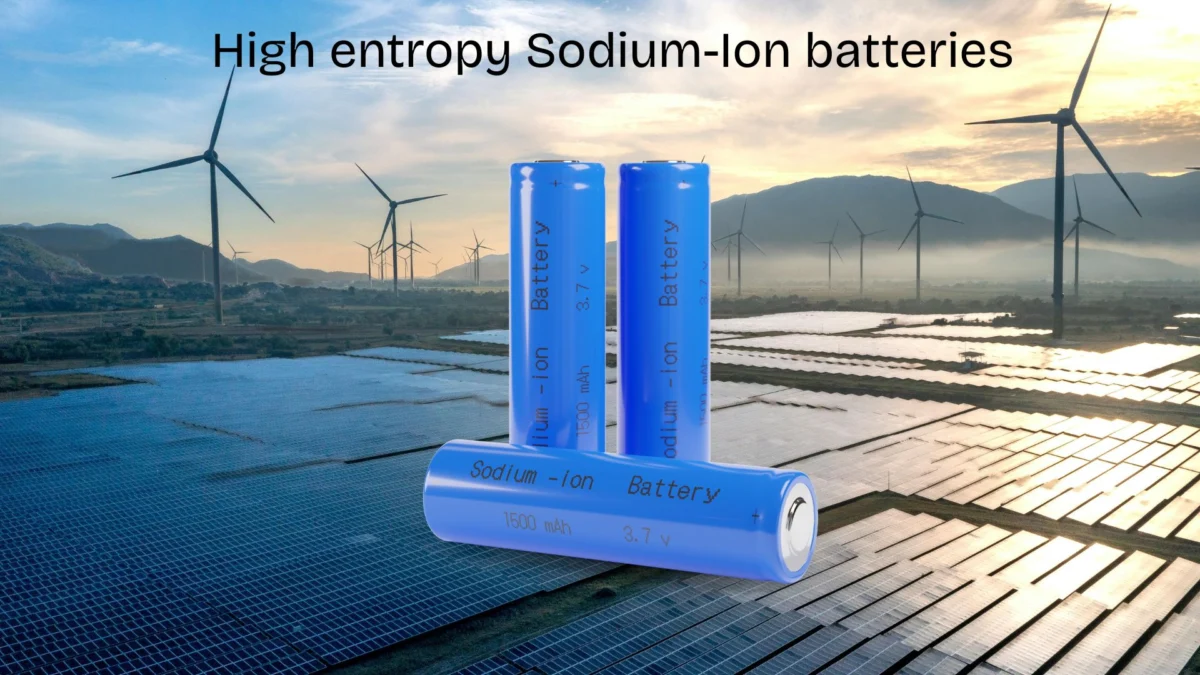
INDORE, INDIA — In a landmark development for the global transition toward renewable energy, an international consortium of scientists has unveiled a breakthrough in battery chemistry that could fundamentally alter the economics of power storage. Researchers from the Indian Institute of Technology (IIT) Indore, the Bhabha Atomic Research Centre (BARC), IIT Mandi, and Boise State University in the United States have successfully engineered a high-entropy cathode material for sodium-ion batteries.
This new material addresses the primary technical hurdles that have long relegated sodium-ion technology to the sidelines: structural instability and slow charging rates. By leveraging "high-entropy engineering," the team has created a battery component that is not only cheaper to produce than its lithium-ion counterparts but also demonstrates remarkable durability and efficiency.
Main Facts: The Sodium-Ion Breakthrough
The heart of the discovery lies in the synthesis of a complex, disordered cathode structure. Unlike traditional batteries that rely on one or two primary transition metals, this new cathode utilizes a precise blend of five: manganese, iron, nickel, copper, and aluminium. This "high-entropy" approach—referring to a state of high atomic disorder—counterintuitively results in a crystal lattice that is more stable than traditional, ordered structures.
Key highlights of the research include:
- Cost-Efficiency: By utilizing sodium, which is vastly more abundant and geographically distributed than lithium, the cost of raw materials is significantly reduced.
- Enhanced Stability: The high-entropy design prevents the structural warping (monoclinic distortion) that typically destroys sodium-ion batteries during use.
- Rapid Charging: The inclusion of aluminium "props open" the atomic layers, allowing larger sodium ions to move freely and quickly.
- Performance: The material retains approximately 84% of its charge capacity even after 250 rapid charge-discharge cycles, a significant milestone for sodium-based storage.
Chronology: From Lithium Dependency to Sodium Innovation
The journey toward this breakthrough began with the recognition of a looming "lithium bottleneck." As the global automotive and energy sectors pivoted toward electrification over the last decade, the demand for lithium-ion batteries skyrocketed. This surge led to volatile pricing, supply chain vulnerabilities, and environmental concerns regarding lithium mining and cobalt sourcing.

The Problem with Sodium
Scientists have long eyed sodium as the logical successor to lithium. Sodium is located directly below lithium on the periodic table, sharing similar chemical properties. More importantly, sodium is found in abundance in common salt, making it accessible to every nation with a coastline.
However, a significant physical hurdle remained: sodium ions are roughly 25% larger than lithium ions. In a standard battery, ions move between the anode and cathode during charging and discharging. Because sodium ions are "bulky," they exert immense physical stress on the cathode’s crystal lattice. In conventional materials, this causes the structure to crack, warp, and eventually fail, leading to short battery lifespans and poor performance.
The Research Phase
Starting in the early 2020s, the collaborative team from India and the U.S. began experimenting with layered oxide cathodes. They hypothesized that the "cocktail effect" of multiple elements could stabilize the material. By 2025, the focus shifted to high-entropy oxides—a relatively new field in materials science where the mixing of five or more elements creates a "stabilization by disorder."
The Final Engineering
In the final phase of development leading up to the June 2026 announcement, the researchers integrated aluminium into a five-metal mix. This was the "eureka" moment. While previous high-entropy cathodes were stable, they often lacked the capacity for fast charging. The addition of aluminium acted as a structural spacer, widening the pathways for sodium ions and solving the speed issue.
Supporting Data: The Science of High-Entropy Engineering
The technical success of the project rests on two pillars: Entropy Stabilization and Operando Analysis.

Entropy Stabilization and the "Cocktail Effect"
In thermodynamics, entropy is often associated with chaos. However, in materials science, high configuration entropy can lower the overall Gibbs free energy of a system, making a complex mixture more stable than a simple one. The researchers blended Manganese (Mn), Iron (Fe), Nickel (Ni), Copper (Cu), and Aluminium (Al).
When these five metals are integrated into the cathode, they compete for positions within the lattice. This competition prevents any single metal from dominating the structure and forcing it into an unstable phase. The result is a hexagonal lattice that remains "locked" in place even as sodium ions are violently shoved in and out during high-speed charging.
Widening the "Atomic Highway"
A critical piece of data provided by the team involves the "d-spacing" or the distance between the atomic layers of the cathode. By introducing aluminium, the researchers physically increased this spacing.
- Standard Cathode Spacing: Often too narrow for sodium, leading to high resistance and heat.
- New High-Entropy Spacing: Expanded by the aluminium "pillars," reducing the "diffusion bottleneck." This allows the battery to achieve high power density, making it suitable for applications that require quick bursts of energy or rapid recharging.
Operando Synchrotron X-ray Diffraction
To prove their theories, the team utilized the Synchrotron X-ray diffraction technique. Unlike standard testing, "operando" means the battery was monitored while in operation.
- The Findings: The X-rays revealed that the material maintained its hexagonal (O3-type) structure throughout the entire voltage range.
- Comparison: Conventional sodium cathodes often shift into a "monoclinic" phase—a tilted, distorted state—when too many ions are removed. This shift is usually irreversible and leads to capacity loss. The new high-entropy material completely suppressed this phase transition.
Official Responses and Institutional Significance
The collaboration between Indian and American institutions underscores the geopolitical importance of energy independence. Officials from the participating institutions have emphasized the scalability of this research.

From IIT Indore:
Lead researchers at IIT Indore noted that this project represents a significant step toward India’s "Atmanirbhar Bharat" (Self-Reliant India) initiative in the energy sector. "By moving away from lithium, we are not just choosing a cheaper metal; we are choosing a path that utilizes resources we have in plenty. This cathode is the bridge between laboratory curiosity and industrial reality," a senior faculty member stated.
From the Bhabha Atomic Research Centre (BARC):
Scientists at BARC highlighted the safety and stability of the material. "In large-scale grid storage, thermal stability is paramount. The high-entropy nature of this cathode makes it inherently more resistant to the thermal runaway issues that have occasionally plagued lithium-ion installations."
From Boise State University:
The U.S. partners emphasized the global implications for the renewable energy transition. "The climate crisis requires us to deploy storage at a scale the world has never seen. We cannot do that with lithium alone. This international collaboration proves that high-entropy engineering is a viable strategy for the next generation of sustainable batteries."
Implications: A Future Beyond Lithium
The successful engineering of this high-entropy material has far-reaching implications for the environment, the economy, and the global power grid.
1. Stabilizing Renewable Energy Grids
Wind and solar power are intermittent; the sun doesn’t always shine, and the wind doesn’t always blow. To make these sources reliable, we need "stationary storage"—massive batteries that store excess power. Because weight is less of a concern for a building-sized battery than it is for a smartphone, sodium-ion batteries are the perfect candidate. Their lower cost makes it economically feasible to build the massive storage grids required to phase out coal and gas-fired power plants.

2. Economic Sovereignty
Currently, the "Lithium Triangle" in South America and processing plants in China dominate the battery supply chain. For countries like India, which has vast salt reserves but limited lithium deposits, sodium-ion technology is a matter of national security. This breakthrough allows for a localized supply chain, from raw material extraction to final battery assembly.
3. Environmental Impact
Lithium extraction is water-intensive and often occurs in ecologically sensitive regions. Furthermore, many lithium-ion batteries require cobalt, the mining of which is associated with significant human rights concerns. The high-entropy sodium-ion cathode uses more common metals like manganese and iron, which have established, more ethical mining practices and a lower overall environmental footprint.
4. The Path to Commercialization
While the laboratory results are stellar—84% retention after 250 cycles—the next step is scaling production. The researchers noted that the synthesis process used for this high-entropy material is compatible with existing industrial battery manufacturing equipment. This means that "Gigafactories" currently producing lithium-ion cells could, in theory, be retrofitted to produce these new sodium-ion cells with minimal capital expenditure.
Conclusion
The work of the international team from IIT Indore, BARC, IIT Mandi, and Boise State University marks a pivotal moment in materials science. By embracing the complexity of high-entropy alloys, they have solved a "size problem" that has frustrated battery researchers for decades. As the world stands on the precipice of a total energy overhaul, the move from scarce lithium to abundant sodium—powered by the "chaos" of high-entropy cathodes—may well be the spark that finally makes clean energy affordable for all.