

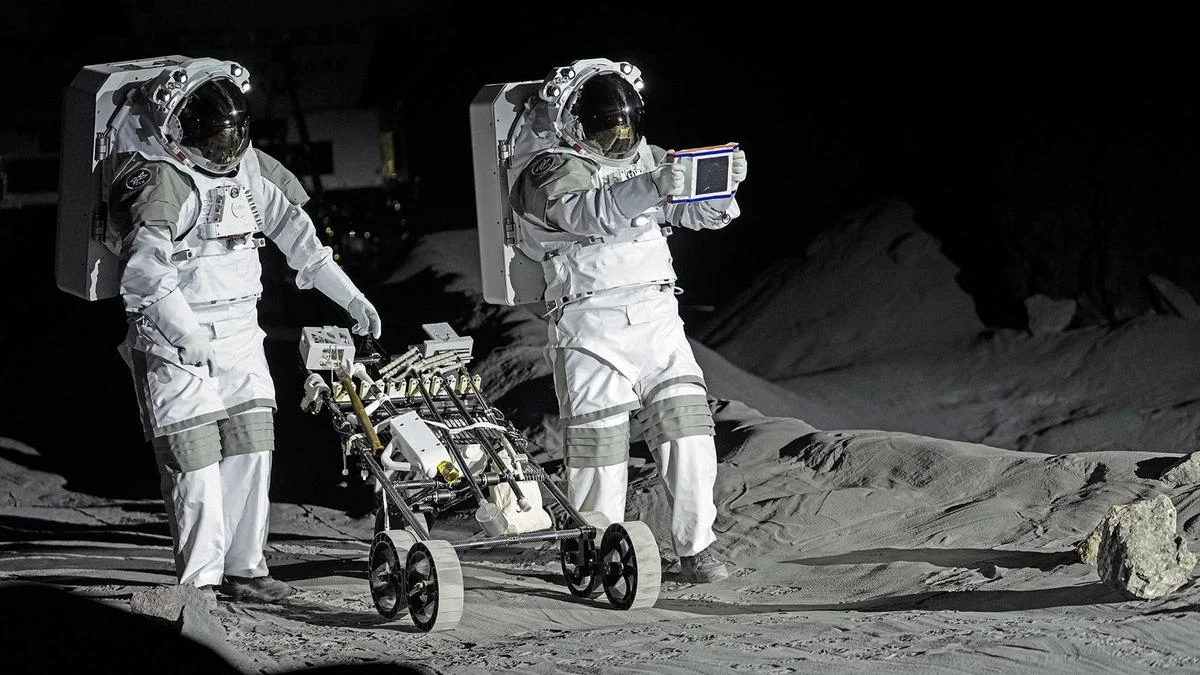
Cologne, Germany – When the spectacle of a rocket launch electrifies the world, our collective gaze is often fixed on the fiery ascent and the audacious individuals strapped within. Yet, this captivating moment is merely the culmination of an unseen, years-long odyssey: the rigorous, multifaceted process known as astronaut training. Far from a simple flight, becoming an astronaut is a profound transformation, demanding unparalleled physical prowess, mental fortitude, and a mastery of complex systems. The European Astronaut Center in Cologne recently offered a glimpse into this intense preparation, with French astronaut Thomas Pesquet and German astronaut Matthias Maurer demonstrating their lunar surface simulation training – a testament to the meticulous groundwork that underpins humanity’s ambitious return to the Moon and beyond.
The popular imagination often romanticizes space travel, reducing it to a heroic journey undertaken by a select few. However, the reality is a relentless regimen of learning, adapting, and pushing human limits. In an era where instant gratification often overshadows the value of process, the profound commitment required for astronaut training stands as a stark counterpoint. It is a testament to human resilience and ingenuity, ensuring that when the moment of spaceflight arrives, the crew is not just capable, but exceptionally prepared for the unforgiving vacuum and myriad challenges of the cosmos.
The Unseen Foundation: Main Facts of Astronaut Preparation
Astronaut training is a holistic discipline, meticulously designed to equip individuals with the diverse skill set necessary for survival and success in space. It encompasses far more than just physical conditioning; it delves into complex scientific principles, intricate mechanical operations, psychological resilience, and emergency response. The core objective is to transform highly intelligent and capable individuals into self-reliant, adaptable, and highly specialized professionals ready to operate in the most extreme environment imaginable.
This preparation typically spans several years, varying based on the mission’s complexity and duration. From the initial selection process, which screens for an extraordinary blend of intelligence, psychological stability, and physical health, candidates embark on a journey that systematically exposes them to every conceivable scenario they might encounter. This includes mastering the specifics of their spacecraft, understanding orbital mechanics, conducting scientific experiments, performing extra-vehicular activities (EVAs), and crucially, preparing for unforeseen emergencies. The overarching goal is not merely to survive, but to thrive, innovate, and contribute meaningfully to scientific discovery and exploration.

A Chronological Evolution of Expertise: The Training Modalities
The evolution of astronaut training has mirrored the progression of space exploration itself. From the pioneering days of Project Mercury and Apollo, focused on basic survival and vehicle operation, to the complex, international collaboration of the International Space Station (ISS) era, and now towards ambitious deep-space missions like Artemis, the training curriculum has become increasingly sophisticated and specialized.
1. Foundational Skills and Core Systems Training:
The journey begins with foundational knowledge. Astronaut candidates spend considerable time in classrooms, delving into orbital mechanics, spacecraft systems (propulsion, life support, power, communications), astrophysics, and engineering principles. This academic phase is crucial for building a deep understanding of the environment they will inhabit and the technology that will sustain them. Concurrently, rigorous physical training commences, focusing on cardiovascular endurance, strength, flexibility, and coordination – all vital for coping with the physical demands of spaceflight and microgravity adaptation.
2. Extra-Vehicular Activity (EVA) Training: The Art of Spacewalking
Perhaps one of the most iconic images of spaceflight is an astronaut performing a spacewalk, or Extra-Vehicular Activity (EVA). This highly complex and dangerous task requires meticulous preparation. EVA training primarily takes place in massive Neutral Buoyancy Laboratories (NBLs). These gargantuan pools, such as NASA’s NBL at the Johnson Space Center in Houston or the hydro-laboratory at the Gagarin Cosmonaut Training Center in Russia, allow astronauts to experience a simulation of microgravity.
Wearing fully pressurized, custom-fitted spacesuits, astronauts are submerged, their buoyancy precisely adjusted to mimic weightlessness. Here, they practice intricate repair tasks, assembly procedures, and scientific deployments on full-scale mockups of spacecraft components, like sections of the ISS or lunar landers. This involves mastering specialized tools, learning precise movements, and developing acute situational awareness in a disorienting environment. Communication with crewmates and ground control is constantly practiced, simulating real-time mission scenarios and potential emergencies. The physical exertion within a bulky suit underwater for hours is immense, preparing them for the stamina required during actual spacewalks, which can last for six to eight hours.

3. Geological Field Training: Becoming Planetary Explorers
For missions aiming to explore celestial bodies like the Moon or Mars, astronauts undergo extensive geological field training. This transforms them from pilots or engineers into adept field scientists. The core idea is to train astronauts to identify, collect, and analyze samples, understand geological formations, and conduct scientific observations in environments that closely resemble extraterrestrial landscapes.
Earth-based analogues are carefully selected for this purpose. Volcanic regions like the Big Island of Hawaii, with its lunar-like basaltic plains and lava tubes, served as crucial training grounds for Apollo astronauts in the 1960s and 70s. Similarly, desert landscapes like the Grand Canyon in Arizona or the Mojave Desert, or even the polar regions, offer insights into extreme environments, crater formation, and ancient geological processes. Astronauts learn to operate scientific instruments, document findings, and navigate challenging terrains while simulating the constraints of a spacesuit and limited resources. This training is vital not just for scientific discovery but also for mission safety, enabling astronauts to make informed decisions about sampling locations and potential hazards.
4. Survival Training: Prepared for the Unforeseen
Spaceflight, despite all technological advancements, carries inherent risks. A spacecraft could land off-target, in an unexpected environment, or an emergency could necessitate abandoning a mission. This is where survival training becomes paramount. Astronauts are rigorously prepared for a wide array of terrestrial survival scenarios, ensuring they can endure until rescue teams arrive.
This training often takes place in diverse, challenging environments:

- Arctic wilderness: Learning to build shelters, start fires, procure food, and navigate in freezing conditions.
- Dense forests: Practicing evasion, finding water, and signaling for help.
- Open sea: As witnessed during the return of astronauts like Sunita Williams and Butch Wilmore, splashdowns are a possibility. Astronauts learn sea survival techniques, including righting capsized capsules, managing hypothermia, and using emergency rafts and signaling devices.
- Deserts: Coping with extreme heat, dehydration, and navigation without landmarks.
Beyond practical skills like hunting, fishing, making shelters from scraps, or crafting rudimentary medical supplies, survival training also hones psychological resilience. It teaches astronauts to manage stress, maintain morale, and foster teamwork under duress – critical attributes when faced with isolation and uncertainty far from home. These exercises often involve international crews, strengthening cross-cultural collaboration in high-stakes situations.
5. Highly-Specialized Simulators: Mastering the Machine
Modern astronaut training heavily relies on highly-specialized simulators that replicate every facet of a space mission. These advanced systems allow astronauts to practice procedures repeatedly in a safe, controlled environment, without the astronomical cost or risk of actual flight.
- Full-scale spacecraft mockups: These detailed replicas of capsules (like Orion or Soyuz) and ISS modules allow astronauts to familiarize themselves with the layout, equipment, and operational procedures within their living and working spaces.
- Motion-based flight simulators: These elaborate cockpits replicate the sensations of launch, orbital maneuvers, and re-entry, complete with G-forces, vibrations, and visual cues. Astronauts learn to pilot the spacecraft, manage complex systems, and react to emergency situations.
- Virtual Reality (VR) and Augmented Reality (AR) laboratories: These immersive environments are increasingly used for detailed procedural training, such as robotics operations (e.g., operating the Canadarm2), complex spacewalk scenarios, and even mental rehearsal of entire mission phases. VR allows for training in microgravity environments that are difficult or impossible to replicate physically.
- Centrifuges: These massive rotating arms expose astronauts to high G-forces, simulating the intense acceleration experienced during launch and re-entry, helping them build tolerance and maintain focus under pressure.
- Mission Control Simulators: Astronauts regularly train with ground control teams in simulated mission environments, practicing communication protocols, anomaly resolution, and critical decision-making under time constraints. This ensures seamless coordination between space and Earth.
- Partial Gravity Simulators: For lunar and Martian missions, specialized harnesses, body suits, and cable systems are used to offload a portion of an astronaut’s weight, simulating the lower gravity environments of these celestial bodies, crucial for practicing movement and operations.
These simulators are also crucial for practicing malfunction and emergency scenarios, from depressurization and fires to critical system failures. This repetitive exposure to high-stress situations helps astronauts develop quick thinking, problem-solving skills, and the ability to remain calm and effective under extreme pressure.
6. Medical and Psychological Training: The Human Element
The human body and mind are profoundly affected by spaceflight. Consequently, medical and psychological training are integral. Astronauts receive basic medical training, enabling them to act as paramedics for themselves and their crewmates. This includes administering injections, suturing wounds, basic dentistry, and using sophisticated medical diagnostic equipment. In long-duration missions, they are often the primary medical personnel.

Equally important is psychological preparedness. Astronauts are trained to cope with isolation, confinement, stress, and the challenges of living in close quarters with a small crew for extended periods. This involves conflict resolution, team-building exercises, and strategies for maintaining mental well-being, including communication with family and psychological support from Earth. Regular medical examinations and rigorous stamina training are continuous throughout their careers, ensuring peak physical condition.
Supporting Data and Key Institutions
The global infrastructure supporting astronaut training is vast, reflecting the international nature of space exploration. Key institutions include:
- NASA (National Aeronautics and Space Administration), USA: Johnson Space Center (Houston) is home to the Neutral Buoyancy Laboratory, the Space Vehicle Mockup Facility, and extensive mission control simulation centers.
- ESA (European Space Agency), Europe: The European Astronaut Centre (EAC) in Cologne, Germany, is a hub for European astronaut training, particularly for ISS operations and increasingly for lunar missions.
- Roscosmos, Russia: The Gagarin Cosmonaut Training Center (GCTC) in Star City, near Moscow, is renowned for its Soyuz spacecraft training, hydro-laboratory, and survival training programs.
- JAXA (Japan Aerospace Exploration Agency), Japan: Provides training for its astronauts, often in collaboration with NASA and ESA.
- CNSA (China National Space Administration), China: Operates its own comprehensive training facilities for its taikonauts.
The cumulative training hours for an astronaut can range from 2-3 years for an ISS mission to potentially 5-10 years for a more complex lunar or Martian endeavor, accumulating thousands of hours in simulators, classrooms, and field exercises. Each astronaut’s training path is tailored, building upon their specific background and mission assignments.
Official Responses and Perspectives
Space agencies consistently emphasize the critical role of rigorous training in mission success and astronaut safety.

A NASA spokesperson might state: "Our astronauts are not just passengers; they are highly skilled operators, scientists, and engineers. The intensity of our training programs reflects the inherent risks and complexities of spaceflight. Every hour in a simulator, every day in a field analogue, builds the proficiency and resilience needed to operate autonomously and effectively millions of miles from Earth. Safety is paramount, and comprehensive training is our best insurance policy."
Josef Aschbacher, ESA Director General, could be quoted: "As Europe prepares for a sustained presence on the Moon and looks towards Mars, the European Astronaut Centre is evolving its training paradigms. We are focusing on greater autonomy, advanced robotics, and the psychological demands of long-duration, deep-space missions. Our astronauts are pioneers, and their training ensures they are equipped not just to survive, but to lead the charge in humanity’s next great leaps."
Dmitry Rogozin, former head of Roscosmos, might have remarked on the unique aspects of Russian training: "The Gagarin Cosmonaut Training Center upholds a legacy of practical, robust preparation. Our survival training, our centrifuge, our hydro-laboratory – these are designed to instill not just knowledge, but an instinctive capability to handle any emergency. The Soyuz system, refined over decades, demands a crew that is intimately familiar with its every nuance, a familiarity forged through relentless practice."
These statements underscore a unified philosophy across international space agencies: training is not an optional extra, but the foundational pillar upon which all space exploration rests.

Implications for the Future of Space Exploration
The implications of this comprehensive astronaut training are profound and far-reaching.
1. Enhanced Mission Success and Safety: The most direct implication is the significantly increased probability of mission success and astronaut safety. By preparing for every conceivable scenario, crews are better equipped to handle malfunctions, adapt to unforeseen challenges, and execute complex operations with precision.
2. Paving the Way for Deep Space: As humanity sets its sights on returning to the Moon with the Artemis program and eventually journeying to Mars, training methodologies are evolving. Future astronauts will need to be even more self-sufficient, capable of longer durations away from Earth, and skilled in performing complex scientific research and maintaining their spacecraft without immediate ground support. Training will incorporate more autonomy, advanced medical protocols for extended isolation, and simulations of even more alien environments.
3. Technological Spin-offs: The development of advanced simulators, VR/AR technologies, and sophisticated medical monitoring systems for astronaut training often leads to technological spin-offs that benefit terrestrial industries, from aviation and medicine to virtual reality applications.

4. Inspiration and Education: The dedication and rigor of astronaut training inspire generations. It highlights the value of perseverance, continuous learning, and teamwork, serving as a powerful educational tool to encourage interest in STEM fields.
5. International Collaboration: The global nature of space exploration necessitates international collaboration in training. Astronauts from different nations train together, fostering cross-cultural understanding and building cohesive teams essential for complex missions like the ISS. This collaboration will be even more critical for future lunar bases and Martian expeditions.
In conclusion, the seemingly effortless act of spaceflight is built upon a monumental effort of human preparation. The demonstrations by Pesquet and Maurer in Cologne are but a snapshot of an ongoing, evolving process that transforms exceptional individuals into the vanguards of human exploration. It is a journey of relentless learning, adaptation, and resilience, ensuring that each step taken beyond Earth’s confines is not just brave, but meticulously prepared, safeguarding the future of humanity’s reach into the cosmos.
