

Executive Summary: A Tale of Two Segments
Royal Enfield, the global leader in the mid-size motorcycle segment (250cc-750cc), has reported a resilient performance for September 2026, characterized by a significant divide between its entry-level dominance and its premium aspirations. The Chennai-based manufacturer recorded total sales of 1,33,958 units, marking a 7.75% year-on-year (YoY) increase from the 1,24,328 units sold in September 2025. While the company continues to flex its muscles in the domestic Indian market, the data reveals a fascinating internal shift: the core 350cc portfolio is currently the sole engine of growth, effectively subsidizing a double-digit decline in the brand’s higher-capacity offerings.
As the company navigates the first half of the 2026-27 fiscal year, the September results serve as a barometer for the changing tastes of the Indian motorcyclist and the increasing volatility of the international export market. With a domestic volume crossing the 1.21 lakh mark and a robust 19.80% growth in the first half of the fiscal year (H1), Royal Enfield remains the undisputed king of the retro-modern aesthetic, even as rivals sharpen their tools to challenge its hegemony.
1. September 2026: The Core Statistics
The month of September 2026 proved to be a period of consolidation and incremental growth for Royal Enfield. Total sales, comprising both domestic dispatches and international exports, reached 1,33,958 units. This represents a sequential growth of 5.91% over August 2026, where the company moved 1,26,479 units.
Domestic Performance
India remains the heartbeat of Royal Enfield’s operations, accounting for over 90% of its total monthly volume. In September 2026, domestic sales stood at 1,21,326 units, an increase of 6.83% compared to the 1,13,573 units sold in the same month last year. This steady climb suggests that despite inflationary pressures and a diversifying two-wheeler market, the aspirational value of the "Thump" remains intact among Indian consumers.
Export Trajectory
On the global front, Royal Enfield witnessed a sharp spike in momentum. Exports rose by 17.45% YoY, reaching 12,632 units. This is a significant recovery considering the fluctuations seen in previous quarters. The growth in exports highlights the brand’s successful penetration into markets across Latin America, Southeast Asia, and Europe, where models like the Hunter 350 and the Himalayan are finding a dedicated following.
2. Segmental Breakdown: The 350cc Juggernaut vs. Premium Headwinds
The most striking aspect of the September sales data is the divergence between the below-350cc and above-350cc categories.
The 350cc Dominance
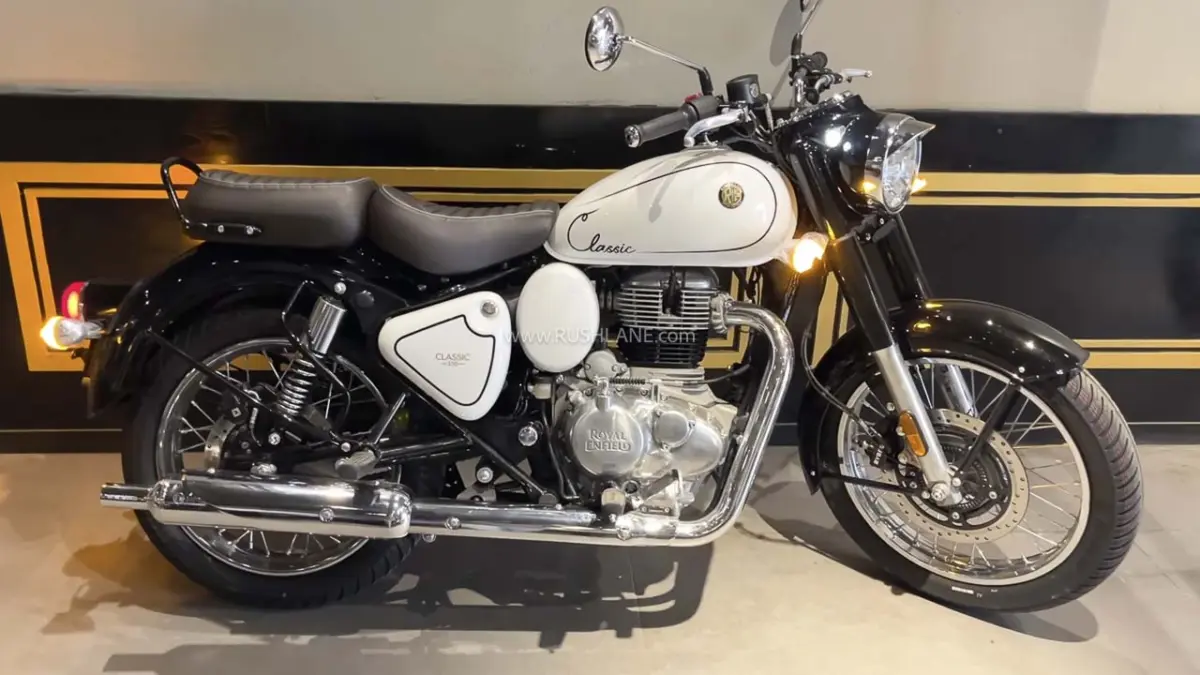
Royal Enfield’s "J-Platform" motorcycles—comprising the Classic 350, Bullet 350, Hunter 350, and Meteor 350—continue to be the primary volume drivers. This category recorded sales of 1,21,495 units in September 2026, a robust 13.04% increase from 1,07,478 units in September 2025. These four models alone contributed a staggering 90.70% of the company’s total monthly sales. The Classic 350 remains the flagship of this fleet, recently bolstered by new color variants and feature updates that have kept consumer interest high.
The Decline in the Premium Range
Conversely, the "above-350cc" segment, which includes the Himalayan 450, Scram 411, Guerrilla 450, and the 650 Twin range (Interceptor, Continental GT, Super Meteor, and Shotgun), faced a challenging month. Sales in this category plummeted by 26.04%, falling from 16,850 units in September 2025 to just 12,463 units in September 2026.

This decline is particularly noteworthy given Royal Enfield’s recent efforts to premiumize its brand. The 26% drop suggests that while the entry-level enthusiast is still flocking to the brand, the more seasoned or "lifestyle" rider might be exploring emerging competitors or delaying purchases. Sequentially, this segment also fell by 6.55% from August 2024, indicating a cooling of demand for the brand’s more expensive, high-performance machines.
3. Chronology of Growth: Q3 and H1 FY 2026-27
To understand the current standing of Royal Enfield, one must look at the cumulative performance over the last six months.
Third Quarter (July–September 2026) Results
The second quarter of the fiscal year (which aligns with the third calendar quarter) was exceptionally strong for the brand. Total sales reached 3,78,669 units, up 16.02% from the 3,26,375 units recorded in Q3 2025. Domestic growth during this period was 16.45%, while exports maintained a healthy 12.32% growth rate. This quarterly surge was largely driven by pre-festive inventory building and the positive reception of the refreshed Classic 350 lineup.
First Half (April–September 2026) Milestones
The first half of the 2026-27 fiscal year has been a period of record-breaking volumes. Total sales crossed the 7-lakh mark, reaching 7,09,096 units—a nearly 20% jump from the 5,91,903 units sold in H1 of the previous year.
- Domestic H1: 6,42,021 units (+23.11% YoY)
- Export H1: 67,075 units (-4.75% YoY)
While the H1 export figures show a slight cumulative decline, the strong performance in September indicates that the downward trend is being reversed. The cumulative data also reinforces the segmental divide: H1 sales for the sub-350cc category rose by 24.47%, while the above-350cc category saw a 9.12% contraction over the six-month period.
4. Supporting Data and Market Dynamics
The data suggests a market in transition. Royal Enfield’s ability to sell over 1.3 lakh motorcycles in a single month is a testament to its manufacturing scale and brand equity. However, the reliance on the 350cc segment creates a "volume trap."
Internal Competition and Cannibalization
Industry analysts suggest that the introduction of the Guerrilla 450 and the updated Himalayan 450 may be causing some internal cannibalization within the premium segment, or perhaps they are facing stiff competition from the very segment they were meant to disrupt. Furthermore, the 650cc twins, once the undisputed value-for-money kings of the large-displacement world, are now entering a mature phase of their product lifecycle, requiring more than just paint updates to stimulate growth.
The Export Pivot
The 17.45% YoY growth in exports for September is a crucial win. Royal Enfield has been aggressively expanding its assembly units (CKD plants) in markets like Nepal, Brazil, Thailand, and Colombia. This localized strategy is beginning to pay dividends by insulating the brand from some of the logistics costs and import duties that previously hampered its global competitiveness.
5. Strategic Outlook and Official Context
While Royal Enfield has not issued a specific statement regarding the September dip in the 350cc+ segment, the company’s strategic roadmap provides some context. The brand is currently in the midst of its most aggressive product offensive in its history.
Focus on the "Four Pillars"
Royal Enfield’s strategy remains focused on its four engine platforms: the J-platform (350cc), the Himalayan platform (450cc liquid-cooled), the 650cc Parallel Twins, and the upcoming electric vehicle (EV) platform. The company is betting heavily on "lifestyle motorcycling," moving beyond just selling bikes to selling apparel, accessories, and curated riding experiences like ‘Motoverse’ and ‘Himalayan Odyssey.’

Manufacturing and Capacity
With H1 volumes crossing 7 lakh units, Royal Enfield is on track to potentially breach the 1.4 million annual unit mark. To support this, the company has been optimizing its Vallam Vadagal and Oragadam plants. The focus is now on ensuring that the premium 450cc and 650cc lines can regain momentum as the festive season peaks in India.
6. Competitive Implications: The Retro Wars Intensify
The landscape in which Royal Enfield operates is no longer a vacuum. The "Retro-Modern" segment is currently the most contested space in the global motorcycling industry.
The Honda Challenge
Honda has recently refreshed its CB350 and H’ness CB350 range, targeting the heart of Royal Enfield’s Classic 350 territory. By offering features like traction control and slipper clutches—features that have traditionally been absent from RE’s 350cc line—Honda is attempting to woo the tech-conscious buyer.
The Triumph-Bajaj Threat
Perhaps the most significant threat comes from the Bajaj-Triumph partnership. Following the success of the Speed 400 and Scrambler 400X, the partnership is reportedly preparing a smaller-displacement "Bonneville" style motorcycle. If priced competitively, this could directly challenge the Interceptor 650 and the higher-end variants of the Classic 350.
The Hero-Harley Alliance
The Harley-Davidson X440, manufactured by Hero MotoCorp, has also carved out a niche for itself, offering a premium brand name at a price point that overlaps with Royal Enfield’s 350cc and 450cc offerings.
7. Conclusion: Navigating the High Road
Royal Enfield’s September 2026 performance is a study in market leadership under pressure. The 7.75% YoY growth is a commendable achievement, driven by a 350cc portfolio that seems impervious to market fatigue. The brand’s ability to maintain a nearly 90% market share in the mid-size segment is a feat few manufacturers globally can claim.
However, the 26% decline in the premium segment serves as a warning. As Indian consumers become more discerning and global competition intensifies, Royal Enfield cannot afford to rely solely on its heritage. The coming months, particularly the Q4 festive period, will be critical. The company must find a way to reignite interest in its 450cc and 650cc platforms while defending its 350cc fortress against the looming shadows of Honda and Triumph.
For now, the "Thump" continues to beat strongly, but the rhythm of the market is changing, and Royal Enfield will need to tune its engine accordingly to stay ahead of the pack.
