

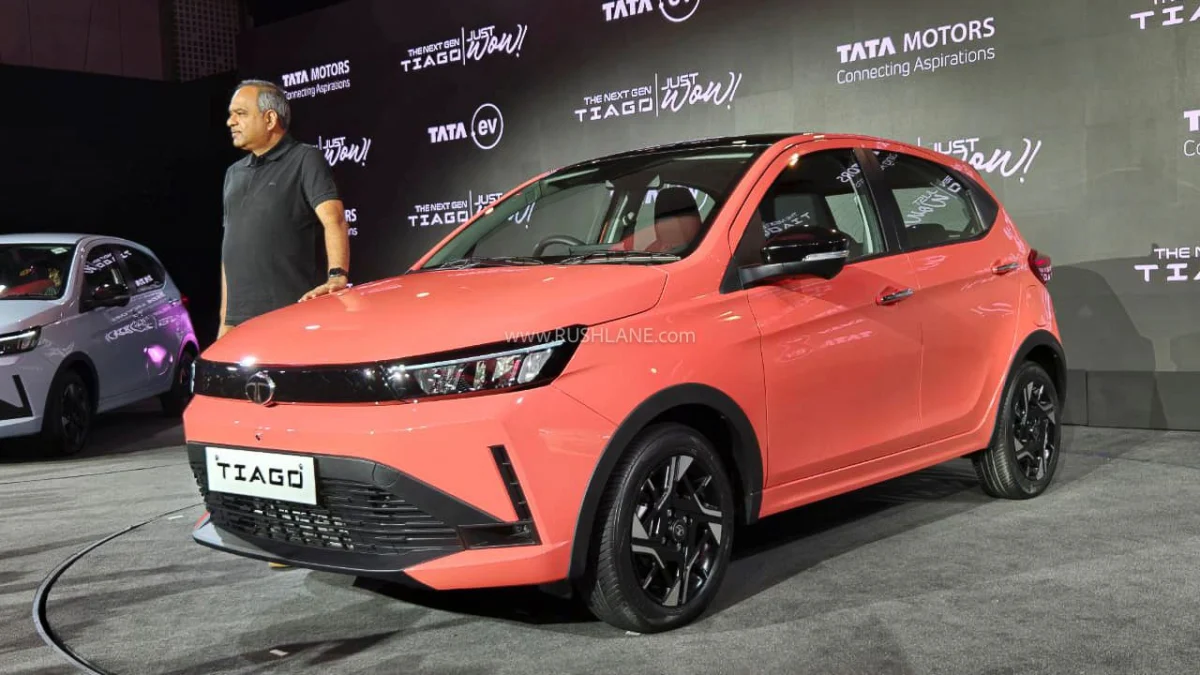
New Delhi, India – In a move that signals a paradigm shift in the Indian automotive landscape, Tata Motors has officially pulled the wraps off its highly anticipated 2026 Tiago facelift. The launch, which took place at a high-decibel event in the national capital, introduces a comprehensive overhaul of the Tiago nameplate, spanning across Petrol, i-CNG, and Electric Vehicle (EV) powertrains. By integrating segment-first technologies, a radical design departure, and an aggressive pricing strategy—including a disruptive Battery-as-a-Service (BaaS) model—Tata Motors is clearly aiming to solidify its dominance in the hatchback segment.
The 2026 Tiago is not merely a cosmetic update; it represents a fundamental re-engineering of what a "budget" car in India should offer. With prices starting at an ultra-competitive Rs 4.69 lakh (ex-showroom), Tata is challenging the status quo held by long-term rivals such as the Maruti Suzuki Swift and Hyundai Grand i10 Nios.
1. Main Facts: Pricing, Trims, and the BaaS Breakthrough
The core of the 2026 Tiago’s market strategy lies in its pricing architecture, designed to capture a wide spectrum of buyers from first-time owners to tech-savvy urban commuters.

The Pricing Spectrum (Ex-Showroom)
The Petrol Manual Transmission (MT) variants start at Rs 4.69 lakh for the ‘Smart’ trim, scaling up to Rs 7.29 lakh for the feature-packed ‘Creative+’ variant. The i-CNG lineup, which continues to be a volume driver for Tata, begins at Rs 5.79 lakh.
For the Tiago.ev, Tata has maintained a dual-battery strategy. The 19.2 kWh version starts at Rs 6.99 lakh, while the 24 kWh version, offering longer range and higher performance, peaks at Rs 9.99 lakh.
Battery-as-a-Service (BaaS): The Great EV Equalizer
The most significant announcement at the launch was the introduction of the BaaS (Battery-as-a-Service) model for the Tiago.ev. This financial innovation allows customers to purchase the electric hatchback at an entry price of Rs 4.69 lakh—identical to the base petrol variant. Owners then pay a battery rental fee of Rs 2.6 per kilometer. This move effectively eliminates the "EV premium" that has historically deterred budget-conscious buyers, potentially accelerating mass-market EV adoption in India.

Trim Hierarchy
Tata has streamlined its nomenclature into five primary personas:
- Smart: The essential entry point.
- Pure / Pure+: Balancing value and necessary tech.
- Pure+ A: Adding aesthetic and convenience touches.
- Creative: The high-tech, stylish mid-range.
- Creative+: The flagship experience with every available bell and whistle.
2. Chronology: The Evolution of a Game-Changer
To understand the significance of the 2026 facelift, one must look at the Tiago’s decade-long journey.
- 2016 – The Genesis: Originally intended to be called the "Zica," the Tiago was launched as the first product of Tata’s "Impact" design language. It was a make-or-break car for Tata Motors, successfully replacing the aging Indica/Bolt lineage.
- 2020 – The Impact 2.0 Facelift: Tata introduced a sharper design and a 4-star Global NCAP safety rating, making the Tiago the safest car in its segment at the time.
- 2022 – The Multi-Fuel Expansion: Tata introduced the i-CNG technology with the industry-first "Twin Cylinder" setup and launched the Tiago.ev, which quickly became India’s best-selling electric car.
- 2024 – The AMT Revolution: Tata became the first manufacturer in India to offer an Automated Manual Transmission (AMT) with a factory-fitted CNG kit.
- 2026 – The Current Facelift: The latest iteration moves the Tiago into a premium territory, adopting design cues from the Safari and Harrier, and integrating high-end electronics previously reserved for the Rs 15-lakh-plus segments.
3. Supporting Data: Design, Technology, and Engineering
A Radical Exterior Re-imagining
The 2026 Tiago adopts a "Digital-First" design philosophy. The front fascia is dominated by slimmer LED headlamps and a revised bumper housing integrated Daytime Running Lamps (DRLs).

- ICE vs. EV Identity: The petrol and CNG versions feature a high-gloss black grille with a tri-arrow pattern. In contrast, the EV variant sports a closed-off grille with signature blue accents, signifying its zero-emission status.
- Illumination: Both versions now feature "connected-style" LED tail lamps at the rear, a trend typically seen in luxury segments, which enhances the car’s visual width.
- Stance: The car retains its practical 170 mm ground clearance, optimized for Indian road conditions, while riding on newly designed aerodynamic alloy wheels.
The Cabin: A Tech-Forward Sanctuary
The interior of the 2026 Tiago has undergone a total transformation. Gone are the basic plastics of the past, replaced by a layered dashboard featuring premium fabric inserts and soft-touch textures.
Key Technical Specifications of the Interior:
- Infotainment: A new 10.25-inch floating touchscreen infotainment system with wireless Android Auto and Apple CarPlay.
- Instrumentation: A free-standing fully digital instrument cluster with customizable views.
- Connectivity: 37 connected car features via the iRA platform, including geofencing, remote climate control (for EV), and vehicle health reports.
- Segment-Firsts: The Tiago now boasts a 360-degree camera system with a blind-view monitor, dual wireless charging pads, and a two-spoke steering wheel with an illuminated Tata logo—a feature debuted on the new Nexon.
4. Safety and Engineering: The Dual Crash Test Demonstration
Tata Motors has built its modern reputation on safety, and the 2026 Tiago aims to push this further. During the launch event, Tata took the unprecedented step of conducting a live "Dual Crash Test" demonstration.

The demonstration featured a Tiago i-CNG that first underwent a frontal pole impact test. Immediately following this, another vehicle was crashed into the side of the same car. The objective was two-fold:
- Structural Integrity: To demonstrate that the reinforced roll cage and high-strength steel used in the 2026 model can withstand multiple impacts without compromising the passenger cabin.
- CNG Safety: To prove that the twin-cylinder CNG tanks remain intact and leak-proof even under extreme deformation, addressing a common consumer concern regarding the safety of gas-powered vehicles.
Furthermore, the 2026 model includes standard safety features such as six airbags in higher trims, Electronic Stability Program (ESP), and Tire Pressure Monitoring System (TPMS).
5. Powertrain Performance: Powering the Future
Tata continues to offer the most diverse range of powertrains in the hatchback segment.

The Revotron Petrol
The 1.2-liter, 3-cylinder naturally aspirated petrol engine remains the workhorse of the range. It produces 86 PS of power and 113 Nm of torque. It is available with either a 5-speed manual or a 5-speed AMT.
The i-CNG Advantage
The i-CNG variant uses the same 1.2-liter engine but is tuned to deliver 75 PS and 96.5 Nm in CNG mode. Tata’s patented twin-cylinder technology places the tanks under the luggage floor, preserving usable boot space—a major pain point in competitor CNG cars.
The Tiago.ev Specs
- Medium Range: 19.2 kWh battery, providing a city-focused range.
- Long Range: 24 kWh battery, offering a claimed MIDC range of up to 315 km.
- Charging: Tata claims 40% faster DC fast charging speeds compared to the previous generation, thanks to improved thermal management systems.
6. Official Responses and Strategic Vision
At the launch, Tata Motors’ leadership emphasized that the new Tiago is designed to "democratize premium technology."

"The Tiago has always been a disruptor," stated a senior Tata Motors spokesperson. "With the 2026 lineup, we are not just selling a car; we are selling an ecosystem. The introduction of BaaS for the Tiago.ev is a testament to our commitment to making electric mobility accessible to every Indian household. We have listened to our customers, and the result is a car that offers the safety of a tank, the tech of a premium sedan, and the frugality of a hatchback."
Industry analysts suggest that Tata’s move to include a 360-degree camera and dual wireless charging in a car starting under Rs 5 lakh is a strategic "shock and awe" tactic designed to force competitors to upgrade their own offerings or risk losing market share.
7. Implications: Market Impact and Competition
The launch of the 2026 Tiago has significant implications for the Indian automotive sector.

Impact on Competition
- Maruti Suzuki Swift: The Swift has long been the king of the segment due to its brand value and fuel efficiency. However, the Tiago’s superior safety rating and the inclusion of high-end tech like the 360-degree camera put the Swift under immense pressure to justify its pricing.
- Hyundai Grand i10 Nios: While the Nios is known for its interior fit and finish, the Tiago’s new "layered" dashboard and fabric inserts bring it on par, while Tata’s CNG-AMT combination remains a unique selling proposition.
The EV Tipping Point
The BaaS model could be the "Jio moment" for the Indian EV industry. By lowering the acquisition cost to match petrol cars, Tata has removed the single largest barrier to EV ownership. If successful, this model could be replicated across Tata’s larger portfolio (Punch.ev, Nexon.ev), potentially shifting the entire market toward electrification faster than government mandates ever could.
Conclusion
The 2026 Tata Tiago is a bold statement of intent. It successfully bridges the gap between an affordable entry-level hatchback and a premium, tech-laden vehicle. With its multi-fuel strategy, uncompromising safety standards, and revolutionary pricing models, Tata Motors has not just updated a car—it has redefined the benchmarks for the Indian automotive industry. As deliveries commence across the country, the Tiago is well-positioned to remain the cornerstone of Tata’s "New Forever" range.
