

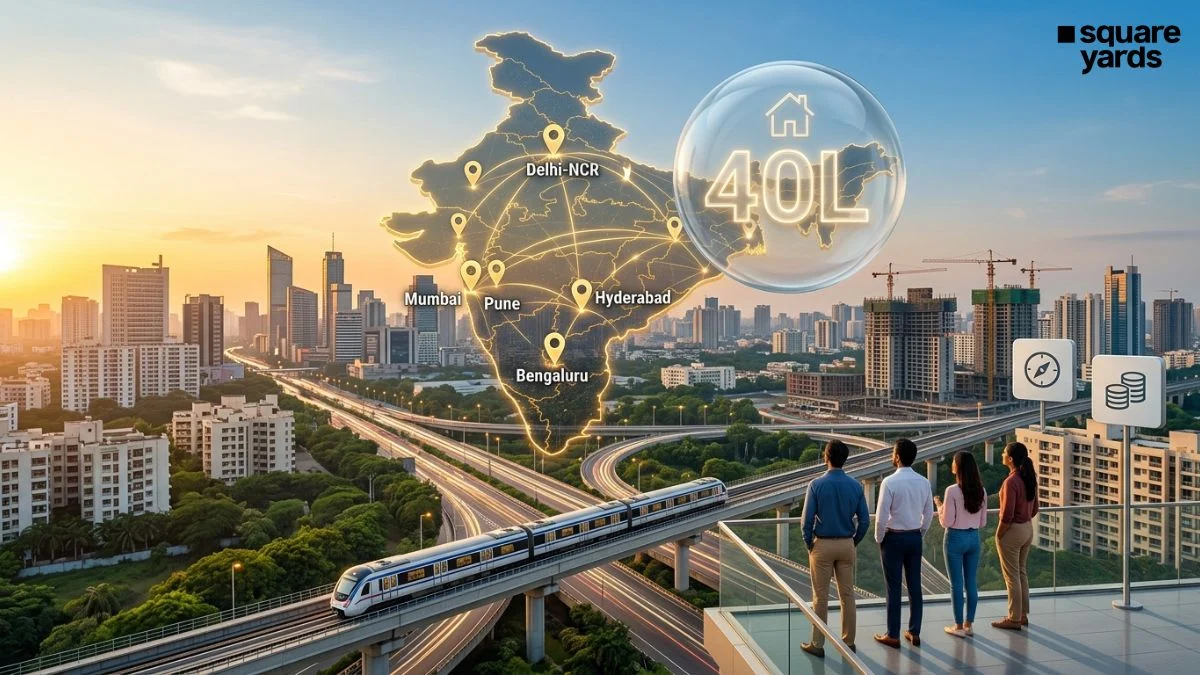
The dream of homeownership has long been the cornerstone of the Indian middle-class aspiration. However, as the calendar turns to mid-2026, that dream is being fundamentally reshaped by a widening chasm in the national property market. A budget of ₹40 lakh, once considered a respectable sum for a starter home in most Indian metros, now tells a story of two Indias. In the cultural capital of Kolkata, it secures a dignified two-bedroom lifestyle; in the financial powerhouse of Mumbai, it barely buys the footprint of a walk-in closet.
Recent data from Square Yards Data Intelligence reveals a market in transition, where "affordability" is no longer a fixed price point but a geographic variable. As developers pivot toward premium and luxury segments, the "affordable" tag is becoming a rarity in urban centers, forcing buyers to choose between square footage and postal codes.
1. Main Facts: The Great Square Footage Divide
The most striking revelation of the 2026 housing report is the sheer disparity in purchasing power across the top seven metropolitan areas. When the benchmark budget of ₹40 lakh is applied, the results highlight a staggering inequality in living standards.
The Kolkata Exception
Kolkata has solidified its position as the most accessible major metro in India. With a median residential price of approximately ₹6,800 per square foot (psf), the city offers the highest value for money. A buyer with ₹40 lakh can expect to secure roughly 590 sq. ft. of living space. This is sufficient for a compact, well-designed 2BHK (two-bedroom, hall, and kitchen) apartment, making it the only metro where a traditional family unit is still attainable at this price point within city limits.
The Mumbai Barrier
At the opposite end of the spectrum lies Mumbai, a city where the real estate market has decoupled from the reality of the average earner. With median prices soaring to nearly ₹38,000 psf, a ₹40 lakh budget yields a mere 105 sq. ft. To put this in perspective, this is smaller than many standard master bathrooms in premium developments. In Mumbai, the "affordable" segment has effectively moved to the extreme peripheries, often hours away from the central business districts.
The Tech Hub Squeeze
In the "Silicon Valley of India," Bengaluru, and the manufacturing hub of Pune, the median prices hover between ₹12,000 and ₹13,500 psf. For ₹40 lakh, buyers in these cities are looking at 300–325 sq. ft. This typically limits options to "studio" apartments or 1RK (one room, kitchen) units, often located in burgeoning suburbs like Sarjapur or Hinjewadi.
2. Chronology: The Shift from Affordable to Premium (2021–2026)
To understand the current state of the market, one must look at the trajectory of the last five years. Following the post-pandemic boom, the Indian real estate sector underwent a structural transformation.
- 2021–2022: The Recovery Phase. Low interest rates and a desire for larger living spaces following lockdowns drove a massive surge in residential sales. Developers focused on clearing inventory.
- 2023–2024: The Premium Pivot. As land prices and construction costs (cement, steel, labor) rose, developers realized that profit margins were significantly higher in the luxury and "aspirational" segments (homes priced above ₹1.5 crore).
- 2025: The Supply Crunch. By early 2025, the pipeline for sub-₹40 lakh housing in Tier-1 cities began to dry up. New launches in this category plummeted as developers prioritized high-end gated communities.
- 2026: The Current Reality. Today, the market is dominated by premium launches. In Bengaluru and Hyderabad, nearly 75% of all new residential projects are priced above the ₹1.5 crore mark, leaving the budget-conscious buyer with dwindling options.
3. Supporting Data: Supply Dynamics and Market Share
The divergence in pricing is fueled by a drastic shift in what is being built. According to Square Yards Data Intelligence, the supply-side statistics explain why certain cities remain affordable while others have become "luxury-only" zones.
New Launch Pipelines
- Kolkata: 41% of all new residential launches remain priced below the ₹40 lakh threshold. This steady supply of budget-friendly housing is attributed to lower land acquisition costs and a developer focus on volume rather than high-margin luxury.
- Hyderabad and Bengaluru: These cities have seen a dramatic "premiumization." In Hyderabad, 74% of new launches exceed ₹1.5 crore. In Bengaluru, that figure is 75%. This is driven by a high concentration of high-income IT professionals and significant NRI investment.
- Pune: Despite its reputation as a middle-class hub, only 5% of new launches in Pune are priced below ₹40 lakh. The city is rapidly catching up to Mumbai’s pricing structures in its core areas.
- Chennai: Chennai represents the "Middle Path." Approximately 80% of its new launches fall in the ₹40 lakh to ₹1.5 crore bracket, catering to a stable middle-income demographic without the extreme volatility seen in the NCR or Mumbai.
Comparative Value Table (Per ₹40 Lakh Budget)
| City | Median Price (per sq. ft.) | Approximate Space (sq. ft.) | Realistic Unit Type |
|---|---|---|---|
| Kolkata | ₹6,800 | 590 | Compact 2BHK |
| Hyderabad | ₹9,100 | 440 | Large 1BHK |
| Chennai | ₹9,300 | 430 | Standard 1BHK |
| Noida | ₹12,000 | 330 | Compact 1BHK / Studio |
| Bengaluru | ₹12,500 | 320 | Studio |
| Gurugram | ₹15,000 | 270 | Micro-unit / Peripheral |
| Mumbai | ₹38,000 | 105 | Non-viable for residence |
4. Expert Perspectives: The Financial Burden
Industry analysts emphasize that the "sticker price" of a home is only the beginning of the financial journey for a buyer. The total cost of acquisition in 2026 involves several layers of additional expenditure.
The "Hidden" 10%
Market experts point out that homebuyers must budget an additional 6% to 10% over the base price for stamp duty, registration charges, and legal fees. For a ₹40 lakh property, this adds a burden of ₹2.5 lakh to ₹4 lakh. When combined with the mandatory 10-20% down payment, a buyer needs nearly ₹8 lakh to ₹12 lakh in liquid cash before they can even secure a home loan.
The Interest Rate Environment
The Reserve Bank of India (RBI) has maintained a supportive stance with a repo rate of 5.25%. For the end-user, this translates to home loan interest rates ranging between 7% and 8%.
- EMI Analysis: A standard ₹40 lakh loan over a 20-year tenure at 7.5% interest results in a monthly EMI of approximately ₹33,000 to ₹35,000.
- The Salaried Perspective: For a household with a combined monthly income of ₹80,000 to ₹1,00,000, this is considered a manageable debt-to-income ratio. However, the challenge is no longer the EMI—it is finding a property worth living in at that loan amount.
5. Implications: Investment Potential and Social Mobility
The widening gap in affordability has profound implications for both investors and the social fabric of India’s urban centers.
Capital Appreciation vs. Rental Yields
The market is currently split into two distinct investment playbooks:
- The Growth Play: Cities like Delhi-NCR, Hyderabad, and Bengaluru have recorded the strongest annual price appreciation. Investors here are betting on long-term capital gains driven by infrastructure projects like new metro lines and expressways. However, high entry costs mean rental yields (the annual rent as a percentage of property value) remain low, often between 2% and 3%.
- The Yield Play: Kolkata offers a different advantage. Because acquisition costs are low, the rental yields are relatively higher, often touching 4% to 5%. For an investor seeking steady cash flow rather than speculative growth, the "affordable" markets are currently more attractive.
The "Gentrification" of the Metro Core
As ₹40 lakh becomes an obsolete budget for the urban centers of Mumbai, Bengaluru, and Gurugram, we are witnessing a "peripheral migration." The working class and lower-middle-class populations are being pushed further into the outskirts. While this spurs development in rural-urban fringes, it places an immense strain on transportation infrastructure and reduces the quality of life due to increased commute times.
The Future of "Affordable Housing"
The government’s "Housing for All" initiatives face a stiff challenge in 2026. With land prices rising, the private sector is increasingly unable to deliver sub-₹40 lakh units without significant subsidies or floor space index (FSI) incentives. If the current trend continues, the definition of affordable housing may need to be officially revised upward to ₹60 lakh or ₹75 lakh in Tier-1 cities to reflect the market reality.
Conclusion: A Market of Hard Choices
As of July 2026, the Indian residential market is no longer a monolith. It is a fragmented landscape where the value of money is dictated by the city skyline. For the first-time homebuyer with a ₹40 lakh budget, the decision is no longer just about the number of bedrooms; it is a strategic choice between the space of Kolkata, the potential of Hyderabad, or the extreme compromises required in Mumbai.
The data from Square Yards serves as a wake-up call for urban planners and developers alike. While the boom in premium housing reflects a growing affluent class, the shrinking space for the ₹40 lakh buyer suggests that the "missing middle" of Indian real estate is becoming more pronounced than ever. For the average buyer, the path to homeownership now requires not just a savings account, but a willingness to look far beyond the city lights.
