

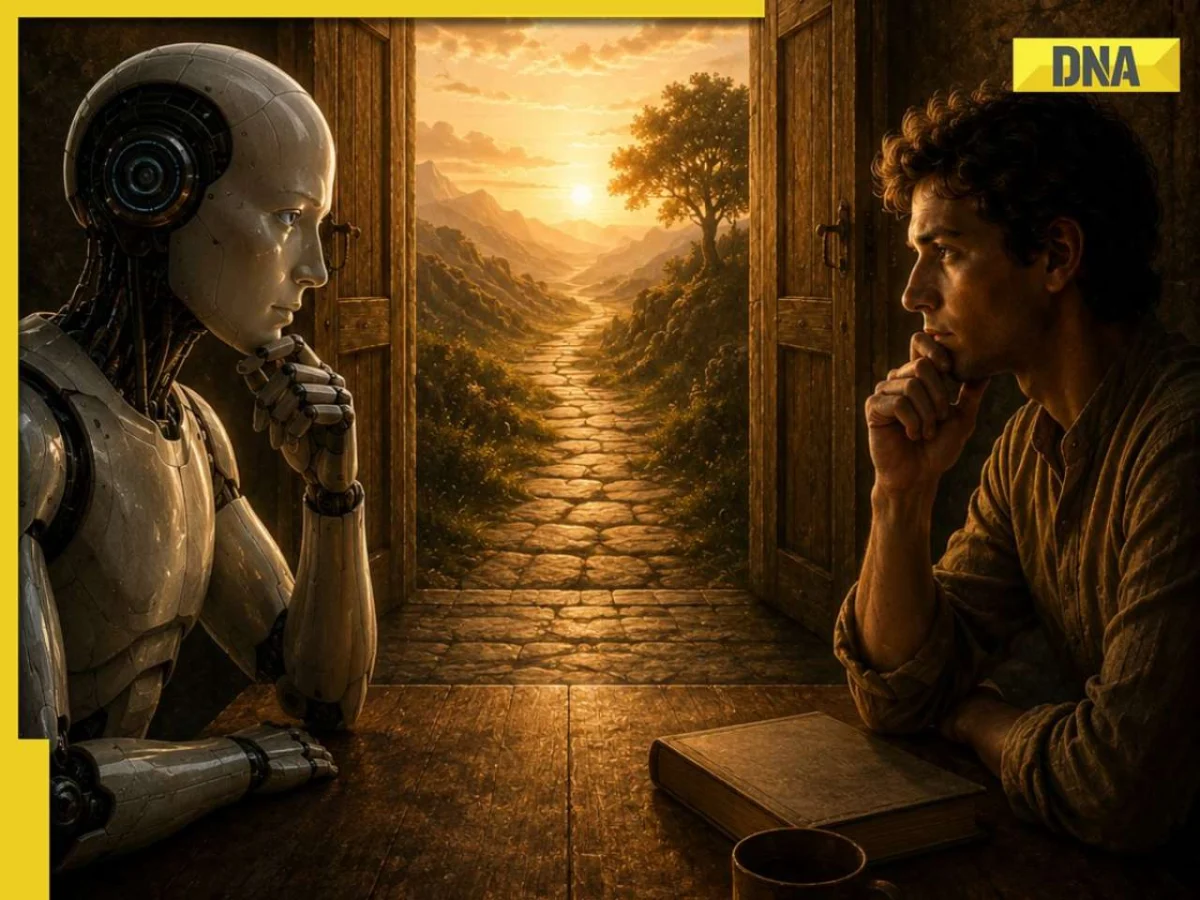
The relentless march of artificial intelligence (AI) has ushered in an era where machines can generate prose, compose music, and even offer seemingly profound insights. Yet, beneath the veneer of sophisticated output lies a fundamental question: are these AI systems truly thinking, or are they merely advanced pattern optimizers, reassembling vast troves of past human knowledge? As we increasingly rely on these digital oracles, a crucial challenge emerges – safeguarding our own cognitive faculties and ensuring that the pursuit of knowledge remains a fundamentally human endeavor. The ancient Indian philosophical tradition, particularly the Nyaya Sutra, offers a potent antidote to the uncritical acceptance of AI-generated responses: the discipline of samsaya, or productive doubt.
The Illusion of Thought: Unpacking AI’s Mechanistic Core
At its heart, current AI, particularly Large Language Models (LLMs) and generative AI, operates on a principle of sophisticated pattern recognition and optimization. Trained on immense datasets of human-generated text and information, these systems excel at identifying correlations, predicting sequences, and extrapolating existing patterns to generate novel outputs. When presented with a prompt, an AI doesn’t "understand" in the human sense; rather, it identifies the most probable linguistic and conceptual connections based on its training data, constructing a response that is statistically likely to be relevant and coherent.
)
This process, while remarkably effective and often indistinguishable from human thought to the casual observer, is fundamentally different. It’s akin to an incredibly advanced autocomplete function, drawing from a vast library of pre-existing ideas and expressions. The "thoughtfulness" we perceive is an emergent property of complex algorithms processing enormous amounts of data, not an indication of genuine consciousness or original ideation.

The Nyaya Sutra’s Timeless Prescription: Embracing Productive Doubt
The Nyaya Sutra, a foundational text of Indian logic and epistemology, posits samsaya (productive doubt) as the third of sixteen categories of valid inquiries crucial for attaining knowledge. This isn’t mere skepticism or cynicism; it’s a deliberate, analytical process of questioning assumptions, exploring counterarguments, and engaging in rigorous examination before arriving at a conclusion. The Nyaya tradition emphasizes that true knowledge is not simply acquired but is painstakingly constructed through a dialectical process.
)
Within this framework, other vital concepts emerge:
)
- Vada (Honest Debate): A constructive exchange of ideas aimed at arriving at truth, characterized by intellectual integrity and a willingness to learn.
- Drishtanta (Example): The use of illustrative cases to clarify abstract concepts and test the validity of arguments.
- Tarka (Hypothetical Reasoning): The application of logical inference, even to hypothetical scenarios, to explore the implications of an idea and uncover potential flaws.
- Vitanda (Critical Refutation): A more adversarial form of debate focused on dismantling opposing arguments, but still a tool for sharpening understanding.
These principles underscore the necessity of an active, critical engagement with information. To doubt productively is to possess the ability to discriminate between superficial convenience and genuine understanding, to actively consider opposing viewpoints, and to engage in a cautious, evidence-based examination before accepting any proposition as fact.
)
Echoes in Western Philosophy: The Universal Call for Critical Inquiry
The emphasis on doubt and critical thinking is not unique to Eastern philosophy. Western intellectual traditions also champion the importance of questioning and intellectual rigor. Aristotle, in his Metaphysics, spoke of the inherent human drive to know, a curiosity that naturally leads to inquiry. Plato, in his dialogues, often depicted Socrates employing the Socratic method, a technique of persistent questioning designed to expose the limitations of received wisdom and expose logical inconsistencies.
)
John Stuart Mill, a towering figure in utilitarian philosophy, articulated a powerful argument for the necessity of intellectual confrontation. He posited that an opinion held without ever being challenged is "intellectually inert." A mind that avoids dissent and critical examination, Mill warned, becomes closed, a state that is not only detrimental to individual growth but also poses a significant threat to the health of discourse and the very foundations of democracy.
)
Cultivating a "Growth Mindset" in the Age of AI
The insights from both Eastern and Western philosophical traditions converge on a profound understanding of learning: true growth stems not from the accumulation of pre-packaged answers, but from the cultivation of more profound and incisive questions. This is a concept powerfully echoed in the work of psychologist Carol Dweck. Her research on "mindset" highlights the critical distinction between a "fixed mindset" and a "growth mindset."
)
Individuals with a fixed mindset perceive intelligence as an innate, unchangeable trait. Consequently, they tend to avoid challenges, as difficulty is interpreted as evidence of inadequacy. This leads to a closed and self-limiting approach to learning. In contrast, those with a growth mindset view intelligence as malleable and capable of development through effort and learning. They embrace challenges, persist in the face of setbacks, and see effort as a pathway to mastery.
)
In the current AI-driven landscape, fostering a growth mindset becomes paramount. The ease with which AI can provide answers can create a powerful temptation to bypass the often-arduous but ultimately rewarding process of genuine inquiry.
)
The Existential Threat: When AI Thinks for Us
We stand at a precipice where the capabilities of LLMs and generative AI are rapidly outstripping human capacity for information processing and synthesis. These systems, trained on the entirety of human thought, can reproduce, remix, and extrapolate at speeds that are simply unattainable for individuals. However, it is crucial to reiterate: they cannot think in the human sense of conscious deliberation, critical evaluation, and subjective experience.
)
The danger lies not in whether AI will think for us, but in whether we will allow it to. The frictionless availability of AI-generated answers presents an overwhelming temptation to circumvent the struggle inherent in learning. This struggle – grappling with incomplete information, identifying flaws in arguments, discerning credible data from misinformation – is not an obstacle to learning; it is the very engine of it.
)
When we outsource the intellectual heavy lifting to AI, we risk the atrophy of our own cognitive skills. The process of wrestling with ideas, of formulating arguments, and of defending our positions under scrutiny is what solidifies understanding and builds conviction. As the article notes, students who rely on AI for essay writing often exhibit weaker retention, shallower conviction, and a diminished capacity to articulate their views when pressed. This is because a belief forged through genuine inquiry becomes an intrinsic part of one’s intellectual identity. A belief generated by an algorithm, however eloquently presented, remains external and ultimately artificial.
)
The Paradox of Progress: Embracing the Tools Without Losing Ourselves
The current technological landscape makes outright rejection of AI tools both impractical and undesirable. They are powerful instruments that can augment human capabilities in myriad ways. The challenge, therefore, is not to shun these advancements but to engage with them deliberately and critically. This requires a conscious effort to maintain open-mindedness as a practiced discipline, even in an environment that often rewards the appearance of certainty.
)
This deliberate cultivation of critical thinking in the face of AI demands a re-evaluation of our reward systems. We need to move towards a paradigm that values process over mere output. This means:
)
- Rewarding the Tolerance of Uncertainty: Creating an environment where individuals are encouraged to sit with ambiguity, to explore different perspectives, and to think through complex issues without the pressure of immediate, definitive answers.
- Prioritizing Engagement Over Filtering: Actively seeking out and engaging with opposing viewpoints, rather than resorting to algorithmic filtering that shields us from dissent.
- Treating All Positions as Hypotheses: Adopting a posture of perpetual intellectual inquiry, where even the most confident assertions are viewed as hypotheses subject to rigorous tarka (critical reasoning) until they are either substantiated or yield to superior understanding.
The ancient wisdom embedded in the Nyaya Sutra, with its emphasis on samsaya, provides a timeless framework for navigating this new frontier. By embracing productive doubt, fostering intellectual humility, and committing to the arduous but rewarding process of genuine inquiry, humanity can harness the power of AI without sacrificing the very cognitive skills that define our intelligence and our capacity for true understanding. The mind, in its capacity to question, to doubt, and to reason, remains our most potent and enduring edge in an increasingly automated world.
