

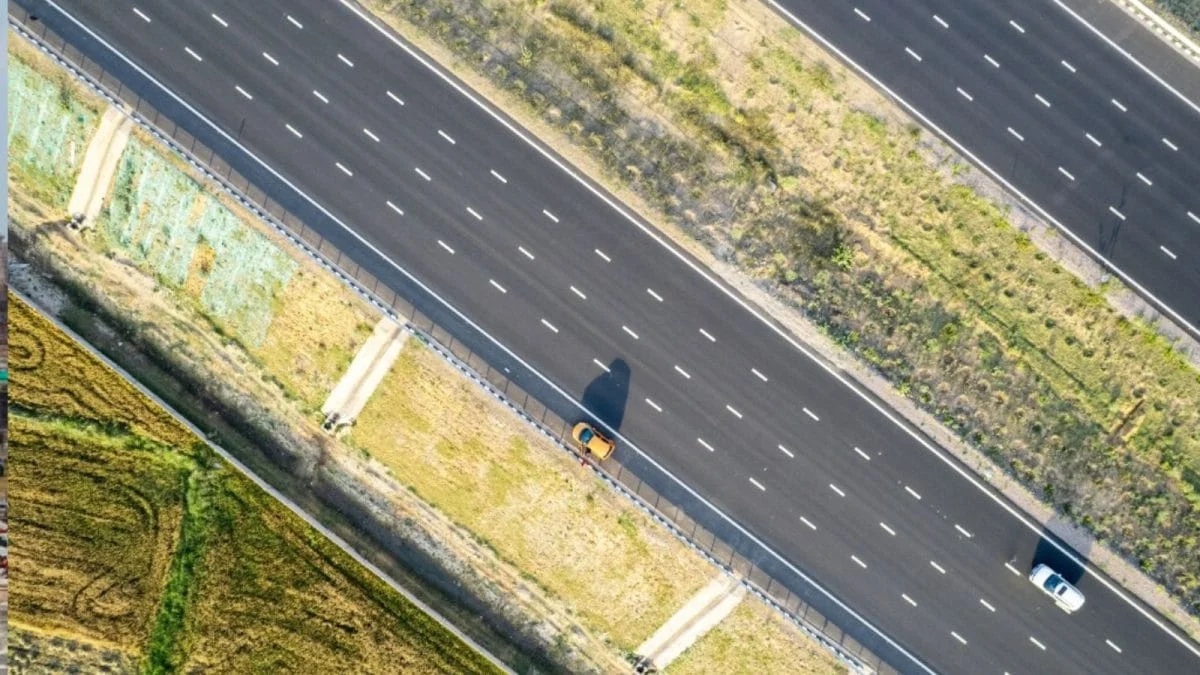
The landscape of Northern and Western India is undergoing a tectonic shift, driven not by traditional urban sprawl, but by 1,386 kilometers of high-speed bitumen and concrete. The Delhi-Mumbai Expressway (DME), envisioned as the crown jewel of the Bharatmala Pariyojana, has transcended its primary function as a transit corridor to become the most significant catalyst for real estate and industrial growth in a generation. As the project nears its 2026 completion deadline, a clear pattern has emerged: the expressway is creating a "linear mega-city" effect, driving property valuations to unprecedented heights in Tier-II cities like Jaipur, Indore, and Vadodara.
Main Facts: The Infrastructure Titan and its Collateral Growth
The Delhi-Mumbai Expressway is not merely a road; it is a $13.1 billion (approx. ₹1 lakh crore) engineering marvel designed to halve the travel time between India’s national and financial capitals. Spanning eight lanes (expandable to twelve), it cuts through five states—Delhi, Haryana, Rajasthan, Madhya Pradesh, and Gujarat—and the Union Territory of Dadra and Nagar Haveli.
While the engineering statistics are impressive, the economic "side effect" is what has captured the attention of institutional investors and individual homebuyers. The corridor has triggered a massive appreciation in land value, particularly within a 50-kilometer radius of its interchanges. In several stretches, land prices have surged by 30% to 40% over the last 24 months.
Key Highlights of the Real Estate Surge:
- The Sohna-Dausa Corridor: This initial stretch has seen the most aggressive appreciation, with land rates jumping by 60% to 70%.
- The Tier-II Pivot: Cities like Jaipur and Indore are seeing a double-digit rise in residential prices (12-18% and 10-15%, respectively), fueled by the migration of industries seeking lower operational costs.
- Logistics Dominance: The demand for industrial land, warehouses, and "plug-and-play" logistics parks has outpaced residential growth in many regions, particularly in the Gujarat and Madhya Pradesh belts.
- Investment Migration: Data from the first half of 2025 reveals that land deals in Tier-II and Tier-III cities totaled 1,907 acres, nearly doubling the 991 acres recorded in Tier-I cities, signaling a definitive shift in where "smart money" is moving.
Chronology: From Blueprint to Real Estate Goldmine
The journey of the Delhi-Mumbai Expressway is a testament to India’s accelerated infrastructure timeline. Understanding the phases of its development provides context for why property prices are peaking now.
- 2018-2019: Conception and Land Acquisition: The project was announced as a centerpiece of the Bharatmala Pariyojana. Initial land acquisition sparked the first wave of speculative buying in rural Haryana and Rajasthan.
- 2020-2022: Construction and the Pandemic Pivot: Despite global lockdowns, construction continued. During this period, the "Work From Anywhere" trend began to make Tier-II cities along the corridor more attractive to professionals fleeing the high costs of Delhi and Mumbai.
- February 2023: The First Major Milestone: Prime Minister Narendra Modi inaugurated the 246-km Sohna-Lalsot-Dausa stretch. This opening served as a proof of concept, immediately slashing travel time from Delhi to Jaipur to around 3.5 hours and causing an instant spike in property inquiries in Sohna and Alwar.
- 2024-2025: Operational Expansion and Industrial Influx: As more sections in Madhya Pradesh and Gujarat became operational, the focus shifted from residential speculation to industrial reality. Warehousing giants and IT firms began securing large land parcels near Ratlam, Indore, and Vadodara.
- 2026 (Projected): Full Completion: The entire 1,386-km stretch is expected to be fully operational. Analysts predict a "final" price correction as the corridor transitions from an investment frontier to a settled economic zone.
Supporting Data: A City-Wise Analysis of the Boom
The impact of the expressway is not uniform; it manifests differently based on the existing economic profile of the cities it touches.
Jaipur: The New Satellite Hub
Jaipur is no longer just a tourism destination; it is becoming a viable alternative to the Delhi-NCR office market.
- Office Space Growth: Projections indicate that Jaipur’s office stock will grow from 7.8 million sq. ft. to 13 million sq. ft. by 2030.
- Cost Advantage: Commercial rentals in Jaipur remain approximately 54% cheaper than those in Gurgaon or Noida. This has attracted BPOs, KPOs, and tech startups, which in turn drives residential demand.
- Price Appreciation: Residential property prices in the Pink City climbed 12-18% in the past year alone.
Indore: The Logistics Heart of India
Indore, consistently ranked as India’s cleanest city, is leveraging the expressway to become a premier logistics hub.
- Residential Surge: Prices rose 10-15% in 2025 as the city’s IT corridor expanded.
- Commercial Viability: IT and enterprise rentals in Indore are now commanding Rs 150-200 per sq. ft., a significant jump from pre-expressway levels.
- The MP Advantage: The expressway passes through the Malwa region, opening up previously inaccessible land for industrial use near Ratlam and Ujjain.
Vadodara and the Gujarat Industrial Belt
In Gujarat, the expressway acts as a force multiplier for an already robust industrial base.
- Annual Appreciation: Prime areas in Vadodara are seeing an 8-10% annual price rise.
- Future Projections: Analysts forecast that land and housing in the Vadodara-Bharuch region will appreciate by another 20-25% over the next 3 to 5 years as the "Golden Quadrilateral" and the DME converge to create a logistical powerhouse.
The Sohna-Gurugram Magnet
Sohna has undergone the most radical transformation. Once a sleepy town on the outskirts of Gurugram, it is now referred to as "South Gurugram."
- Price Benchmarks: Property prices in Sohna have touched or exceeded Rs 15,000 per sq. ft.
- Gated Communities: The demand for plotted developments and luxury gated communities has skyrocketed, driven by HNIs (High Net-worth Individuals) looking for vacation homes or long-term investments with easy access to the capital.
Official Responses and Expert Insights
Government officials and real estate analysts view the expressway as a structural shift in India’s urbanization strategy.
The NHAI Perspective:
Officials from the National Highways Authority of India (NHAI) have frequently emphasized that the DME is designed with "wayside amenities" that are themselves mini-economic zones. "We are not just building a highway; we are building a corridor of prosperity," a senior official noted during a recent infrastructure summit. "The 94 way-side amenities planned along the route will include hotels, food courts, and even heliports, creating localized employment hubs."
Industry Analyst Views:
Real estate consultancy firms like Anarock and JLL point to the "Early Mover Advantage." According to industry experts, the window for high-yield investment is closing.
"The surge in land deals in Tier-II cities (1,907 acres in H1 2025) compared to Tier-I cities (991 acres) is a clear indicator that institutional money is betting on the periphery," says a lead researcher at a top property firm. "The expressway has de-risked these investments by providing guaranteed connectivity."
Developer Sentiment:
Leading developers who have launched projects in Sohna and Jaipur cite the "Logistics-Residential Synergy." They argue that when a city becomes a logistics hub, it creates a stable base of middle-management jobs, which creates a permanent demand for mid-to-high-range housing, rather than just speculative trading.
Implications: The Future of Urban India
The long-term implications of the Delhi-Mumbai Expressway extend far beyond property prices.
1. Reverse Migration and De-congestion
By making Tier-II cities economically viable, the expressway is facilitating a "reverse migration." Professionals are finding that they can enjoy a higher quality of life, lower pollution levels, and shorter commutes in cities like Jaipur or Vadodara while remaining connected to the major metros. This, in turn, may help de-congest the over-stressed infrastructure of Delhi and Mumbai.
2. The Rise of "Rurban" Economics
The 50-km radius around the expressway is seeing the birth of "rurban" areas—regions that were once purely agricultural but are now transitioning into industrial and residential zones. While this brings economic prosperity, it also poses challenges for urban planners to ensure that this growth is sustainable and does not lead to haphazard ribbon development.
3. Logistics Efficiency and Inflation
From a macro-economic standpoint, the expressway is expected to reduce logistics costs from 14% of GDP to around 8-9%. This efficiency will make Indian exports more competitive and could potentially cool inflation by reducing the cost of transporting goods across the country’s most vital trade route.
4. The Environmental Balance
While the expressway features green initiatives like animal overpasses (a first in Asia) and millions of planted trees, the rapid urbanization of the corridor puts pressure on local water tables and ecosystems. The next decade will determine if these Tier-II cities can manage their growth more sustainably than their Tier-I predecessors.
Conclusion: A Closing Window of Opportunity
The Delhi-Mumbai Expressway is the physical manifestation of India’s "New Urban" ambition. For property buyers and investors, the data is unequivocal: the infrastructure has laid the groundwork for a decade of growth. However, as the 2026 completion date approaches, the era of "cheap land" is rapidly ending. The transition from a construction project to a living, breathing economic artery is almost complete, and with it, the map of Indian real estate has been permanently redrawn. Whether it is a luxury villa in Sohna, a tech-hub apartment in Jaipur, or a warehouse in Indore, the expressway is no longer just a way to get from point A to point B—it is the destination itself.
