

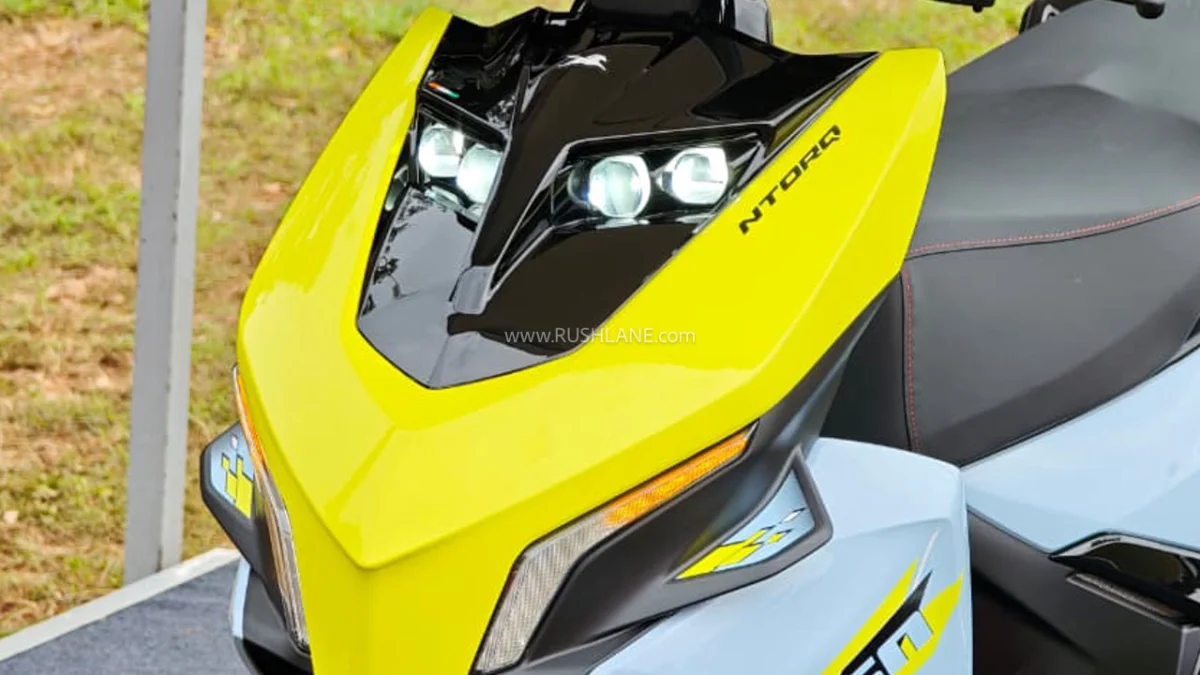
Main Facts: A Paradigm Shift in TVS’s Scooter Strategy
TVS Motor Company, a titan in the Indian two-wheeler industry known for its "Racing DNA," is reportedly in the advanced stages of developing a new flagship scooter: the TVS Ntorq 160. This move represents a significant strategic pivot for the Chennai-based manufacturer. While the brand recently introduced the Ntorq 150 to bolster its presence in the higher-displacement segment, that model—featuring an air-cooled engine—was perceived by many enthusiasts as an incremental evolution of the existing Ntorq 125 platform rather than a revolutionary leap.
The upcoming Ntorq 160 is expected to be a "true" maxi-scooter, designed to compete directly with high-performance rivals such as the Yamaha Aerox 155 and the Hero Xoom 160. Unlike the current Ntorq lineup, which prioritizes urban agility with 12-inch wheels and air-cooled powerplants, the new 160cc entrant is rumored to feature liquid-cooling technology, larger 14-inch wheels, and a chassis designed for high-speed stability and long-distance touring. This development signals TVS’s intent to capture the "prosumer" segment of the market—riders who demand motorcycle-like performance with the convenience of an automatic transmission.
Chronology: From the 125cc Disruptor to the 160cc Maxi-Scooter
To understand the significance of the Ntorq 160, one must look at the timeline of TVS’s performance scooter journey:
- February 2018: TVS launches the Ntorq 125. It was a watershed moment for the Indian scooter market, introducing a stealth-aircraft-inspired design, a peppy 3-valve engine, and the industry-first ‘SmartXonnect’ Bluetooth-enabled instrument cluster.
- 2019–2023: TVS expands the Ntorq 125 range with the Race Edition, SuperSquad Edition (Marvel-themed), and the high-spec XT variant. These models solidified TVS’s grip on the youth demographic.
- Late 2024 / Early 2025: TVS launches the Ntorq 150. Positioned as a sportier alternative, it utilized an air-cooled engine. While it offered more torque and a slightly higher top speed, the market consensus was that it lacked the refinement and "big-scooter" feel required to challenge the Yamaha Aerox 155.
- Mid-2025 (Current Phase): Reports emerge regarding the development of a 160cc maxi-scooter. This project is seen as a direct response to the growing popularity of premium, liquid-cooled scooters and the entry of Hero MotoCorp into the 160cc space with the Xoom 160.
- Expected 2026: Projected launch window for the TVS Ntorq 160, potentially coinciding with new emission norms or major industry showcases.
Supporting Data: Engineering a Powerhouse
The Ntorq 160 is not merely a bored-out version of the 150; it is expected to be an entirely new engineering exercise. Industry insiders suggest several key areas where TVS is focusing its R&D:
1. The Powertrain
The heart of the new scooter is expected to be a 160cc, single-cylinder, liquid-cooled engine. For context, the Yamaha Aerox 155 produces approximately 15 PS of power and 13.9 Nm of torque. It is highly probable that TVS will aim to exceed these figures, potentially leveraging the technical expertise gained from the Apache RTR 160 4V—one of the most powerful 160cc motorcycles in the world. A 4-valve head and fuel injection will be standard, optimized for a smooth, linear power delivery suited for a CVT (Continuously Variable Transmission).

2. Chassis and Ergonomics
Maxi-scooters are defined by their footprint. The Ntorq 160 is expected to transition from the 12-inch wheels of its predecessors to 14-inch alloys. This change is crucial for high-speed stability and better handling over undulations. Furthermore, the wheelbase will likely be stretched to accommodate a more relaxed riding posture.
A major point of speculation is the "spine" design. Most traditional maxi-scooters (like the Aerox) feature a central spine that houses the fuel tank, sacrificing the flat floorboard for chassis rigidity. However, TVS has previously shown innovation with the Jupiter 110, placing the fuel tank under the floorboard to maximize under-seat storage. Whether TVS opts for a rigid spine or maintains a flat floorboard will determine if the Ntorq 160 is a "pure" maxi-scooter or a "maxi-styled" commuter.
3. Feature Set and Connectivity
TVS has a history of outclassing competitors in the tech department. Anticipated features for the Ntorq 160 include:
- Advanced Instrumentation: A potential move toward a 7-inch TFT touchscreen, similar to the unit found on the iQube electric scooter, featuring turn-by-turn navigation via HERE maps.
- Safety Tech: Dual-channel ABS is almost a certainty, given the performance bracket. There is also talk of traction control, a feature becoming increasingly common in premium global scooters.
- Convenience: A massive under-seat storage compartment capable of holding a full-face helmet, a front-mounted dashcam (a first for the segment), and a multi-function key slot or keyless ignition.
Official Responses and Market Context
While TVS Motor Company has not officially confirmed the technical specifications or the release date of the Ntorq 160, the company’s recent financial reports and investor calls highlight a clear focus on "premiumization."
During the last quarterly earnings call, TVS management emphasized that the "premium scooter segment is growing at a faster rate than the entry-level segment." This internal data supports the move toward a 160cc platform. The success of the Ntorq brand, which has consistently sold over 25,000 units monthly in India, provides a strong foundation for an upscale variant.

The competitive landscape has also forced TVS’s hand. Hero MotoCorp’s Xoom 160, with its "ADV" (Adventure) styling, and Honda’s rumored entry with the ADV 160, have created a sub-segment of "lifestyle scooters." TVS, which prides itself on being a performance leader, cannot afford to leave this segment uncontested.
Implications: What This Means for the Indian Market
The arrival of the TVS Ntorq 160 carries several implications for the manufacturer and the broader industry:
1. The "End of the Commuter" Stigma
For decades, scooters in India were viewed as utilitarian "step-throughs" for grocery runs. The Ntorq 160, following in the footsteps of the Aerox, aims to solidify the scooter as a legitimate touring machine. If TVS successfully delivers a liquid-cooled engine capable of maintaining 100 km/h cruising speeds, it could tempt buyers away from entry-level performance motorcycles.
2. Pricing Dynamics
The premium scooter segment is price-sensitive but willing to pay for tangible technology. The Yamaha Aerox 155 is priced around ₹1.50 lakh (ex-showroom). TVS will likely aim for a competitive "introductory" price point, potentially ranging between ₹1.45 lakh and ₹1.60 lakh. This would position it as a premium alternative to the Ntorq 150 and a direct rival to the Hero Xoom 160.
3. Technological Trickle-Down
The development of a 160cc liquid-cooled scooter engine could have future implications for TVS’s electric vehicle (EV) division. The thermal management systems and high-speed chassis dynamics developed for the Ntorq 160 could eventually find their way into a high-performance version of the TVS iQube or a production version of the TVS Creon concept.

4. Brand Loyalty and Upgrading
TVS has a massive base of Ntorq 125 owners who are now looking to upgrade. By providing a 160cc maxi-scooter, TVS ensures that these customers stay within the brand ecosystem rather than migrating to Yamaha or Aprilia.
Conclusion: A New Chapter for the Ntorq Legacy
The TVS Ntorq 160 is more than just a new model; it is a statement of intent. By moving away from the "upgraded commuter" philosophy of the Ntorq 150 and embracing the specialized engineering of a maxi-scooter, TVS is poised to redefine the limits of the internal combustion engine in the Indian scooter market.
As enthusiasts await the first spy shots and official teasers, the expectation is clear: TVS must deliver a machine that doesn’t just look like a racer but performs like one. With liquid cooling, 14-inch wheels, and a suite of segment-first features, the Ntorq 160 could very well become the new benchmark for performance on two wheels—without a gear lever.
