

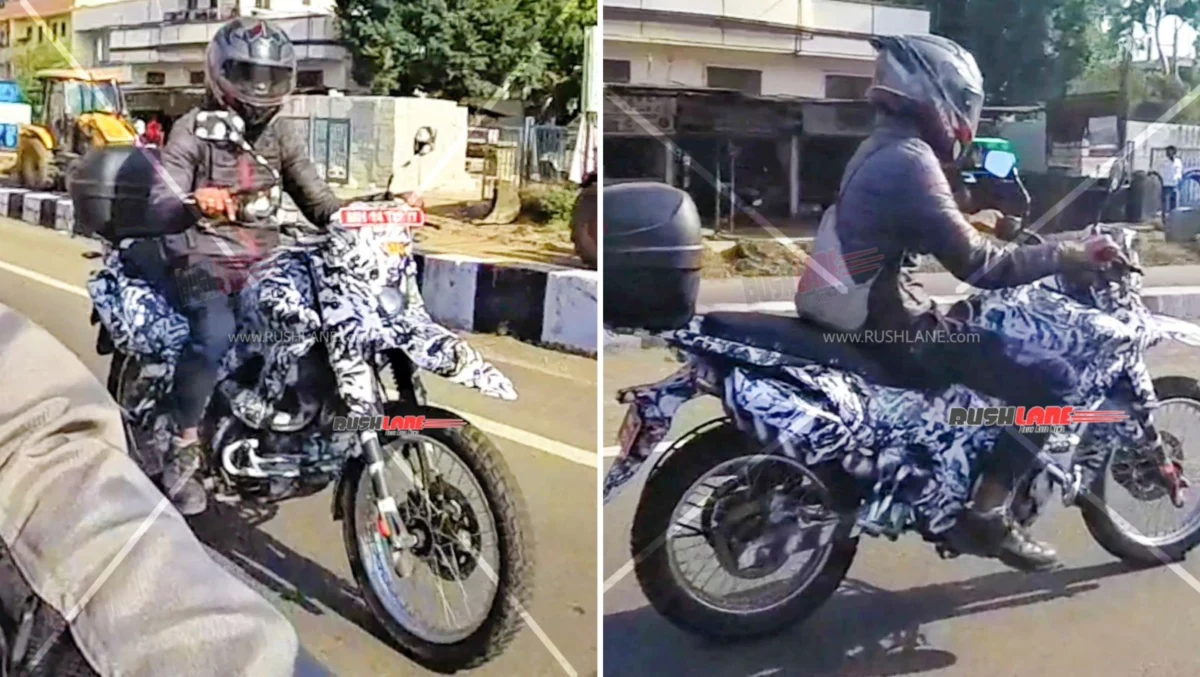
The Indian motorcycling landscape is on the cusp of a significant transformation as Bajaj Auto, one of the world’s largest two-wheeler manufacturers, prepares to enter a segment it has long facilitated for others but never claimed for itself: the dedicated adventure touring market. Recent sightings of a heavily camouflaged test mule near Pune have sent ripples through the automotive industry, providing the clearest glimpse yet of what is expected to be a game-changing entry in the quarter-liter adventure segment.
For years, Bajaj has been the silent engine behind KTM’s global success in the adventure category, manufacturing the 250 and 390 Adventure models at its Chakan plant. However, under its own branding, the company has largely stuck to street-fighters, cruisers, and "adventure-sport" crossovers like the now-discontinued Pulsar AS series. This new development marks a paradigm shift in Bajaj’s product strategy, signaling a move toward purpose-built, off-road capable machinery designed for the burgeoning class of Indian touring enthusiasts.
I. Main Facts: Decoding the Pune Spy Shots
The latest round of spy shots, credited to automotive enthusiast Shubham Sharma, reveals a motorcycle that has progressed significantly from earlier prototypes. While the camouflage remains dense, the mechanical "bones" and ergonomic "silhouette" of the machine are now clearly identifiable.
Design and Ergonomics
The motorcycle features a classic adventure-touring stance. Key visual markers include a high-mounted front "beak" mudguard, which is a staple of the ADV genre, paired with a secondary tire-hugging fender. The riding position is notably upright, achieved through a combination of mid-set footpegs and a tall, wide handlebar. This "rider triangle" is engineered to offer long-distance comfort while allowing the rider to transition easily to a standing position—a critical requirement for navigating broken patches or off-road trails.

Hardware and Cycle Parts
The test mule is equipped with wire-spoke wheels, a departure from the alloy wheels seen on Bajaj’s street-focused Pulsar range. The wheel sizes appear to follow the industry-standard 19-inch front and 17-inch rear configuration, striking a balance between highway stability and off-road agility. These wheels are shod with dual-purpose, block-pattern tires, further cementing its "go-anywhere" credentials.
The suspension setup comprises long-travel telescopic forks at the front—likely featuring gaiters for protection against dust and debris—and a rear monoshock. The ground clearance appears significantly higher than any current Bajaj model, potentially hovering in the 200mm to 220mm range.
Touring Capability
Practicality seems to be a cornerstone of the design. The spied unit featured a robust rear luggage rack equipped with a sizeable top box. Despite the luggage, the long, single-piece contoured seat appears to offer ample room for both the rider and a pillion, suggesting that Bajaj is targeting the "touring couple" demographic.
II. Chronology: The Evolution of Bajaj’s Adventure Ambitions
To understand the significance of this upcoming ADV, one must look at the timeline of Bajaj’s involvement in the segment and its recent corporate declarations.

- 2015: The Pulsar AS Experiment: Bajaj launched the Pulsar AS150 and AS200. While marketed as "Adventure Sport" bikes, they were essentially semi-faired versions of the NS series with a projector headlamp and a tall windscreen. They lacked the suspension travel and wheel dimensions required for true off-roading and were eventually phased out.
- 2017–Present: The KTM Synergy: Bajaj’s partnership with KTM deepened, with the Chakan plant becoming the global hub for small-capacity KTM ADVs. This provided Bajaj engineers with invaluable data on long-travel suspension geometry and high-stress engine cooling required for adventure riding.
- Early 2024: The Roadmap Announcement: Bajaj Auto’s leadership confirmed an aggressive product offensive, stating plans to launch eight new motorcycles within the 125cc to 250cc segment. This segment is considered the "sweet spot" of the Indian market, balancing performance with affordability.
- Late 2024 – Mid 2025: Discovery of the "Project Adventure": The first grainy images of a new chassis began circulating. Unlike previous Pulsars, this frame featured different mounting points and a taller headstock.
- June 2026 (Current Status): The emergence of near-production-ready test mules suggests that the R&D phase is nearing completion, moving into the final stages of real-world endurance testing.
III. Supporting Data: Engineering and Performance Speculation
While Bajaj has remained tight-lipped regarding technical specifications, industry analysts and the visual evidence from the spy shots allow for a high-confidence projection of the bike’s mechanical heart.
The KTM Connection
There is intense speculation that this ADV will utilize the 249cc liquid-cooled, DOHC, single-cylinder engine currently found in the KTM 250 Adventure and the Husqvarna 250s. In its KTM guise, this engine produces approximately 31 PS of power and 25 Nm of torque.
However, Bajaj is known for re-tuning shared platforms to suit a broader audience. For its own ADV, Bajaj might focus on:
- Low-end Torque: Adjusting the gearing and ECU mapping to provide better "tractability" at low speeds, making it easier to ride in city traffic or on steep inclines.
- Thermal Management: Enhancing the radiator size or fan shroud design to handle the slow-speed, high-load conditions typical of Indian trail riding.
Comparative Landscape
The 250cc adventure segment is becoming one of the most competitive in India. If Bajaj utilizes the KTM-derived 250cc mill, it will position the bike directly against:

| Feature | Bajaj 250 ADV (Estimated) | Hero Xpulse 210 | Suzuki V-Strom SX |
|---|---|---|---|
| Engine Type | Liquid-Cooled, 250cc | Liquid-Cooled, 210cc | Oil-Cooled, 249cc |
| Power | ~28 – 30 PS | ~25 PS | 26.5 PS |
| Front Wheel | 19-inch Spoke | 21-inch Spoke | 19-inch Alloy |
| Primary Use | Touring/Light Off-road | Hard Off-road | Soft-roading/Touring |
Features and Electronics
In line with recent updates to the Pulsar N250 and NS400Z, the upcoming ADV is expected to feature:
- Full-LED Lighting: A stacked LED projector setup with signature DRLs.
- Digital Instrumentation: A Bluetooth-enabled LCD or TFT console offering turn-by-turn navigation, call alerts, and possibly "Ride Modes" (Rain/Road/Off-road) that adjust ABS intervention.
- Switchable ABS: A crucial feature for off-roading, allowing the rider to lock the rear wheel on loose surfaces.
IV. Official Responses and Corporate Strategy
Bajaj Auto has traditionally been conservative with "official" reveals until a product is weeks away from launch. However, recent statements from the company’s management during quarterly earnings calls provide context for this motorcycle’s existence.
The company has highlighted a "Premiumization" strategy. With the mass-market commuter segment (100cc-110cc) seeing stagnant growth, Bajaj is pivoting toward "Lifestyle Motorcycling." The success of the Freedom 125 (CNG) has secured the bottom end of their portfolio, allowing the company to take risks in the premium 250cc+ space.
While a spokesperson declined to comment specifically on the "Adventure" project, they reiterated that "Bajaj is committed to filling every white space in the 125cc to 400cc portfolio with products that offer superior technology at a disruptive price point." This "disruptive pricing" is the key; Bajaj often manages to price its products 15-20% lower than its European partners (KTM) while offering 90% of the performance.

V. Implications: What This Means for the Market
The arrival of a dedicated Bajaj ADV has far-reaching implications for the Indian two-wheeler ecosystem.
1. The Democratization of Adventure Touring
Currently, the "entry-level" for a reliable liquid-cooled ADV is the KTM 250 Adventure, which carries a premium price tag. By launching its own version, Bajaj will likely bring the cost of entry down significantly, making liquid-cooled adventure touring accessible to a much larger demographic of young riders.
2. The Evolution of the Pulsar Brand
The big question remains: Will this be branded as a "Pulsar"? If so, it would be the most radical departure in the brand’s 20-year history. Alternatively, Bajaj might revive the "Adventure" moniker or create a new sub-brand entirely to distance it from the "street-racer" image of the Pulsar.
3. Pressure on Competitors
Hero MotoCorp, the current leader in the budget ADV space with the Xpulse 200/210, will face its first direct threat from a manufacturer that matches its scale and service network. Similarly, the Suzuki V-Strom SX, which has enjoyed success as a "road-biased" tourer, will have to contend with a Bajaj rival that offers more off-road capability (spoke wheels vs. Suzuki’s alloys).

4. Global Export Potential
Bajaj is India’s largest exporter of motorcycles. A 250cc ADV built on a robust, cost-effective platform would be a massive hit in Latin American and Southeast Asian markets, where road conditions mirror those of India and the demand for versatile "do-it-all" motorcycles is soaring.
Conclusion
The spied Bajaj ADV is more than just a new model; it is a statement of intent. It represents the culmination of a decade of learning from KTM and a strategic pivot toward the future of Indian motorcycling. As the test mules continue to clock miles on the highways around Pune, the industry waits for the final quarter of 2026, when this machine is expected to finally shed its camouflage and redefine the adventure segment. For the Indian rider, the wait for an affordable, powerful, and truly capable "Desi" ADV may finally be coming to an end.
