

HOUSTON, TX — For over six decades, NASA’s Lyndon B. Johnson Space Center (JSC) has served as the nerve center for human space exploration. From the Apollo moon landings to the intricate, decades-long assembly of the International Space Station (ISS), the Houston facility has been the primary arbiter of American activity in the cosmos. However, as the ISS approaches its twilight years, a profound institutional shift is underway.
NASA is currently navigating a complex transition, moving from its traditional role as the sole proprietor of low-Earth orbit (LEO) infrastructure to becoming one of many customers in a burgeoning commercial marketplace. This evolution is not merely a change in policy; it is a physical and operational transformation of the facilities that have defined the space age.
Main Facts: A Pivot Toward the Commercial LEO Economy
The fundamental shift at Johnson Space Center centers on the retirement of the International Space Station, currently slated for 2030. While the station remains a marvel of international cooperation and engineering, its aging modules and the high cost of maintenance have prompted NASA to look toward the private sector for the next generation of orbital laboratories.
Under the Commercial LEO Destinations (CLD) program, NASA is incentivizing private industry to design, build, and operate space stations. The goal is for NASA to "rent" space on these private platforms for its astronauts and scientific experiments, rather than bearing the multi-billion-dollar annual cost of operating a government-owned facility.
This transition involves three critical pillars of JSC’s infrastructure:
- Mission Control: Shifting from a centralized command structure to a collaborative model where NASA expertise supports private flight controllers.
- The Space Vehicle Mockup Facility (Building 9): Integrating private sector hardware—such as modules from SpaceX, Blue Origin, and Voyager Space—alongside NASA’s own equipment.
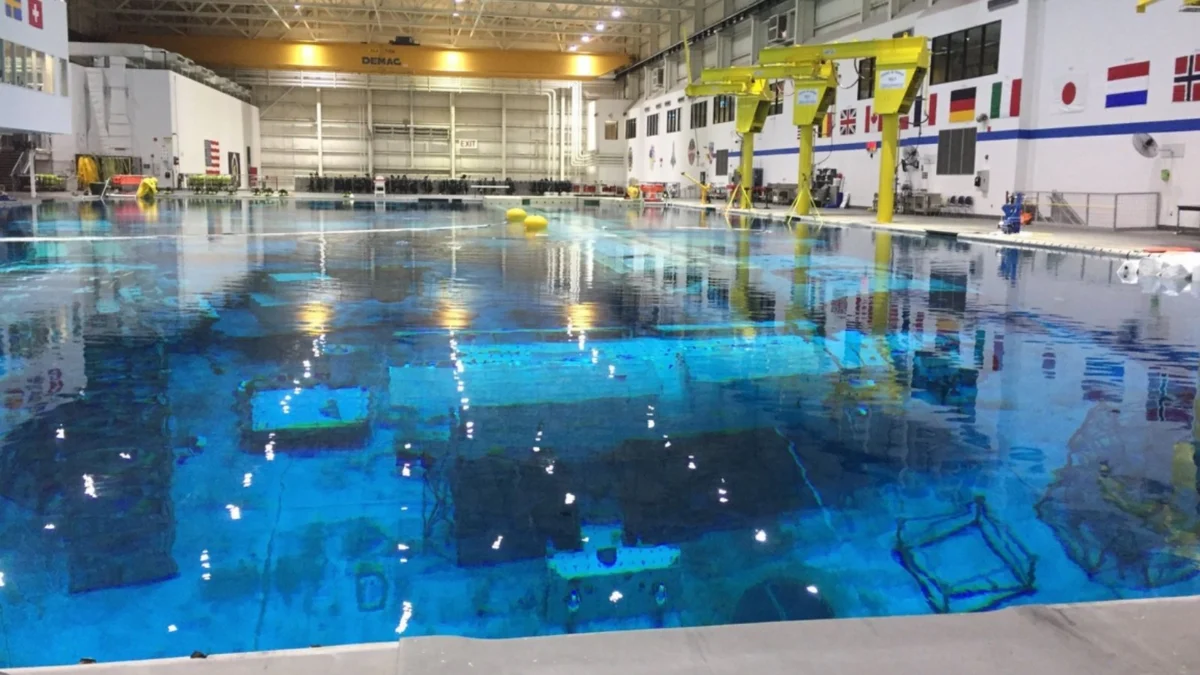
- The Neutral Buoyancy Laboratory (NBL): Expanding the use of the world’s largest indoor pool to include private sector spacesuit testing and commercial mission rehearsals.
Chronology: The Road to Deorbit
The path toward a commercialized low-Earth orbit has been decades in the making, following a timeline that balances the need for continuity in research with the reality of aging hardware.
- 1998: The launch of the Zarya module marks the beginning of the ISS era.
- 2011: The retirement of the Space Shuttle fleet forces NASA to rely on commercial partners (SpaceX and Boeing) for cargo and eventually crew transportation, setting the precedent for the CLD program.
- 2021: NASA awards initial contracts totaling approximately $415 million to three teams: Nanoracks (now part of the Voyager Space/Starlab effort), Blue Origin, and Northrop Grumman. This marks the official "kickoff" for the private station race.
- 2024–2026: A critical "overlap" period. NASA begins integrating private station mockups into Building 9 and the NBL, while simultaneously managing the most intensive period of ISS research to date.
- 2030: The projected retirement and controlled deorbit of the ISS. NASA has recently contracted SpaceX to develop the "US Deorbit Vehicle" to ensure the station safely burns up over the Pacific Ocean.
- Post-2030: The "Post-ISS Era" begins, where NASA expects to be one of several tenants on multiple private stations, such as Orbital Reef or Starlab.
Supporting Data: Infrastructure and Investment
The scale of this transition is reflected in the massive facilities at JSC and the financial commitments made by the federal government.
The Financial Landscape
The $415 million awarded in 2021 was intended to spark the design phase. However, the total investment in the LEO economy is expected to reach the billions. By offloading the operational costs of the ISS—which exceed $3 billion annually—NASA aims to redirect those funds toward the Artemis program, which seeks to establish a permanent human presence on the Moon and eventually Mars.
Building 9: The Proving Ground
The Space Vehicle Mockup Facility (SVMF) is a cavernous room where astronauts learn the physical layout of their spacecraft. Traditionally filled with 1:1 scale replicas of the ISS modules, it now reflects a mixed-use reality.
- Starlab Mockups: Voyager Space and Airbus have established a presence here to test internal layouts.
- SpaceX and Blue Origin: Hardware from these giants is now a permanent fixture, as astronauts must train for the specific vehicles that will ferry them to both the ISS and future private stations.
The Neutral Buoyancy Laboratory (NBL)
Located near JSC, the NBL contains 6.2 million gallons of water. It is the only place on Earth that can effectively simulate the sustained weightlessness required for spacewalk training.
- Current Capacity: While the NBL is currently heavily utilized by NASA and the U.S. Navy (for recovery operations), private companies are increasingly booking "pool time" to test their own proprietary spacesuits and airlock mechanisms.
- Emergency Scenarios: Training has evolved to include complex medical simulations. Performing CPR in microgravity, for example, requires specialized techniques because the lack of gravity prevents a rescuer from using their body weight for chest compressions.
Official Responses: Guidance from the Flight Deck
NASA leadership emphasizes that while the agency is stepping back from ownership, it is not stepping back from leadership. The expertise housed within the walls of JSC is considered a national asset that will be "exported" to the private sector.
Diane Dailey, NASA Flight Director, noted that the future of Mission Control will require a delicate balance of oversight. "Future mission control centers will require specialists responsible for areas such as propulsion, communications, and computers," Dailey said. She emphasized that NASA’s decades of experience in these disciplines will provide the blueprint for how private operators manage their own fleets.
Agency officials have also addressed the potential for the ISS to remain in orbit beyond 2030. While the current plan is a 2030 retirement, NASA has signaled to Congress that the station could remain operational if the commercial alternatives are not yet flight-ready. The primary goal is to avoid a "gap" in American presence in LEO, similar to the gap between the Space Shuttle and the SpaceX Crew Dragon.
Implications: The Risks and Rewards of a Commercial Orbit
The shift from a government-run station to a commercial marketplace carries significant implications for science, geopolitics, and the economy.
1. Continuity of Research
The ISS is a unique laboratory for aging research, materials science, and pharmaceuticals. If the transition to commercial stations is not seamless, years of scientific progress could be stalled. NASA’s strategy at JSC is designed to ensure that astronauts are trained on private hardware before the ISS is retired, ensuring a "warm handoff."
2. Geopolitical Competition
The retirement of the ISS comes at a time of heightened tension. China’s Tiangong space station is already operational and seeking international partners. By fostering a vibrant commercial sector, the U.S. aims to ensure that it remains the primary destination for international astronauts and space-based commerce, maintaining its strategic edge in LEO.
3. Economic Expansion: The Trillion-Dollar Frontier
The "LEO Economy" is no longer a theoretical concept. From satellite servicing to manufacturing high-purity fiber optic cables in microgravity, the potential for profit is immense. By opening JSC’s facilities to private companies, NASA is effectively subsidizing the R&D of a new industry, much like the early government support of the aviation industry.
4. Strategic Focus on Deep Space
Perhaps the most significant implication for NASA itself is the liberation of resources. By becoming a customer in LEO, NASA can transform Johnson Space Center into the primary hub for Deep Space operations. The lessons learned from the ISS—and the training facilities currently being adapted—will serve as the foundation for the Gateway (a station in lunar orbit) and the eventual human mission to Mars.
Conclusion
As the sun begins to set on the International Space Station, the lights at Johnson Space Center are burning brighter than ever. The transition represents a "coming of age" for the space industry. No longer a government monopoly, space is becoming a shared domain.
Through the evolution of Mission Control, the integration of private hardware in Building 9, and the expanded mission of the Neutral Buoyancy Laboratory, JSC is proving that it can adapt to a new era. The center is evolving from a singular command post into a collaborative hub—a move that ensures Houston will remain "Space City" for the next century of exploration.
