

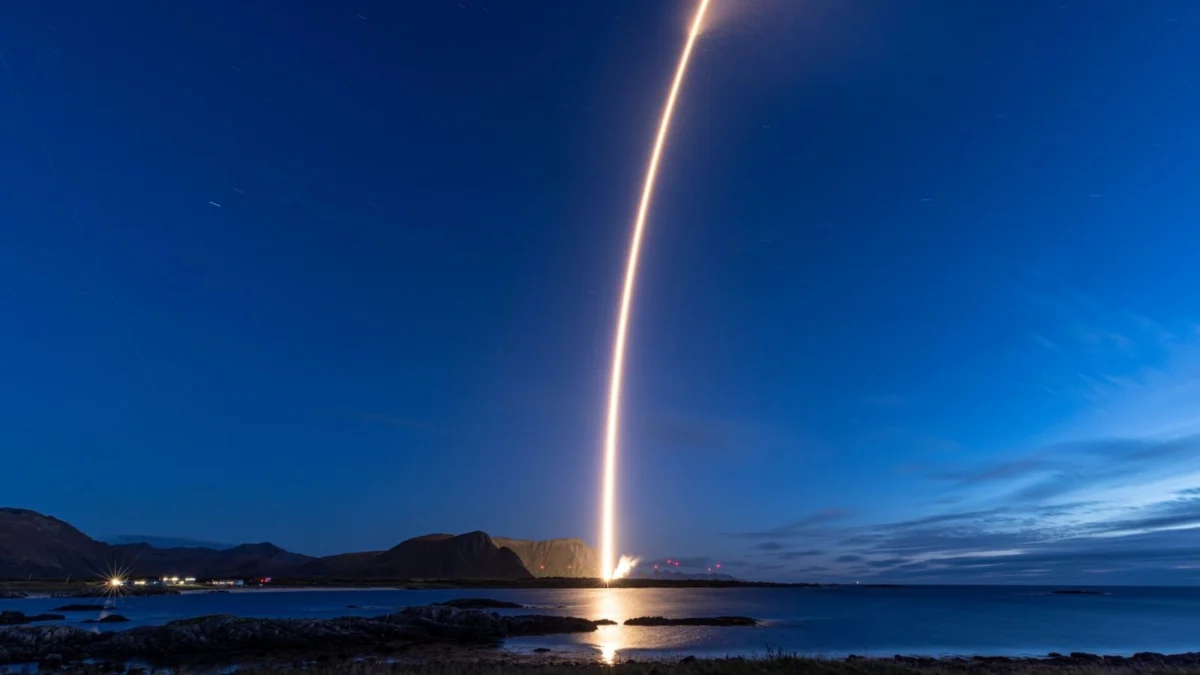
ANDØYA, NORWAY – In the quiet, sub-arctic stillness of the Norwegian archipelago, the roar of a new era in European spaceflight echoed across the North Atlantic on the night of September 5, 2026. At 10:12 PM local time, Isar Aerospace’s Spectrum rocket ascended from the Andøya Space Centre, piercing the darkness and eventually settling into Earth’s orbit. This successful mission marks the first time a privately developed rocket has reached orbit from Western European soil, signaling a seismic shift in the continent’s strategic autonomy and its burgeoning "NewSpace" ecosystem.
For decades, Europe’s access to space was largely tethered to the European Space Agency’s (ESA) facility in Kourou, French Guiana—a geographically ideal but logistically distant outpost in South America. With Isar Aerospace’s "Onward and Upward" mission, the geographical barrier has been broken. The achievement transforms the rugged coastline of northern Norway into a competitive gateway to the stars, positioning Europe as a formidable player in the global commercial satellite launch market.
The Mission: A Masterclass in Orbital Precision
The Spectrum rocket, a 28-meter-tall, two-stage liquid-fueled launch vehicle, performed a near-flawless ascent. Approximately seven minutes after liftoff, the rocket’s upper stage reached its initial elliptical orbit. Unlike the company’s previous attempt, which ended in a premature ocean splashdown, the September 5 flight demonstrated the maturity of Isar’s proprietary propulsion and guidance systems.
The flight profile was complex. After achieving an initial elliptical orbit with a perigee of 180 kilometers and an apogee of 500 kilometers, the upper stage executed a critical circularization burn. This maneuver was essential to ensure the payloads were placed in their designated operational altitudes. Two hours post-launch, Isar Aerospace confirmed the successful deployment of five CubeSats and a non-deployable scientific experiment, validating the Spectrum rocket as a reliable "workhorse" for the small-to-medium satellite market.
Chronology of a Breakthrough: From Failure to Flight
The path to the Arctic Circle was paved with significant technical hurdles and a rigorous learning curve. To understand the magnitude of this week’s success, one must look back at the turbulent eighteen months that preceded it.
March 2025: The "Going Full Spectrum" Setback
Isar Aerospace’s first attempt to reach orbit took place in March 2025. Named "Going Full Spectrum," the mission was met with high expectations but ended in disaster less than a minute after liftoff. The rocket suffered a catastrophic anomaly, crashing into the Norwegian Sea.
The subsequent investigation was exhaustive. Isar’s engineering teams identified a dual-point failure: an unintended opening of a vent valve coupled with a loss of attitude control during a critical roll maneuver. While the failure was a blow to morale, the company utilized the data to overhaul the Spectrum’s flight control software and valve hardware, adopting a "fail fast, learn faster" philosophy reminiscent of successful private space ventures in the United States.
2026: A Year of Frustrating Delays
The second flight, dubbed "Onward and Upward," was originally slated for January 2026. However, the mission faced a gauntlet of delays that tested the resolve of the Munich-based firm:
- January: A faulty pressurization valve forced a scrub during the final countdown.
- March: Persistent North Atlantic storms and the intrusion of a private vessel into the restricted launch zone disrupted two separate windows.
- April 9: A leak was detected in a composite overwrapped pressure vessel (COPV), a sophisticated component used to store helium for tank pressurization.
- June 15: The rocket was rolled back from the pad after sensors detected "off-nominal behavior" in the vehicle’s fluid systems.
"We had some setbacks, but we came back stronger from them," said Isar’s Spectrum chief engineer during the post-launch webcast. "This success validates a tremendous amount of engineering across all teams."
Supporting Data: The Spectrum Rocket and the Andøya Advantage
The Spectrum rocket is specifically engineered to meet the demands of the "SmallSat" revolution. As constellations of small satellites become the standard for global internet coverage and Earth observation, the demand for flexible, low-cost launchers has skyrocketed.
Technical Specifications of Spectrum:
- Height: 28 meters.
- Payload Capacity: Up to 1,000 kg to Low Earth Orbit (LEO).
- Propulsion: Multi-engine clusters designed for high efficiency and redundancy.
- Manufacturing: Isar Aerospace has established a state-of-the-art facility near Munich, designed for high-cadence production. The facility is currently capable of producing more than 30 Spectrum rockets per year, a volume intended to drive down costs through economies of scale.
The Strategic Importance of Andøya:
The choice of Andøya Space Centre is not merely aesthetic. Located at 69°N, the site provides a direct trajectory for polar and sun-synchronous orbits (SSO), which are highly sought after by Earth observation companies. Launching from Norway eliminates the logistical nightmare of transporting sensitive satellite hardware to South America or relying on geopolitical rivals.
While Russia’s Plesetsk Cosmodrome is technically located in European Russia, the "Western European" distinction for Andøya is vital for NATO-aligned nations seeking secure, sovereign access to space without the complexities of Russian or Chinese involvement.
Official Responses: A Milestone for European Industry
The reaction from the aerospace community has been one of collective relief and celebration. For years, critics argued that Europe was falling behind the rapid innovation cycles of American companies like SpaceX and Rocket Lab.
"This is right now making history," the Spectrum chief engineer remarked, visibly emotional during the live broadcast. "Making history for Spectrum, making history for Isar, and making history for Europe. I’m incredibly proud of this massive achievement."
The European Space Agency (ESA), which has increasingly pivoted toward supporting commercial "NewSpace" initiatives, viewed the launch as a validation of its strategy to foster competition within the European sector. Analysts suggest that the success of Isar Aerospace will likely spur increased venture capital investment into other European startups, such as Rocket Factory Augsburg (RFA) and HyImpulse, which are also vying for a slice of the launch market.
Norwegian government officials also lauded the event, noting that the Andøya Space Centre is now firmly established as a premier global spaceport, promising high-tech jobs and economic diversification for the Arctic region.
Implications: Strategic Autonomy and the Global Space Race
The success of Isar Aerospace carries implications that extend far beyond a single successful flight. It addresses a critical vulnerability in European defense and commerce: the "launcher crisis."
1. Ending the Dependency Cycle
In recent years, Europe found itself in a precarious position. The retirement of the Ariane 5, delays in the Ariane 6, and the cessation of Soyuz launches from Kourou following the invasion of Ukraine left the continent with a "launch gap." European satellite operators were forced to book rides on American rockets. Isar’s success provides a domestic alternative, ensuring that European data and defense assets can reach orbit on European terms.
2. High-Cadence Commercial Operations
With a manufacturing capacity of 30 rockets per year, Isar Aerospace is not aiming for sporadic scientific missions; it is aiming for a "bus service" to space. This high-cadence model is essential for maintaining the health of mega-constellations, which require frequent launches to replace aging or failing satellites.
3. A New Paradigm for European Engineering
Traditionally, European aerospace was characterized by large, state-funded consortia and decades-long development cycles. Isar Aerospace, funded by private venture capital and moving with the agility of a software company, has proven that the "Silicon Valley model" of aerospace can thrive in the heart of Bavaria and the fjords of Norway.
Looking Ahead: The Road to Flight 3
While Flight 2 is a resounding triumph, the company is already looking toward the future. The next steps involve "Flight 3," which is expected to carry even heavier payloads and further refine the recovery or reusability potential of the Spectrum architecture.
"Flight 2 is a big, big milestone," the chief engineer concluded. "But this is just the beginning. The goal was never just to reach orbit once; it was to stay there and provide a permanent bridge between Earth and space for the next generation of technology."
As the Spectrum’s upper stage continues its silent trek across the stars, the message to the global space community is clear: Europe is no longer just a passenger in the space race. It is now a driver.
