

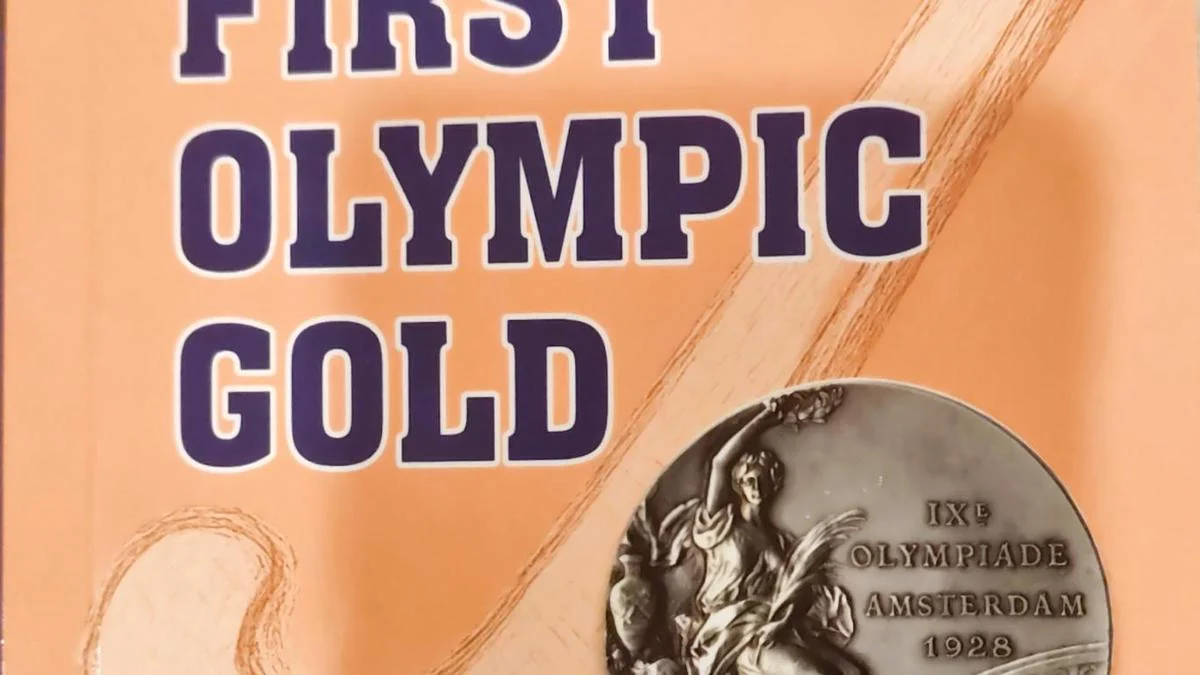
NEW DELHI — In a landmark event for Indian sports historiography, a comprehensive new volume titled India’s First Olympic Gold was officially released on May 26, 2026. Authored by the esteemed hockey historian K. Arumugam, the book was unveiled by the President of the Indian Olympic Association (IOA), P.T. Usha, in a ceremony that brought together the past, present, and future of Indian athletics.
The publication marks a significant milestone in documenting the nation’s sporting heritage, offering an exhaustive look at the 1928 Amsterdam Summer Olympics—a tournament that not only birthed a sporting dynasty but also provided a burgeoning national identity for a country still under colonial rule.
Main Facts: Commemorating a Century of Excellence
The release of India’s First Olympic Gold serves as both a scholarly resource and a tribute. Held at a prestigious venue in the capital, the launch event was attended by legendary athletes, sports administrators, and historians. The book is the culmination of years of archival research by K. Arumugam, a name synonymous with hockey journalism in India.
The primary focus of the work is the 1928 Amsterdam Games, where the Indian hockey team secured its first-ever gold medal. However, the book distinguishes itself by looking beyond the scoreboard. It delves into the socio-political landscape of the 1920s, exploring the bureaucratic hurdles, the internal politics of the then-nascent Indian Hockey Federation (IHF), and the sheer financial precarity that nearly derailed the campaign before it even began.
Key highlights of the book include:
- Archival Photography: A collection of rare, previously unpublished photographs of the 1928 squad.
- Primary Sources: Reproductions of newspaper snippets from Indian and European press outlets from nearly a century ago.
- The Dhyan Chand Narrative: A detailed account of the rise of Major Dhyan Chand, who emerged from the 1928 Games as the world’s first international hockey superstar.
- Identity Politics: An analysis of how the "Indian" victory was perceived by the British Raj and how it fueled the Indian independence movement’s psychological morale.
Chronology: The Road to Amsterdam (1925–1928)
To understand the magnitude of the 1928 victory, Arumugam’s book meticulously reconstructs the timeline leading up to the final match on May 26, 1928.
1925–1927: The Formation of the IHF
The journey did not begin in Amsterdam but in Gwalior in 1925, with the formation of the Indian Hockey Federation. The book details the struggle to unify various regional hockey associations—primarily those of Punjab, Bengal, and the United Provinces. The narrative describes a period of intense "internal tussles," where regional loyalties often threatened the selection of a truly national team.
Early 1928: The Financial Crisis and Selection Trials
Perhaps the most harrowing chapter of the book involves the financial struggles of the team. Arumugam reveals that the IHF was essentially bankrupt in the months leading up to the Olympics. The book recounts how the provincial associations had to scramble for funds, and how the team was nearly unable to afford the voyage to Europe.
Selection trials held in Calcutta (now Kolkata) are described in vivid detail. It was here that a young soldier named Dhyan Chand, representing the United Provinces, mesmerized selectors. Despite his brilliance, the book notes that the final squad was a delicate balance of Anglo-Indians and native Indians, reflecting the complex social fabric of the time.
March–May 1928: The Voyage and European Tour
The team set sail from Bombay on the S.S. Kaiser-i-Hind. The book tracks their stopovers and the exhibition matches played in England. Interestingly, the Indian team defeated various English club sides with such ease that the British press began to take notice. Arumugam suggests that the sheer dominance of the Indian team was one reason why England did not field a team in the 1928 Olympics—fearing a loss to their colonial subjects.
May 17–26, 1928: The Tournament
The book provides a match-by-match breakdown of the Olympic tournament:
- May 17: India vs. Austria (6–0)
- May 18: India vs. Belgium (9–0)
- May 20: India vs. Denmark (5–0)
- May 22: India vs. Switzerland (6–0)
- May 26: The Final vs. the Netherlands (3–0)
The final, played against the host nation in front of a partisan crowd, is the book’s crescendo. Despite several players, including Dhyan Chand, suffering from fever and illness, India clinched the gold without conceding a single goal throughout the entire tournament.
Supporting Data: The Statistical Dominance of 1928
Arumugam utilizes historical data to underscore India’s absolute hegemony during this era. India’s First Olympic Gold presents a statistical deep-dive that remains staggering by modern standards.
| Category | Statistic |
|---|---|
| Total Matches Played | 5 |
| Total Goals Scored | 29 |
| Total Goals Conceded | 0 |
| Leading Scorer | Dhyan Chand (14 goals) |
| Clean Sheets | 5 |
The book also highlights the "Dhyan Chand Effect." Of the 29 goals scored by India, nearly 50% came from the stick of Dhyan Chand. Arumugam uses newspaper clippings from the Amsterdamsche Courant and The Times to show how European spectators were convinced that Dhyan Chand’s stick had a magnet inside it, leading to an impromptu inspection by officials—a legendary anecdote that the author verifies through contemporary reports.
Beyond the goals, the book provides data on the team’s composition. The 1928 squad consisted of 15 players. The author notes the significant contribution of the Anglo-Indian community, which provided the backbone of the team’s defense and goalkeeping, while the "native" players like Dhyan Chand and Feroze Khan provided the flair in the attacking line.
Official Responses: Preserving the Heritage
During the launch, high-ranking officials emphasized the importance of sports literature in nation-building.
P.T. Usha, President of the Indian Olympic Association (IOA):
"My role as president of the IOA allows me to appreciate how profoundly that early triumph shaped India’s broader sporting identity," Usha stated. "Before we were a free nation, we were world champions. This book is not just about hockey; it is about the spirit of a nation that refused to be defined by its colonial status. Arumugam’s work preserves a defining chapter of our hockey heritage, ensuring that future generations understand the foundations on which India’s sporting pride was built."
Dilip Tirkey, President of Hockey India:
Tirkey, a former captain and a legend of the game himself, praised the author’s meticulousness. "As a player, you hear stories of 1928, but seeing the actual newspaper snippets and the data compiled here is moving. We often talk about the ‘Golden Age’ of Indian hockey, but we rarely document it with this level of detail. I hope more such work is done to preserve our history. If we don’t know where we came from, we cannot know where we are going."
The author, K. Arumugam, noted that his motivation was to bridge the gap between myth and history. "We have many legends about 1928, but very few records that are accessible to the public. This book is an attempt to give the fans the ‘how’ and ‘why’ of that victory," he said.
Implications: The Legacy of 1928 in Modern India
The release of this book has several implications for the current landscape of Indian sports and its cultural memory.
1. The Validation of Sports History
For too long, Indian sports history has relied on oral traditions. India’s First Olympic Gold sets a professional standard for sports historiography in India. By utilizing primary sources and rare archives, Arumugam demonstrates that sports stories are essential components of a nation’s historical record.
2. Reinforcing the ‘Hockey Identity’
As India seeks to regain its footing on the global hockey stage—following the bronze medal successes in recent Olympics—this book serves as a psychological anchor. It reminds the sporting fraternity that India’s dominance was not an accident but the result of a specific system and a unique talent pool that revolutionized the sport.
3. Decolonizing the Sporting Narrative
The book explores the "identity separate from its British rulers." In 1928, the Indian team played under the Union Jack, but the world saw them as "Indians." The book argues that this victory was one of the first instances where the international community recognized India as a distinct entity. This decolonial perspective provides a new lens for historians to view the Indian independence movement, suggesting that the hockey field was as much a site of resistance as the political stage.
4. Educational Value for Future Generations
With the inclusion of rare pictures and snippets, the book is poised to become a vital resource for schools and sports academies. It provides a tangible link to the past for young athletes who may only know Dhyan Chand as a name on a trophy.
Conclusion
India’s First Olympic Gold is more than a recount of a tournament; it is a meticulously researched tribute to the pioneers of Indian sport. By documenting the 1928 Amsterdam journey—from the internal bickering of the IHF to the final whistle against the Netherlands—K. Arumugam has ensured that the "Wizardry" of Dhyan Chand and his teammates is preserved in fact, not just in fable.
As the IOA and Hockey India look toward the future, this volume stands as a reminder that the path to Olympic glory was paved nearly a century ago by a group of men who overcame financial hardship and colonial suppression to prove that, on the hockey turf, India was second to none.
