

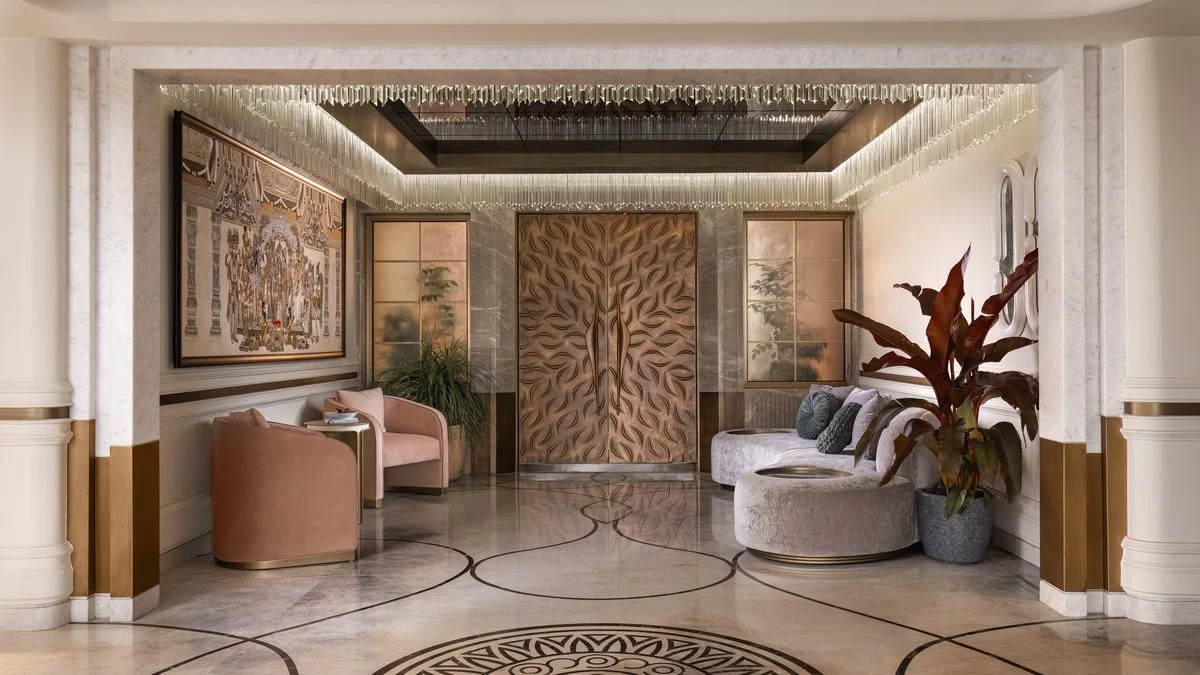
Visakhapatnam, India – Stepping into Casa Navira in Visakhapatnam is an immediate immersion into a world where architecture transcends mere function, becoming a profound expression of art and intention. The first encounter is not with a mere portal, but with a pair of breathtaking handcrafted brass doors, their surfaces imbued with a warm, antique-bronze patina. These are not just doors; they are sculptural masterpieces, their geometric patterns symbolizing the harmonious convergence of positive energies. Each door, an imposing eight feet tall and weighing a substantial 150 kg, boasts a unique, undulating surface that lends it a captivating sense of depth and movement. They are framed by an architrave meticulously crafted from marble and supported by a specially detailed metal framework, a combination that bestows upon the entrance a palpable sense of scale, permanence, and ceremonial grandeur.
"The entrance was conceived not merely as a door, but as a complete architectural composition," explains Yogesh Kumar, principal designer at Studio Sculpt, a multidisciplinary interior design studio based in Chennai. "The brass work on the door is completely handcrafted and executed by 10 skilled artisans who collectively invested 600 man-hours of work." Kumar’s vision for Casa Navira’s entrance was to achieve a seamless aesthetic, where only the door and its handle would be visible, deliberately omitting conventional locks, keyholes, or access-control devices that could disrupt the visual harmony.

This sophisticated approach to design necessitated the discreet integration of advanced technology. "To achieve this, a fingerprint-access system was discreetly integrated into the architrave," Kumar elaborates. "It communicates with a sensor-operated locking mechanism concealed within the door and handle assembly. Each door is supported by three heavy-duty hinges designed to handle loads of more than 400 kg per door, providing additional strength, stability, and long-term durability." This meticulous attention to detail ensures that the entrance is not only visually stunning but also functionally robust and secure.
The Evolving Narrative of Entrance Design
The entrance door has undergone a profound transformation, evolving from a simple point of ingress into a powerful statement piece that reflects the homeowner’s identity, values, and aspirations. "Much like a carefully curated piece of art, the entrance often offers the first glimpse into the personality of the home and the people who inhabit it," observes Chandhana Ramesh, Founder & Principal Architect at Empatio Architecture in Chennai. "As contemporary homes become increasingly personalized, clients are investing more thought into arrival experiences. Social media platforms like Instagram and Pinterest have undoubtedly amplified this shift." A well-designed entrance, she emphasizes, introduces the design narrative, offers a preview of the homeowner’s sensibility, and builds anticipation for the spaces that lie beyond.

This evolving perspective is reflected in several key trends shaping the contemporary entrance landscape:
- Renewed Appreciation for Indian Craftsmanship: There is a resurgence of interest in traditional Indian craft traditions and materials. Elements like reclaimed wood, intricate brass work, traditional joinery techniques, and perforated screens are being employed to infuse spaces with warmth and a sense of cultural heritage.
- Timeless Elegance of Heritage Motifs: Antique temple doors, Chettinad-inspired detailing, handcrafted jaalis (latticework), and elaborate brass embellishments bring a richness and authenticity that mass-produced elements simply cannot replicate.
- A Shift Towards Earthy Palettes: Homeowners are increasingly opting for softer, more natural color palettes. Earthy browns, charcoal grays, muted greens, and warm bronze tones are favored over glossy finishes, allowing the entrance to age gracefully and harmoniously with its surroundings.
- Subtle Textural Richness: Instead of overt ornamentation, there’s a growing emphasis on subtle textures. Fluted surfaces, brushed finishes, and natural wood grain add depth and visual interest without overwhelming the design.
- Layered Compositions: The focus is shifting away from single-material dominance towards layered compositions that artfully combine craftsmanship, performance, and visual appeal, creating a more dynamic and engaging entrance experience.
The Integral Role of Architecture and Materiality
A truly impactful statement door should feel intrinsically connected to the architecture it serves, rather than appearing as an afterthought. Sharon D’mello, founder of Studio Nola, an architecture and interior design firm in Goa, highlights the critical importance of scale, material authenticity, durability, and the door’s relationship with the facade. "One of the first few points to consider is the foreground of the door and the scale of the door," D’mello explains. "A taller or wider door can create a sense of grandeur and elegance, while a more modestly scaled entrance can feel warm, intimate, and inviting." She stresses that the proportions of the entrance must always complement the overall architecture of the home, aligning with its size and the intended spatial experience.

Material selection plays a pivotal role, not only for its aesthetic contribution but also for its durability, climate resilience, and maintenance requirements. Harkaran Singh Boparai, Founder and Principal Architect at Harkaran Boparai Studio, a luxury architecture practice in Delhi and Dubai, emphasizes that "the proportions need to feel right, the materials should complement the facade, and the door should sit naturally within the elevation. Details such as lighting, hardware, glazing, and even the way someone approaches the entrance all shape the experience. Durability is just as important because this is one of the most frequently used elements of the house."
New Age Materials and Timeless Choices
The contemporary entrance design embraces a diverse range of materials, blending traditional favorites with innovative new options:

- Premium Woods: Engineered hardwood constructions, natural veneer systems, smoked oak, ash veneers, and walnut are gaining popularity as sophisticated alternatives to traditional teak.
- Artistic Metals: Cast bronze, patinated brass, hand-beaten copper, brass, corten steel, and blackened steel are increasingly used. These metals develop beautiful patinas over time, lending a contemporary edge to entrance designs.
- Durable Timber Innovations: Accoya wood and thermally modified timber are in vogue due to their exceptional durability and dimensional stability, offering a sustainable and long-lasting solution.
- Modern Composites and Claddings: Metal-clad doors, aluminum composite systems with timber finishes, and engineered timber are widely adopted for their blend of aesthetics and performance.
- Unconventional Materials: The exploration extends to more unique materials such as hand-cast metal panels, stone-clad doors, leather-wrapped surfaces, woven timber compositions, terrazzo elements, textured concrete panels, and handcrafted ceramic components.
- Textural Experimentation: Fluted glass, burnt timber, natural stone veneers, fiber-reinforced concrete panels, and even leather inserts are being incorporated to add unique tactile and visual qualities.
- Versatile Timber and Metal: While timber remains a beloved choice for its inherent warmth and richness, aluminum and engineered finishes are well-suited for homes with a sharper, minimalist aesthetic.
Lighting, too, plays a crucial role, enhancing textures and craftsmanship while modulating the mood throughout the day.
The Palette of Entrance Doors: Color and Texture
While wood offers a timeless appeal, a fusion of bold colors and diverse materials is currently defining entrance design. "Apart from wood like teak, oak, and walnut, brass, metal, stone, and marble are excellent options to explore, depending on the climate and size of the home," advises Devang Patel, principal designer and co-founder of P&D Associates, an architecture and interior design solutions firm in Bharuch. He notes that while warm wooden tones continue to dominate, they are increasingly complemented by sophisticated shades such as charcoal, deep olive, terracotta, and matte black. For those seeking a more dramatic statement, particularly for holiday homes, colors like muted red, olive green, royal blue, and crisp white, paired with striking handles, are proving highly popular.

Texture is another key element that adds depth and character. "Textures like fluted patterns on wood, rust-finished brass, metal inserts, and statement hardware, especially door handles, are in vogue," Patel observes.
The Enduring Essence of Timber
Timber continues to be a dominant material, but its interpretation is becoming increasingly contemporary. This includes veneer marquetry, engineered-wood constructions, fluted surfaces, and layered compositions. "Natural grain patterns and variations are being celebrated rather than concealed," notes Chandhana Ramesh. "Deep walnut tones, smoked timber finishes, charcoal blacks, earthy browns, muted greens, and oxidised metallic finishes are becoming increasingly common." Timber is frequently paired with materials like bronze, brass, stone, patinated metal, textured glass, or hand-cast elements. Sculptural handles and bespoke hardware are now significant design features in their own right.

Essential Considerations for Entrance Design: Do’s and Don’ts
Do’s:
- Holistic Arrival Experience: Design the entrance as an integral part of the overall arrival experience, ensuring the door’s proportions harmonize with the home’s scale.
- Cohesive Finishes: Select finishes that complement the architectural style and interior décor scheme.
- Prioritize Craftsmanship and Authenticity: Emphasize quality craftsmanship and the use of authentic, high-quality materials.
- Consider Practicalities: Factor in climate, maintenance requirements, and longevity from the initial design stages.
- Invest in Quality Hardware and Security: For oversized or statement doors, invest in robust hardware and advanced security systems.
- Leverage Lighting: Utilize lighting to accentuate textures, highlight material richness, and create desired moods.
Don’ts:

- Treat as an Isolated Object: Avoid designing the door as a standalone decorative item detached from the surrounding architecture.
- Compromise Usability for Aesthetics: Do not let visual impact overshadow practicality and ease of use.
- Over-Complicate: Refrain from excessively ornate designs that can detract from the overall aesthetic.
- Blindly Follow Trends: Avoid adopting trends without considering their long-term relevance and suitability for the project.
- Sacrifice Functionality: Never compromise on functionality, ease of maintenance, or integrated security in the pursuit of purely aesthetic goals.
Technological Advancements Shaping Entrances
Engineering innovations have dramatically expanded the possibilities in entrance design. Ramesh Lohar, principal interior designer and founder of R+R Architects in Ahmedabad, points out, "Latest pivot hardware, concealed reinforcements, and precise execution now allow for oversized doors that operate effortlessly despite their weight. This gives architects greater freedom to create uninterrupted surfaces, with the entrance appearing as part of a monolithic wall. The detailing becomes quieter, while the spatial impact becomes much stronger."
Concealed pivot mechanisms, reinforced steel subframes, precision bearings, and advanced structural engineering have made it possible to create doors that were once considered impractical. Hidden frames, flush detailing, and integrated hardware contribute to a sleek, monolithic appearance.

Security has also been seamlessly integrated into the design process. Modern homes increasingly feature smart locks, biometric access, facial recognition, digital keypads, remote access via mobile apps, integrated video doorbells, and discreet surveillance systems, ensuring privacy and security without compromising aesthetics.
Showcase of Showstopper Entrances
The article then delves into several exemplary entrance designs that embody these trends and innovations:

Manipunj Residence, R+R Architects; Ahmedabad
This entrance is conceived as a subtle architectural gesture. A large pivot door clad in light-toned travertine seamlessly merges with the facade when closed, creating a monolithic appearance through its restrained palette and clean geometry. Upon opening, it reveals a layered sequence of spaces with warm timber ceilings and curated artwork. The defining feature is its integration with the travertine facade, with the pivot mechanism allowing smooth operation of the large-format stone-clad door.
Nayam, Empatio Architecture; Chennai
Envisioned as the first crafted object encountered, the 10-foot main entrance door at Nayam features custom veneer marquetry, creating a subtle geometric tapestry. The design celebrates the natural tonal variations within the timber, resulting in a warm palette of rich walnut and honey-brown. A sculptural timber handle, inspired by traditional Indian woodcraft, serves as a functional art piece. A concealed digital locking system ensures advanced security without visible hardware.

Avelora House, HBS Studio, Amritsar
This impressive 13-foot door is framed in rich natural wood. It combines clean vertical grooves with a finely crafted lattice panel for texture and depth. The warm timber finish is balanced by sleek black stone cladding and a contemporary digital lock. The lattice panel and linear grooves create texture through light and shadow, with the wood set against dark stone cladding.
The Averin, AB Design; Kolkata
An 8-foot entrance door finished in a warm taupe hue features concentric carved detailing for depth and movement. An oval stone inlay acts as a subtle focal point, complemented by a minimal black pull handle. The sculpted concentric pattern transforms the door into an architectural element, with a natural stone insert adding texture and contrast.

Villa Serena, Studio Nola; Goa
Inspired by Portuguese streetscapes, this nearly 7-foot door boasts a bold sage green hue, contrasting with the villa’s blush pink exterior. It features a solid core with an integrated glass arch for glimpses of the interior while maintaining privacy. The hardware is clean and uncluttered, with an elaborate nature-inspired door knocker as the sole ornamental element. A monochromatic pathway leads to the door, with light fixtures and the knocker inspired by Goa’s coastal landscape.
The Art House Project, P & D Associates; Bharuch
This 10-foot entrance door is crafted from aged teakwood, aged between 50 to 100 years. The double door in solid teak features a rich walnut brown polish with a semi-glass polyurethane coating. Decorative wrought iron inserts finished in matte black add a unique touch. Small, openable windows with metal grills provide an additional layer of security with traditional styling.

The House of Collected Time, Disha Subramanium; Delhi
A 9-foot main entrance door crafted from solid wood and HDHMR is finished with high-gloss PU paint. The design emphasizes proportion, refined detailing, and material richness over overt ornamentation. The entrance is envisioned as an opening gesture of the home’s narrative, supporting a broader theme of layered inhabitation and collected memories.
Conclusion: The Gateway to a Personal Narrative
The modern entrance door is far more than a functional barrier; it is a meticulously crafted preamble to the living experience within. It speaks volumes about the homeowner’s aesthetic sensibilities, appreciation for craftsmanship, and embrace of innovation. From the grand, sculptural brass doors of Casa Navira to the subtly textured timber of Nayam, each example showcases a commitment to creating an arrival experience that is both visually arresting and deeply personal. As technology continues to integrate seamlessly into design and material exploration pushes boundaries, the entrance door will undoubtedly remain a canvas for architects and designers to craft unforgettable first impressions, transforming the simple act of entering a home into a rich and meaningful journey.
