

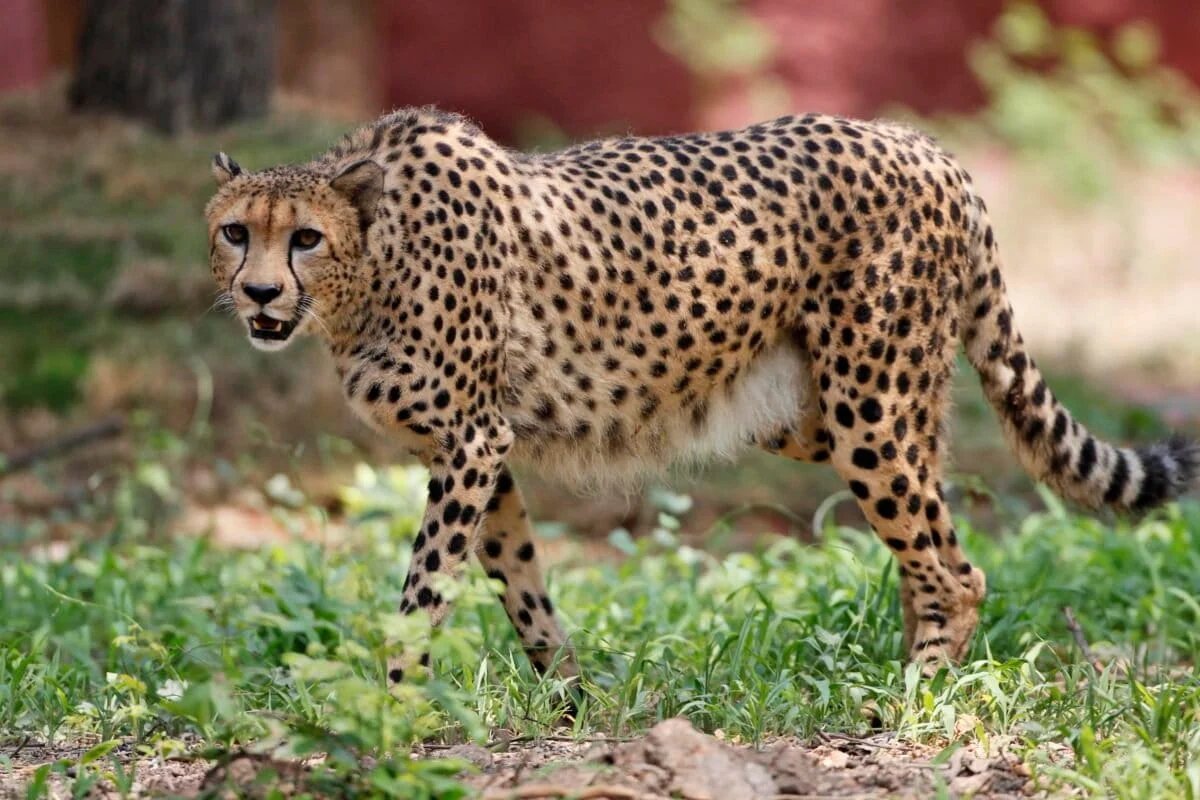
In the early weeks of April 2024, a young male cheetah named KP-2 accomplished a feat that was both a biological triumph and a management nightmare. Leaving the confines of Kuno National Park in Madhya Pradesh, the feline traversed over 150 kilometers of rugged terrain, eventually crossing state lines into the world-famous Ranthambore Tiger Reserve in Rajasthan.
This journey did more than just set a record for distance; it provided a rare "triple sighting" for stunned tourists—a tiger, a leopard, and a cheetah all occupying the same landscape. While the image was a dream for photographers, for conservationists, it represented a harrowing glimpse into the spatial and predatory challenges facing Project Cheetah, India’s ambitious attempt to reintroduce the species 70 years after its local extinction.
I. Main Facts: A Bold Venture into Apex Territory
Project Cheetah was officially inaugurated in September 2022 with the arrival of eight cheetahs from Namibia, followed by 12 more from South Africa in early 2023. The stated objective of the Prime Minister’s flagship wildlife program is twofold: to establish a self-sustaining, free-ranging population of cheetahs in India and to use the cheetah as a "flagship species" to restore India’s neglected open natural ecosystems (ONEs), such as grasslands and scrub forests.
However, the reality on the ground has been marked by high mortality rates and unexpected dispersal patterns. KP-2, a sub-adult male, belongs to a cohort of exploratory cats currently testing the boundaries of their new home. His trek into Ranthambore is significant because Ranthambore is one of the most tiger-dense regions in India.
The presence of KP-2 in a landscape dominated by nearly 70 tigers and a high density of leopards highlighted the extreme vulnerability of cheetahs. Unlike the apex predators of India, cheetahs are "flight" rather than "fight" animals. In a direct confrontation with a tiger or a leopard, a cheetah has almost no chance of survival. KP-2’s month-long residency in Ranthambore, where he moved cautiously through hilly, undulating terrain far different from the flat savannas of Africa, was a period of high-stakes suspense for the Forest Department.

II. Chronology of the Dispersal: From Kuno to Rajasthan
The timeline of KP-2’s journey illustrates the restless nature of translocated carnivores attempting to establish a territory.
- Early April 2024: KP-2 exits the boundaries of Kuno National Park. This was not his first attempt at dispersal; he had previously been "rescued" and returned to Kuno twice before after wandering into nearby agricultural or forested zones.
- Mid-April 2024: Radio-collar signals confirm KP-2 has crossed the Chambal River and entered the Dholpur-Karauli landscape of Rajasthan, eventually moving deep into the tourist zones of Ranthambore Tiger Reserve.
- Late April 2024: Reports emerge of a "triple sighting." Tourists in Ranthambore witness a cheetah in the same general vicinity as the reserve’s resident tigers and leopards.
- May 2024: KP-2’s sibling, KP-3, follows a similar trajectory, moving toward the Dholpur area of Rajasthan. Reports indicate that KP-3 began preying on local cattle, highlighting the potential for human-wildlife conflict.
- Early June 2024: Following weeks of surveillance by a dedicated team of trackers, KP-2 is successfully tranquilized and brought back to Kuno. This "rescue" occurred just days before a high-profile visit by Madhya Pradesh Chief Minister Mohan Yadav to the national park.
While KP-2 was returned safely, the project suffered a setback during the same period. KGP-12, a female cheetah who had successfully given birth in the wild, lost all four of her one-month-old cubs to predation. This brought the number of cheetahs currently roaming free down to 14, while the rest remain in protective enclosures.
III. Supporting Data: The Spatial Crisis
The primary criticism from wildlife biologists regarding Project Cheetah centers on the lack of adequate space. The spatial requirements of a cheetah are vastly different from those of a tiger.
The Home Range Conflict
According to Ravi Chellam, a renowned wildlife biologist and conservation scientist, a single female cheetah requires a home range of between 833 and 958 square kilometres. Males, while requiring less space individually (13 to 130 sq km), often range widely during their exploratory phase.
Kuno National Park covers approximately 748 square kilometres. When the entire Kuno Wildlife Division is included, the area reaches 1,235 square kilometres. Statistically, this means the park can comfortably support only one or two female cheetahs if they are to be truly "free-ranging."

Density Comparisons
Cheetahs naturally exist at very low densities compared to other big cats:
- Cheetahs: 0.025 to 2 animals per 100 sq km (depending on habitat quality).
- Tigers: 8 to 18 animals per 100 sq km.
- Leopards/Lions: Up to 15 animals per 100 sq km.
Because Kuno is part of a larger landscape connected by corridors to five other tiger reserves—including Ranthambore, Mukundra Hills, and Madhav—any cheetah that leaves the park is almost guaranteed to enter a territory already occupied by a more dominant predator.
Habitat Suitability
Dharmendra Khandal, a conservation biologist with Tiger Watch, notes that the terrain in Ranthambore is "hilly and undulating" with sparse vegetation. Cheetahs are evolved for high-speed chases on flat, open ground. The rocky, broken ground of the Aravalli and Vindhya ranges not only makes hunting difficult for the cheetah but also provides perfect ambush cover for leopards and tigers, the cheetah’s primary competitors.
IV. Official Responses and Management Dilemmas
The Indian Forest Department has adopted a "hands-on" management style that has sparked debate among global experts. Each free-ranging cheetah is assigned a dedicated three-member monitoring team consisting of a forest guard, a tracker, and a driver.
The "Rescue" Paradox
Whenever a cheetah like KP-2 wanders outside the park boundaries, official press notes describe the subsequent capture and return as a "rescue." This terminology has drawn scrutiny. If the goal of the project is to establish a "free-ranging" population, critics ask why the animals are being recaptured for exhibiting natural dispersal behavior.

The official stance is that these interventions are necessary to prevent the animals from entering human settlements or falling prey to tigers in neighboring reserves. However, this creates a management loop where the cheetahs are essentially living in a "managed wild" rather than a truly natural state.
Jurisdictional Hurdles
Management becomes exponentially more complex when cheetahs cross state lines. KP-2’s move into Rajasthan required coordination between the Madhya Pradesh and Rajasthan forest departments. Differences in management priorities and the lack of a unified "Cheetah Corridor" management plan often lead to delays in tracking and intervention.
Transparency Concerns
The project has faced calls for greater transparency. The third annual progress report for Project Cheetah, which was expected in late 2024, has yet to be fully publicized. Furthermore, the action plan’s goal of restoring "wastelands" remains a point of contention. Biologists like Ravi Chellam argue that the government must stop categorizing open natural ecosystems as "wastelands," as this classification allows for industrial diversion of the very habitats the cheetah needs to survive.
V. Implications for the Future of the Project
The journey of KP-2 is a harbinger of the challenges that will define the next phase of Project Cheetah. As more cheetahs are brought from Africa and more cubs are born in India, the pressure on the limited land at Kuno will only intensify.
1. The Necessity of Alternative Sites
It is becoming increasingly clear that Kuno cannot be the only home for India’s cheetahs. Sites like the Banni Grasslands in Gujarat and the Gandhi Sagar Wildlife Sanctuary in Madhya Pradesh are being readied, but these landscapes also face challenges, from local pastoralist land rights to prey base enrichment.

2. Prey Base and Livestock Conflict
KP-3’s predation on cattle in Dholpur highlights a looming social crisis. If cheetahs cannot find enough wild prey (specifically small-to-medium antelopes weighing 20-30kg), they will inevitably turn to livestock. This could turn local communities against the project, undermining the conservation goals.
3. Redefining "Success"
If success is defined by a truly free-ranging population, the government may have to accept higher mortality rates from natural causes, including predation by tigers. The current "zero-loss" mentality necessitates constant human intervention, which prevents the cheetahs from truly integrating into the Indian ecosystem.
4. Ecosystem Restoration
The most significant implication of KP-2’s trek is the reminder that the cheetah is a landscape-level species. For Project Cheetah to succeed, India cannot simply manage a park; it must manage a landscape. This requires protecting corridors, restoring degraded grasslands, and moving away from the "fortress conservation" model toward one that allows for the movement of wide-ranging carnivores across state and park boundaries.
In conclusion, KP-2’s daring walk into Ranthambore was not just a wandering cat’s curiosity; it was a diagnostic test for India’s wildlife policy. It exposed the "spatial hunger" of the species and the limitations of the current habitat. Whether Project Cheetah becomes a global gold standard for reintroduction or remains an expensive experiment in semi-wild management will depend on how officials address the hard data provided by KP-2’s 150-kilometer trail of suspense.
